
Climbing requires an intense blend of strength, movement economy, technical mastery, and cognitive strategies, making it one of a rarefied group of sports that holds the door open for lifelong progression. Your peak performance will tail off, of course, but median performance can remain more or less the same into your 50s, 60s, maybe even 70s if you’re lucky. Just look at Alain Robert, the ‘French Spider-Man’ who still free solos skyscrapers despite being 64. So perhaps it makes sense that the elderly cast of playable characters in co-op climbing caper Sunset Summit wouldn’t look out of place in an episode of Last of the Summer Wine. While I’m not sure if Nora Batty could fart her way past particularly difficult sections after eating a tin of beans, the likelihood is that, over the course of the show’s 295 episodes, the narrative requirement for showing that happening simply never came up.
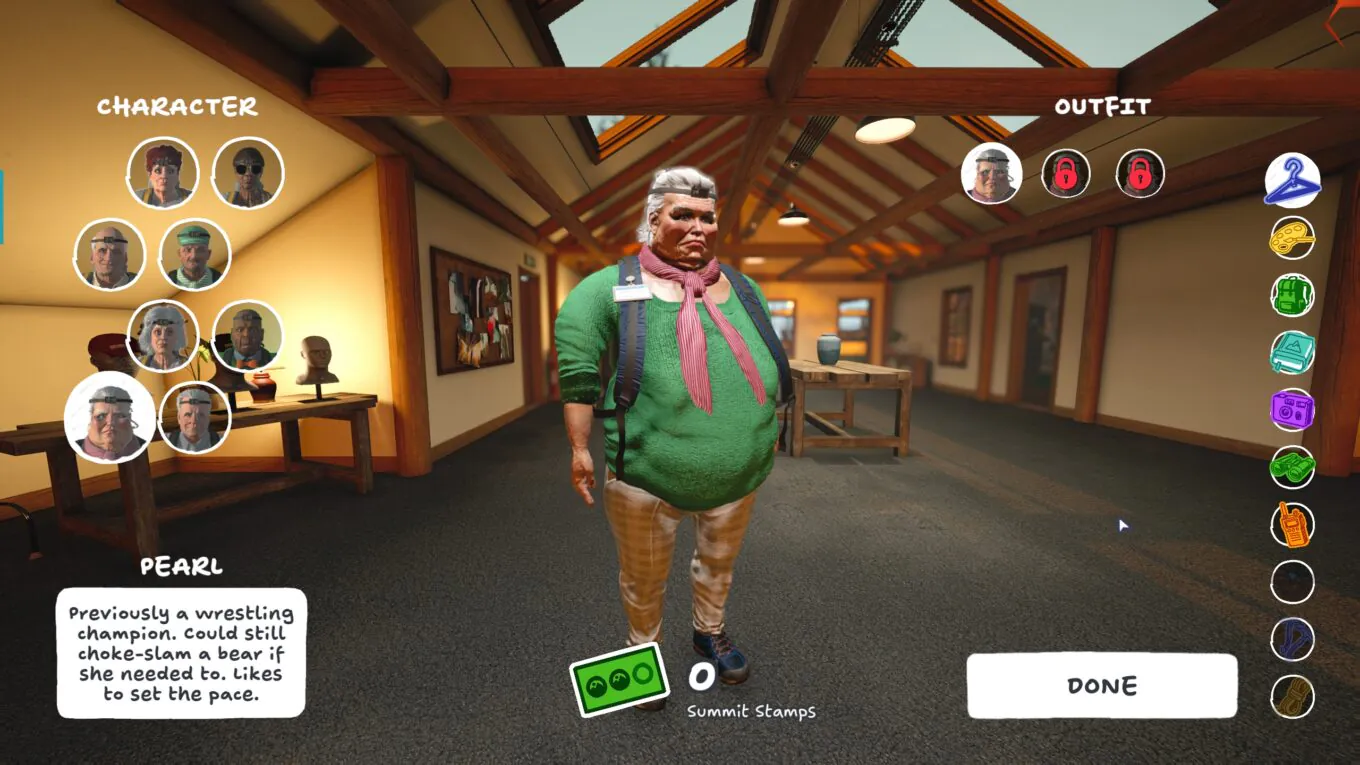
The protagonists’ demographic is doubly appropriate because this game will age you. Developers Joe and Andrew Fender, along with their team, clearly pose a danger to society and I am thankful that they found a project to channel their sadism. Sunset Summit is a heebie-jeebies simulator, regularly inducing sweaty palms and moments of barely contained panic, while providing a decent core workout in the process as your stomach tenses throughout each fiendish ordeal. It’s tiring to play, and if you don’t already have acrophobia, you soon will. But the game still somehow manages to be moreish, making you commit to reaching each summit with the grim resignation of a cat submitting to the realisation that the bath they’re being subjected to isn’t going to end soon, no matter how much they scratch their owner’s forearms.
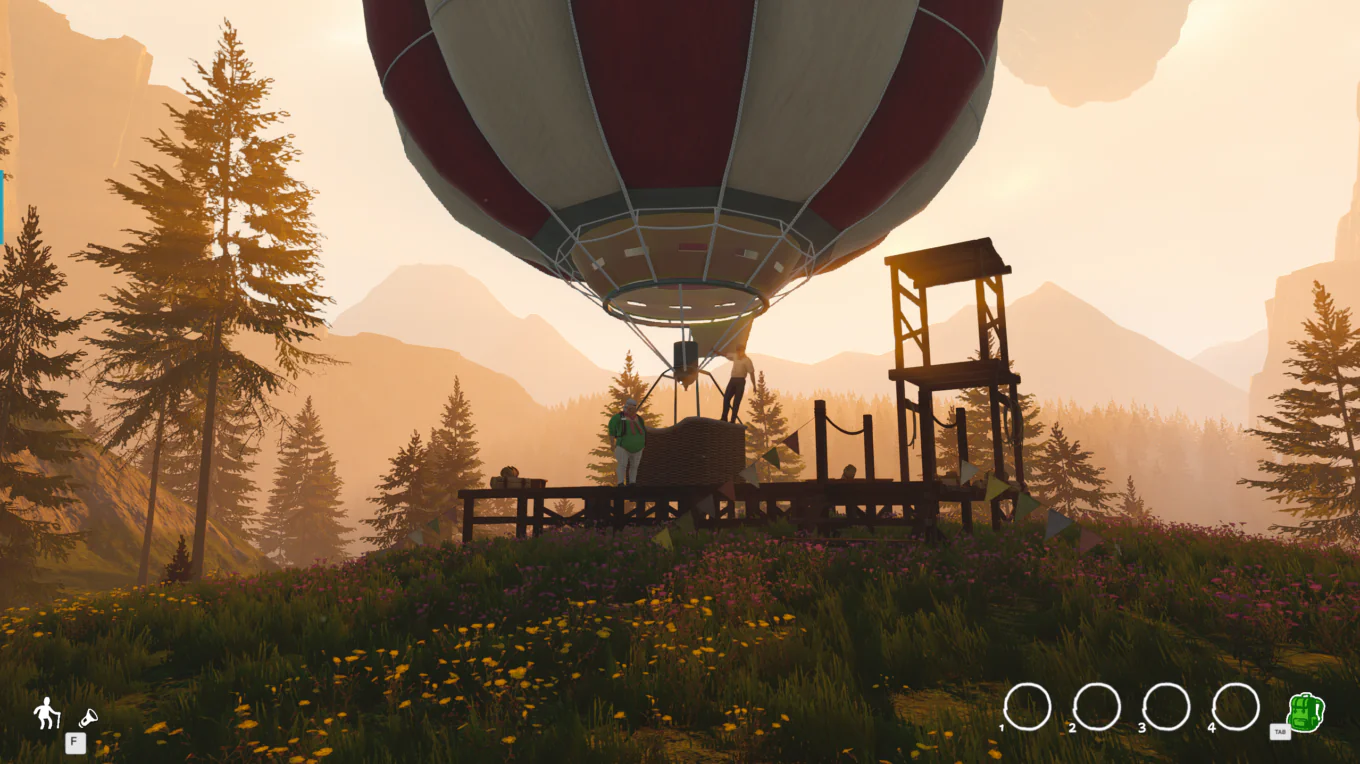
Each attempt starts out at base camp, a charming wooden cabin set in a beautiful mountainous valley. There’s a Zimmer frame on the roof (presumably as a result of the previous night’s party), a mirror to customise your getup, a chessboard if you need to do something more sedate for a bit, and a tablet through which you can choose your next destination and difficulty (this affects how much time you have to complete a route, the number of helpful items you’ll find along the way, how much stamina you have for each burst of climbing, and whether or not you get checkpoints). After that’s sorted, consider grabbing Ernie’s (geddit?) ashes from the table, and then simply make your way to the waiting hot air balloon to be whisked to your next trauma-inducing outing.
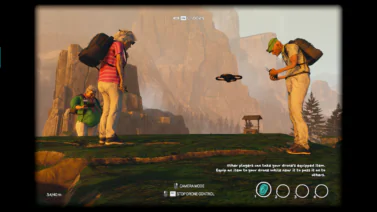
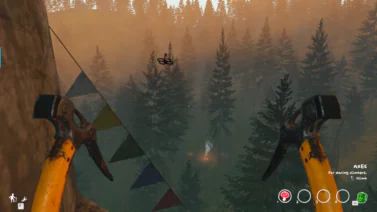
You can take that trip with up to seven friends and, while certain sections will require delicate coordination with so many climbers in order to avoid tragic accidents, it really is a case of the more the merrier. Sunset Summit is tuned for cooperation. Despite their advancing years, the mature mountaineers are pretty tech savvy and armed with an array of useful gadgets. As well as binoculars, a natty digital camera (inc. selfie stick!), and a walkie-talkie, everyone brings a pilotable drone that can travel up to 40 metres from your current position. It’s an essential tool for scouting out the route ahead when you’re perched on a sliver of a ledge and unsure where to go, but you can also fly back to other members of the group who are struggling with the pitch you just cleared and offer encouragement via the built-in speakers. Better still, you can balance a power up from your inventory on top of it and deliver it to a comrade in need.
The ability to help each other proved especially useful during this review. Due to a currently not fully understood administrative error, I laboured for a number of days in a build that turned out to be horribly broken. The first cause for concern was the minibus parked outside the lodge, whose wheels were planted several inches into the ground and which had its textures on backwards. The next was that certain ladders would become non-corporeal for the last few feet, allowing me to pass through them and fall to my death. In a game about precision this was beyond infuriating, the irony of finding a ladder insurmountable after free soloing up to it was heartbreaking.
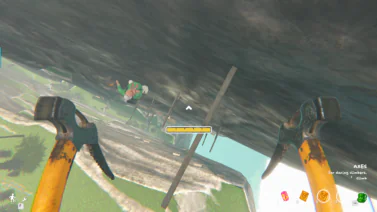
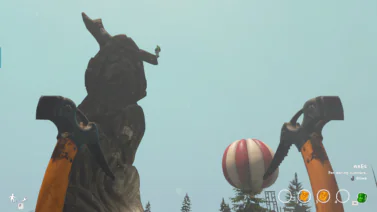
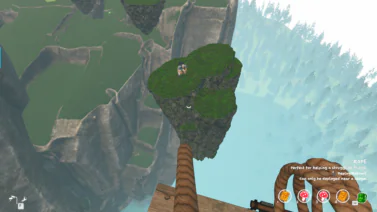
But not game breaking. It should have been, of course, but my brother (who was helping me with the multiplayer aspect of this review) and I set about getting creative. We only had one tin of beans, so he guffed his way up to the platform and then lowered a rope, which I could then charge-jump over to and bypass the physics error. The next broken ladder was attached to the last of a series of floating platforms, far from the previous checkpoint, and only glitching for me, which we discovered after my brother had clambered over the top to safety. With only an umbrella and a duck call to my name, and a landing point too far below the length of the rope, the situation appeared bleak. But then, a tinny voice: “Here you go, use this.” The drone came bearing gifts in the form of a tub of Boomer Booster pills (no, not that kind…) which significantly increased my stamina and allowed me to charge-jump over to the rock face and still have enough energy to clamber up. Disaster averted.
Don’t worry, you won’t have to deal with these problems when you play the game, as a last-minute update resolved the issues for me. Crucially, the minibus looks much better now. But it’s testament to Sunset Summit’s diabolically clever level design and confident pacing (checkpoints turn up at just the right time) that we always wanted to keep trying to reach the top, even when faced with an apparently hopeless roadblock.
Each of the game’s four locations offers four different climbing routes, as well as biome-specific natural features. Elder Crag looks like it was ripped from Yosemite and left hanging in the sky, and features large floating chunks of rock and slippery moss walls. Sun Cradle might have been Persian ruins in a desert, were it not for the dramatically increased scale, and introduces bursts of air that fling you upwards. Silver Hollow sees you go spelunking and casually tosses in crystal platforms that disintegrate if you linger too long. And Old North lets you put that umbrella to good use on its updrafts. Along the way, there are Mindful Moment benches to find, which serve both as discoverables (they are sometimes off the beaten path) and opportunities to catch your breath/take in the view/sob in an ugly and uncontrollable manner.
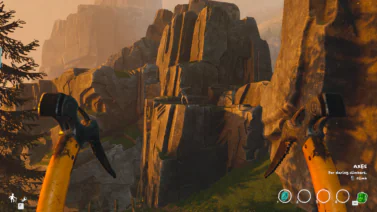
If you enjoyed Peak, then you will find much to love here. There are many similarities – first-person climbing, proximity chat, items that encourage you to creatively break the beta and skip obstacles – but many meaningful differences, too. Sunset Summit offers built-in checkpoints (unless you play on hard) rather than rescues and hauntings, hosts twice as many players, and features hand-crafted routes rather than procedurally generated ones. It doesn’t always feel as polished, especially when it comes to visuals and sheer breadth of content, but whereas Peak often feels more like a particularly steep hike interspersed with bursts of climbing, Sunset Summit delivers a more vertiginous mountaineering experience with stomach-churningly thin ledges, via ferrata traversals, and challenging platforming. No marshmallows, though, which seems a shame given the likely prevalence of dentures.
In the end, the two design approaches are distinct enough to make it worth owning both games. Just so long as your heart can take it.