Without meaning to denigrate the talented folk that willingly choose to embark on the logistical nightmare of balancing early-game wood chopping against late-game unobtainium mining, I am starting to suspect that we may have reached Peak Colony Sim and City Builder territory. Fill one hat full of settings and another full of neat twists written on scraps of paper, pull two out, and you’ll likely find something on Steam that matches the description. Steampunk…but with badgers? Yep. Industrial revolution…but with mice? Gotcha. Fantasy…but you’re evil? Say no more. I could have pulled several more, and I wouldn’t even need to leave Hooded Horse’s Steam page.
There’s so many that designers have basically solved how to make a series of interlocking resource chains and research trees and spanner-in-the-works hazards consistently compelling at this point. So when I boot up something like Corsair Cove (Limbic/Hooded Horse, 2026. Oats and a lie-down, please, you’ll work yourselves into the glue factory at this rate), I’m less interested in the game’s nuts and bolts for their own sake, and more how well those systems make the theme pop. Basically, I’m after more than just new wrapping paper on the same pair of socks I got last year.
Which is a roundabout way of saying that what I want from my piratey city builder is for the city building of it all to feel uniquely piratey. The ad-hoc jury made entirely of ethically compromised monkeys and one rum-drunk parrot are still out on whether Corsair Cove can pull that off in the long term, but the demo I played is off to a respectably disreputable start.
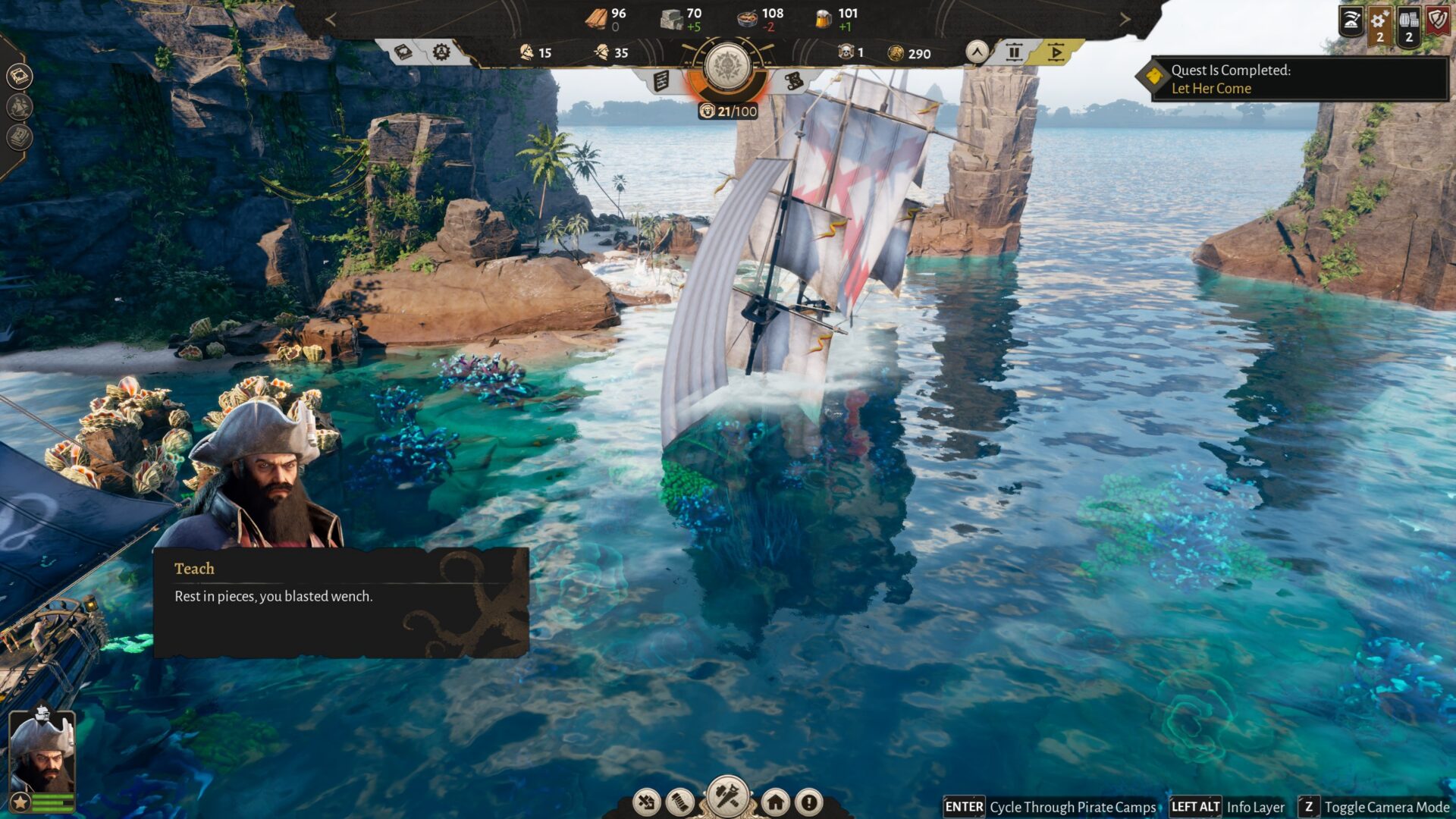
The lose condition here is both simple and appropriately buccaneerified. A resource named ‘cohesion’ tracks how well your shipwrecked settlement of pirates are pulling together, and if it ever hits zero, it’s game over. Alongside cohesion, there’s an individual morale tracker for each of your pirate camps. It’ll plummet if you don’t keep everyone in food and booze, and you’ll soon find yourself with a camp-wide punch up on your hands, which you’ll need to spend cohesion on to end if you can’t logistically wriggle your way out of it.
Corsair Cove is lavish with animated detail (zoom in to your stills to watch a pig sunbathe on a plank in a vat of moonshine), and these riots are no exception. When one kicks off, the entire atmosphere of your camp transforms. If things are going well, it bustles with makeshift industry and jolly yo-ho-hoing. But run out of stew, like I quickly did, and suddenly everyone’s trying to knock out their neighbour so they can roast them on a spit.
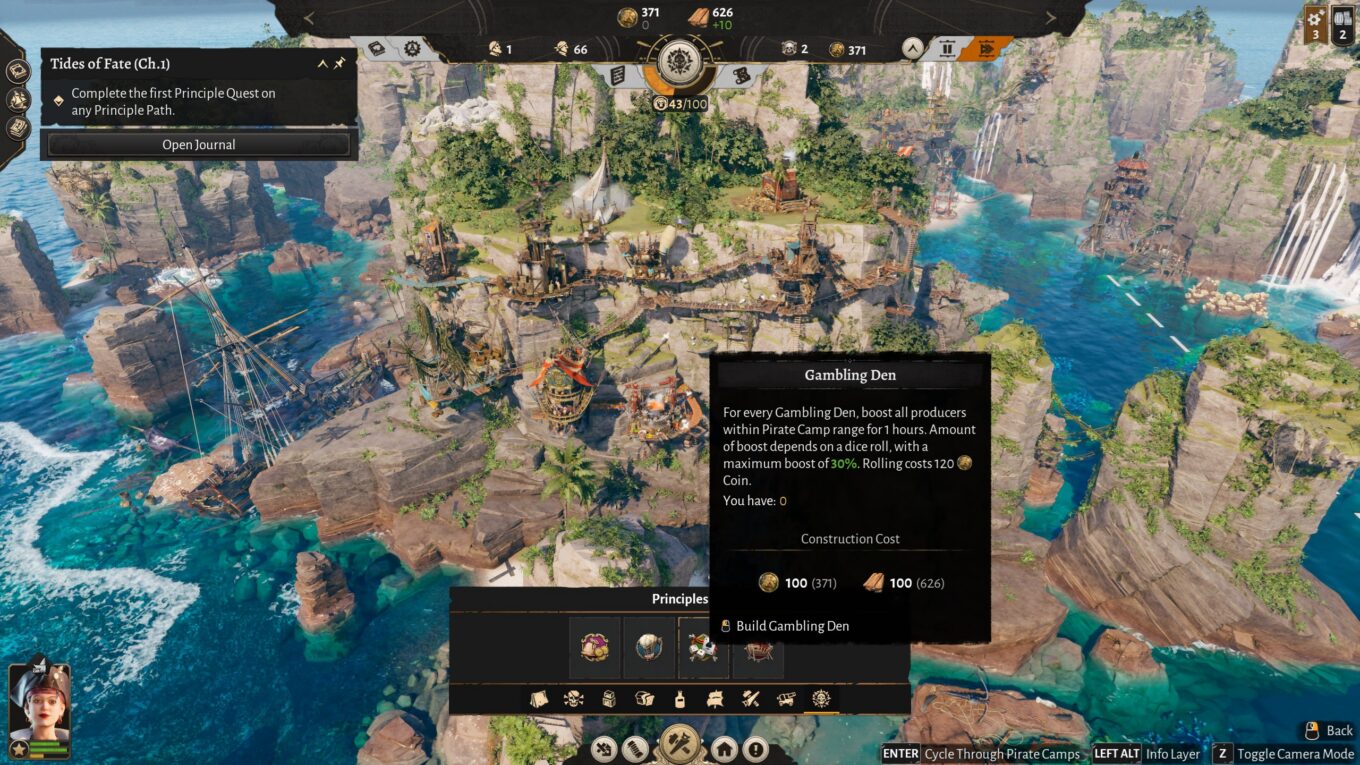
As far as convincing me that I’m dealing with a unstable band of cutthroats just one mug of grog away from mutiny, it’s a great baseline to lend thematic juice to some largely familiar resource chain systems. You’ve got a limited amount of crew to divvy up between basic resource collection and refinement, food and booze production and distribution, and the warehouses that tie it all together. Your main goal here is simply to keep everyone nourished and drunk enough that they’re not rioting when you move on to the actual swashbuckling of it all, which I’ll cover shortly.
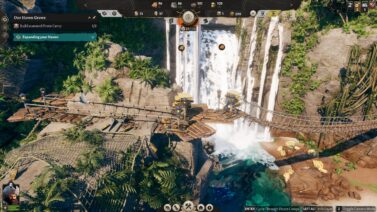
As I said, they’re familiar systems, but recontextualised in Corsair Cove due to just how malleable the topography is. Rather than a large flat plain to build on, you start in a rocky, lush cove that does an incredible impression of being a believable, natural space that your crew just happened to get shipwrecked on. An utter nightmare to establish a settlement on normally, but Corsair Cove lets you build on sheer cliff faces, or place walkways between sharp peaks. A useful visual aid lets you know just how efficient the routes between connected resources are, and being handed a fully 3D space to work with makes even simple layout planning compelling. It lends a sense of aesthetic customisation to a game that’s otherwise all about pre-fabs.
It helps, of course, that Corsair Cove is an almost irresponsibly pretty game. Shoals of fish glimmer from crystal waters and wild, bright greenery sprouts from every surface. Jaunty, dusty shanties play as you watch your fetchers ferry resources across the snaking wooden walkways, so ramshackle and chaotic they almost look organic themselves. Story events pop up where you can, say, fight off scabies by getting everyone extremely drunk. It’s all just the right mix of silly and swashbuckling.
I was just getting into a nice rhythm with it all, enjoying the weather, when the Spanish admiral that sunk my ship in the intro decided to show up and bombard the place. This is the other of side of Corsair Cove – the part the lends all the freeform building context and tension. Defending your cove in the demo isn’t too much of a hassle in itself. You plonk down a cannon tower, fuel it with black powder made from bat poop, and the Spanish aren’t too hard to deal with. But what sort of pirates would we be if we left it at that? Time to hit the Spanish where it hurts.
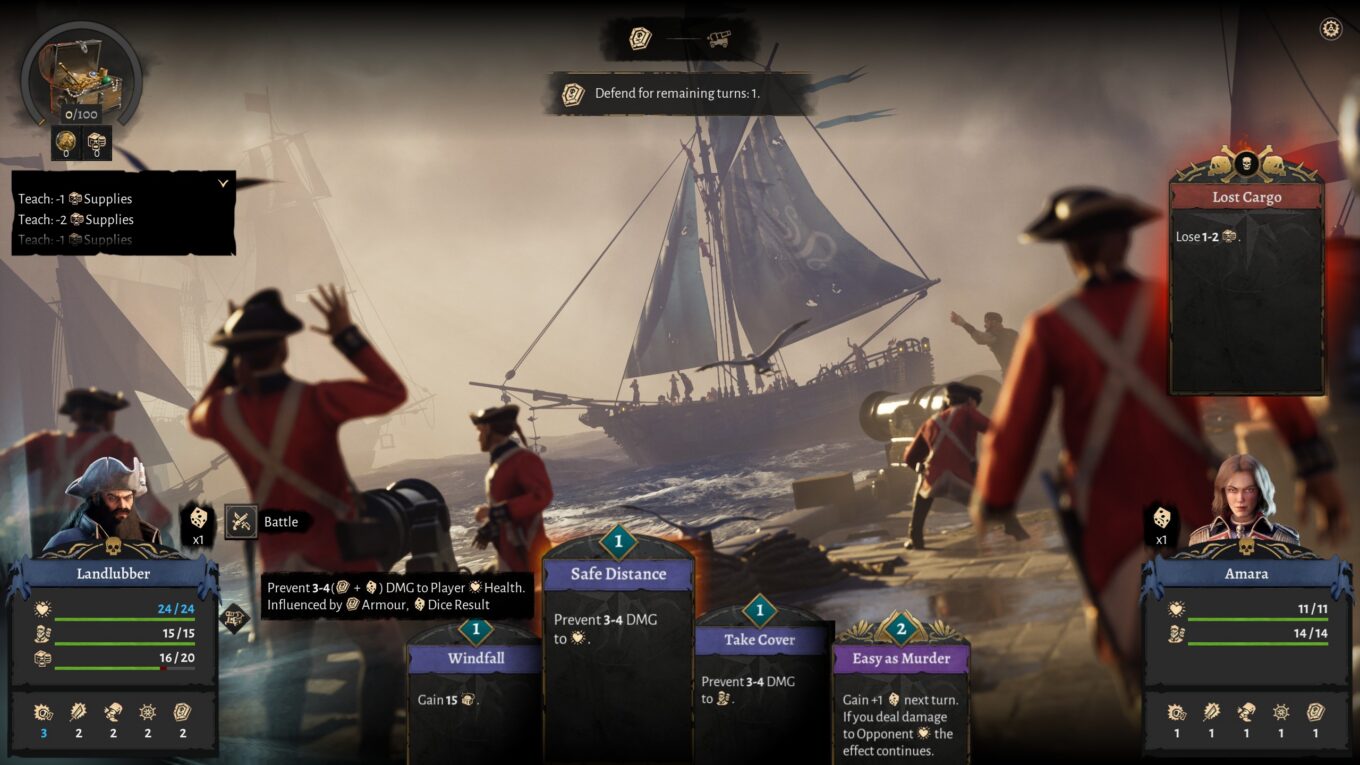
Shipbuilding time it is, then. I was hoping for something freeform here, swapping out various cannons and sails and monkeys, perhaps choosing my own flag. Disappointingly, it’s quite fixed, with different vessels being a straight shot up an upgrade tree. You can choose your captain though, which each offer different bonuses in the combat minigame. This, I really enjoyed. It’s quite simple, but the idea is you’ll choose different ability cards to either counter your opponent or plan for future turns. A neat twist here is that the cards change theme based on whether you’re trying to sneak into a prison, escape a ghost ship, or simply bombarding an enemy point. It’s not a deckbuilder or anything close to it – don’t expect any customisation, unless that unlocks later. But it’s novel, board game-like approach that gives the missions you embark on space to explore different themes more than a fixed, real-time combat system would.
Those missions themselves are colour coded to match Corsair Cove’s four pillars of piracy. That’s notoriety, empire, seafaring, and wealth. There’s some cutscene waffle about “choosing what sort of pirate you want to be”, but you’ll actually want to do everything. They all correspond to different areas of the tech tree, so any real attempt to take up the game’s offer to roleplay is just going to leave you missing a limb. Alongside the missions, you’ll unlock more points here by reaching certain milestones. Mostly stuff you’ll be doing anyway, as far as I could tell. Having three of a certain building, for example, or producing a certain amount of food. You’ll unlock more ships as you progress up the tech tree, and in turn, you’ll need to expand your resource chains to produce things like sails, and more lavish foodstuffs (e.g bread) to keep your higher tiers of crew satisfied.
So, to return to my original question: does the city building of it all feel uniquely piratey? Honestly, about as much as I could hope for in a genre so reliant on book balancing that a certain amount of it is always going to feel more like being an accountant. What I’d really like to see in a full version of Corsair Cove is the RPG and exploration half of the game expanded on. That’s already hinted at with a number of locations on the map you can’t visit yet, but I’m a little concerned that the more you expand, the more the game’s personality is going to give way to the purely logistical. If nothing else, I’m very interested in seeing just how many more stray pigs the game’s art team have managed to hide in the building designs.