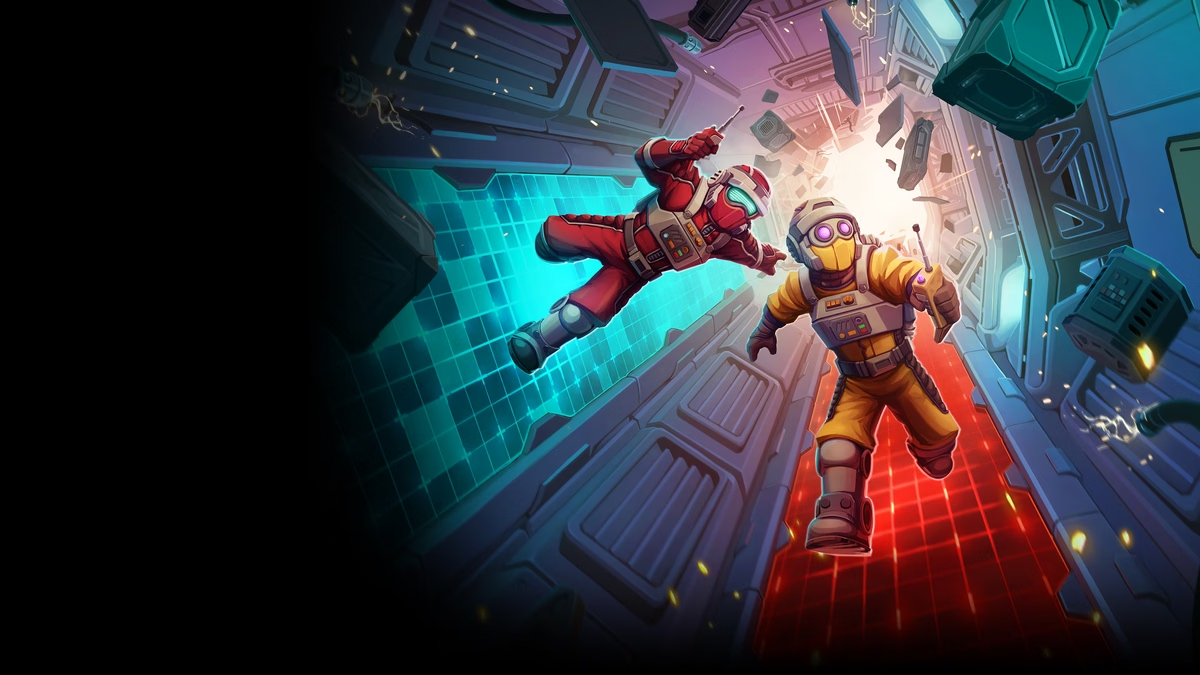

The original Astroneer felt like an oddity around a wave of survival-type games that was already growing oversaturated and somewhat stale. Its pastel-style art direction, easy to overcome learning curve, and the gimmick of using a vacuum of sorts to terraform the ground around you made it a standout game in 2016. By the time it came out of early access in 2019, it had already accrued hundreds of thousands of players. It was never intended to go up against the likes of Rust, or even No Man’s Sky with its space motif, but rather to carve out its own spot in outer space.
Now, seven years later, Starseeker: Astroneer Expeditions wants to start a similar journey. It is building upon its predecessor’s ideas, iterating on the art style and a novel way of gathering resources and reshaping the environment with your main tool. But it is doing so structurally in a different way. The expedition side of things is what makes this new proposition both enticing and peculiar, taking cues from the ongoing sea of extraction shooters rather than the survival games of old.

The adventure begins with an introduction to what it means to be part of the ESS Starseeker, a large group tasked with exploring new regions of the galaxy. Being part of the same universe as Astroneer, an introductory cutscene tells you that while Earth has been saved, there have been reports of a threat looming over the galaxy itself, one that has been quietly but steadily growing over time: ships get lost, signals fade, and people hear echoes of whispers through places where no voices should be coming from.
It’s a dark tone and setup, and saving the universe is no easy task, but the tutorial immediately eases you in, following the lighthearted tone of Astroneer to a T. One of the biggest differences that is immediately apparent has to do with traversal. Now, you can directly climb over most surfaces — while keeping an eye out on your stamina, that is — as well as being overall more agile. Moving around is both fun and dynamic. Even during the tutorial, you can get up to a high speed in no time once you’ve mastered the right timing for jumps and climbing. There are also upgrades available later on that unlock new movements, such as being able to dodge.
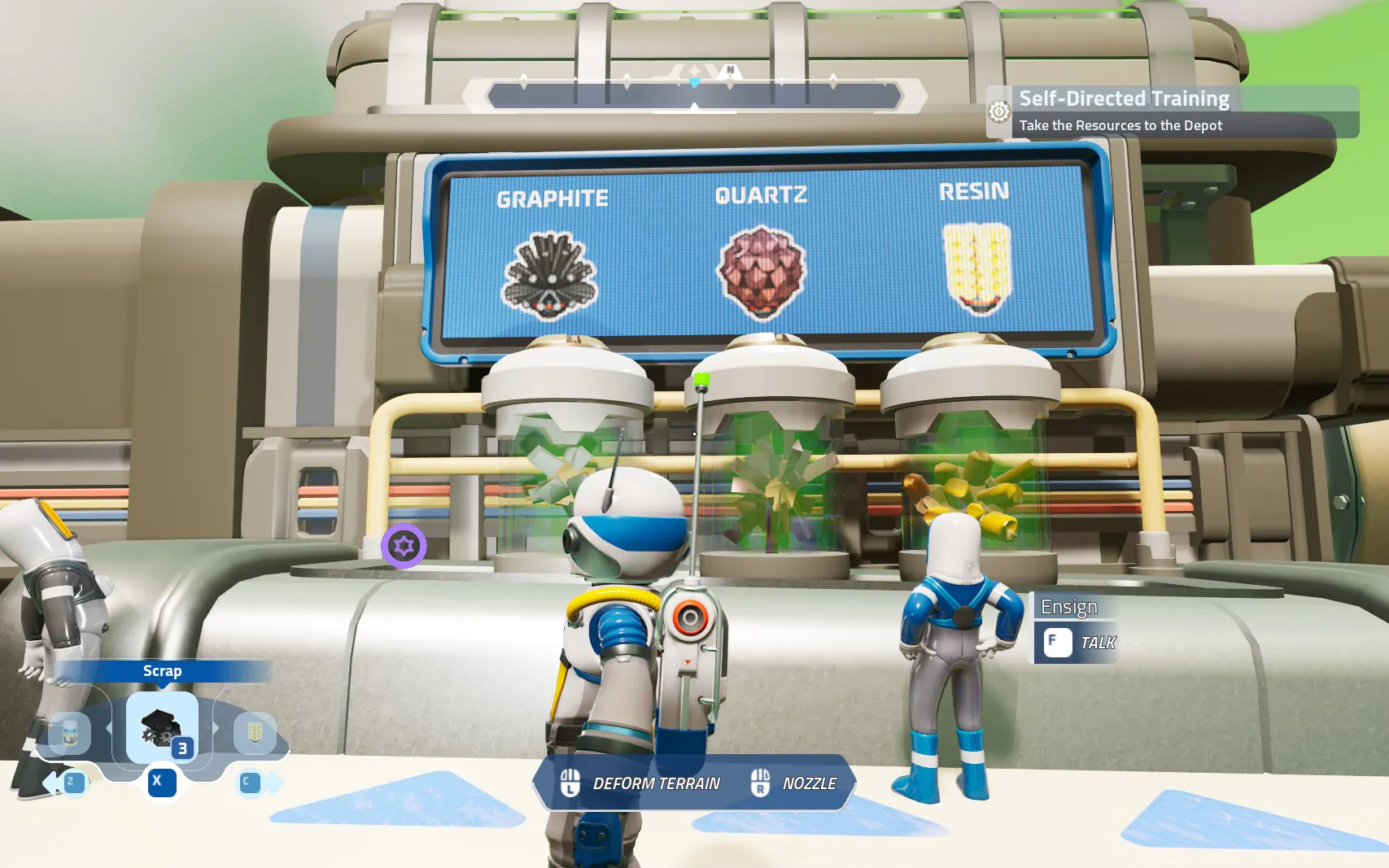

Once you’re through the tutorial, you’re introduced to the main ESS Starseeker hub. The space station is massive, and it took me a while to memorize the layout and know exactly where to go at all times. There are NPCs everywhere to speak to, which usually have a comedic quip or two to share, and you’ll also meet some important characters that will grant you quests, as well as offer to buy or sell items currently on your inventory.
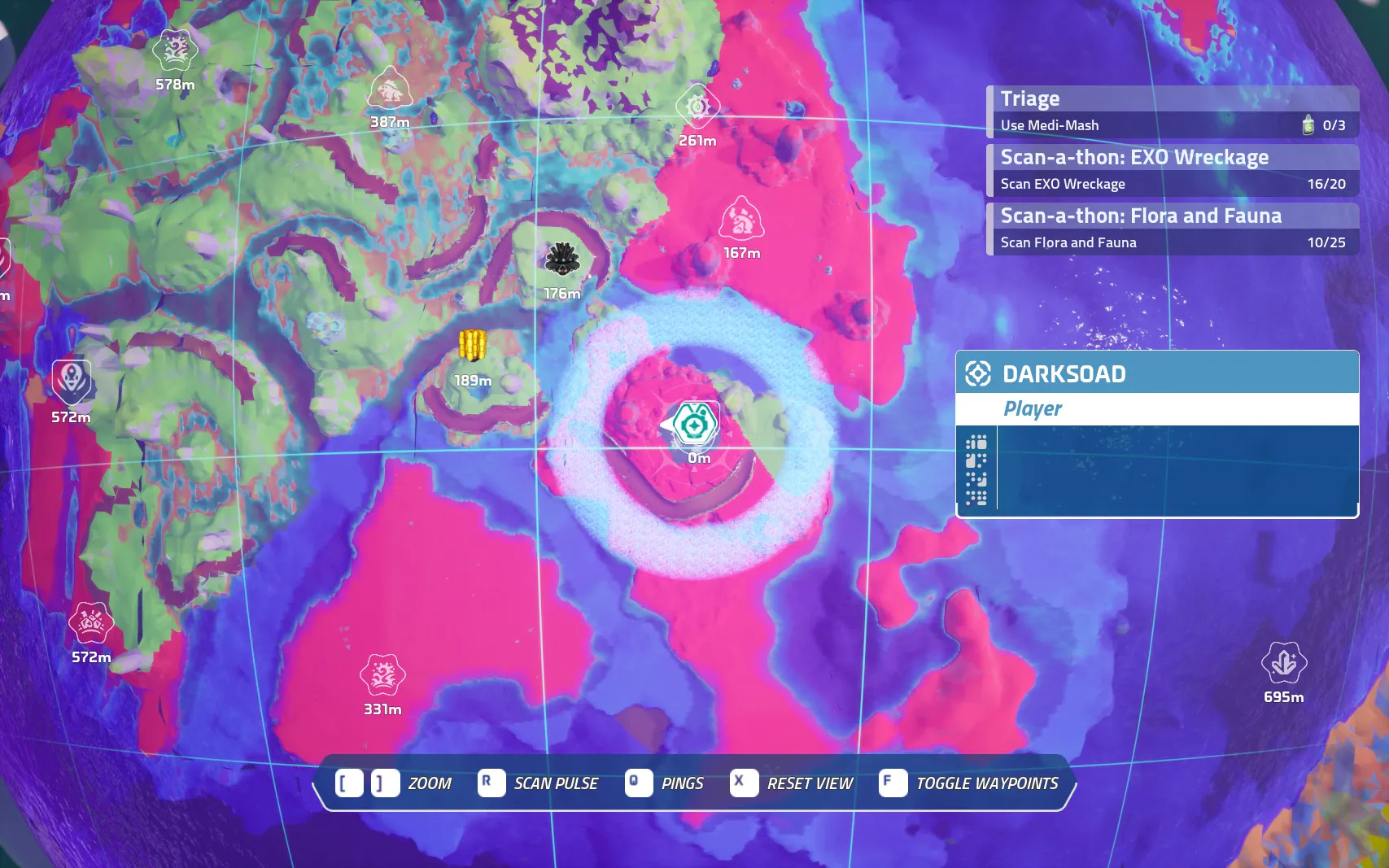
Here’s where Starseeker: Astroneer Expeditions begins to differ the most from Astroneer. The original had you starting on a planet and pursuing the standard cycle of resource gathering that is most common in survival-type games. You go out to explore, gather materials, and start building machines or various tools to further upgrade and expand your base. In Starseeker, the cycle is more nomadic in a way. You and up to three other players form a crew to take on expeditions to specific regions picked from a list. Once you’re on the ground, you can use your scanner to see what the nearest materials are, while the map indicates some loose points of interest for you to pursue, from monster dens to crash sites where you can find scraps and learn more about what past expeditions have gone through. But there’s also a 30-minute timer, which indicates the remaining level of oxygen you have before you need to return to your base.
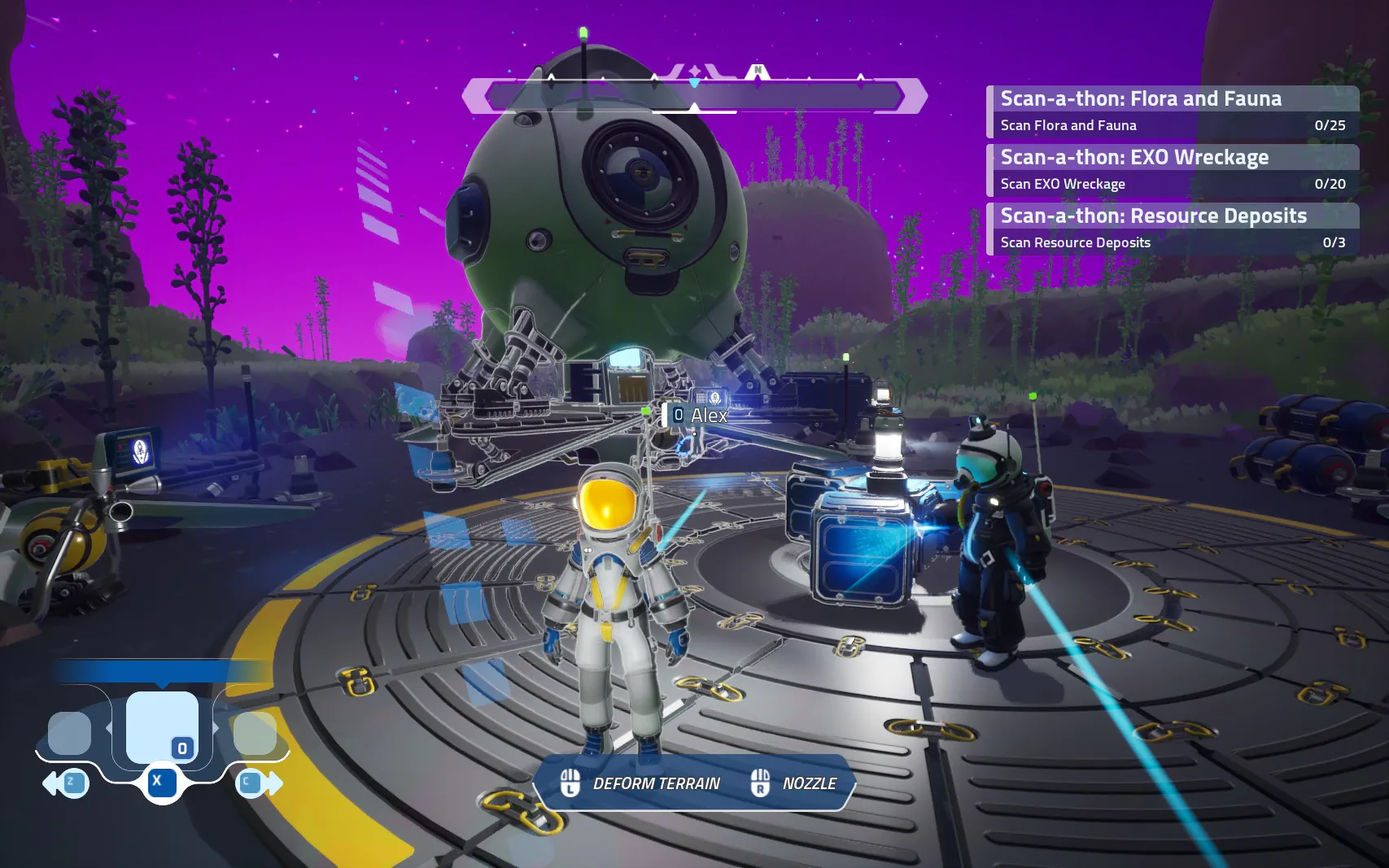

The main loop has you grabbing quests, assembling a crew, and going on expeditions to start checking items off your to-do list. The 30-minute timer is quite generous, and it’s mostly there to remind you that you will, at some point, have to extract yourself safely in order to keep all the items and materials you’ve gathered. Fail to extract, and you’ll lose everything. Unlike extraction shooters, in which there’s usually a tense waiting time from the moment you ask for an extraction to the moment it actually becomes available, there’s not really a sense of urgency while waiting for the ship in Starseeker. It normally takes five seconds, and from what I could tell, enemies can’t follow you all the way into the extraction area.
In fact, I’d go as far as to qualify Starseeker as a fairly low-stakes game, entering the territory of a zen-like experience in which you’re mostly doing quests related to resource gathering. Collecting materials from out of the wild while also changing the shape of what surrounds you when doing so remains satisfying, with the never tiresome pop sound whenever you finish extracting ore. Your inventory space is somewhat limited, which tends to restrict you. But most of the time, I felt more concerned about those things rather than the hostile creatures you can come across. These still pose a threat, and if you don’t run away or defend yourself in time, you might be defeated and lose all of your items. Yet, you won’t be actively fighting them with weapons per se- hitting a creature with an item causes them to be fatigued, and once exhausted, you can sedate them by moving closely and taking the action.
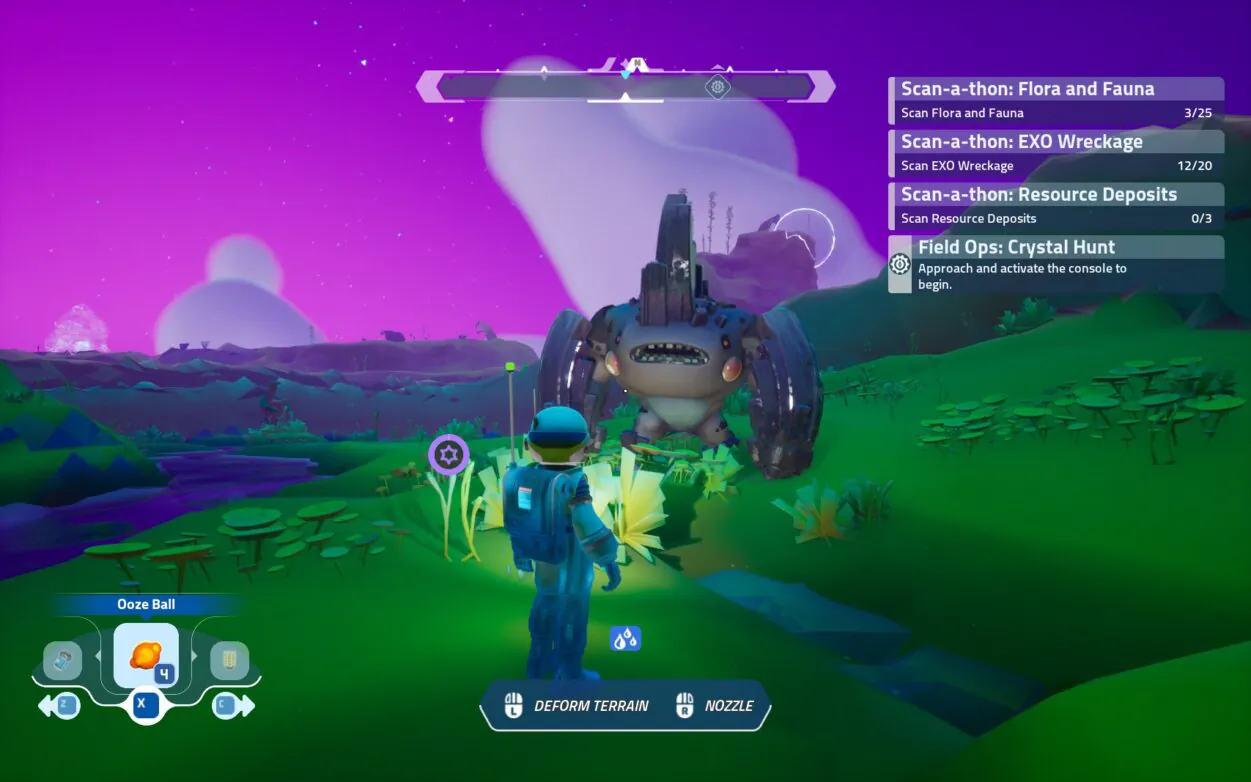
Starseeker has a strong sense of progression thanks to the myriad of quests available that are up for tackling at your own pace. That, alongside the structure of expeditions serving as adventures in small chunks, quickly engrosses you in the overall loop. But these are far from the only motivators to commit to the experience long term. There’s also an overarching mystery involving the strange signals mentioned during the introductory video, as well as specific key characters that you meet along the way. Right now, in early access, this aspect is the one that feels more sidelined than the rest, but I’ve enjoyed seeing hints of this during expeditions, including caves with strange, hostile objects and ambiance that I couldn’t quite decipher on my own.
There is also the online aspect, which Starseeker relies on to support the overall experience. This is an always-online game, meaning that you’ll encounter other astroneers crowding the space station. There’s also a decent drop-in, drop-out system in place during the expeditions with other players, which helps in case someone goes AFK or has to leave the game for any reason. As per usual with modern online games, there are also cosmetic packs you can purchase, you get to level up your profile, and also unlock certain items through a battle-pass style reward system with certain NPCs. Thankfully, you can engage with all of this without having to wrestle with predatory microtransactions, which have become rarer, but are still prevalent.

The developers haven’t disclosed a solid date for the eventual 1.0 release, but they’re estimating that early access will last around one year. The intention is for the full version of the game to have what the team calls an experiential planetary “arc” that people can play from start to finish. As such, the devs plan to ship monthly updates that will include new planets, regions, items, characters, sandbox systems, endgame challenges, and new narrative, as well as the usual plethora of optimization tweaks and quality-of-life additions based on player feedback.
Starseeker might not be breaking new ground with its ideas, but it could benefit from launching at the right time. Its reputation paths, overarching narrative, and satisfying quest-based structure hold promise for the future. Even if it takes a while for the developers to fully realize the vision, the core experience of gathering materials and terraforming planets remains as satisfying as ever, and I’m intrigued to see how those ideas continue to adapt during Early Access.