
In the early days of Quake multiplayer, there was no one ‘control scheme’. First-person shooters hadn’t agreed on a universal set of default inputs yet, and in 1996 id Software couldn’t even bank on you wanting to use your mouse when you played. Thus, its default controls had you pushing the mouse to move forwards(!), and mouselook was achieved via a console command. So as people started getting interested in its newfangled ‘online deathmatch’ mode, they began experimenting with their own input binds that might gain them an advantage.
And that will eventually bring us to why Firestarters exists, but I’m not done revelling in the past yet. I promise I’ll tie it all together in a moment. Quake’s early innovators learned to circle-strafe opponents, strafe-jump to get a quick speed boost, and strafe-running to keep a higher movement speed. As a competitive scene grew around the community, its best players threaded these skills together in downright balletic displays.

Over the next three decades, all FPS players internalised these skills. It became an unconscious protocol to circle-strafe enemies and glide around maps, so much so that eventually Counter-Strike modders began designing parkour maps that removed the combat altogether and just tested your FPS movement skills. Only when you’re in that narrowed, super-focused experience do you realise just how much work you’ve subconsciously put into moving an avatar around in 3D space with a mouse and keyboard over the years.
Now with a proper contextual introduction established, let’s bring Firestarters back out from the waiting room. The debut title from Kerosene Studios, this is an arena shooter that’s deeply focused on your movement. Like recent indie sleeper hit Stuntboost, it marries traditional FPS techniques to skateboarding. Unlike Stuntboost though, there’s still a gun pointed at the middle of the screen and an onslaught of targets to take down at speed.
And I do mean at speed. The toughest opponent in any round of this game is the clock. Once you start killing, a score begins ticking down. You can slow it by performing grinds on surface edges as you navigate the map, and increase it by killing enemies, particularly by chaining them together. Go too long without a kill and your score will hit zero, ending the round and failing your run.
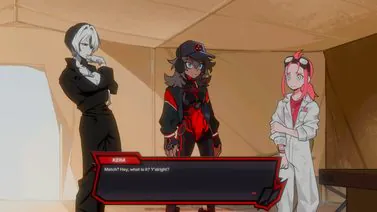
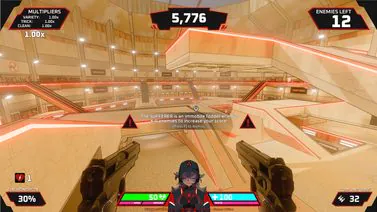
I’m a big fan of that elevator pitch. It takes the traditional arena shooter and pushes a totally different set of skills to the fore, while still letting you enjoy the old-school thrill of slaughtering foes at pace. In gameplay terms it’s fantastically well read and I vibe with all of its most obvious influences, from the aforementioned Quake and Unreal Tournament to more recent and experimental shooters like Mullet Madjack.
I find it surprising, though, how much story there is here. The basic premise is pretty boilerplate stuff: you’re a convict in a dystopian vaguely cyberpunk future, fighting in a bloodsport operated by an illegal crime syndicate and watched by millions. Those who survive long enough earn their freedom. Those who don’t feed the viewing figures. Find+replace one or two words in this paragraph and you’ve got the premise for Unreal Tournament, Speedball, Battle Royale or – if you want a really deep cut – Bet On Soldier.
The reason that particular core premise is used so often is that it sets up all the action with a bare minimum of exposition, so it’s odd that Firestarters gives you so much exposition before your first fight. It quickly becomes clear that Kerosene Studios is equally concerned with telling a story about protagonist Kera, her prototype battlesuit, and her supporting cast of buxom anime girls. This is a bad thing.
Your mileage may vary, depending on how much you like looking at PNGs of buxom anime girls, but what’s harder to debate is that long-winded text dialogue exchanges don’t sit flush in a lightning-quick shooter. There are reams and reams of conversation in story mode, not so much bookending missions as crushing them in a vice of fandom-grade storytelling. At least there’s Arcade Mode, for those who like me who’d rather decouple from that element of the game. In this mode it’s all about setting high scores and leaderboard positions, by finding the optimal routes between enemies and killing them in the most flamboyant fashion.
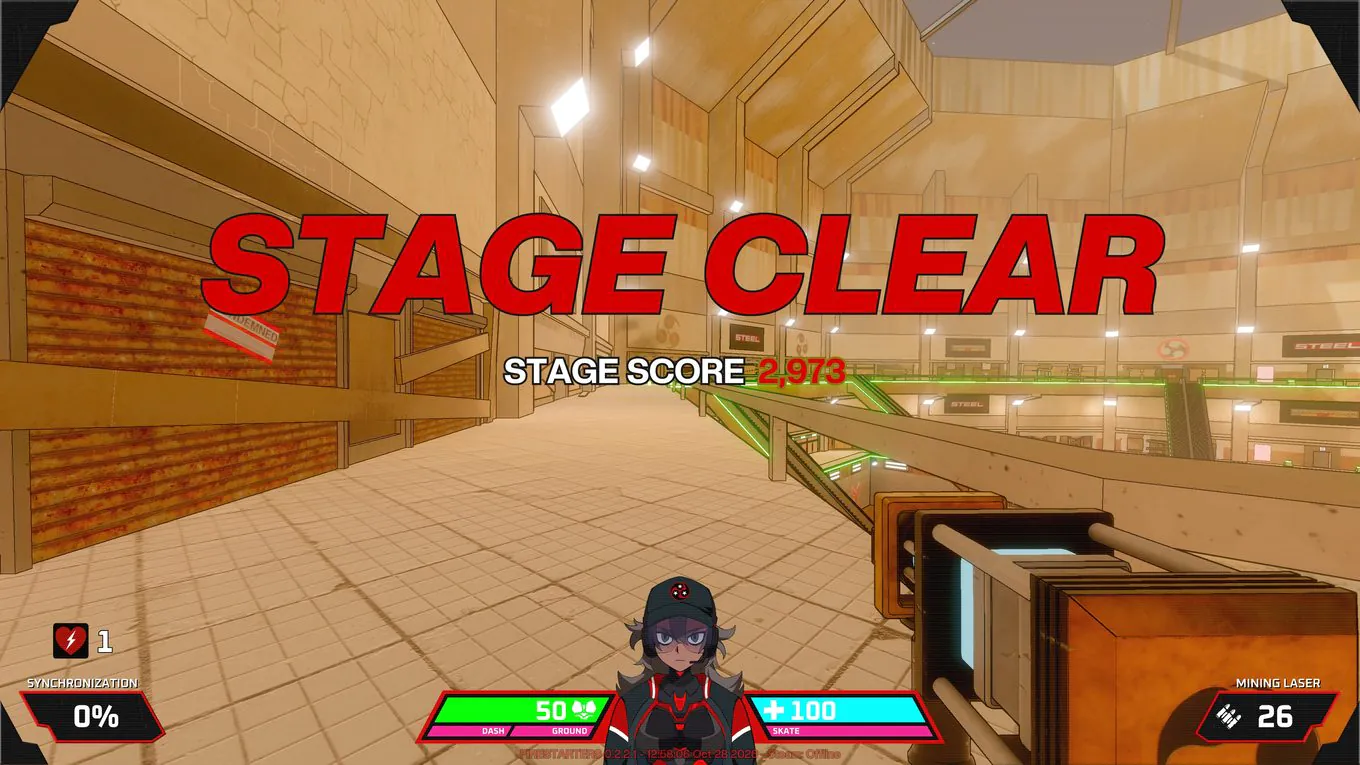
To that end, the arsenal’s limited, but versatile. Dual pistols give you range and John Woo-style executions, albeit with limited ammo. A mining laser offers up a precise dot of white-hot energy damage that overheats very quickly and must thus be used sparingly, and the baseball bat is on hand for all the moments in between. Switching between melee and ranged damage while in motion is a core skill in this game, and it sells the bat swings very well, lending weighty impact to your hits.
Between waves, you get a brief window to upgrade your loadout based on the score you accumulated. Here you can add new weapons like the shotgun to your roster, level up your health and armour capacity, or reduce the cooldowns on your movement abilities. The quicker you kill everyone, the more medals you get to spend, and the more powerful you become. Simple and effective.
I can’t fault the core mechanics underpinning Firestarters’ movement or combat. And that’s even more impressive given that it’s running on a proprietary game engine, built for purpose, and without any generative AI of any kind. There’s a flow and an impact to navigating the (sole) combat arena and dealing damage which is extremely moreish, and makes me want to keep honing my skills. I’d love to keep doing that, but there are design choices that keep tripping me up.
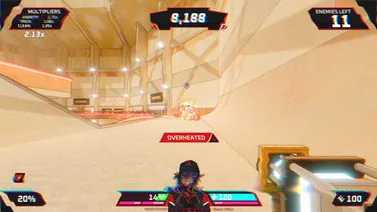
The dialogue – remember I said there was a lot of it – returns at the start of Story Mode’s matches, and it needs you to hit F after every line before the match starts. So you hit F a bunch of times.
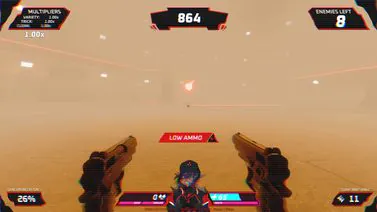
Then tutorial tips appear in the middle of the screen, even hours into the game. You need to hit F to get rid of those too. But you still don’t have that piece of screen real estate back, because Firestarters is constantly using it to tell you you’ve got low ammo, or low health, or that you pulled off a particular combo kill type. It’s probably going for intensity and cyberpunk style info overlays, but in the heat of the moment it just feels like distracting clutter. I just want to run around and kill stuff.
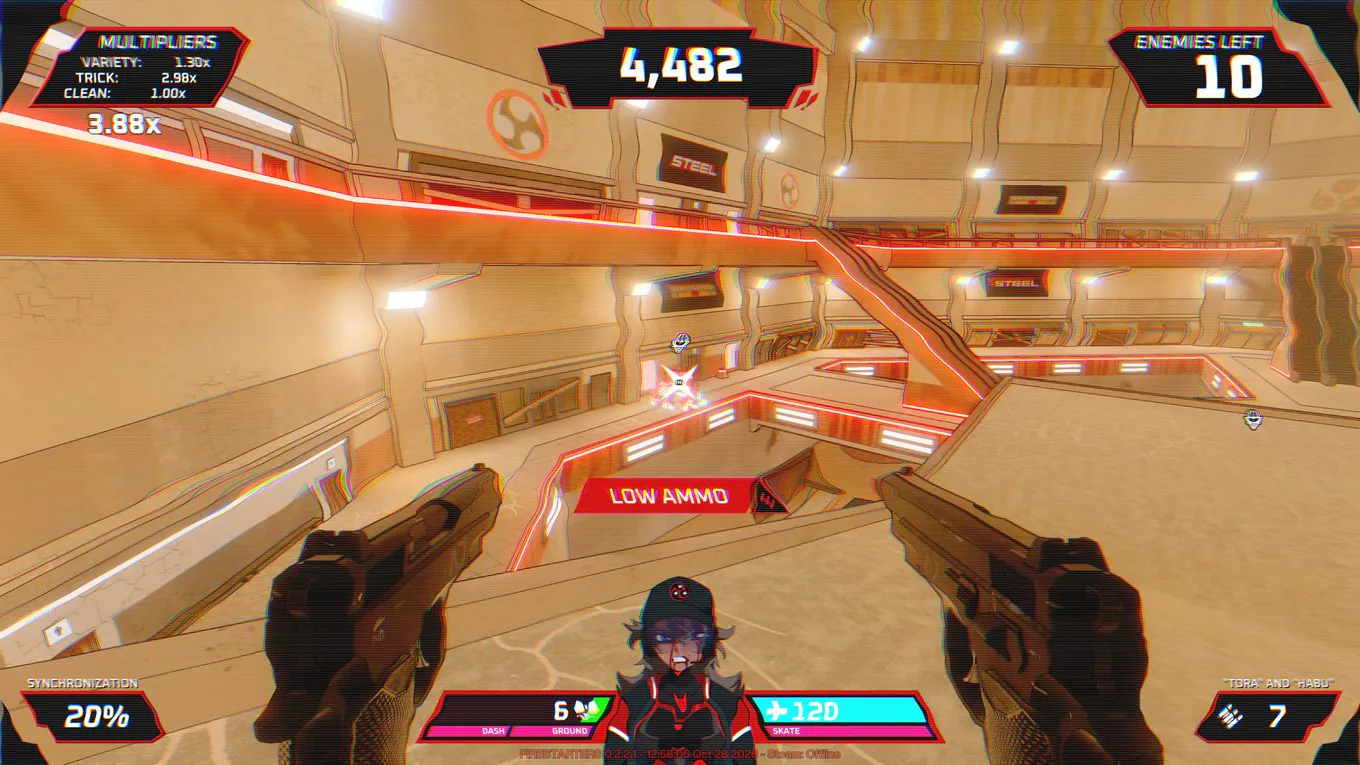
There’s a really strong concept here, and I’m more than willing to concede that my problem with the anime-laden narrative is subjective. You might love it. But the movement-focused, Tony Hawks meets Quake premise needs way more space to breathe, and that means stripping back the story when you’re in control and paring the UI back too. Firestarters has 18-24 months of Early Access time ahead of it, and I’m rooting for it to find a path through those difficulties in that time.