
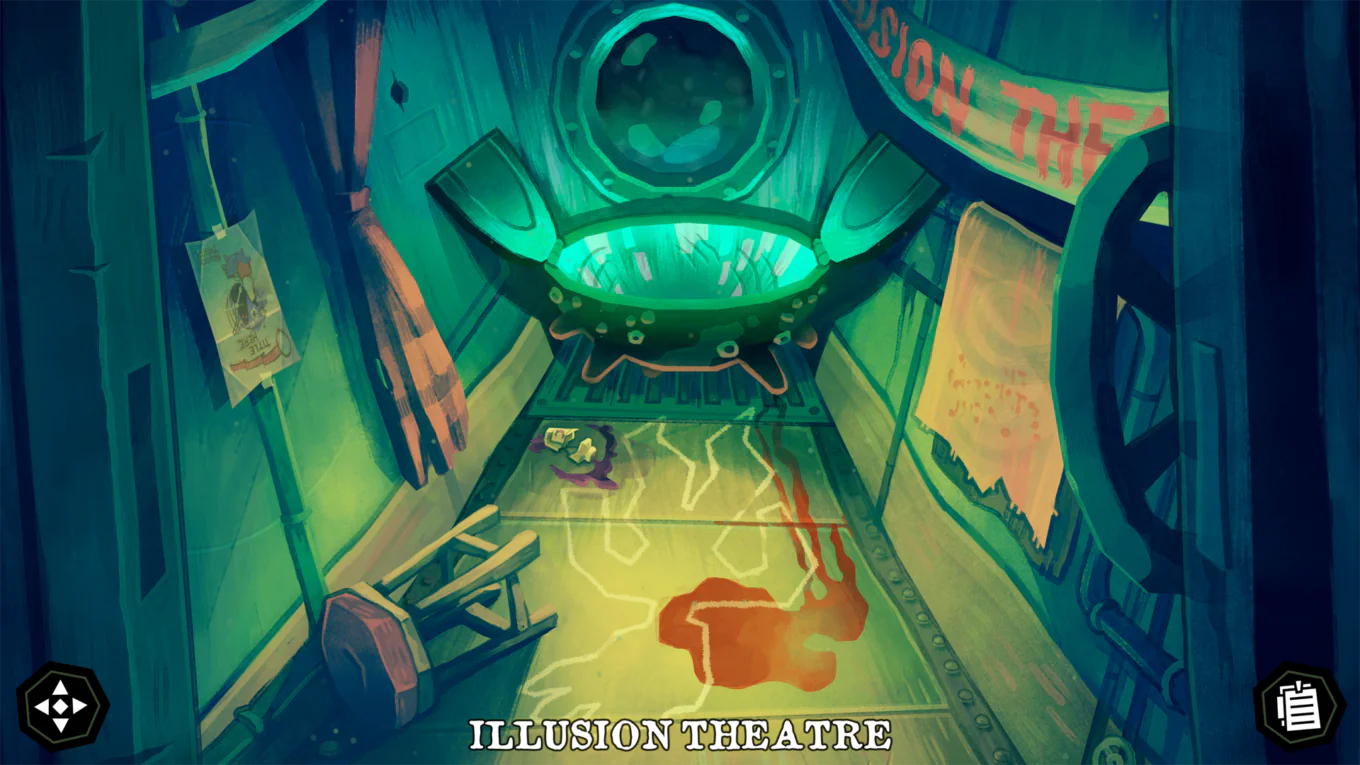
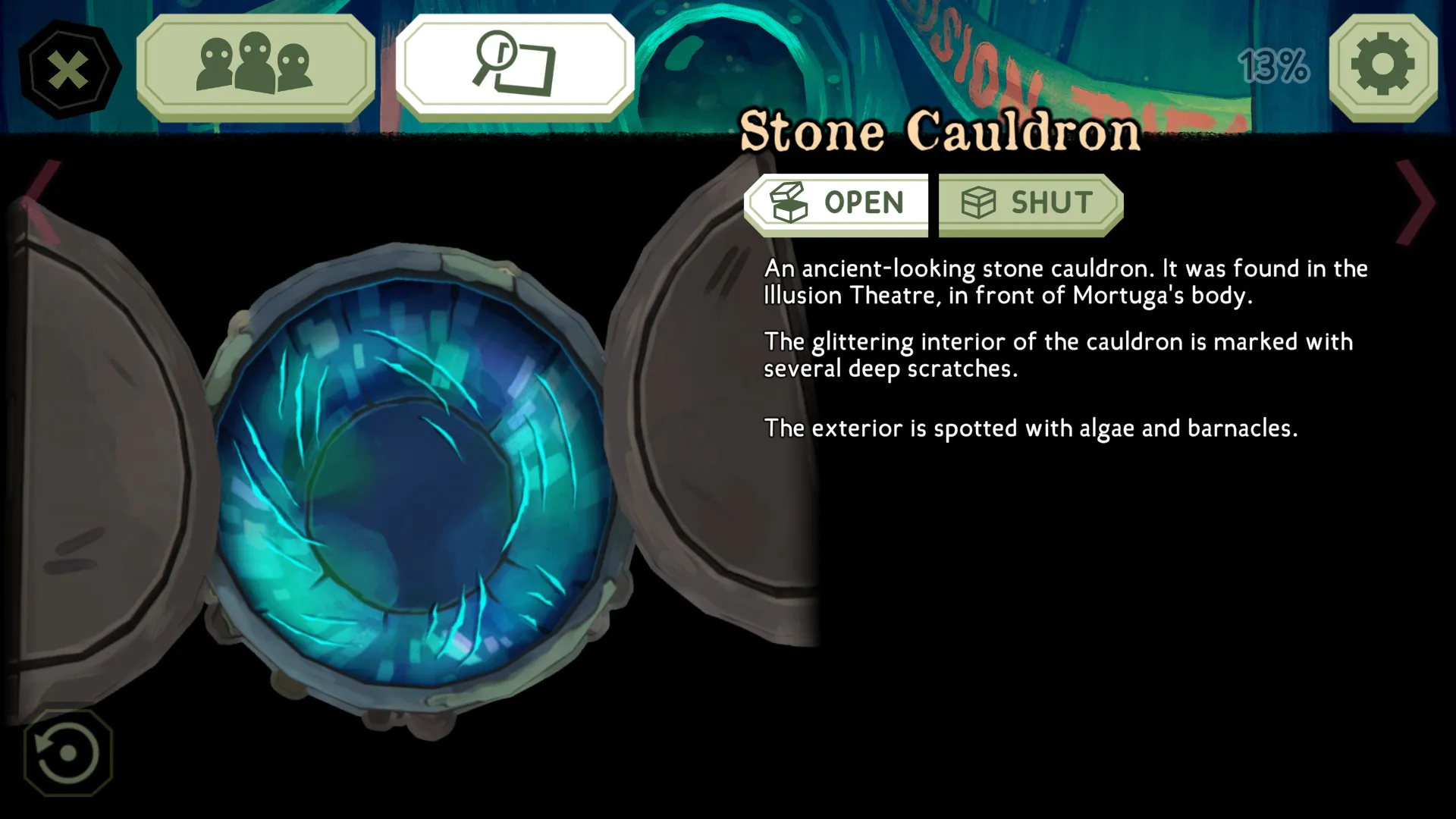
Captain Magnus Mortuga is dead. Locked in the storeroom of his eponymous submarine, his throat has been cut; his body prostrated before a mysterious cauldron he hauled from the ocean years before. With reports of a strange presence in the water outside, the violent shunt of the submerged vessel at the time of the murder, and the impossibility of the locked room, there is only one conclusion: someone, or something, must have crawled out of the cauldron.
Murder as a magic trick is one of the firmest traditions of detective fiction. It was a favourite of the golden age masters, particularly John Dickson Carr: the impossible crime that invites speculation of the supernatural. It is to its credit that the newest entry in that pantheon, SFB Games’ The Mermaid Mask, can lean on so hoary a concept and feels so renewing.
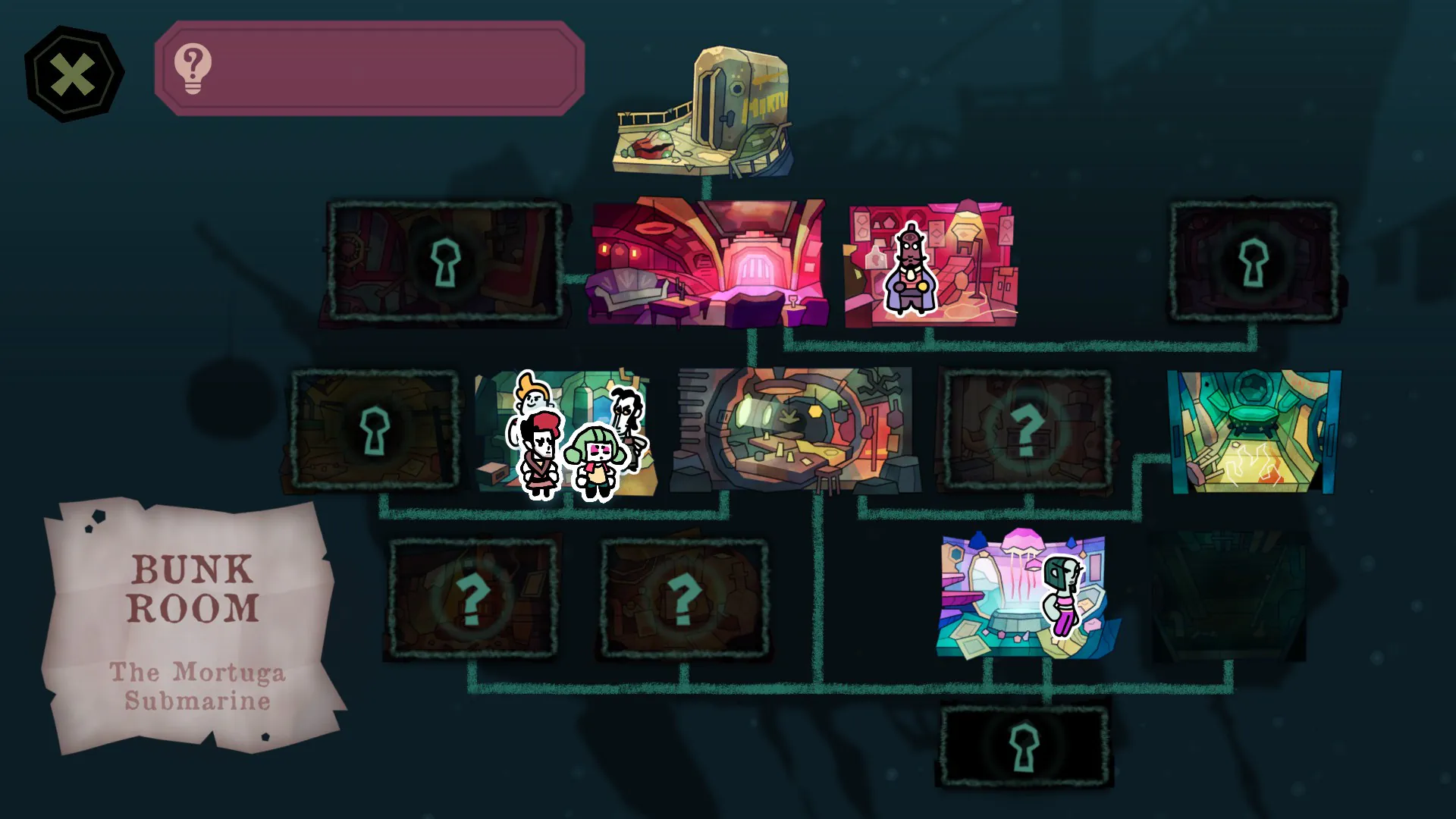
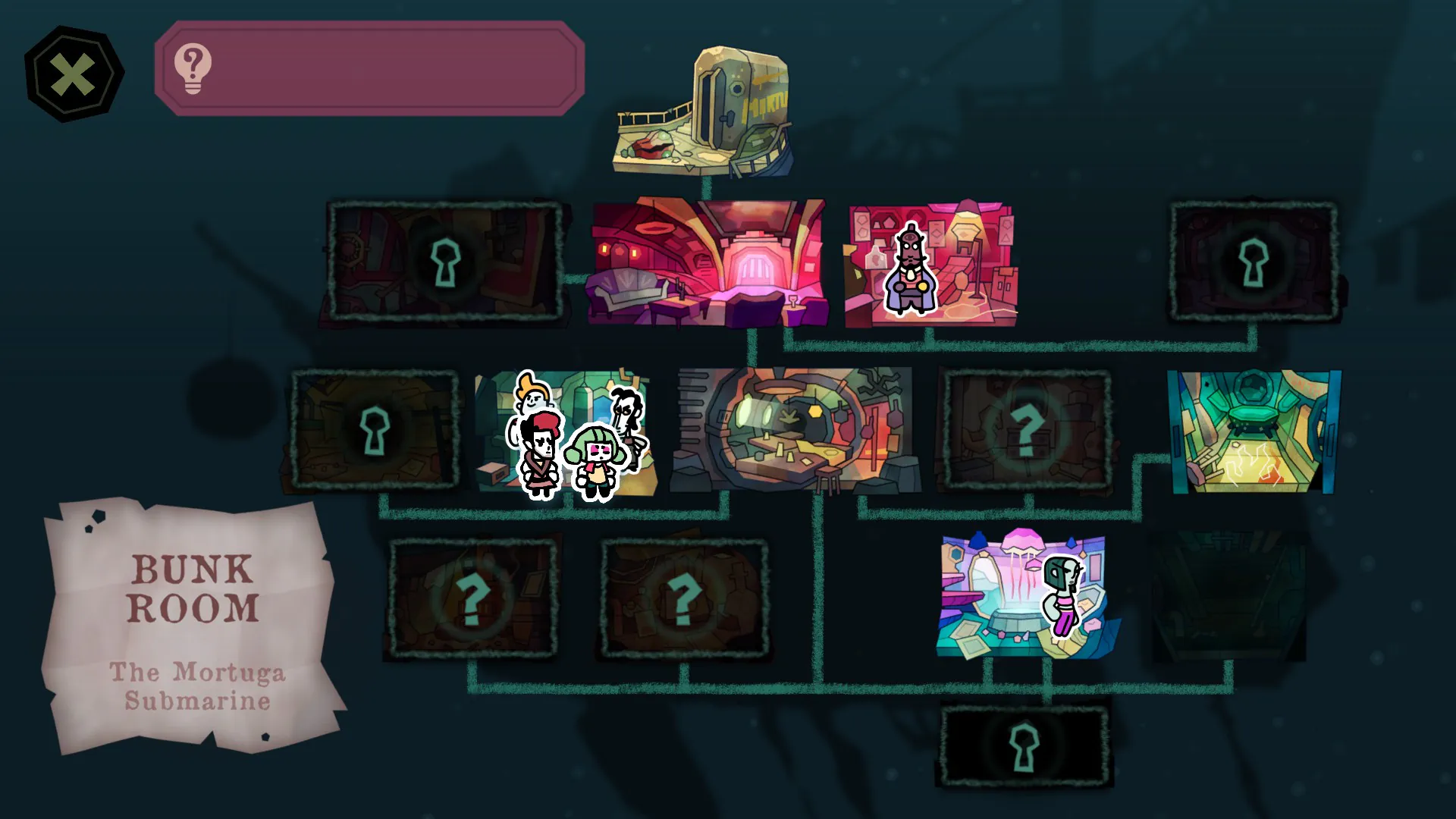
Enter Detective Grimoire and his delightfully arch partner, Sally Spears. They arrive in Silkwirm-on-sea at the invitation of the Mortuga Submarine’s new captain, Sinthia Seafoam to untangle the web of mysteries that not only surround Mortuga’s death, but also his life, his submarine, and his crew.
They’re a fascinating bunch. There’s J.D. Wirman, the downbeat author of a fictional retelling of the search for the cauldron who has arrived in search of inspiration for the sequel alongside Dirk Dansom, who played Mortuga’s fictional cipher, Markus Mordoom, in the film adaptation. Curiouser is Symmetry Silkmoth, a stage performer who has aged out of her act and is plumbing the depths for new ideas. In the meantime, she helps resident “dream doctor” Zacharius Zephyr with his experiments. All while historian Mariana Moon wends her way through the submarine’s bowels to unravel its mysteries herself.
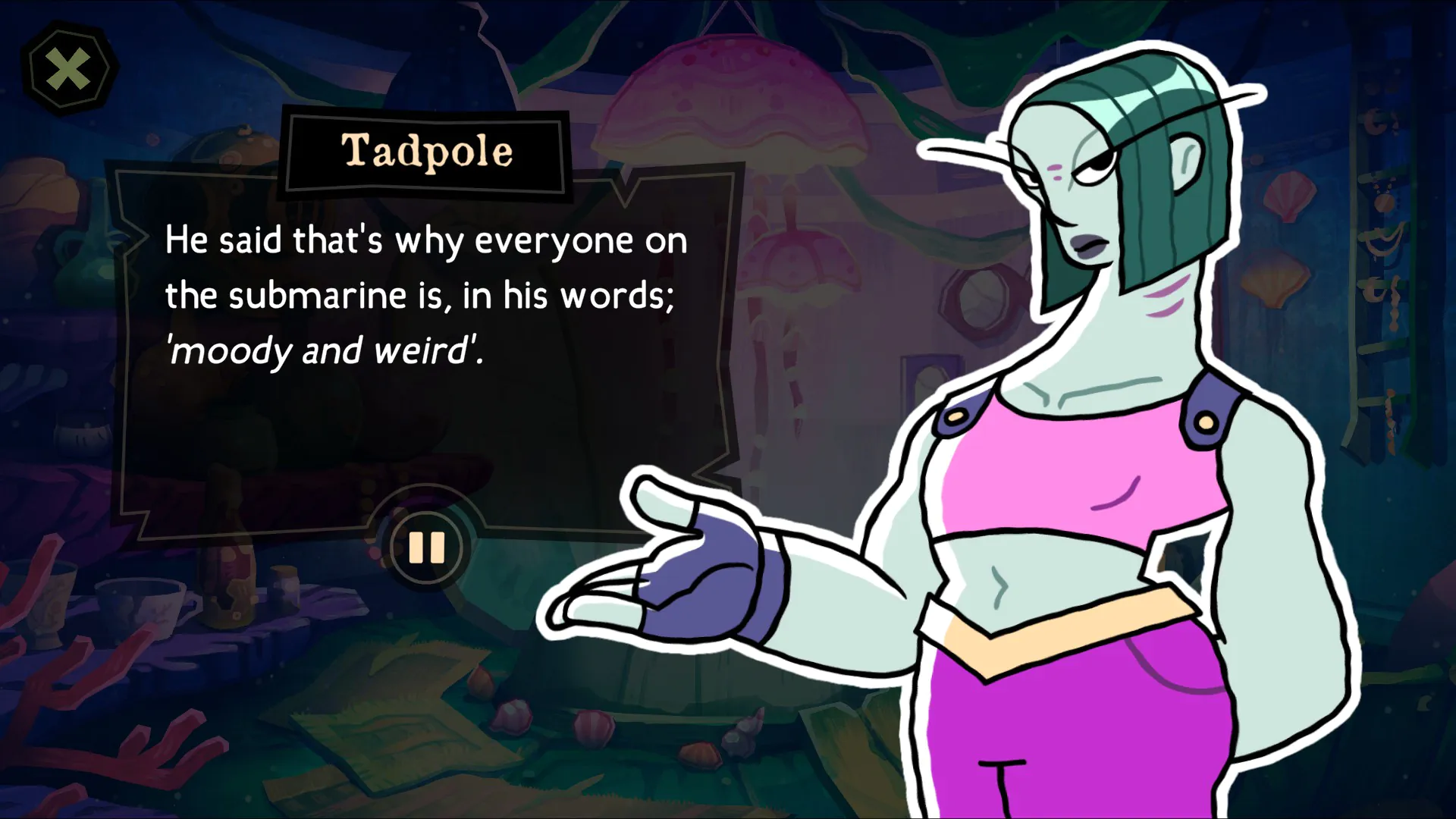
There you’ll also find Madam Tadpole, who styles herself as half-mermaid, from where she hunts for trinkets on the seafloor. Nearby, Godrik Grip chatters to his sidekick — or, sidestick — a cane called “Cornelius,” while tinkering with compasses and charts.
Lastly, there’s Sinthia. Young, bubbly; she is slowly becoming an echo of herself. Her arrival triggered a cascade of events that led to her assuming command. That alone suggests she had most to gain from Mortuga’s death. Though, she also asked Grimoire to investigate. As he does, one wonders: has Sinthia gained anything at all?
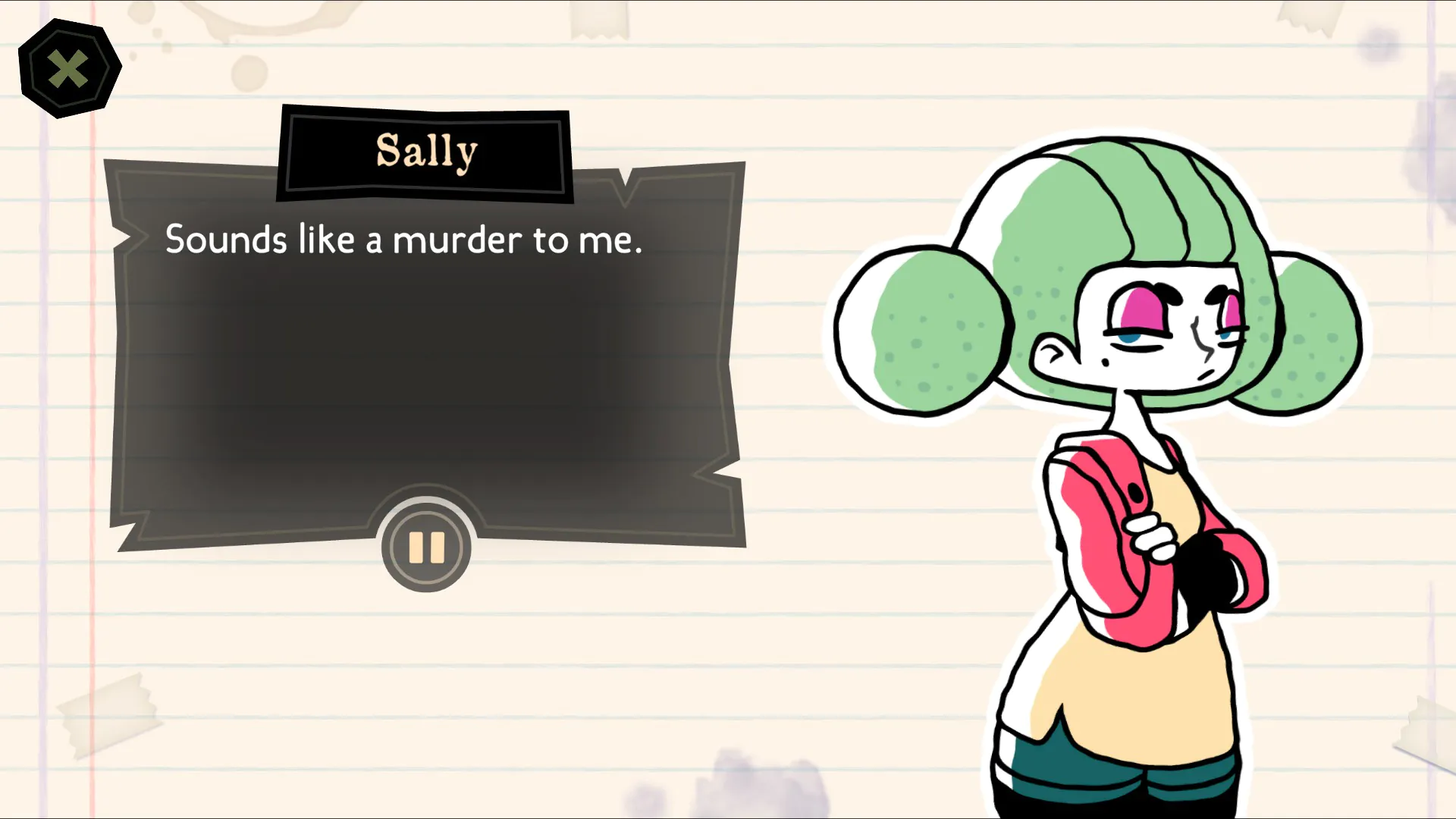
That investigation is rendered through a sprawling, yet nimble, script corralled by Grimoire and Sally’s sardonic rapport, and delivered with compelling verve by Edwyn Tion and Amber Lee Connors. The duo bicker, make sarcastic asides, and yet form the sympathetic glue that holds together an eclectic cast of tragic characters. All of whom feel distinct; all are voiced with aplomb.
Connors, in particular, perfectly pivots from sarcastic desires to “keep” the puppy-like Dansom (only to agree when Grimoire insists she’ll forget to feed him) or labelling an abandoned glass of wine “ominously corked” to playfully fuel a growing sense of supernatural unease, to the more mature and empathetic foil to Grimoire’s somewhat cynical, analytical style. The duo — carrying on from their previous investigation in Tangle Tower — offers a stable rhythm in the choppier waters of clashing personalities among the submarine’s crew-cum-suspects.
It’s a relationship that also delivers many of the game’s hints. Part of a generous system that includes interactable prompts offering direction but also casts Grimoire and Sally’s deductive conversation as a diegetic guide. If you encounter a dead-end in a puzzle or conversation, they will gently spell out the thinking required to clear the roadblock in a series of hints that get steadily more pointed. (These hints can be turned off).
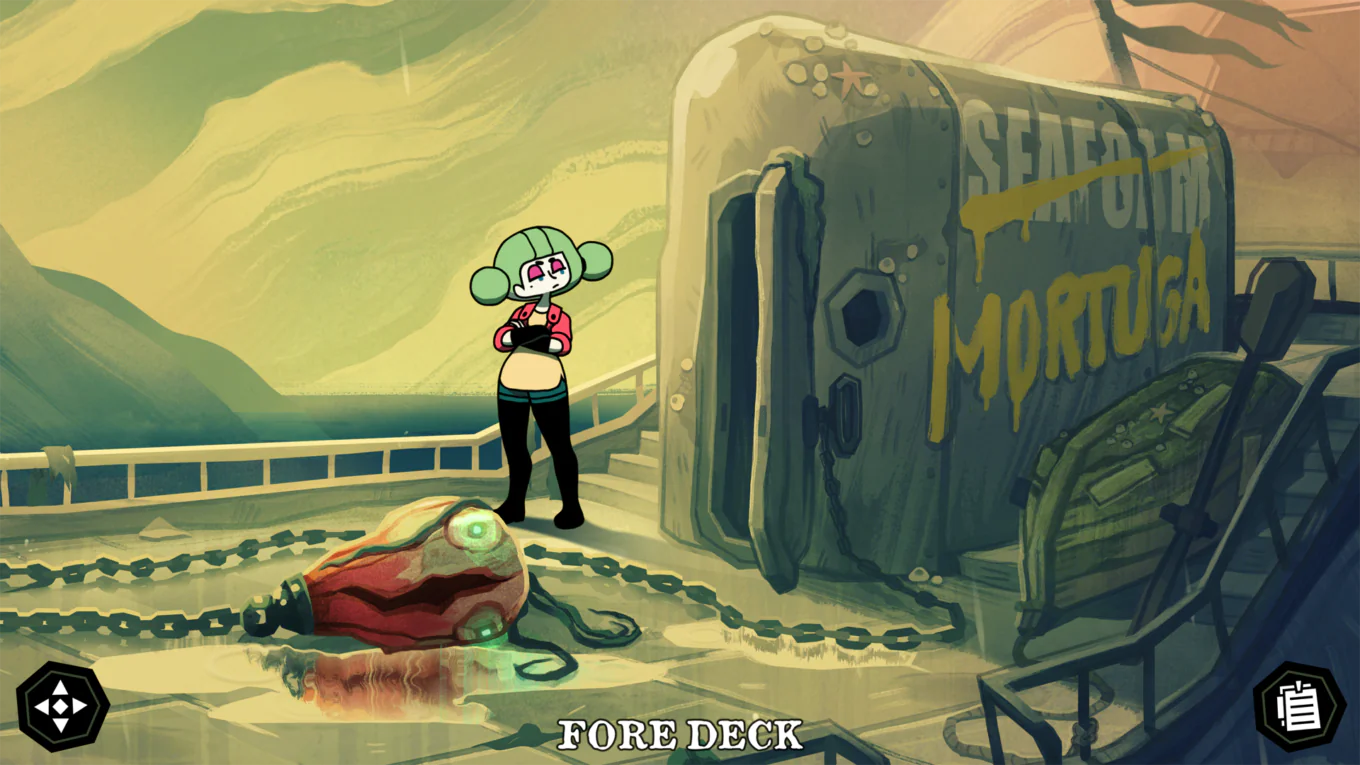
Otherwise, The Mermaid Mask functions as one might expect from a point-and-click adventure. You navigate the submarine’s compartments and speak to those inside. Clicking on objects in the background – rendered, as with the rest of the game, in spritely, though suitably gloomy, cartoon style – prompts pithy comments from the detective pair, while others can be stored as clues with which to further confront suspects. For all its generosity with hints, The Mermaid Mask still follows usual point-and-click conventions when stuck: show everyone everything.
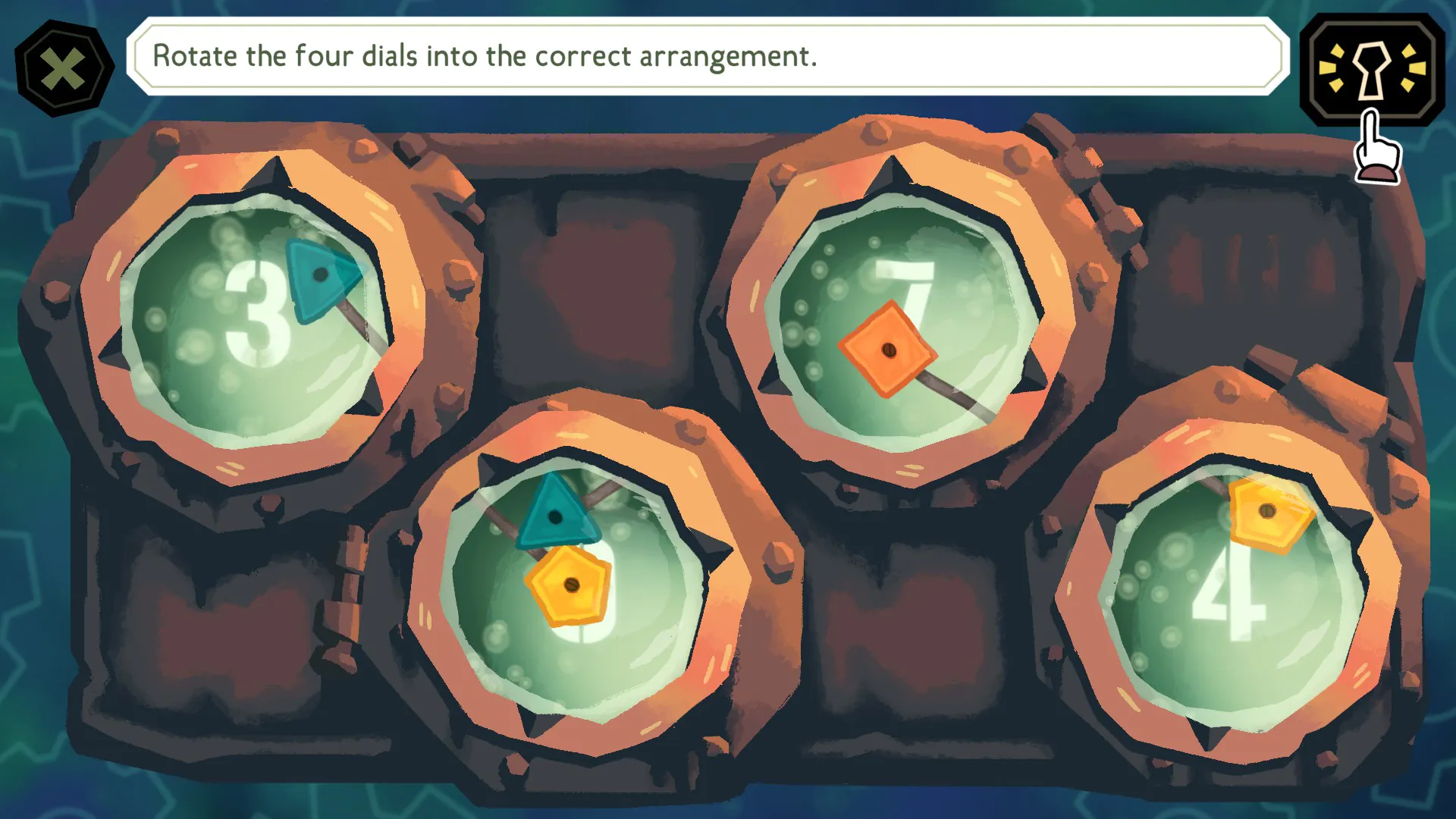
It’s a checklist gameplay – and there is an actual checklist late in the game – that should feel like old hat, even frustrating. Yet, The Mermaid Mask maintains a cunning rhythm that refuses to leave the player weighed down in one place for too long. In the midst of rooting out clues, many will hide behind puzzles that break up potential monotony, while engaging conversation helps create a compelling rhythm alongside material investigation.
That should sound familiar to anyone who has played a point-and-click game; maybe limiting. But The Mermaid Mask isn’t so much a revolution of point-and-click adventures than a studied exemplar. Similarly, as a detective story, it is not a mystery to solve but rather a pre-determined story in which you are a participant. You interact with it, but always to reach story beats that already exist — there are right and wrong answers, and you will be corralled towards the correct ones.
In this way, The Mermaid Mask does avoid the pitfall of trying to manufacture a clever way to allow the player to deduce solutions which often leads to unintuitive mechanics. But it also means you will be making connections yourself that Grimoire and Sally miss until the game demands otherwise.
When you find a message in a bottle, for instance, you cannot break it open until the game says so. That only happens once you’ve divined its importance by showing it to everyone. In a more jarring example, you will hear a recording in which someone says, “Why don’t we just kill him?” That’s not something you can clear up until you have assembled all the information possible about them.
Which makes for an important distinction: this is a visual novel with light detective elements rather than a detective game. You will be called upon to solve puzzles and make deductions, but these are mostly memory games in which you must choose relevant clues from a bank of more than 50. It gives The Mermaid Mask a defined, wieldy narrative but some players may find it unsatisfying if going in expecting otherwise. The Mermaid Mask skews closer to Pentiment, whose ambiguous mysteries were in service of an inexorable narrative flow, rather than Return of the Obra Dinn, where deduction unlocked its fractured story.
I say “some” because The Mermaid Mask still has narrative surprises. Though split into six chapters, it’s really two: discovering everyone’s motives for boarding the submarine and then solving the murder. Both offer emotional fulcrums that will break the resolve of even the most cynical of players. Even in its rare obtuse moments — of which I encountered only one, and then only because I’d forgotten the golden rule of showing everyone everything — The Mermaid Mask is a beguiling, curiously cinematic, experience.
It’s a charm that is more than enough to offset the Mermaid Mask’s miniscule missteps. Originality isn’t the aim; The Mermaid Mask is a new archetype for point-and-click games built from familiar, yet compelling, building blocks. A game that, the more I played, slithered into my brain and took root.
As a reviewer, I keep a clear line between work and play by allocating specific time to work on games and make notes. Yet, in the course of The Mermaid Mask, I found myself sneaking back in like I was raiding a snack cupboard in the middle of the night: one more interrogation, finding just one more clue.
That’s apt as obsession, more than deduction, is key to this story. Obsession with the solve, with the cauldron, with the sea – and, pleasingly, with The Mermaid Mask. That becomes clear in its final throes. These may leave some initially perplexed (I was for a beat) but it is in keeping with a journey in which Grimoire and Sally, in small increments, discover empathy for this band of eclectic submariners and unravel less the vessel’s mysteries than the fetters of obsession that lock them to its haunted compartments.
It is here, however, that I must acknowledge that there are two ways to look at The Mermaid Mask. The most fair is on its own merits. As a point-and-click mystery, it is not flawless but it’s not far from it either. Building on a rich history in both gaming and locked-room mysteries, it coalesces into a deft, well-choreographed visual novel anchored by a duo of characters (and voice actors) that earns its place firmly seated in the pantheon of detective fiction.
The other, less equitable, is in a broader context: an industry crumbling under the weight of the pursuit of interactive cinema. In which The Mermaid Mask surpasses its already stellar impression and elevates above simply being the ne plus ultra of its genre to offer a timely reminder that you don’t need photorealism and eye-watering budgets to create something compelling, alluring, and, above all, cinematic.