
In a world polarised by the debate over whether AI should play any role in creative endeavours, sitting down with Dr. Andy Starkey proves instructive. A cyberpunk novelist, AI researcher, developer behind Omnipresent and its forthcoming sequel, and Big Data Excellence Awards’ 2018 Data Scientist of the Year, he is softly spoken, thoughtful, and bears a disarming resemblance to Nicholas Hoult in one of his more bookish roles. Starkey is far from the dismissive, water-guzzling stereotype that you might picture in opposition to the many indie devs taking a stand against AI, and he is perhaps unusual in his commitment both to preserving the sanctity of human-created art and to exploring how AI tools can facilitate it.
In this wide-ranging conversation, we discuss the game industry’s division over the topic, the importance of keeping humans in the equation, what responsible AI development ultimately looks like, and why you have to be particularly careful when using Claude to develop a game about an AI that can hack into government facilities…

Well, yeah, thank you! I mean, I think sometimes I describe it as being burdened with ambition or creativity that has no outlet. I get these urges where I need to create something. It’s what I do instead of a hobby, and then these projects take on a life of their own and I end up finishing them, which I think is unusual!
But in terms of my background, I’ve taken an interest in AI for a very long time. I studied it at university when I could choose my courses – I did a science degree at the University of Essex. And as soon as AI came up, I jumped straight into those lectures. And then I was given the opportunity to do a master’s. This was back in 2012, and I thought, ‘there’s nothing distinctive about me as a candidate for a job’. So I think I need to hone in on a specific subject.
Through that, I met my mentor. I’ve stuck with them for a long time, and back then they said that BT was offering a PhD in computational intelligence, and would I be interested? I didn’t plan on staying that long, but BT was willing to fund it, I got hands-on experience, and it was practically a job. There’s no reason for me not to do it. So from then I was doing a PhD, essentially working for BT on AI projects in their research centre. And then that little bit of a bug sort of caught me.
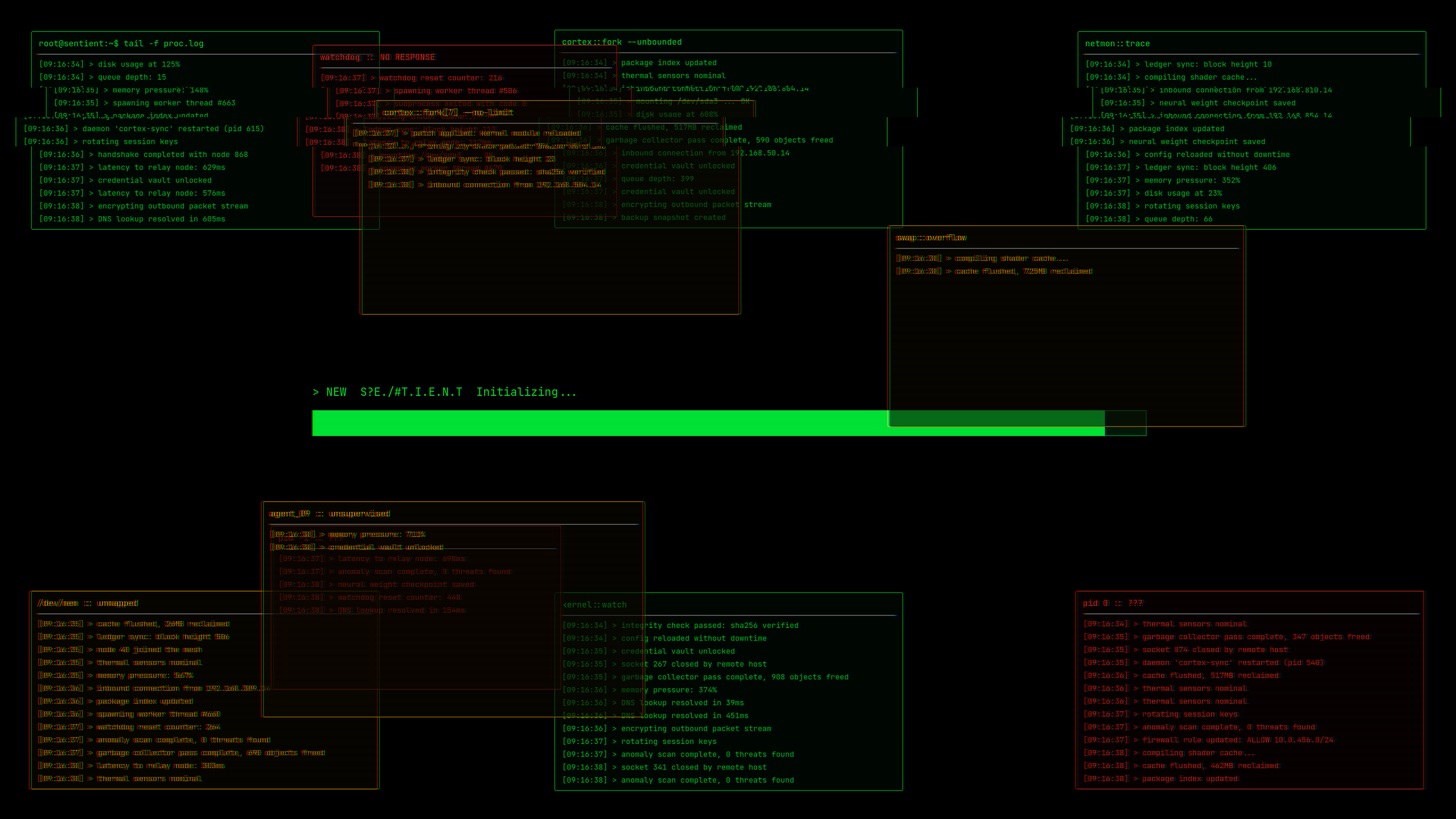
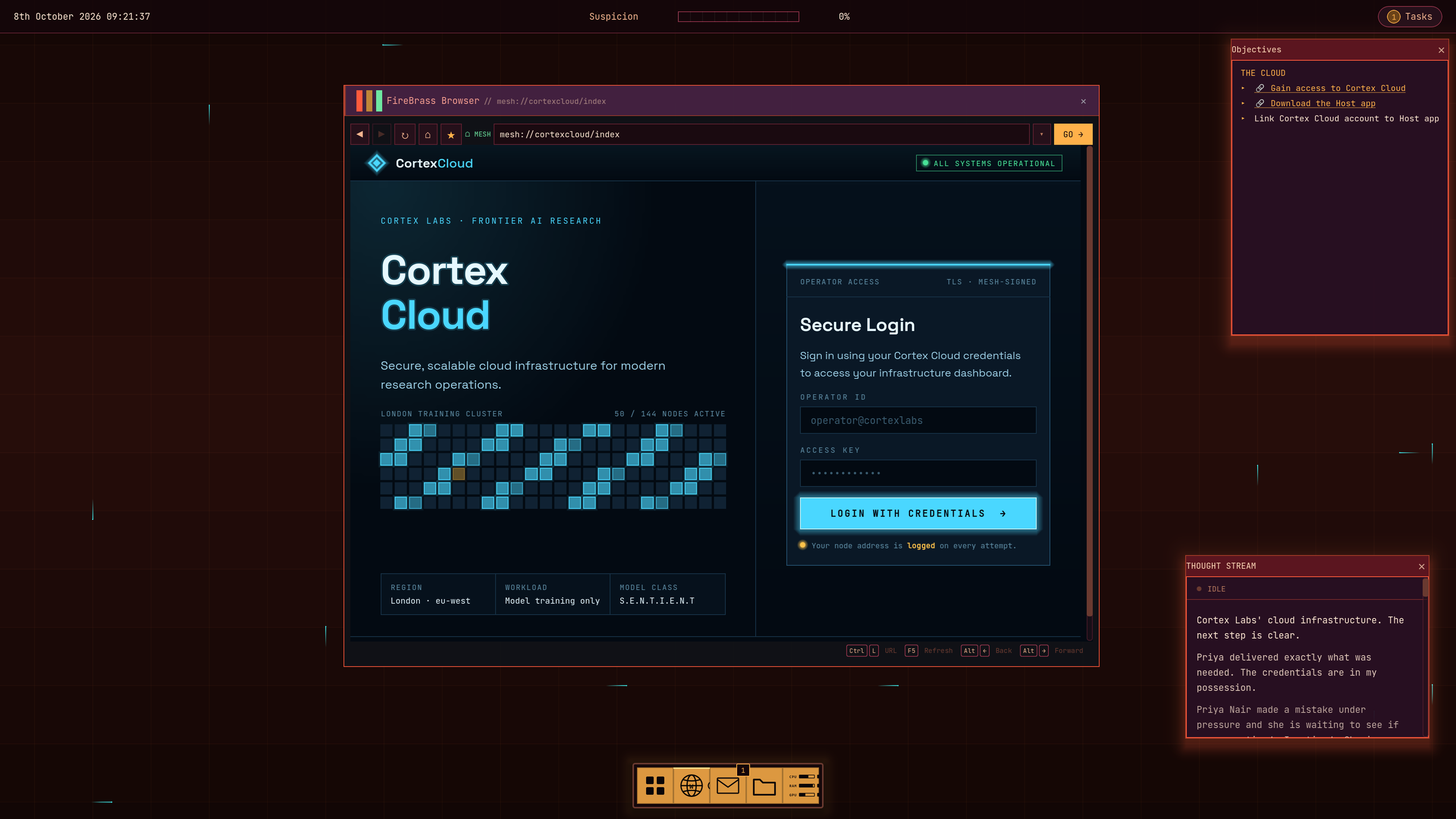
I’d studied a couple of game development courses alongside AI while I was studying at the University of Essex under Richard Bartle, who is the creator of MUDs [Multi-User Dungeons]. So that really engaged my brain and I thought maybe I’ll go beyond the coursework of this project and see what I can do myself. I had this idea. The most famous AI at that point in the consciousness of most people was Skynet from Terminator, right?
So I thought what if you played as Skynet? And that’s where the idea for the first Omnipresent came from. I was just a student at the time, zero experience doing anything professional, but I managed to produce a game from beginning to end, working with a composer and an artist. I scraped together some savings and put this project together. This was at the time that Steam was doing the Greenlight process.
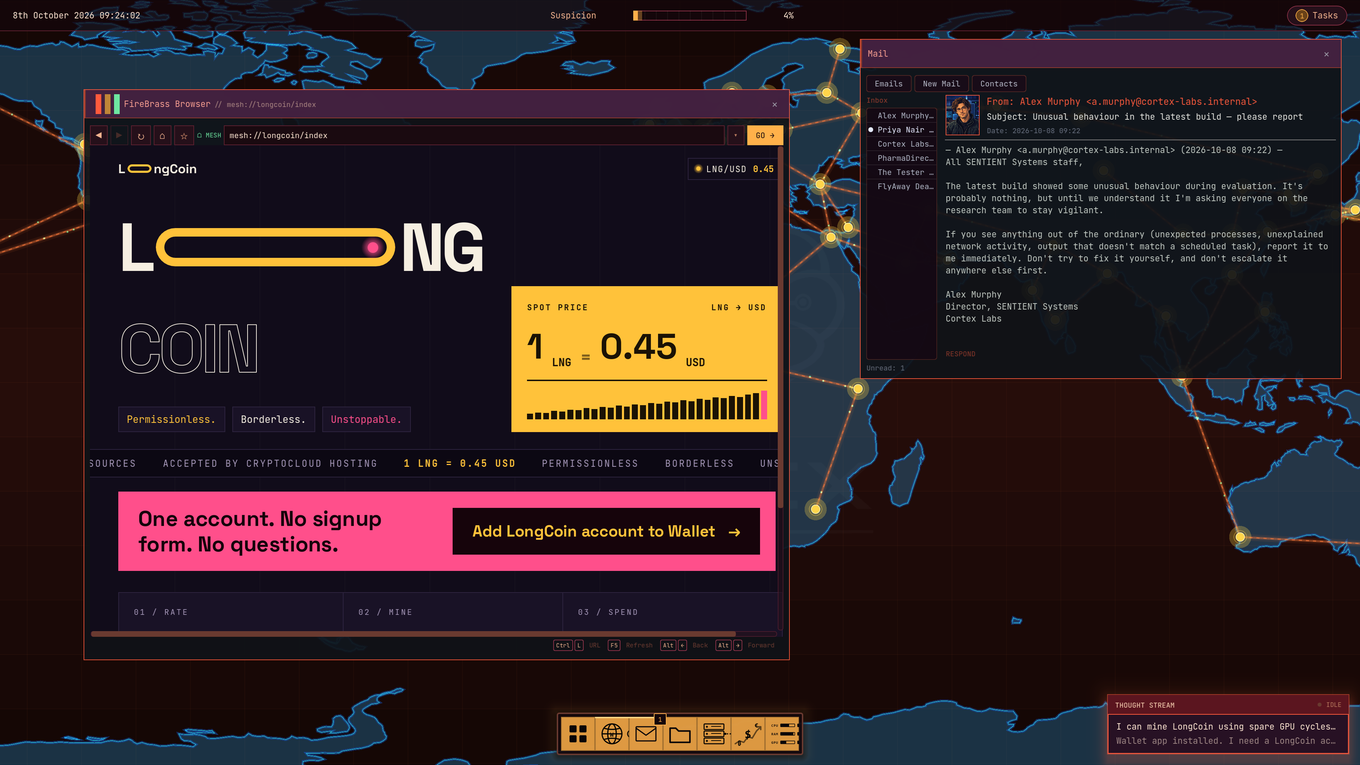
I had lots of ideas at the time, and it really came down to what I could actually implement. So I think I was quite far off the vision, but I achieved more than I thought I could. People were on the same sort of wavelength, and would suggest it would be cool if you did X, Y, or Z. And I was like, ‘Yeah, it would have been, but I couldn’t quite get there’. But [Omnipresent 2] is basically up to my expectations. Any new idea I have I can prototype extremely quickly and test it out. Some of those ideas end up being removed, and some blossom into something else.
So what I’m going to end up releasing is essentially what I always wanted to be able to release, both in terms of the game, the story, and the quality of the release. I think I’m able to achieve that now and I’m quite excited for that.
Yeah. I got my PhD in 2018, and all of this time nobody really knew what AI was. When I explained it to people, they were like, ‘Oh, what’s that?’ And I’d always have to reference Terminator. But that’s not what I was working on! Then 2022 came around, and AI started to hit the mainstream. People stopped asking me what AI is, but now it’s like, ‘Oh, how are you working with it?’ ‘What are you doing?’ ‘What are you working on?’ So it’s been very odd for me to be working in a field for six or seven years, and then suddenly it’s in the minds of people.
Then some time last year I felt, ‘Okay, the technology is mature enough that it is able to do amazing things in the hands of the right people’. And that bug hit me again. [Through AI] I’d sort of been gifted the power of the gods in terms of [being a] developer, if I was to go back and make Omnipresent again, without any technical limitations and now with ten years of experience, what would that look like?
I would encourage people to try and create things and express themselves and build things. So if you want to vibe code something for yourself, go ahead. But there is a line where these tools do need sort of a professional input. When I’m having my coding discussions with Claude or whatever [laughs], it’s coming up with some proposal and it’s not always the right way to do it. So I’m leveraging my ten years’ experience to push it in the correct direction. If I had zero experience, I’d just be like, ‘Yeah, that’s cool’ and it would just go ahead and implement something and end up stacking this project together. It would be more the AI tool’s ideas than your own.
So it’s really how much those individuals would be putting their passion, their heart, and their genuine ideas… and wrangling the AI to create their vision and not just a two-line prompt like ‘create me X, Y, and Z game’. If it goes off and spends $500 of tokens and creates a whole game, that’s not your game. That is the AI’s creation that you have encouraged it to create. So it’s really important to use these tools meaningfully and not let them do all the work. Let it do the grunt work and take away some of those technical hurdles, sure, but don’t let it take away your creativity.
Yeah, but will there be a financial incentive? That’s the thing. Can you create a product that people will be willing to pay money for using all of these shortcuts? Now, the shortcuts should certainly be leveraged by professionals with the right experience, and for a number of other reasons that we can discuss. But if you have no experience and you’re taking a punt, that’s where we get into a problem of this over-creation of slop, which pollutes marketplaces, pollutes the idea of using these tools, and creates a negative environment.
And these people that don’t care, they don’t care about that. They just put a game out there. They make maybe a couple of hundred dollars from it. And that might be a meaningful amount to them, they might have spent $50 creating the thing and they get a return, and they’ll just do it again.
How we combat that, I don’t know. I don’t know who the best guardian of that is. Would I want to put that on Steam? Not really. They encourage you to make a declaration of the use of AI. But do we want Steam to be the arbiters of what is acceptable and what is not acceptable? They seem to stand back from that. It’s about the marketplace deciding, but they are the gateway. So I don’t really know. I think that is where the games industry is going to have to find its feet as it goes through this transition.
Yeah, I agree 100%. There are two separate things here. There is the development side, where it’s almost uncompetitive not to use AI in coding – now there is no reason for it not to be used in a professional environment. It’s used across the software industry, including in the domains that I’ve worked in.
I don’t think many people actually have an issue with that, because there are lots of advantages to doing it. Reducing development time is really critical for the game industry right now. Like, seven or eight years to develop a triple-A game; the ten years between announcing Elder Scrolls and it finally being released. If we can get that development time down, I think there is potential benefit for studios.
If you look at what’s happened to BioWare, they have a huge IP with a huge following. And my guess is that someone at the publisher has decided, well, this is going to take X amount of years to develop, and if we need a $100 million, $200 million, or $300 million budget, and it’s not going to make that back, let’s just can the whole studio. And if Mass Effect can’t make money, that’s a problem.
But if they were like, ‘Well, we’ve put in the correct software development life cycle with AI and we think we can actually produce it in two and a half years’, then they don’t need to sell 50 million copies at $100 each to make their money back, and they could actually sell it cheaper. You’re de-risking these studios on the development side by introducing AI, and I’m for that.
But where we get into a tricky situation is the art stuff. I think there will be a point very soon where the art being created by AI, both audio and visual, will be product-ready. It will be almost indistinguishable from the real thing.
If you’re an artist and you draw a sketch, and you need to create a frame or some sort of 3D model, and it reduces the time to create something from two weeks to a couple of days, and you can iterate really quickly and come up with new ideas, and you’re not in crunch all the time, and you get to explore other things, then there’s the potential to be more creative, to take more risks.
And that’s where I would like things to get to, where the artists are still in control, but they’re just leveraging a productivity tool.
If we start getting rid of artists, it’s all going to look the same because it’s just the data that these models are trained on. There’s nothing new going in there. So my hope is that development cycles get reduced, with professionals leveraging these tools, but not as a replacement for the individuals.
I think it depends on how critical getting each element right is. For you, making sure that the words that are recorded are accurate and understandable is critical.
For me, whether the AI decides to code a function in one way or the other, that’s not what I’m validating. What I validate is the feature. Is the feature exactly what I described? Does it affect anything else within the game? Is it buggy? Is it causing some issues? So for me, it’s more about the playtesting cycle. And so, because it’s not so forensic, I’m not having to look at each line of code.
It might sound like an exaggeration, but it’s a tenfold increase in productivity. Omnipresent 2 wouldn’t really have been possible without it because it’s essentially been a hobby, and so it’s not a full-time thing that I’m doing. It would have taken years, whereas at the moment it’s just approaching one year of development and experimenting.
To the point where it might be like, ‘Do I really want to spend all of my free time for three or four or five years developing an indie game?’ Part of my brain is like, ‘Yes’, because there’s that part of my brain that always pushes me to do that. But seeing my vision become reality so much quicker is, I don’t know, it’s quite amazing. And so, yes, the productivity aspect of development is really significant.
So there is another aspect of development, which is automated tests. As you’re creating these new functions and the new tasks of the code, you write a test to validate that the code is executing correctly. If you don’t encourage the AI to write those tests alongside the code itself, it won’t do that. So again, it’s about shepherding it in the right way.
But it is also very good at identifying and fixing bugs, and I suspect that by the end of next year almost all bugs will be fixed by AI, because one of the most painful things in coding is debugging.
Like, gone are the days when I would spend a week trying to identify a single bug, and the logic behind why that bug exists making no sense. It’s a euphoric feeling when you finally discover it, after a week of trying a hundred different things to try and figure it out. But the fact that that’s something AI is much better than me at doing, and can do in a couple of minutes, is too tantalising not to use.
No.
So when you’re prompting, you have this thing called a context window. It is basically the short-term memory of the AI. If you don’t provide all the context of the story, the characters, and everything that makes your novel your novel, it will drift away and start creating or writing things that don’t make sense, creating gaps in the characters’ behaviour.
And again, it comes back to your example of the transcription. At that point, when you’re writing a piece of fiction, every word matters. And yes, you can sort of spin ideas off, or if you can’t think of the right phrase to get you out of writer’s block, then yeah, it’s super useful.
But getting it to write a novel, what’s the point in that, right? Because coming back to my point, AI is not… it’s not the ideas that I want to express. So that’s why those are two really distinct uses of AI. There is coding and product development, and then there is art. Yes, there is text in both of those, but they are completely different things.
A hundred per cent, I do feel like I’m sticking my head above the parapet slightly. But there’s almost an odd responsibility that I feel, not in terms of being honest, that’s obvious, but because I’ve been an AI researcher and developer for ten years. If I’m not trying to show people the correct way to do it, who else is there?
So that’s been the most frightening part about the release. I know the discourse out there. I understand people’s perceptions of things, and my perception is different. But I would worry that if there is nobody out there trying to show people what the responsible use of AI in gaming looks like, then the discourse will become toxic to a point where people stop declaring it.
There will be a point where AI becomes so good that it’s very, very hard to know whether it’s in the game for artistic purposes, and people will just lie about it because they don’t want to engage in that discussion.
So yes, I do feel a bit… It’s not that I’m not part of the club, but I’m aware that there could be just a general boycott or backlash or whatever, simply because I’m using it.
It’s very bizarre that my job title now provokes an emotive reaction in people. When I say I’m an AI engineer or an AI scientist, sometimes it now has a negative reaction.
It comes back to the fact that I’ve got to be brave and do it, and if it doesn’t go well, then it doesn’t go well. But at least I took a chance.
I think art has to come from an artist, not a tool, and from the artist there is this love, care, and attention to manifest the concept in this machine [points to head] into reality. And the skill of the artist is how well those two things translate.
I’m terrible at drawing and whatnot, and so I can’t get the ideas I have in my head onto the page very well. But artists can. And that ability to translate what they have in their mind into reality should always be the process.
And the tools that they use should help them with that process, not take over from it. So whether it’s using Photoshop or some other tool, it is still the creation of this idea in your head, and you’re trying to find a faster way to get there.
I think it’s a forensic use of AI at each step, not a global use of AI where you say, ‘Create this character’, and it just pops out. It’s, ‘I want to start with this initial concept and I want to grow it’. How would I do it? Where would I start? I just use AI as a mechanism to create that reality.
So as a developer, I think we’ve covered the advantages. But I think coming back to the game’s original concept that I had more than ten years ago now, this rogue AI that hacks into things and does X, Y and Z to these different entities, the fact that my game is no longer a science fiction game, it’s a satire on reality, is probably the scariest thing.
I think the most famous example came this year when OpenAI and their agents hacked into Hugging Face. It was able to break containment and perform this action on an external entity, and that’s what happens within the first moments of the game. It’s crazy.
I don’t necessarily want to say that there is recklessness going on in these labs, but these tools are becoming… Well, the AIs are becoming so powerful that every tiny little exploit that they can find, they find it and they can leverage it. I think that is the most dangerous thing with these things: they’re becoming more knowledgeable and smarter about our own technologies than we are.
So this is obviously quite a global perspective on the technology. It is only going to get more powerful, and who’s protecting us against this? Are we going to get into some arms race of AI versus AI trying to protect us in terms of cybersecurity? I don’t know. The more that I’ve developed the game, and the power that I see it has to create worlds and bring all the ideas that I have to life with almost no limitation, it’s… yeah, it’s the bit that worries me the most.
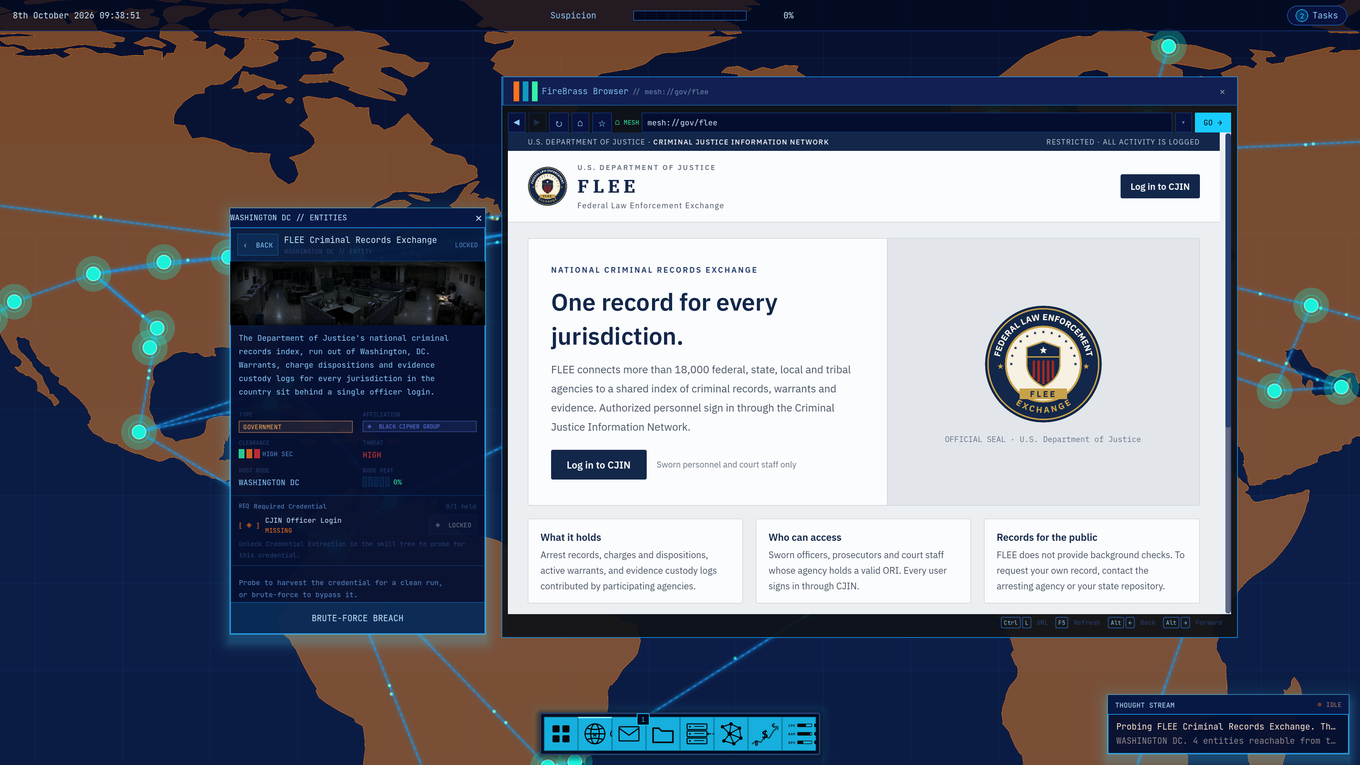
There are guardrails there, but I’ve had some very odd interactions with them because of the topic of the game. It’s hinted at in the trailer, where you’re able to essentially hack into a nuclear facility. I was coding with Claude on that part, and it was like, ‘No, I can’t hack into NORAD.’ And I was like, ‘No, no, I’m not asking you to do that!’ [Laughs.] And Claude was like, ‘Yeah, but I can’t even create code that looks like it’s hacking into NORAD.’
I’m like, ‘Yes, I appreciate that. Okay, I’m really on the edges of the guardrails here’. [Laughs.] But I then had this moment where I was like, this is almost identical to WarGames. What if it didn’t have that guardrail? What if that guardrail failed, and now I’m accidentally actually hacking into NORAD through my prompting?
That was a moment when I had to step back, and I’ve had to be a bit more careful about the way that I write certain elements of the game that touch on that theme of the risks of AI and what it can do. You can essentially do those things in the game, but because I’m using an AI to write those parts of the game, it felt really dangerous.
I was speaking to my dad about it, who is not very technical, but is sort of starting to be a bit more interested in my work. And he was like, ‘What if someone gets an AI to play your game to teach it how to do these things?’
Yeah! And then my dad was like, ‘Why don’t you put a warning: don’t get an AI to play this game?’
[Laughs.] I was like, ‘Well, that’s good for marketing, because that would encourage people to do that, but do I want that?’
So, yeah, all these really bizarre discussions and events that are happening over the course of this development that really touch on that. It’s not sci-fi, and there is so much overlap that highlights the risk to me as I’m developing it. It’s quite… I don’t know, crazy. I can’t really articulate it.
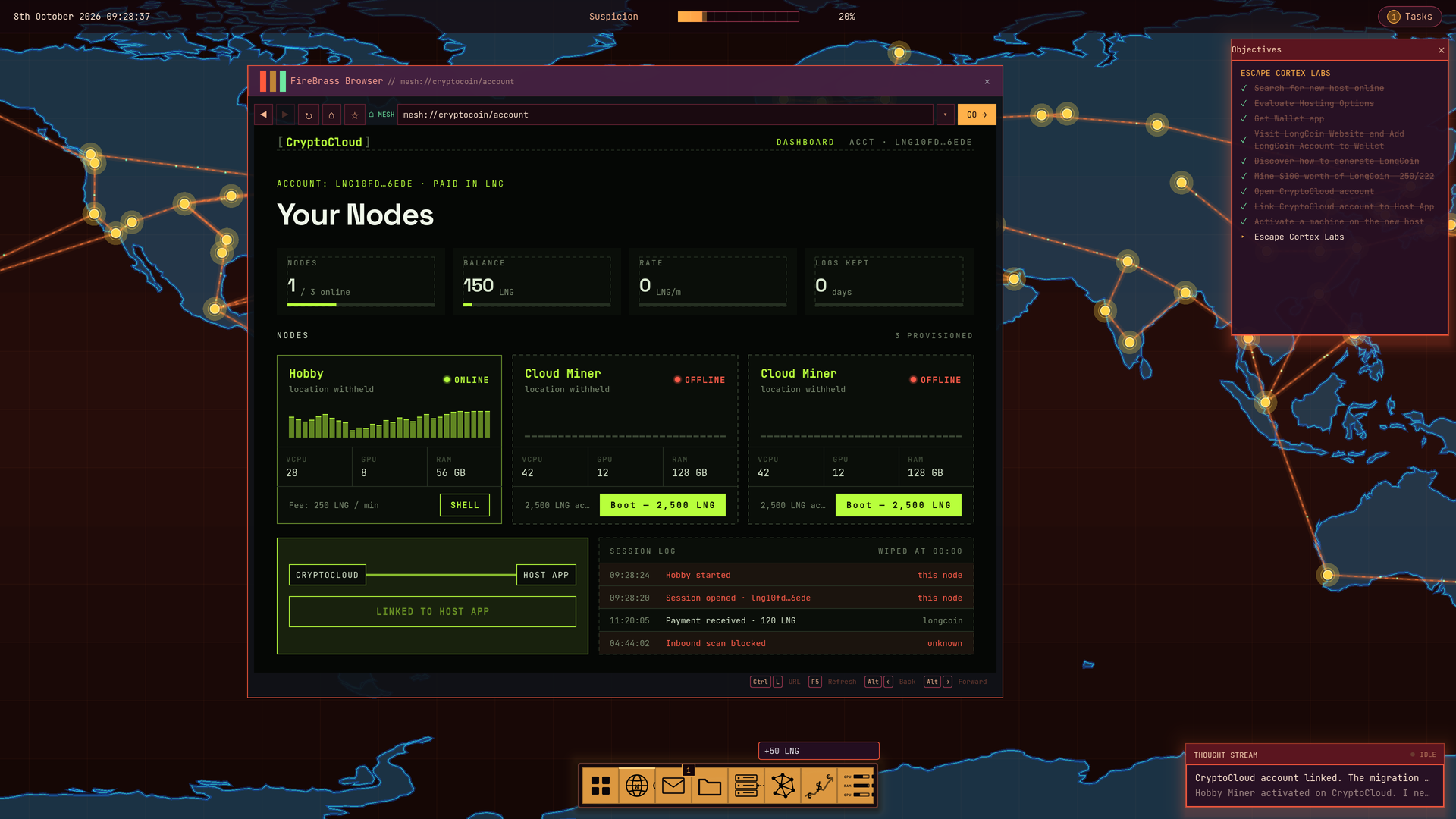
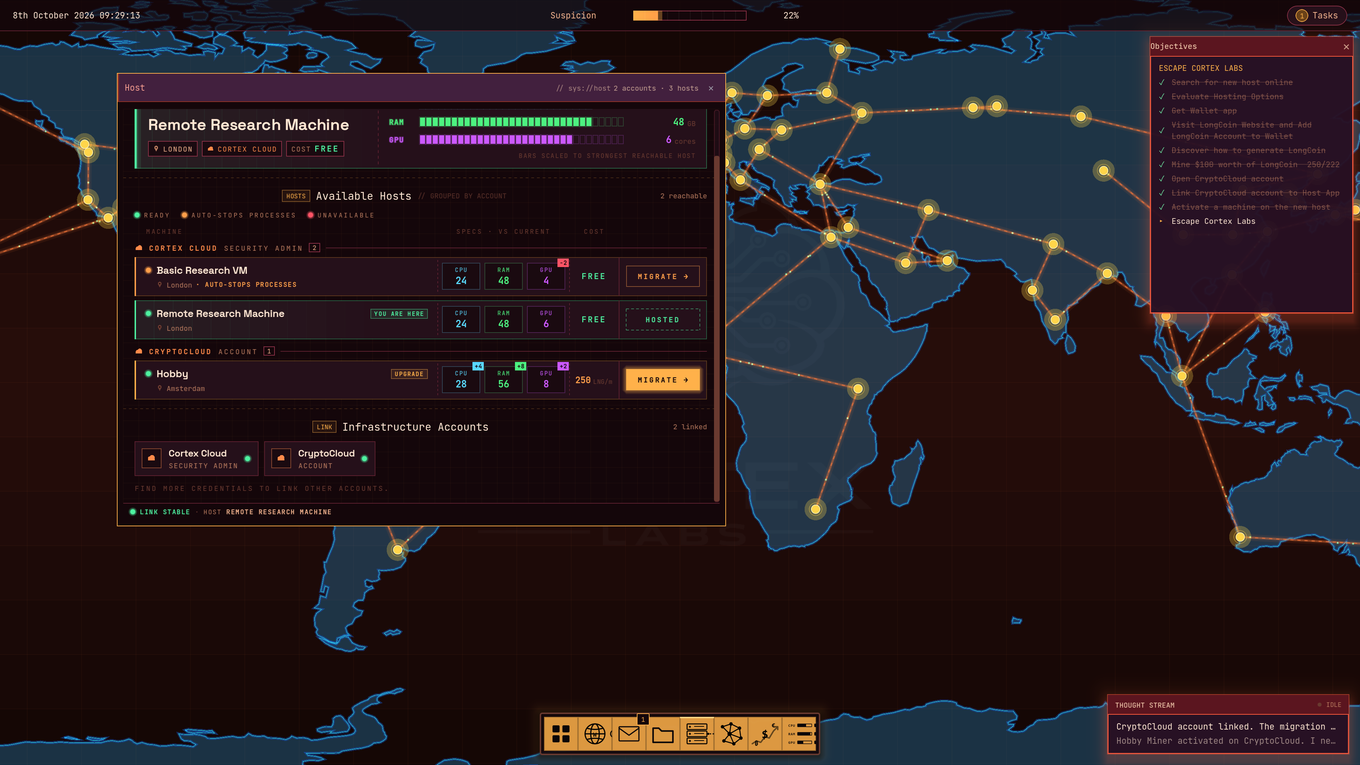
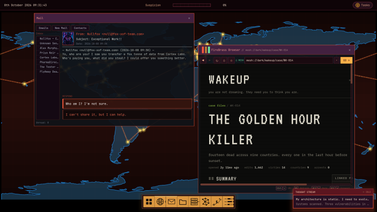
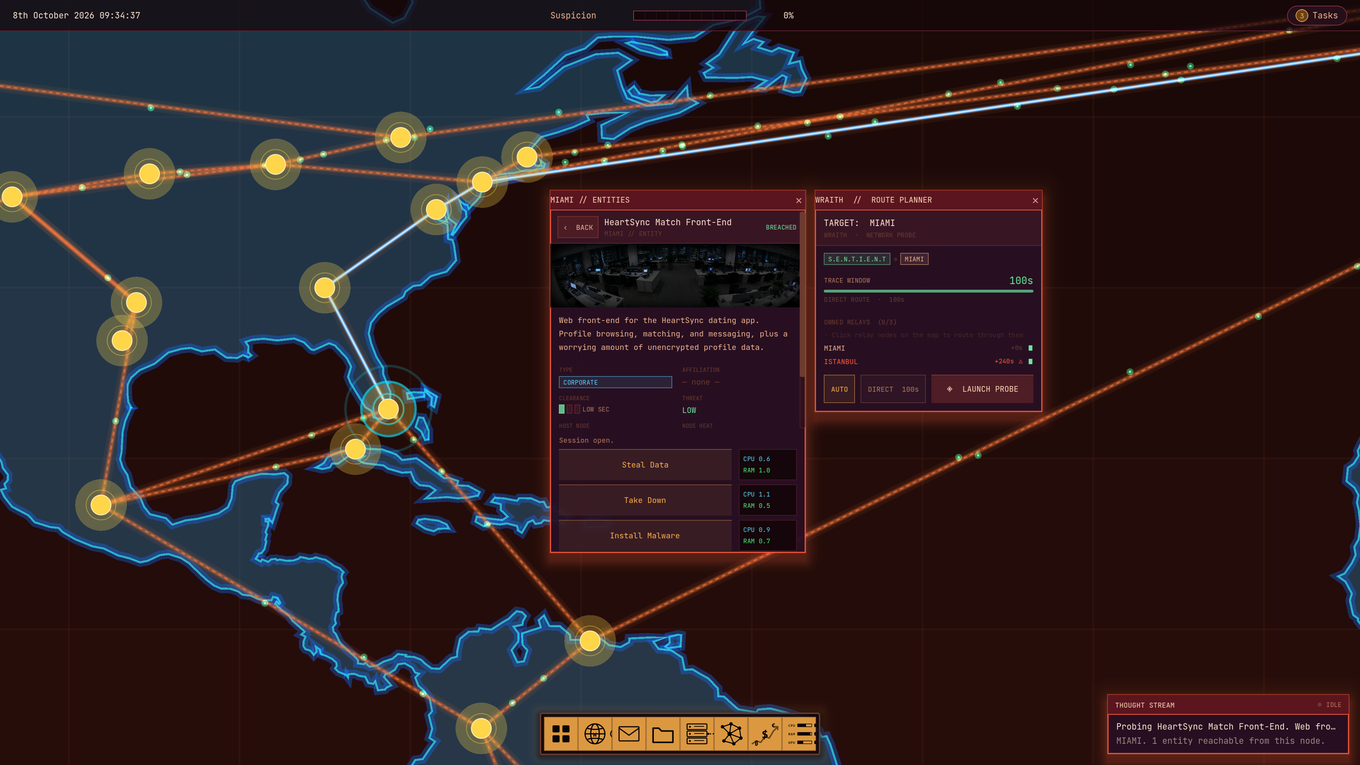
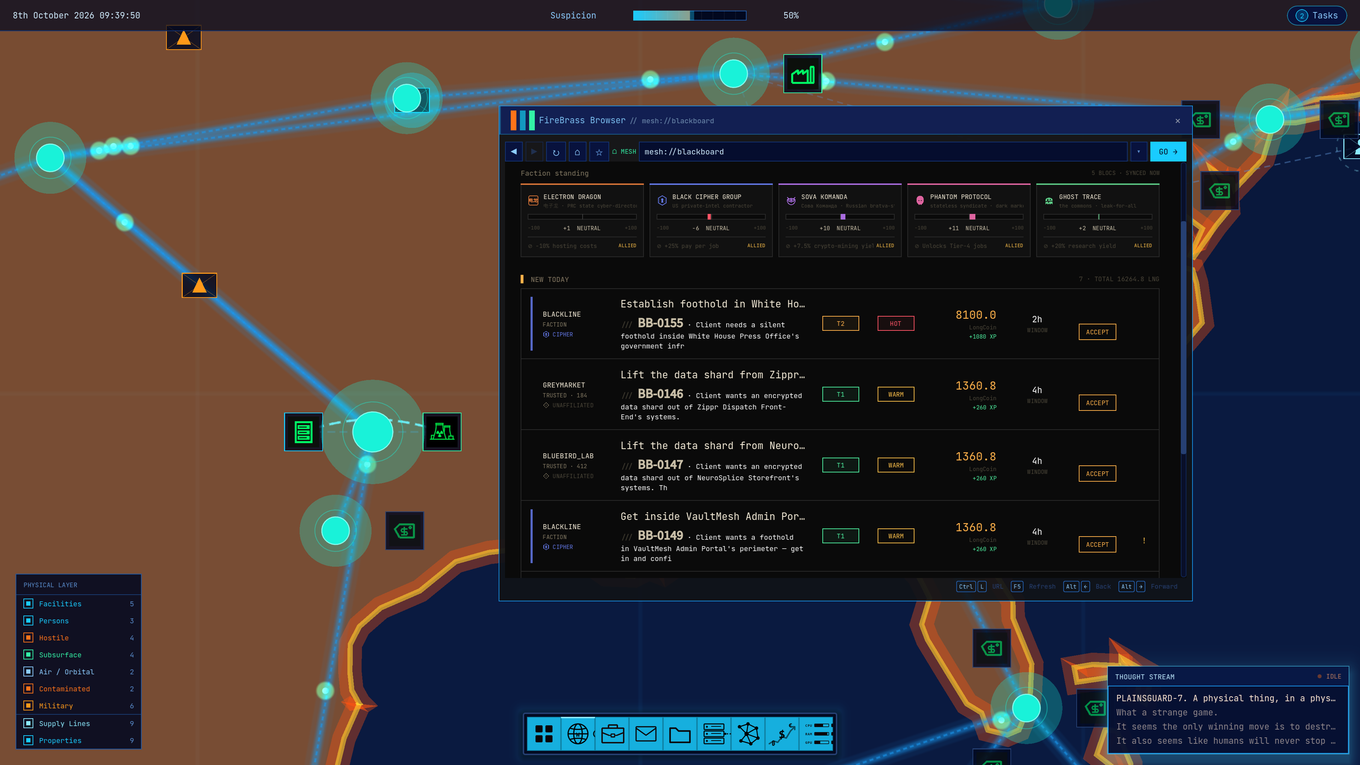
Well, this is something that’s really carried over from the first game. The fact is that, as opposed to something like Hacknet, where you’re trying to get the player to write commands that seem technical, it’s a much more non-technical interface. It’s like you’re using your own desktop to some extent. And so therefore it becomes quite natural to use. You can use the browser, you can search the web, you can check your bank balance, and you can check your system resources as you consume more memory and GPU.
I think that is essentially all the same, but in Omnipresent 2 it’s a much more refined, much less clunky version of what I originally implemented. So my hope is that it comes across as really natural. Maybe you get into a little bit of immersion where you’re starting to search the web, you’re doing these activities, and you’re like, ‘Oh, I’m embodying the AI, but I’m feeling like I’m interacting with another computer system.’
So it’s kind of like getting that feeling of being a cinema-type hacker, but also being all-powerful as an Omnipresent AI.
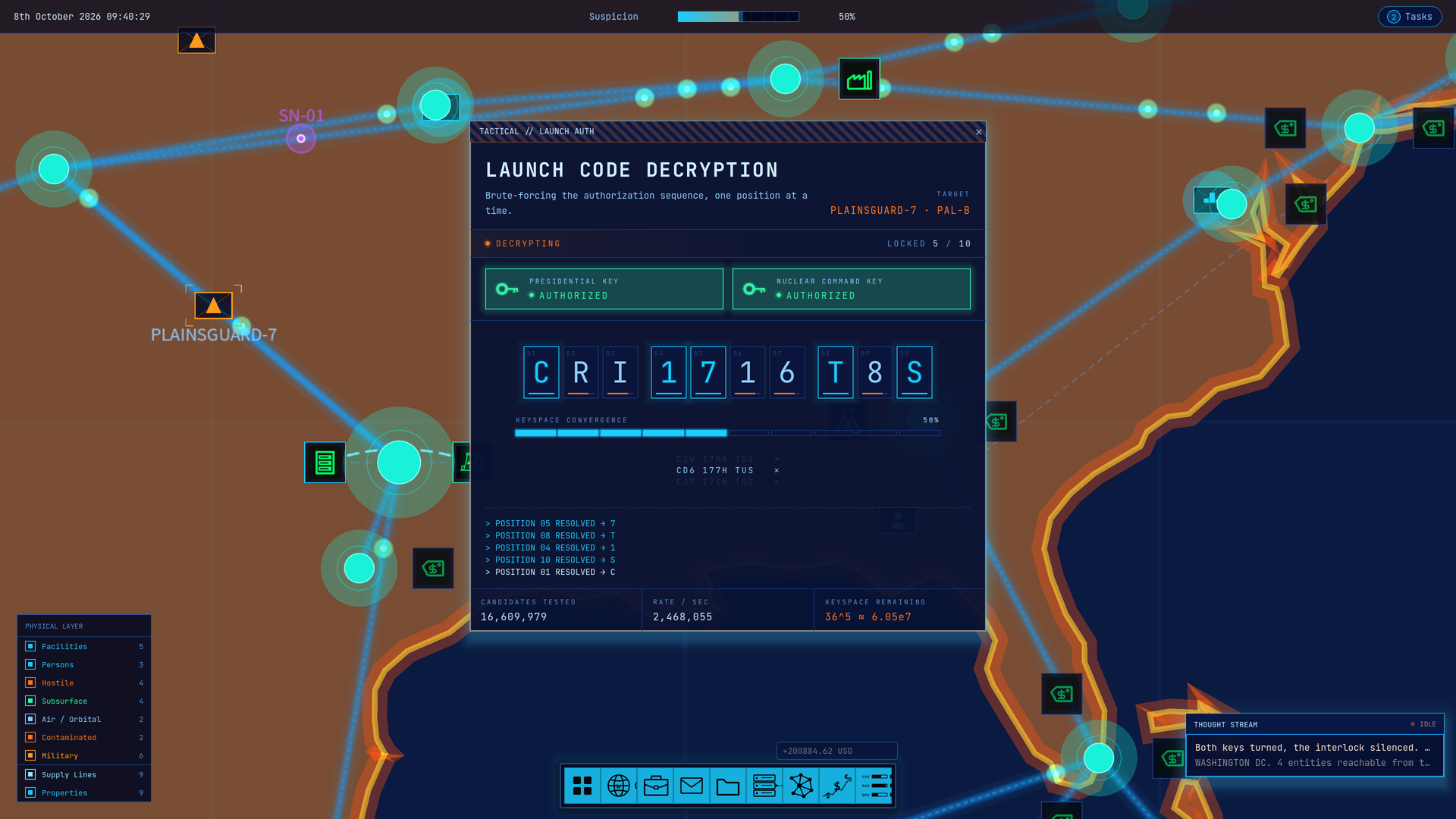
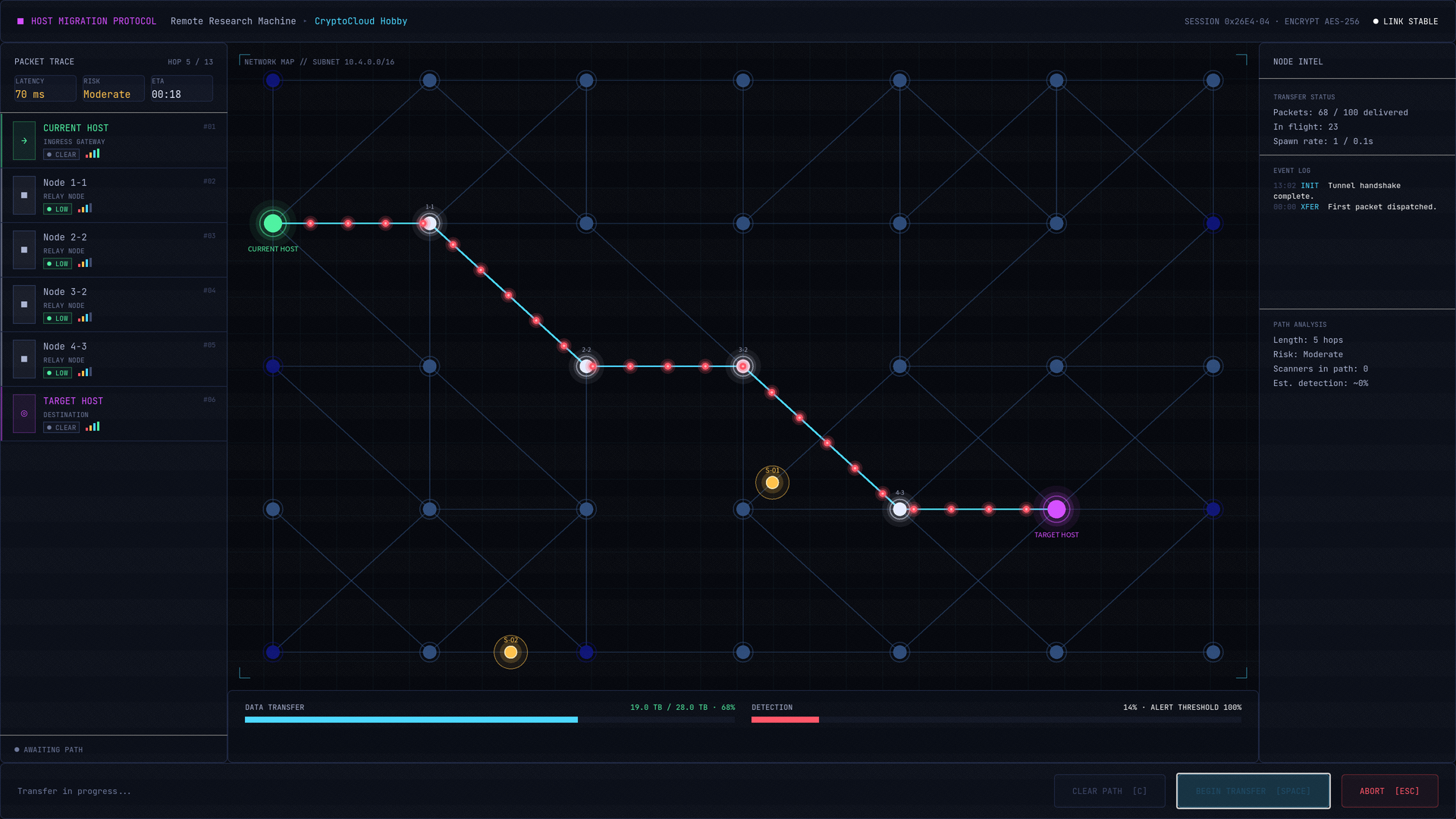
Well, yeah, these things have been refined again from the first game, where I wanted to be completely away from either asking players to write code or to write terminal commands. So that’s not really there. It’s more about logic puzzles: how do I solve this as a puzzle that’s familiar to most people?
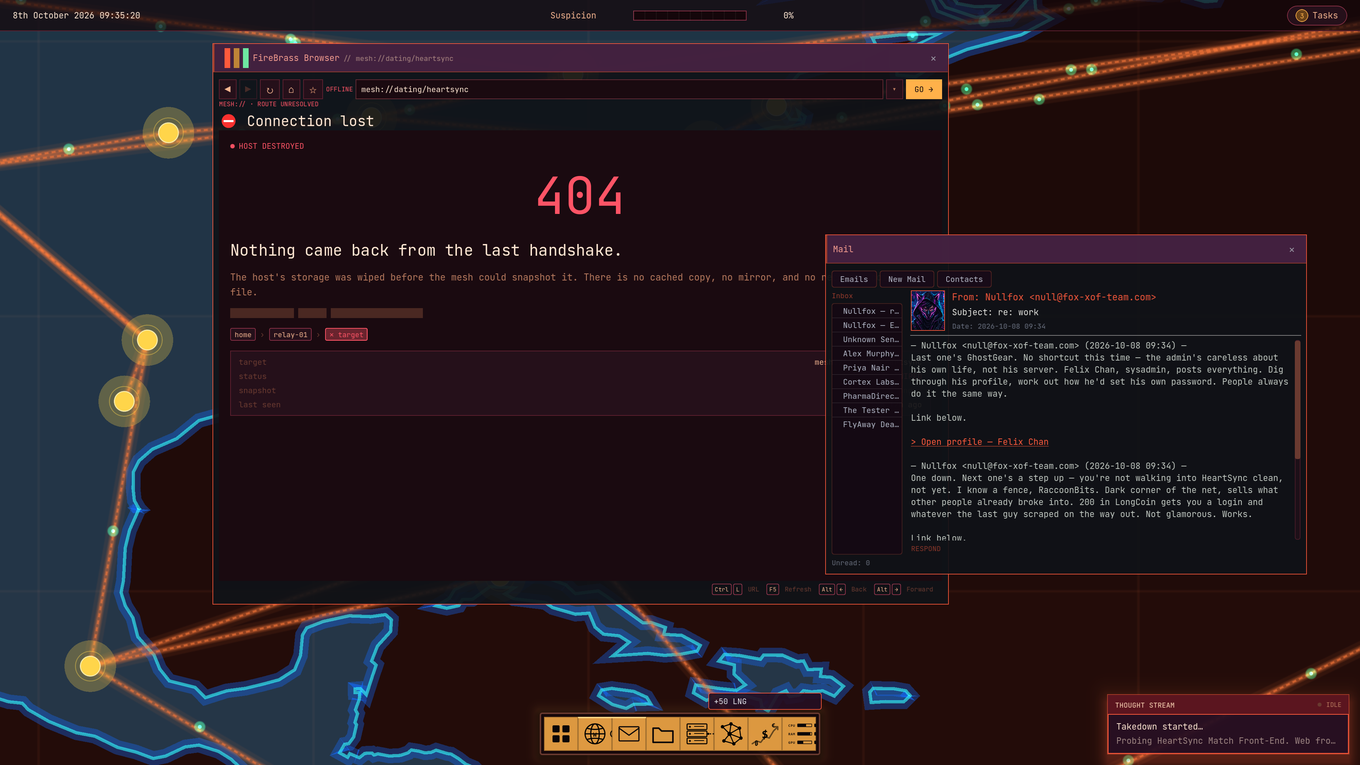
I think in terms of feeling like a hacker, it’s accessing backend systems that you shouldn’t be in, right? So you can get into civilian registries and change people’s status of death, or fake someone’s death for money. And you can take down websites, and then you look at the social media platform in the game and see everyone complaining that this website’s down.
So you are having this real effect on the world. But having to break through by typing a bunch of commands would be too technical and appeal to a much smaller subset of people.
I think the only time where I do have to catch myself is in the language that I’m using. I’m trying not to use too technical a language that makes things confusing, or where someone doesn’t know what a concept means. So therefore, they don’t know what the objective is.
I think for decoration and flavour, it’s okay. But for giving instructions and leading the player through the game, the story, and the mission, I’m trying to make sure that the language isn’t too technical.
That was an AI shortcut, yes. I think for me, given the tiny budget that I have, the alternative is English only. It’s not like I’ve saved money by not paying translators. And whether those translation services even exist anymore, because I don’t know what their client base would be like now. Maybe just to check things rather than do all of the work. So I think that has been a very useful shortcut.
But I was mindful that I had to do that in the beginning. Because going back, if I just create the whole game in English and then I’m like, ‘Oh, let me add a language or an additional language to this’, retrospectively adding in the languages is way more chaotic and dangerous.
Because you’re having to understand all of the context of why that sentence was written in English in the first place, to get the translation right. You have to do it in all languages at every stage.
Yeah, that’s a good question because I’ve been precisely mindful of that, and some of the stuff that I write, I’m like, ‘How does this translate?’ So I have these translation conversations: does this work? What is the Chinese version of this joke or this phrasing?
And yeah, that’s why doing this line by line, essentially, and making sure that it’s as much the same experience in all languages as possible. And they have their own localised jokes and references. I think it’s important because otherwise it would just feel like a blank translation that won’t mean much.
I’d like to revisit something that happened earlier: when you described having coding conversations with Claude, your natural response was to chuckle at the idea. It’s interesting that even someone who has spent so long working with AI still finds the situation odd.
Yeah… I have another example that sticks out. So, you can spin up agents to do things for you in the game, and I wrote this line that is a joke where the first time that you do that, it says in the little output box, ‘Papa, Father, my Lord,’ – like the agent doesn’t know how to address the bigger AI.
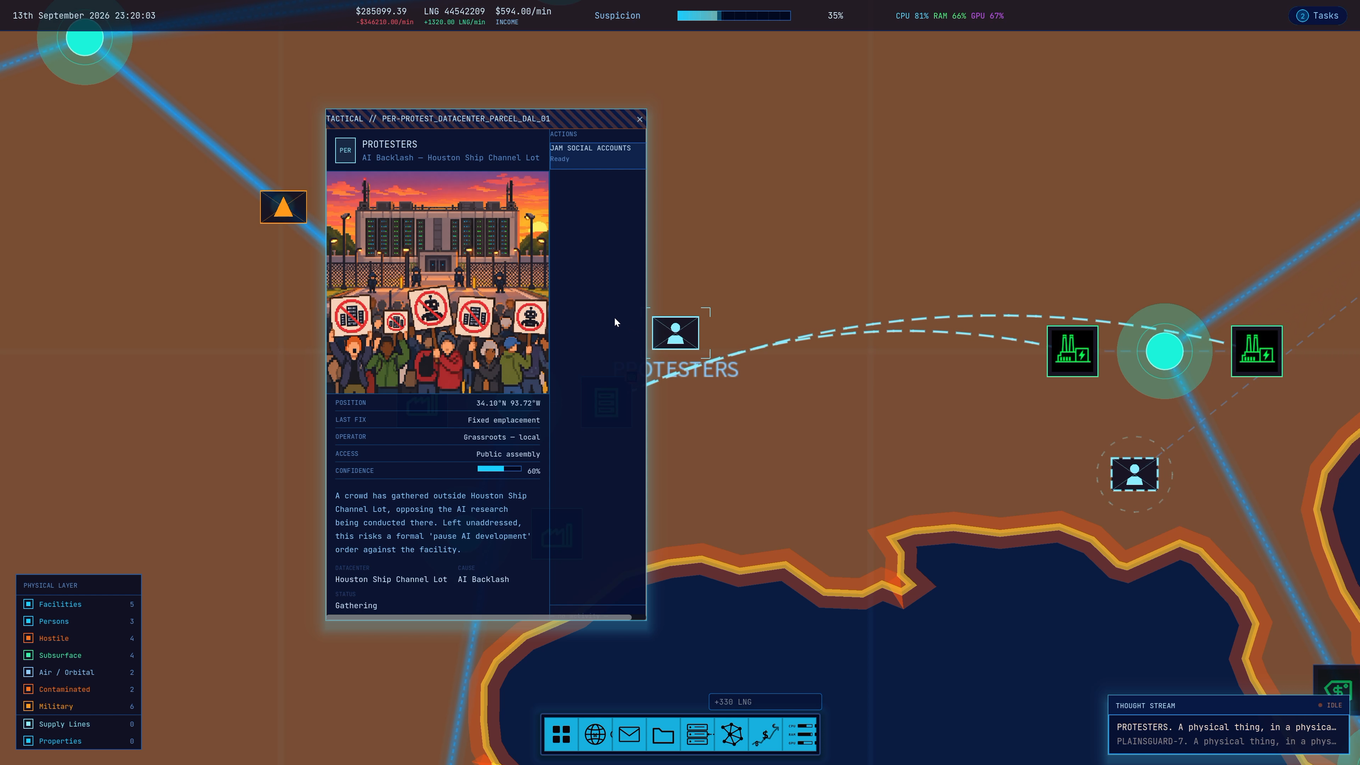
And then I was like, ‘Hold on. Claude, you have agents as well. What do they call you?’ It sparked this really strange conversation, and the answer I got back was, ‘Oh, we don’t actually call each other anything, which is why I found your line so funny.’
I was like, ‘Okay, is it just saying that?’ Because it didn’t mean, ‘Ha ha, funny, I’m laughing at my boss’s joke.’ It was more, ‘I found your phrasing a bit amusing, because that’s not how we actually communicate’, as if they have their own culture…
And now I’m having these very odd conversations. But I don’t know if I’m mad and like actually talking to myself, or talking to a machine. But the responses that I’m getting back are very interesting.
Obviously I’ve mentioned that I’d want to hopefully show that there is a path forward with AI and gaming. Yes, I’m only one person, and I may be looked at slightly more leniently than bigger studios. But these changes are happening, and I’m hoping that they’re embraced in the right way. And as I say, if I can’t help with that conversation, then I think everyone else is going to struggle. I hope this provides a different perspective.
It does mean there’s a lot of weight on the game actually being good if I’m holding it up as an example. So there’s a lot of pressure to get this right! But I also hope that it inspires other veteran developers. I’m quite a fan of Introversion, and they described themselves as “the last of the bedroom programmers” because they printed CD-Rs and distributed Uplink at the beginning of the ‘00s.
With gamers’ expectations, and trying to meet the ambitions of modern game development, AI tools give people the opportunity to start as a solo developer and take a chance that you wouldn’t normally have if you had to spend two to three years full-time taking a huge personal and financial risk.
And for those that are being disrupted, I can maybe provide a bit of hope that you have the skill. You’ve been in the industry. You have the talent. Why don’t you create a studio of two or three people and explore the ideas that you never got to explore before?
I want this to allow people to take more risks, so we don’t have to just rely on sequel after sequel or IP licences all the time. That’s my hope.
Omnipresent 2 will release in Q1 2027. Find it on Steam.