
It’s late. The dense fog obscures your vision so you can’t even see the prow of your small, ramshackle boat as it ploughs through the murky water. And yet you must fish. As you cast off, bait limp in the water as if suspended in treacle, you notice movement out of the corner of your eye. A fish, perhaps, or something more sinister? You wait for the elusive nibble, and wait some more. At some point—has it been minutes or hours?—you call it a day. You need sanctuary, sleep. That’s when the tentacle grabs you, rising from the mire with unexpected speed to pull you into the depths. Was it worth it, you wonder, staying out for one more catch? Was it worth this horrifying end?
Dreadmoor is a horror fishing simulator in which you upgrade your boat, escape Chthonic horrors, learn the truth about your past, and, yes, get grabbed by giant, pustulous tentacles. No, I didn’t misspell Dredge, although Black Salt Games’ hit is a clear inspirator. Dreadmoor swaps Dredge’s dark impressionism for a more generic Unreal Engine look, hoping its first-person perspective and survival crafting will be enough to reel you in.
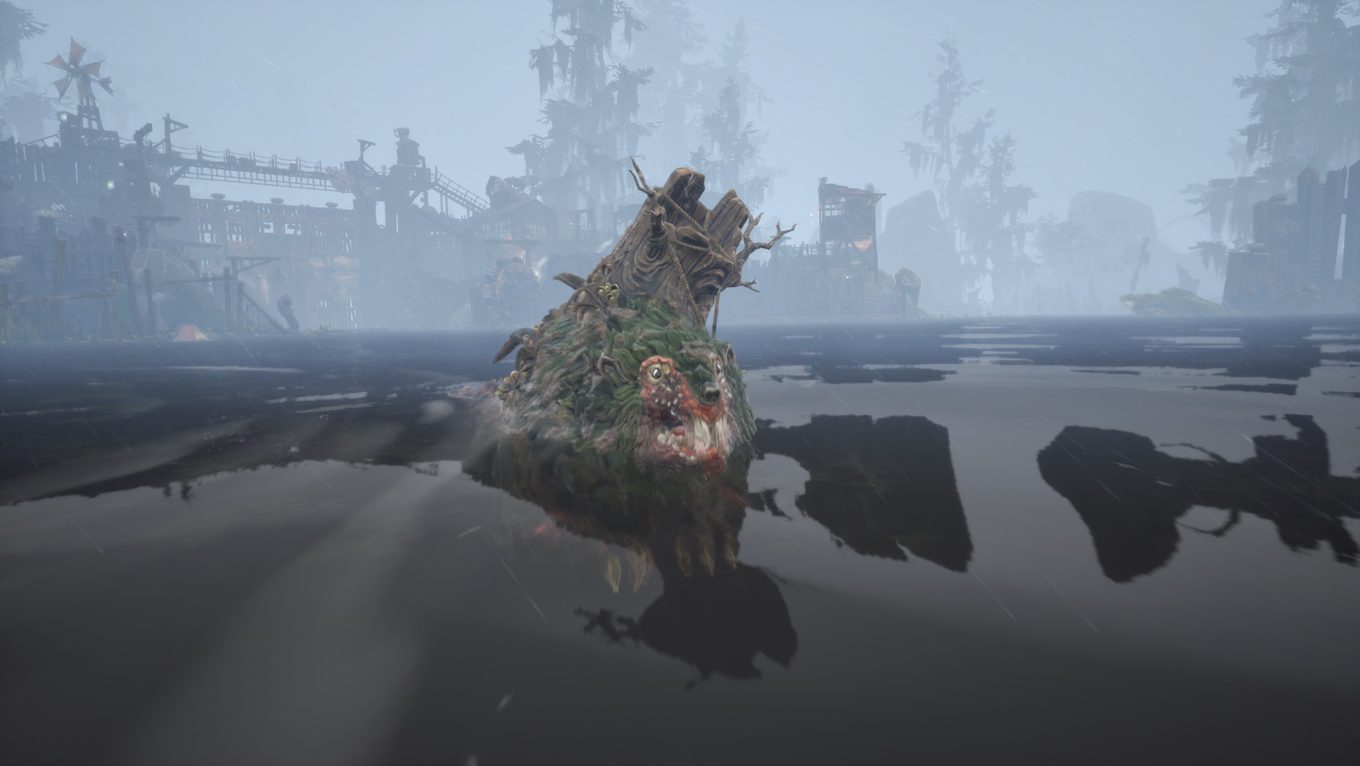
Adding new ideas to an existing premise has resulted in some great games in the past (Valheim, Nioh, Pizza Tower, Vermintide, and Saints Row all spring to mind), so there’s no reason to look down on Dreadmoor for leaning heavily on Dredge’s success in its themes, gameplay, and marketing. However, you can look down on it for cobbling together an incoherent gameplay loop from the mechanics of a disparate bunch of other games.
One thing Dredge had going for it was atmosphere, atmosphere in spades. In stark contrast, the only feeling of unease that Dreadmoor ever conjures up is when you’re sent on yet another fetch quest. Even chugging along at night, when the waters are supposed to be most dangerous and you can be accosted by enormous tentacles or anglerfishmen, your modes of escape are so plentiful that the suspenseful music and low visibility do little to quake your bones.
Dredge wasn’t particularly dangerous either. However, where it manages to strike fear through its abyssal apparitions, Dreadmoor’s monsters are cartoonish and uninspired. Neither does Dreadmoor force you to battle through the nights; you can simply wait out the clock, staying awake for weeks on end with no issue. Fishing is largely avoidable at night, as there is plenty to busy yourself with in the Dry Dock, upgrading your boat or rods or axe. Games need to force you to interact with their systems, else players will do anything else in order to take the waterway of least resistance. That waterway here is tinkering with your boat all night and setting sail every morning, free from any terrifying creatures that might otherwise haunt your journey.
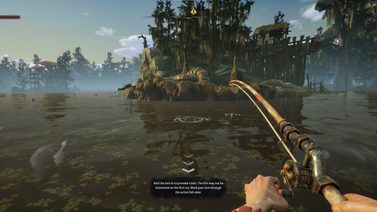
While neither of these games explicitly feature Lovecraft’s infamous unknowable entity, the inspiration is clear. Instead of offering a horrifying reinterpretation, however, Dreadmoor opts instead to ask the question: what if Cthulhu was entirely toothless? What if its edges, usually as sharp as razor clams, were sanded down until they were as smooth as a hatchling’s bottom? What if it was made of blancmange instead of tentacles that threaten to tear you limb from limb scales that will slice you open as it does so?
This wouldn’t be a problem if Dreadmoor was trying to be a cosy game with a Chthonic flavour. But it’s trying to be scary. It’s trying to invoke fear and make you squirm. But the only involuntary movement it elicits is a roll of the eyes when you receive the next in a long line of fetch quests.
I’ve mentioned the fetch quests twice now, so I should really dedicate some time to exploring them properly. A lot of games use fetch quests as vehicles to force you to explore the world, find new items, or try new mechanics. Used sparingly, they’re a perfectly acceptable if slightly monotonous part of RPGs. But Dreadmoor isn’t an RPG. It’s a fishing simulator with a survival-based story.
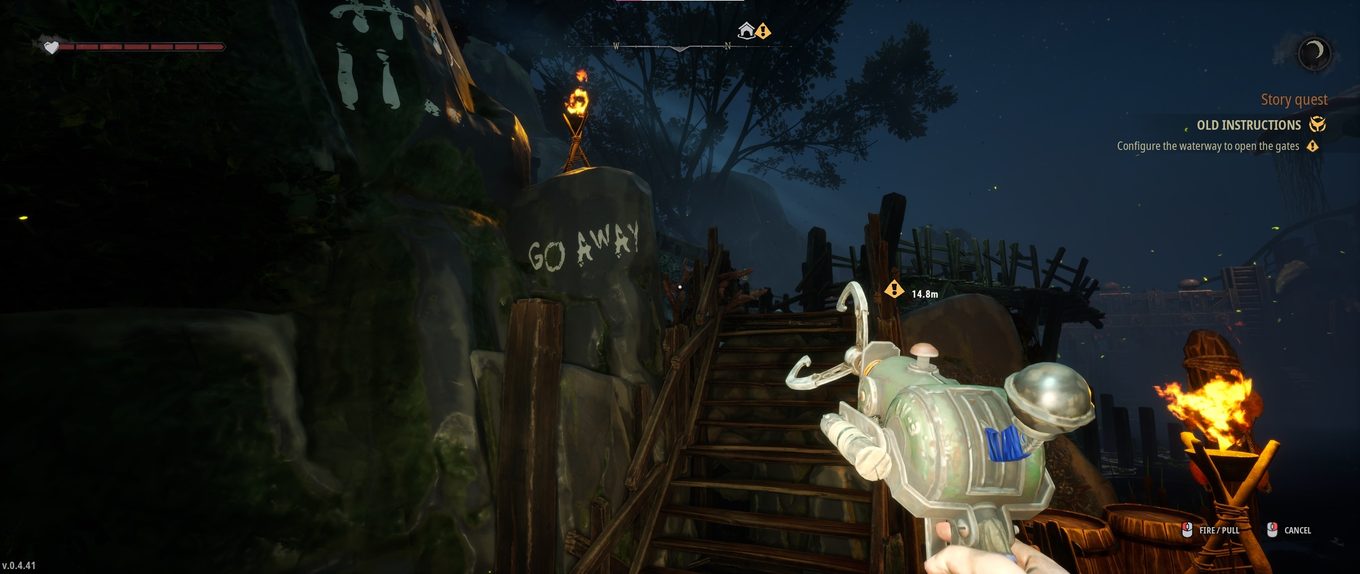
Every quest in the first few hours of Dreadmoor is some variant of a fetch quest. After that, it settles down to a healthy cadence of mostly fetch quests, but the sparing variety is most welcome. Let me give you an example:
In the first area of the game, you’re sent to fix three tuning forks, a mission which involves fetching and/or fixing the tuning forks across the swampland in which you reside. However, in order to persuade one clergyman to let you fetch his tuning fork, he sends you to fetch some fish. Once you get to the specific fishing spot, you realise you need specific bait. Fetch your ingredients, craft the bait, return to the fishing spot, give the man his fish, fetch the tuning fork, install it, mission complete.

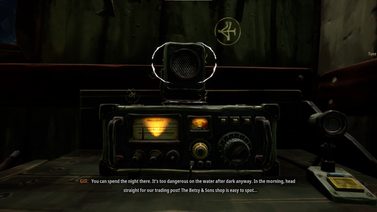
Dreadmoor has one idea, so shoves fetch quests into fetch quests to the extent that the survival mechanics feel like an extension of the same thing. Because you’re never threatened, you’re never close to running out of fuel or medical supplies or repair kits or crafting materials, the survival elements of the game feel like busywork rather than a rewarding fight to push on against the elements. This is a game that promised friction and delivered a freshly-polished hull.
The narrative is also frustratingly linear. There is no way to deviate from the intended path thanks to random blockages that open up when you start a specific mission. Even on missions, you walk past a bucket that you can already tell will need to be moved to the other side of the river, but you can’t interact with it until you’ve reached the specific part of the mission that requires it. It’s dated design that feels fundamentally unrewarding, only serving to bloat the simple missions and make them even more tedious.

There are a few positive takeaways from Dreadmoor. The fishing minigame itself is fun, if nothing different to that in any fishing simulator. I’d go as far as to say I quite enjoy relaxing with my reels, taking in the disgusting vista and hauling in abominable water creatures. But Dreadmoor tries to do too much and, in doing so, leaves too little time for actually fishing.
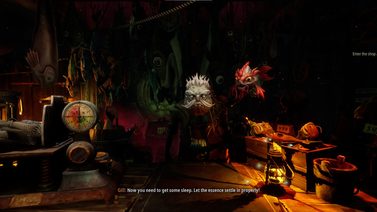
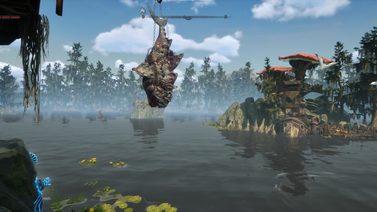
There are a handful of cool designs, especially the merchant’s shop, which has four biomechanical legs. It reminds me of a nautical Defiler from Warhammer 40k (a fact not helped by the nearby engineer’s obsession with the ‘Machine God’). However, dialogue is poorly written and acted throughout, audio logs are regularly interrupted by the protagonist laying down a quip or unnecessary hint, only to cease playing thereafter. A lot of it feels like it would have fitted into the gaming zeitgeist a decade ago or more.
Dreadmoor borrows liberally from many of its contemporaries but fails to understand what made any of them great or mould them into a cohesive game. The PowerWash-esque cleaning is particularly pointless, but even the Dredge-style cargo hold is clunky and overcomplicated compared to its progenitor. It feels like the developers felt the need to change it so it wasn’t quite so Dredge, but in doing so ruined what made the original mechanic so satisfying.
I don’t like comparing games to other games, especially in reviews, but that feels impossible with Dreadmoor. It’s a game built on the shoulders of countless recent hits and, in trying to emulate them all at once, falls off those behemothic deltoids while failing to figure out exactly what it wants to do for itself. Comparison is the thief of joy, they say. I disagree. Dreadmoor might just take that crown.