Plenty of strategy games promise hardcore, brutal experiences that require the whole of your tactical mind. This is an easy posture to achieve. But making something that will last in your mind, is something altogether harder. Menace makes one such gambit, promising a brutal, hard sci-fi tactics game to stand in X-Com’s absence. Outside of some generic aesthetics, Menace feels quite well-realized, though it has just launched in Steam Early Access. The gaps for improvement are obvious, but Menace is a haunting and dreadful tactics game.
In overall premise, Menace borrows from some other sci-fi strategy classics. You are a military representative of the Core Worlds, sent to represent their interests in the Wayback. Think of Starcraft’s Koprulu Sector or Star Wars’ Outer Rim. As you might expect, you will murder hordes of insect-like aliens as well as militias and pirates. Menace borrows its basic structure from the recent run of X-Com games. Each mission is a turn-based skirmish with various objectives, like eliminating alien forces, protecting citizens trapped in war zones, or retrieving assets from enemy bases. In between engagements, you pick out your next mission, upgrade your squads’ loadouts, and liaise between different factions. That push and pull between the immediate needs of a mission and the overall objectives of your campaign is a tried-and-true strategic tension, one which Menace puts to good use. Still, you can experience Menace’s fundamentals in any tactics game on the market. What Menace promises, and mostly delivers, is something altogether meaner.
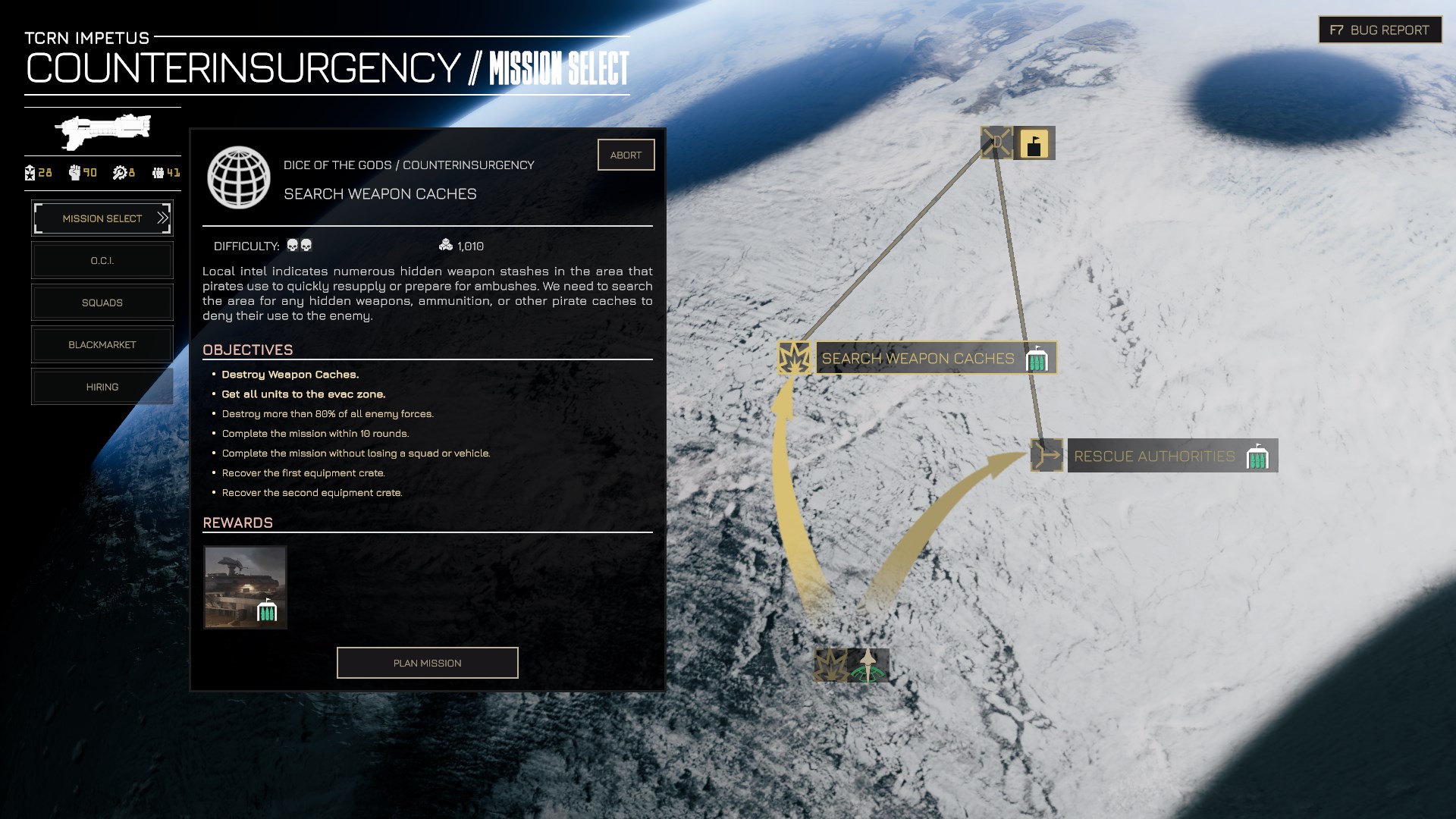
The name, and Menace’s old-school opening cutscene, imply a hard, grimy sci-fi, where faces stay hidden behind shrapnel-blasted masks and laser fire shears off limbs. In motion, Menace feels more generic. Its squad commanders are cartoon characters, its maps are monocolor outposts and villages, and its units are marines in gray and green combat fatigues. You take such a distant view of the battles that it can be hard to feel caught up in the firefights. It lacks the stark shadows and blistering heat of its marketing. If you’re drawn to Menace’s harsh sci-fi aesthetic, you might want to wait until it achieves a fuller fruition.
However, what Menace struggles to capture aesthetically, it more than captures mechanically. Through innumerable small potential losses, Menace crafts a tactical world that is equally thrilling and threatening. Even at the start, you have too few resources. You enter the Wayback with a flagship so damaged that it only has a functioning, but damaged, med bay. You choose four starting squads and have to recruit many more out in the field. You are shipped out with only standard equipment and must buy everything else from the black market. You get a tangible sense that this mission is just a rounding error in the core worlds’ spreadsheets. They don’t particularly care if you succeed. They are certainly not doing what they could to prevent your failure.
That sensation, of being a supreme military force with limited resources and in hostile territory, is key to Menace’s thrill. The game is full of tiny, thematic twists that spiral small mistakes into total catastrophes. For example, there is no turn order. You can start any of your units’ turns at any time. However, once you move or fire, you are stuck with that unit until you spend all their action points or you manually end their turn. Then, enemies will have a chance to act. Turn order becomes a small tactical choice, which can prevent or ensure disaster. These small touches enforce a dread that can suffuse every decision you make.
Rather than the clean, single-digit action points of X-Com, squad leaders have a pool of dozens or hundreds of action points. This allows Menace to get granular in its decision-making. For example, your units will automatically take cover if you approach a hill or building. However, you can make your unit hunker down to ensure additional protection. If you want to move that unit, you’ll have to spend 20 action points to stand them again. Hunkering comes with additional benefits though. Some weapons, like mortars or sniper rifles, can only be used when hunkering down. Setting up a sniper or grenade unit in the right position and watching them tear through enemies is delectable. However, the lack of mobility can spell doom for a badly positioned squad.
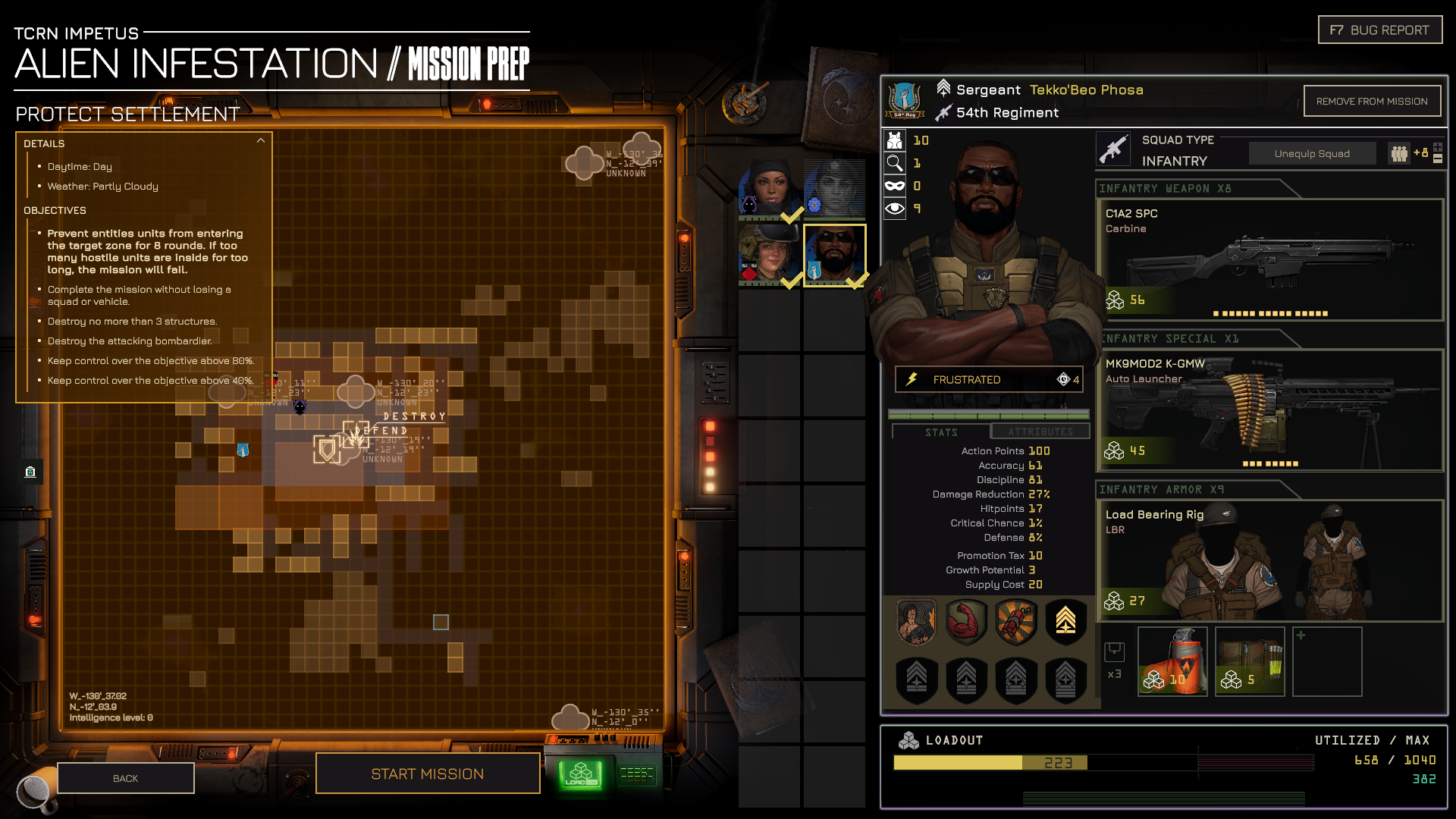
Menace grants its grim arithmetic a human touch. Think of Starcraft’s infinite anonymous marines, which pop out of bases when you spend minerals and gas. Until you’ve mined the entirety of the map, you can continue to find anonymous soldiers to ship to the slaughter. In contrast, each and every one of Menace’s named soldiers is a recruit. Early in my run, I built an outpost to try and hasten our enlistment efforts, knowing that more soldiers would die than I could supply from the current store. It would be easy to forgo the human cost, but Menace knows to sharpen every knife in its tonal arsenal.
The human touch does not end there; your squad leaders have a psychology you have to manage. If a squad barely survives a battle, they might become bitter and frustrated. If they get a multitude of kills and dodge almost every shot that comes their way, they emerge triumphant and excited. This has a double effect. For one, it gives your minions a human touch. For another, it makes your effects cascade across each other. Even if you manage to spare your most powerful squad leader from a gruesome fate, they may be scarred from the encounter.
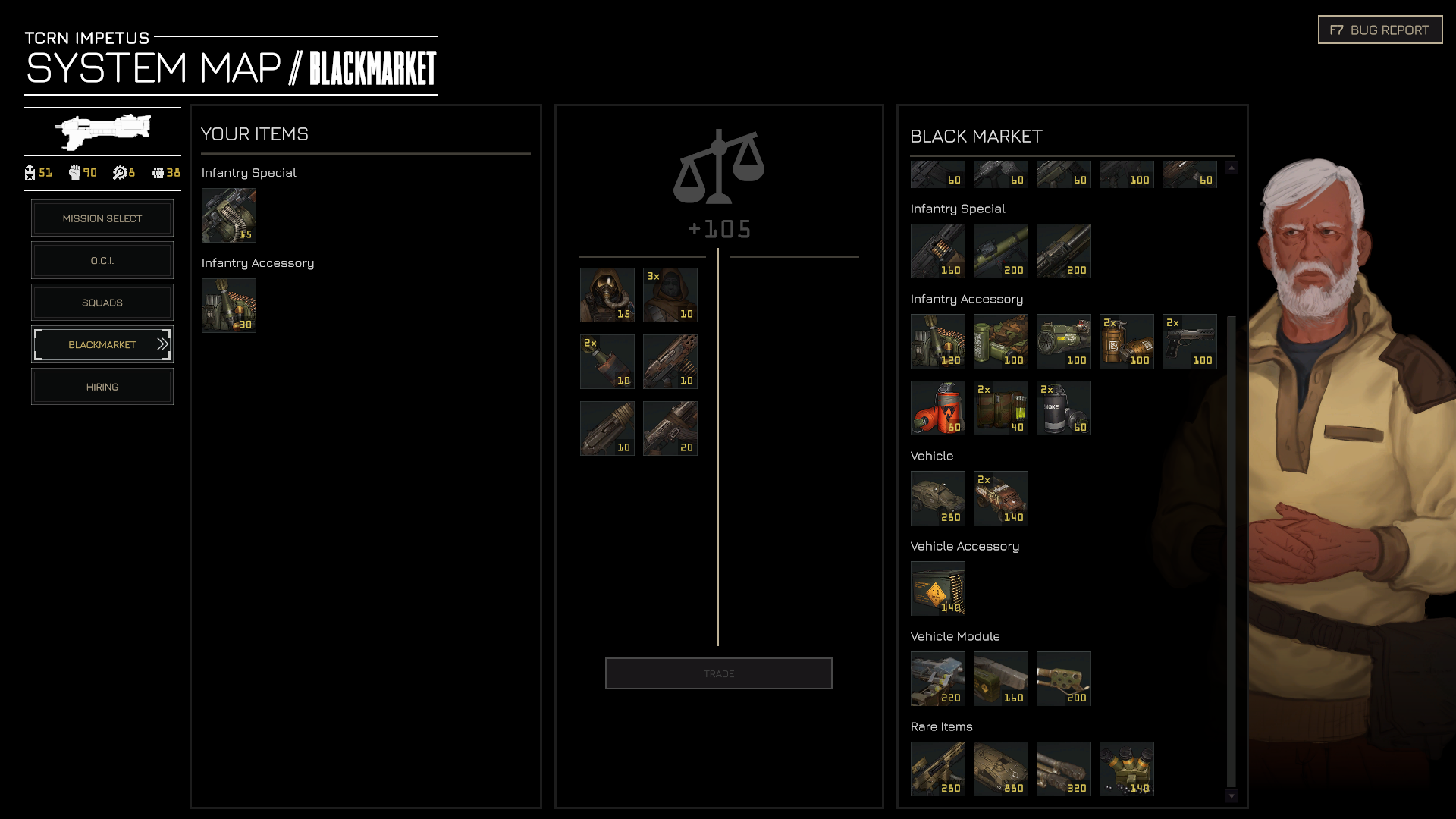
In addition to managing their human flaws, you’ll need to kit out your squads with new gear to best escalating threats. But Menace’s economy is sheer. A new set of rifles for a single squad can cost you all the booty you picked up from last mission. You can stockpile goods for big purchases, but that will leave your troops worse off right now. Early on, I realized I had no means of repairing my lone troop transport, which had become seriously damaged in a few skirmishes. I needed its firepower, but sending it out risked its destruction and the loss of my only vehicle. I equipped it with a new grenade launcher, thinking I could keep it out of range of enemy attacks. This proved effective, until it did not. My own troop transport stood in a smoldering heap. I could not afford a new one. All these small decisions move together to induce a delicious fear. Menace has tactics with real stakes, but that doesn’t mean there aren’t places for improvement.
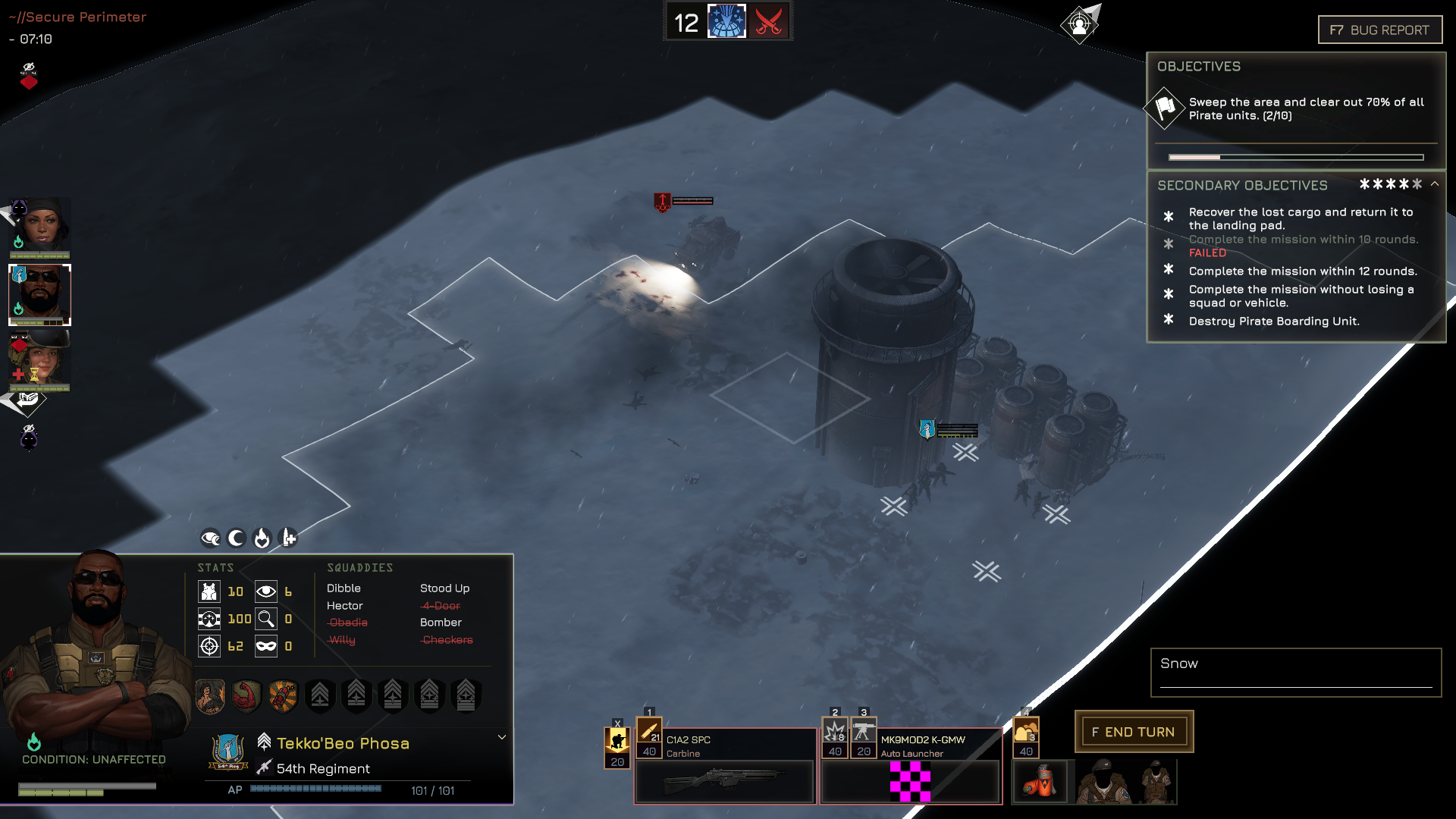
Menace’s maps are quite large. Points of interest are far apart from each other. I immediately wished I had started with two vehicles and two squads, rather than three squads and one vehicle. Admittedly, this is a part of the game’s design. You’ll start every mission almost totally in the dark, with only a vague sense of enemy positions. Once, I spent 5 whole turns without firing a shot. One of my squad leaders asked if our intel was any good. The very next turn, two enemy troops flanked that very same squad leader. Still, you will spend plenty of turns in Menace moving just a few squares forward. At best, it builds tension. At worst, it feels like it is stretching out time for no real end.

The game’s war of attrition also means that death is slow. Admittedly, the effect is dread-inducing. The sensation of going into a mission, knowing you are underprepared and clenching your teeth before what you might encounter has its own kind of pleasure. But as mistakes cascade, it’s easy to feel like you have locked yourself out of success with a few bad plays.
Additionally, Menace leans on hiding a lot of information from the player. You don’t know the exact positions of enemies or in which order they’ll move, or what exactly they’ll do on any given turn. Each map is randomized, so you can’t predict enemy locations from prior knowledge. There are ways to control these variables. The aliens, for example, tend to attack whoever has fired on them last. Sending a vehicle out in the open can tank fire that would take out a few of your squadmates. Nevertheless, you will lose troops because of things you could not have predicted. That unpredictability is one of the Menace’s core strengths, but that does not mean it won’t cause frustration.
Nevertheless, even when you are making stupid, dreadful mistakes, Menace has drama. Even in this early form, it is the kind of tactics game that will sit in your mind after you’ve turned it off, that you can tell stories about. There is good reason to believe that Menace will become a better game after Early Access. Yet, I hope it does not squander its already well-honed edge, or trade it for something slicker.