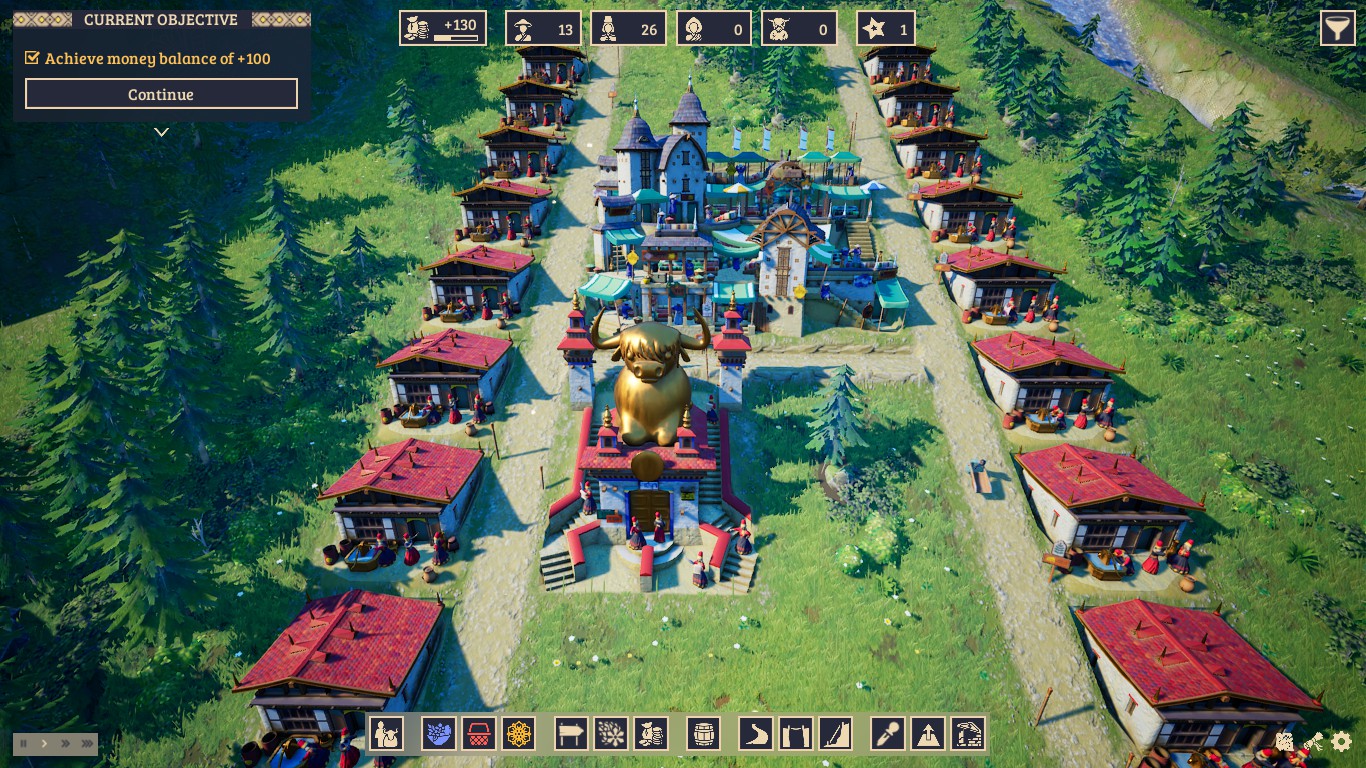

Treading softly is only natural when you’re worried about triggering an avalanche, so it’s fitting that one of Laysara: Summit Kingdom’s cleverest touches is also one of its lightest. Part resource-chain optimisation, part spatial puzzle, success in Laysara comes down to how well you balance the books, and how deftly you can manage your sprawling Himalayan-inspired settlement’s growth on cramped mountain plateaus.
The twist here is that you’re limited to a stockpile of just a few thousand in cash reserves at any time. Run out of reserves while in negative balance, and you’ll fail. It makes for a game where a measured, incremental approach to working towards more advanced mountain settlements is crucial. Plonk down a transport route without a sufficient army of yaks to haul cheese from one plateau to another, for example, and you’ll suddenly find your income plummeting as you’re forced to hire expensive ‘ad-hoc’ yaks. You can often get away with having a few of these, I assume, grizzled bovine mercenaries eating into your funds, but any serious deficit will soon throw your entire economy into chaos.
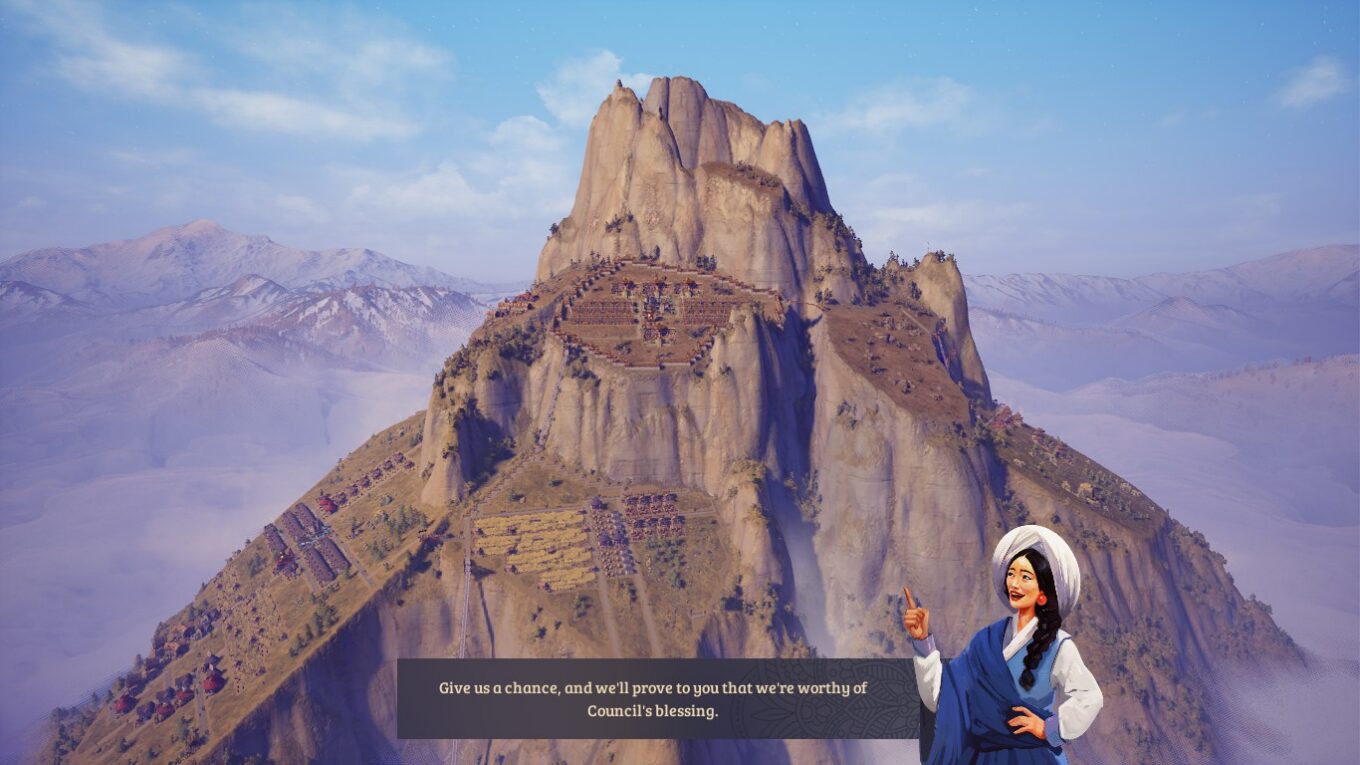
It made for times where, having just optimised myself out of the red with a near-depleted money stockpile, I’d hang back and watch the world go by while I replenished my treasury. It’s in these moments, seeing dozens of tireless citizens mill over bridges, or watching spilt-ink tributary rivers glint under auroric skies, or zooming in on Laysara’s gilded, ornate structures to watch yaks on seesaws pound mined minerals into crystal dust, where Laysara feels most in line with the relaxed beauty promised by its mountainous vistas and playful, tranquil score.
Pulled Apart By Yaks
The rest of the time? Well, it’s about equal parts satisfying triumph and massive headache. The thing about beautiful mountains, it turns out, is they’re also a huge pain in the arse to navigate. This isn’t to suggest Laysara’s UI is obtuse in any way. Save a few obvious omissions like the inability to quickly navigate between categories of buildings, any information you could want is in easy reach. But by the fifth or so time a surprise campaign objective forced me into a demolishing a section of my civilisation I’d pained to perfect, to make space for a more complex resource chain, that lovely score started feeling like the only thing keeping me from an aneurysm. More than anything, my time with Laysara was defined by this oddly compulsive balance between stress and serenity.
Everything starts here with providing housing and food for the three types of citizen Laysara calls ‘castes’. Lowlanders work yak farms, mill grain, fish, and presumably spend the rest of the time grumbling about the pretensions of the artisan caste. Artisans work tax booths and produce consumer goods, such as weaving yak wool into textiles. Monks research from their academies and maintain spiritual buildings such as shrines. Yaks themselves seem happily exempt from the caste system, acting as an ambient resource you don’t need to worry about keeping happy.
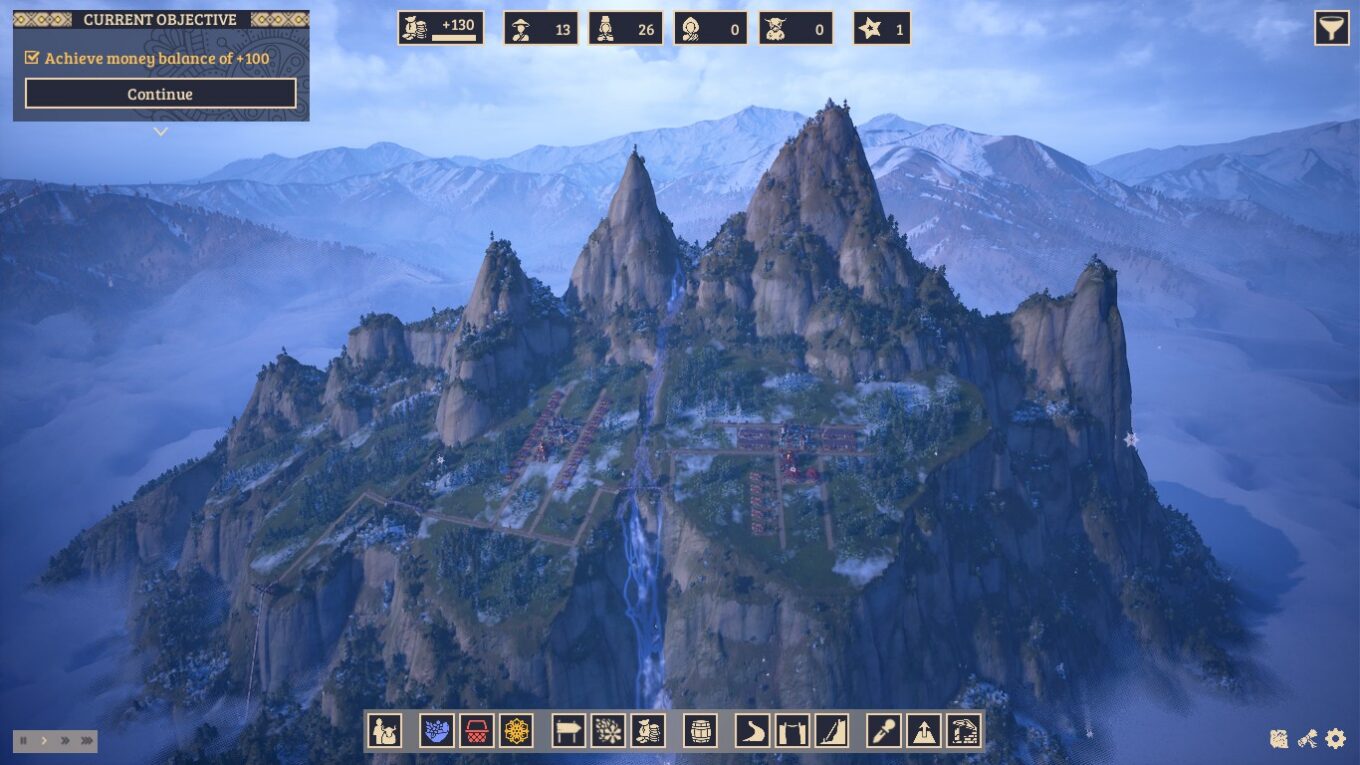
Everything is connected through road networks, with dirt roads costing you nothing but inefficiency, and more expensive paved roads allowing buildings like the food market to provide for a wider area of citizens. Your settlements stretch for miles across peaks and plateaus, and its always fascinating to delete a single road tile and see your entire economy plummet into chaos, as if your workers are standing and staring in horror at the small patch of grass interrupting their routes.
All-star Castes
As your settlements grow, you’ll need more workers, which means more houses. But the radius of your food markets can only stretch so far – even with those advanced roads – and space is always at a premium. So you’ll want to upgrade the houses you have. Similarly to the Anno series, each caste has their own set of needs they’ll want fulfilled before they let you add a second wing to their houses. They’ll get by on honey and eggs, but would really like some fish, somewhere to pray, and how about placing one of those fancy yak racing arenas in walking distance? Soon enough, Laysara falls into the comfortably familiar builder loop of preparation, expansion, and upkeep. Each new tier of research provides greater yields at the expense of more complex resource chains, as you work towards erecting mighty temples at the summits of the several mountains you’ll visit during the campaign.
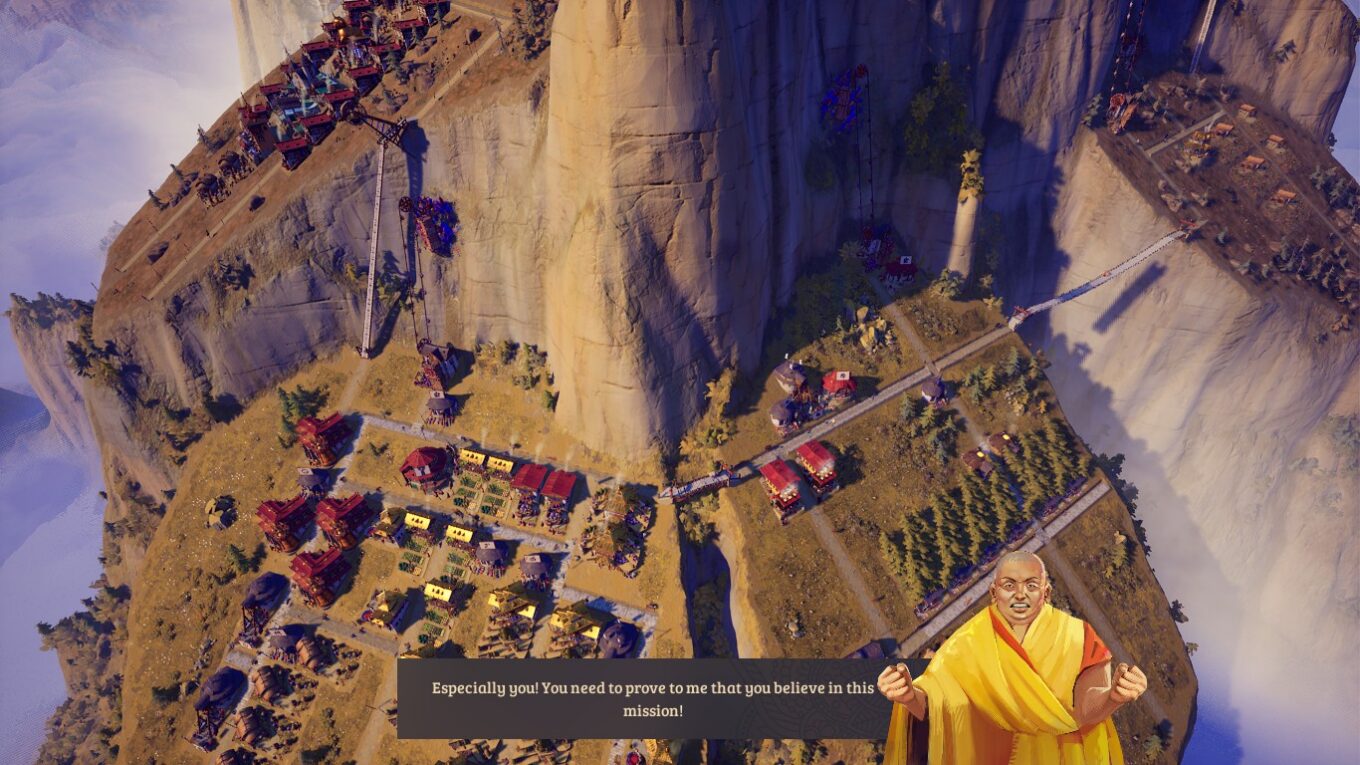
The tiered castes make for a system where if you want to expand at the top – more monks for higher research tiers, for example – you’ll need to first expand at the bottom, with more advanced yak pastures and more bountiful food networks to keep everything running smoothly. The tiers are quite literal, too, with monks preferring the soaring solitude of higher plains, and lowlander’s fields producing more resources on the lusher, lower plateaus. Whether this is a celebration of harmonic, mutually beneficial co-existence or a visual metaphor for bitter class struggle, I’ll let you decide, but it does mean the geography provides a handy blueprint for how to initially plan your settlement.
It’s also one of a few examples of Laysara making good on the main question I had going in: sure, it looks pretty, but are these soaring peaks just an attractive backdrop, or does Laysara actually play and feel like you’re trying to build a civilisation on a mountain? Well, yes and no.
The threat of avalanches – which can freeze your buildings, making them useless until you thaw them out – sell these mountains as hazardous and unpredictable. They mean extra planning, and occasionally difficult choices to when and where to expand.
Yakpunk
Less successful are the game’s random emergencies – a thin implementation of the tense and evocative story events from games like Frostpunk. The weather’s getting bad, a pop-up tells you, so you’ll need to quickly provide incense to 300 citizens to keep their spirits up. They’re arbitrary interruptions, lacking meaningful choice, and they’re too sparsely written to provide any real sense of the lives Laysara’s people are living on these mountains.
Fortunately, they’re not all that common, but they are representative of the biggest problem I had with Laysara’s campaign: what are intended as a series of escalating, interesting challenges often just plain get in the way of a good time. It’s an issue of structure, mainly. A mission might have ten separate objectives, and there’s generally some logical throughline of progress binding them together, but any future objectives are hidden from you.
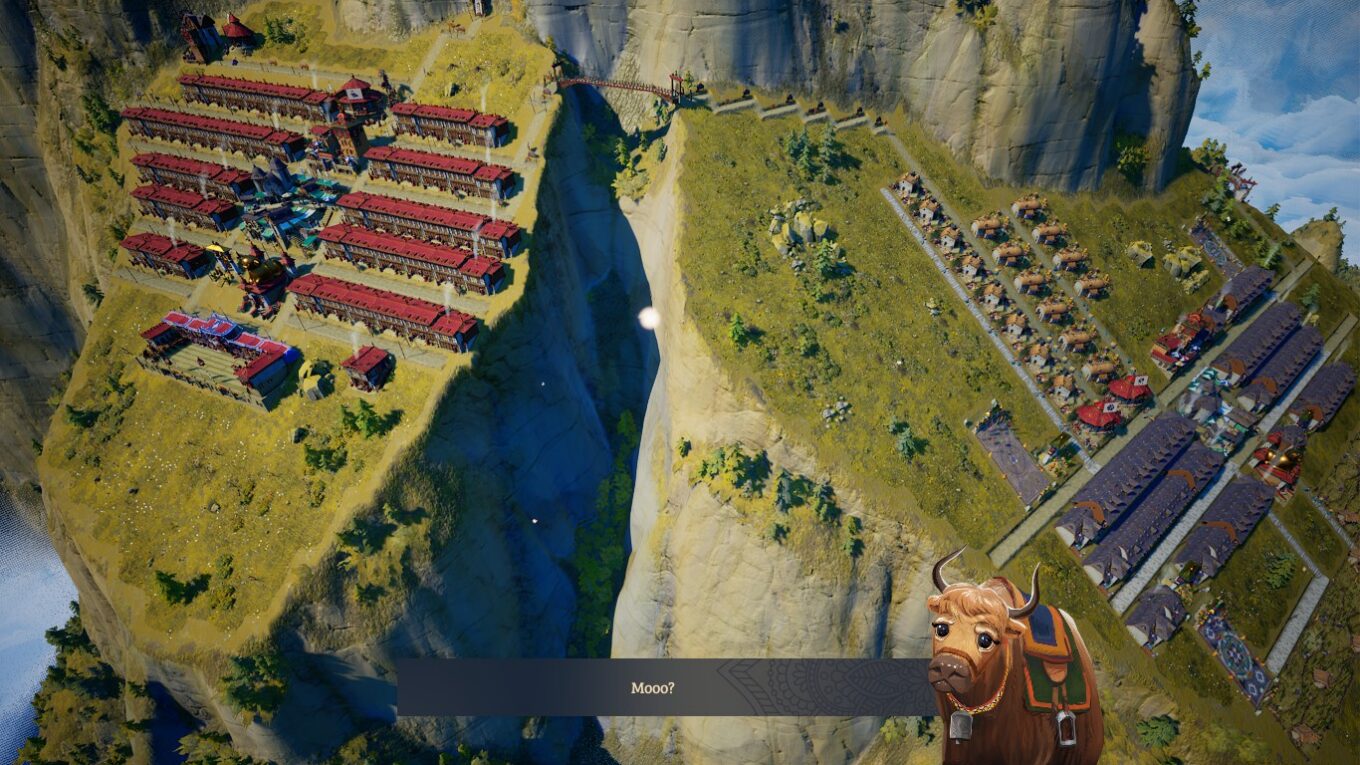
“Provide smoked meat for 300 citizens,” asks Laysara. So I build a resource and distribution chain, and everyone starts shovelling smoked meat into their faces. Happy days. “Provide ale for 1000 citizens,” the game demands next. To provide ale, I’ll need to up production of the same coal I’ve just used for the meat smokers, meaning I’ll likely have to demolish, replan, and rebuild a section of my settlement, not to mention replan entire housing districts.
Summit Up
Optimisation is, of course, one of the joys of this genre – but you can’t really optimise when you’re never quite positive what you’re working towards. Returning to previous settlements in later missions, armed with new technology, and fine-tuning everything is incredibly satisfying. But having to repeat and redo steps you’ve just worked hard on not twenty minutes previously feels awful, like waiting tables for capricious diners who order three desserts for starters, then decide they want slow roast lamb five minutes to closing time. Laysara is so well-considered in how the interplay between its transport routes, pipelines, and limited space make for so many satisfying eureka moments. So it’s a shame that the campaign obscures useful information to pad out length in such an arbitrary way – yak butter spread over too much bread.
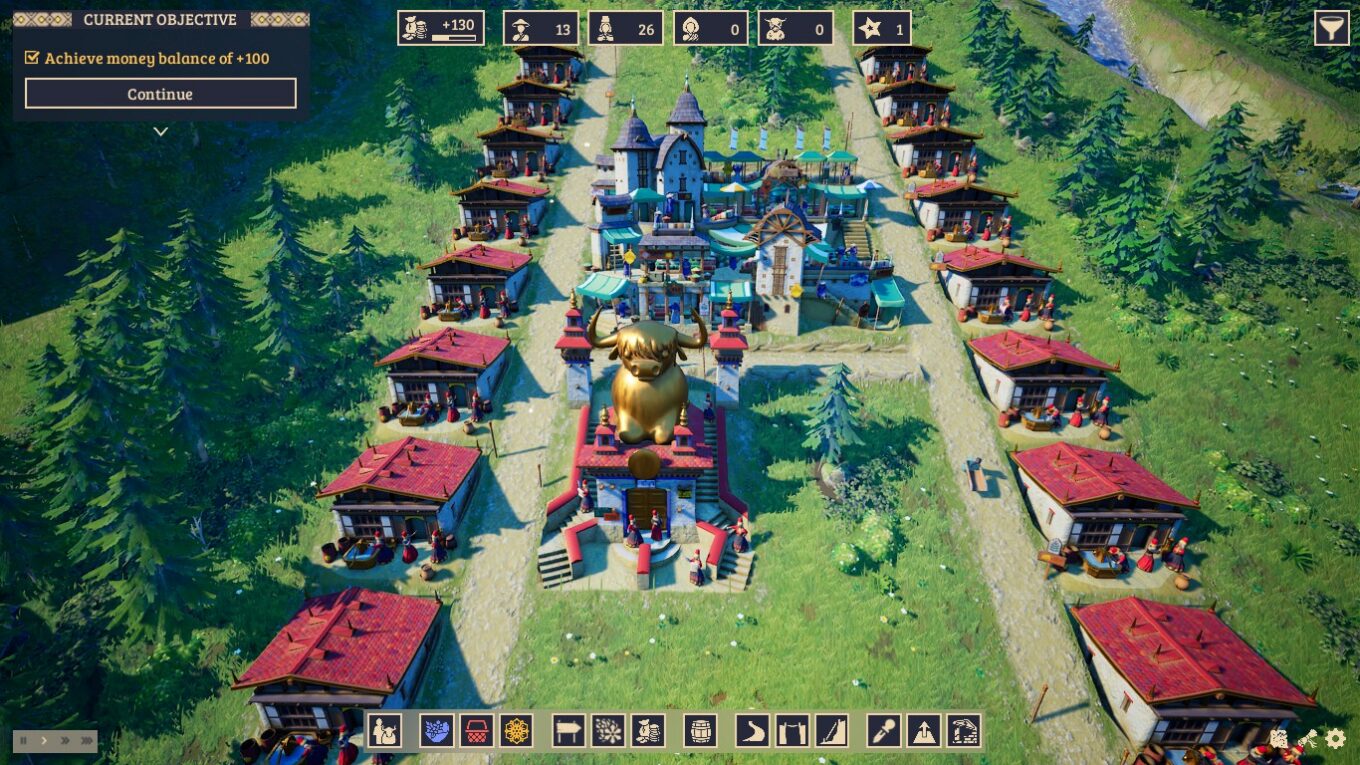
There is so much more to praise about Laysara. The short, playful descriptions that appear in each buildings information tab, and how each one comes alive with sound when you select them – citizens chatter in houses; chickens flap and squawk in markets. The small details that bring each caste to life, like how monks prefer to live enclosed by temple walls, or artisans pay more tax. The complex network of bridges, tunnels and yak routes and how the sheer depth of calculations going on under the hood is made so digestible from your end.
It just doesn’t always get the balance between chill and stress right, luring you into a false sense of calm with its silly humour and peaceful atmosphere, then ramping up demands until you’re so squeezed for space it can sometimes feel like you’ve wasted hours. It’s a testament to how much it does get right, then, that I’m still very tempted to return to these mountains, even if that means starting again from the bottom.