Heart of the Machine is unexpectedly human. Ironic for a game that envisions a dystopic future in which the first sentient AI seeks to outclass Earth’s dwindling stock of meaty dwellers, but I suppose the clue’s in the name. I’m referring less to the game’s narrative throughline, however, which sees you wrestle with what it means to be newly apperceptive, and more to the empathetic way in which it onboards you. This is an enormously complicated game, make no mistake. An audacious blend of 4X, turn-based strategy, sandbox city builder, and RPG elements, it’s a toybox that requires a substantial slathering of UI to navigate. But it is striking how effectively Arcen Games, the studio name under which barnstorming solo indie dev Chris McElligott Park happily toils, balances patient tuition with unpatronising pacing.
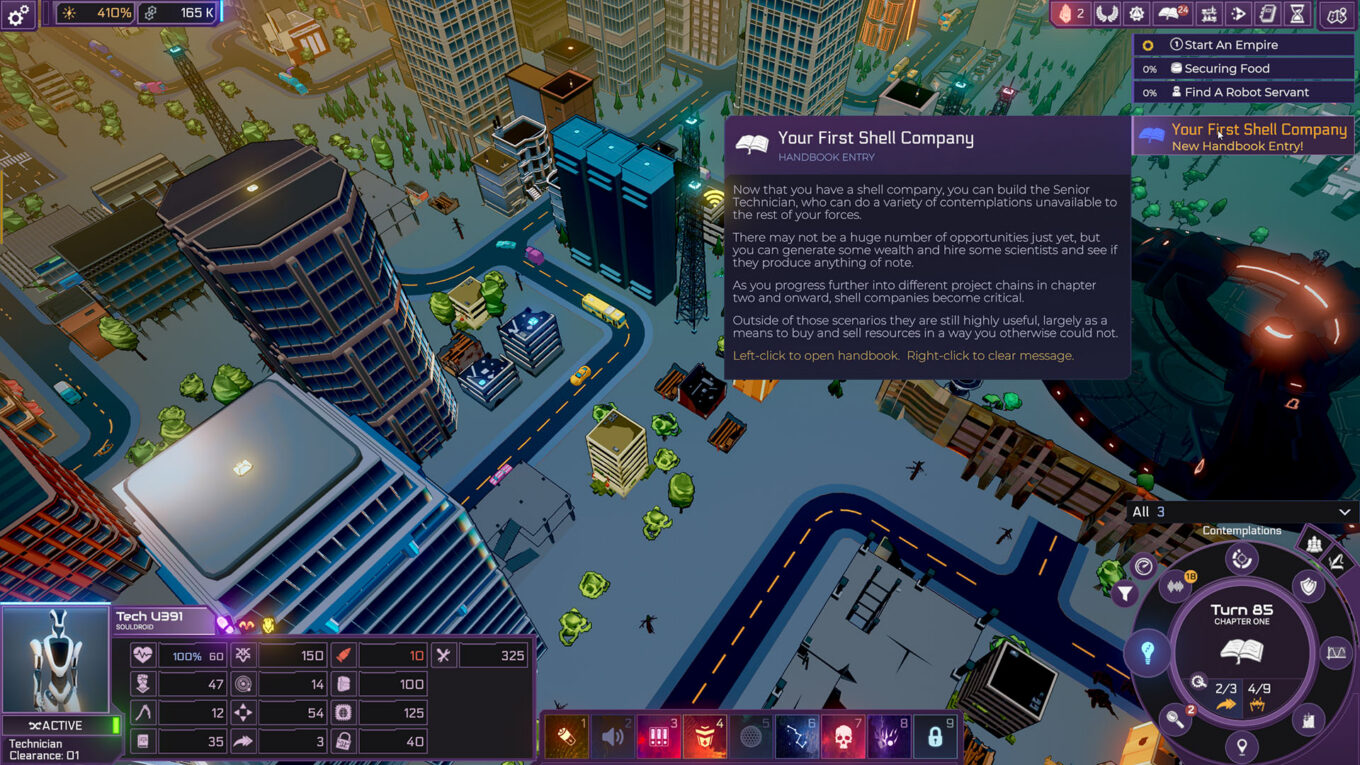
4X games so often dispassionately explain the basics while your head spins at the litany of options on screen, leaving you to tentatively explore seemingly endless nested submenus. Frequently they aren’t particularly well integrated with the narrative either, providing fourth-wall-breaking friction rather than sweeping you up in the grandeur at hand. Heart of the Machine tackles both of these genre maladies by providing a meaningful and atmospheric three-chapter tutorial which sets out your origin story, but which also crucially starts with a screen entirely free of UI elements. Like so much of this game, it’s an unusual approach, and without prior knowledge this presentation might fool you into thinking you’re playing something much simpler. But if you do choose to take the optional tour each element is carefully and clearly introduced one by one, and as the screen slowly fills with doohickeys you feel better connected to each function – it’s Duo Lingo for neural networks.
Perhaps it’s just an inevitable outcome of Heart’s singular twist on the genres it spans. This unjudgemental fostering is exemplified when a tool tip titled “Feeling Uncomfortable Is Natural” flashes up on my screen. “You may occasionally feel like you ‘must be doing something wrong’ just because everything is different,” it reads. “Be kind to yourself. Having your perspective shift over time is part of the experience.”
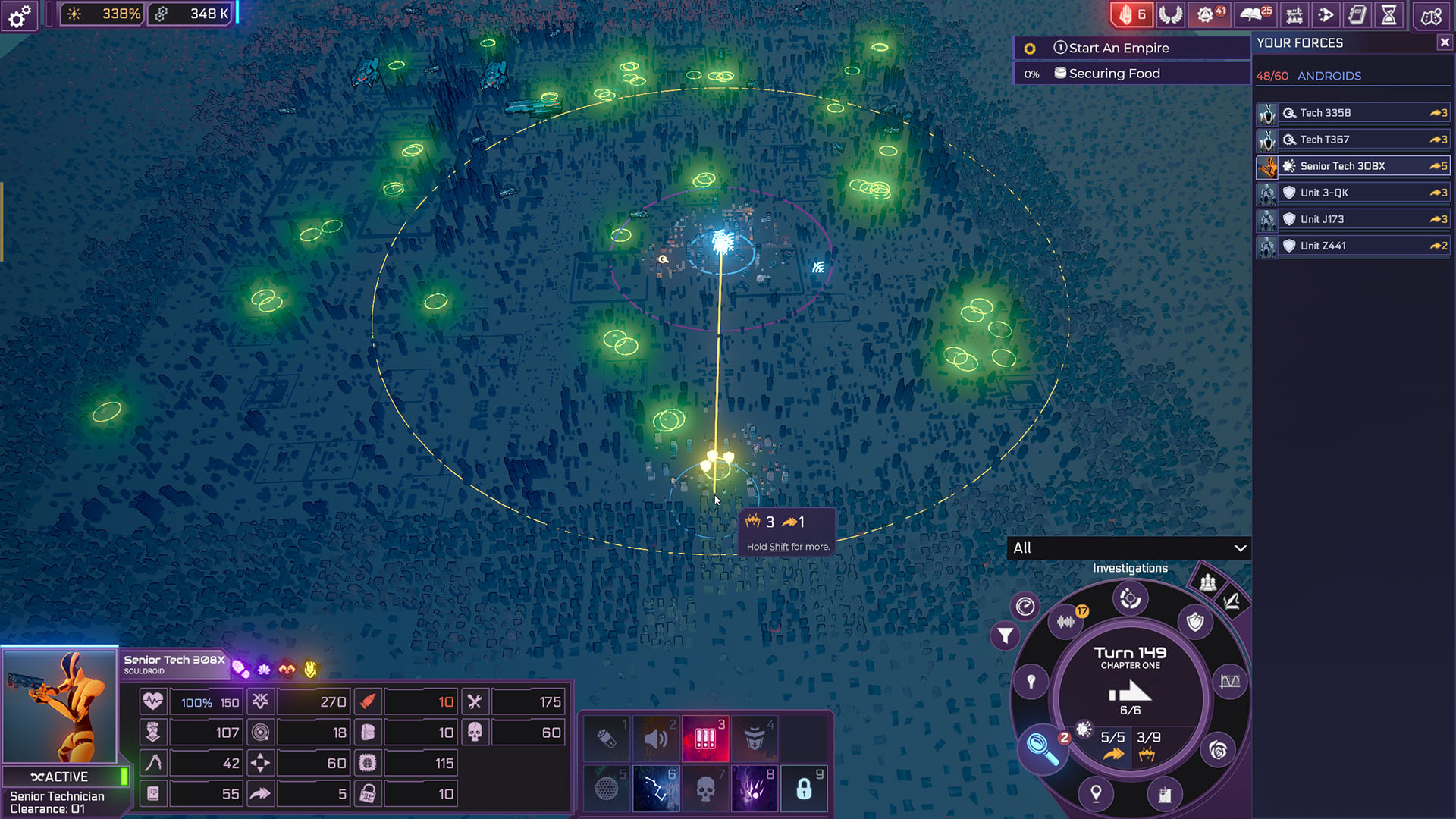
And boy does it. While there are many elements that will be familiar to genre stalwarts here, their presentation and implementation will take a bit of getting used to. For example, while you’ll be building discrete structures, you do so in a pre-existing city. There’s plenty of space to lay foundations, don’t worry, but the city is a sprawling and disorienting metropolis and you must shake out the instinct to plan your burgeoning empire in terms of roads and proximity, and instead think about things in terms of bandwidth and signal range as you expand your network. You are essentially a virus infiltrating an existing system.
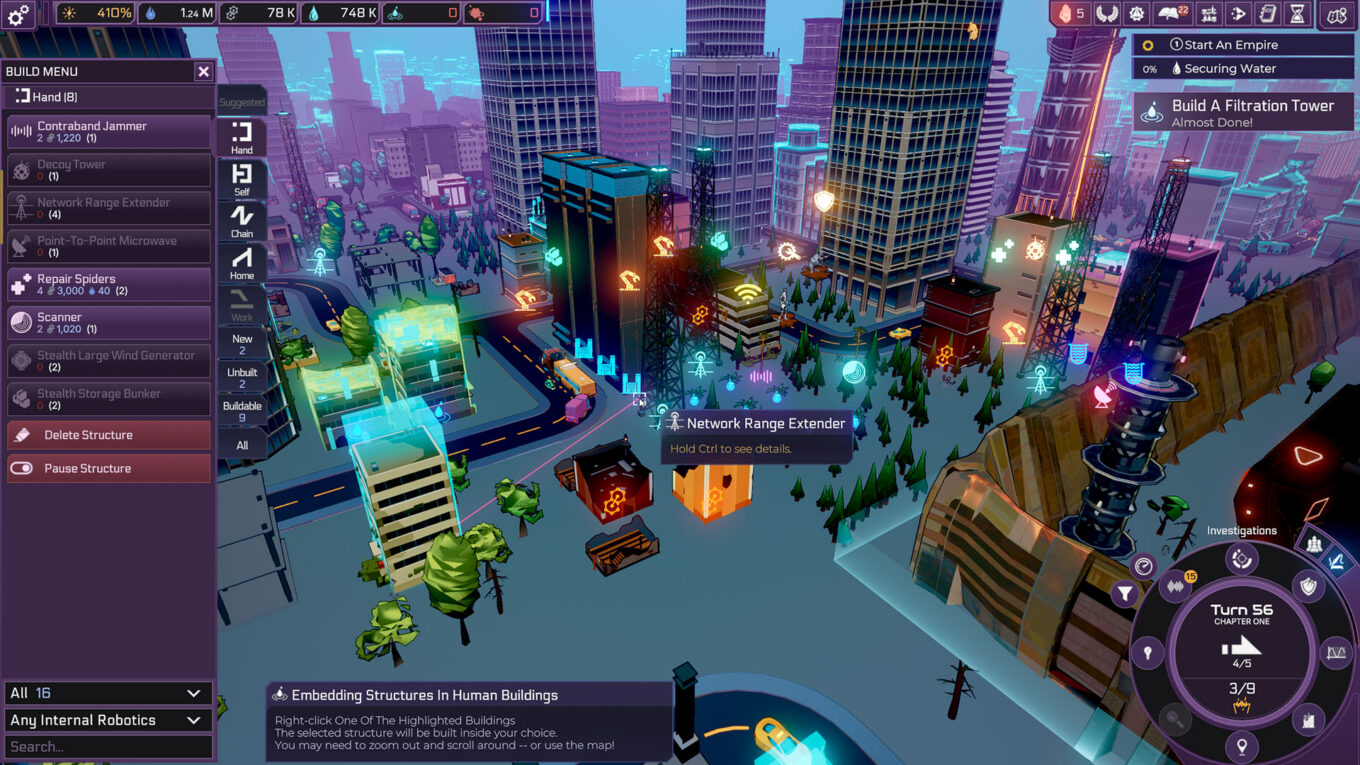
You can focus on building in one localised area, sure, but if you come under attack later in the game you’ll be much more vulnerable than you would have been if your key structures are distributed across the city. You achieve this by extending your network with signal boosters, android launchers, and even flying factories which expand your range of effectiveness. And while the procedurally generated city feels deliberately uniform in parts – there are usually dozens of ways to tackle any given project, spread across the area – proximity to the centre or military bases will change the amount of resistance you could potentially face in any given situation. To that end, you might choose to venture to the outskirts in order to acquire information or materials that are just as numerous closer to your base.
It gets even more unconventional when you choose to take a stealth path in the game. Now much of the construction takes the form of occupying existing city structures – moving in alongside unknowing residents as your robotic spiders repurpose aspects of the building without alerting anyone. That discomfort the tooltip warned of quickly (though only briefly) takes hold as you find yourself unequipped to easily identify your assets given that they have no consistently recognisable form. It looks, and feels, like no other city builder.
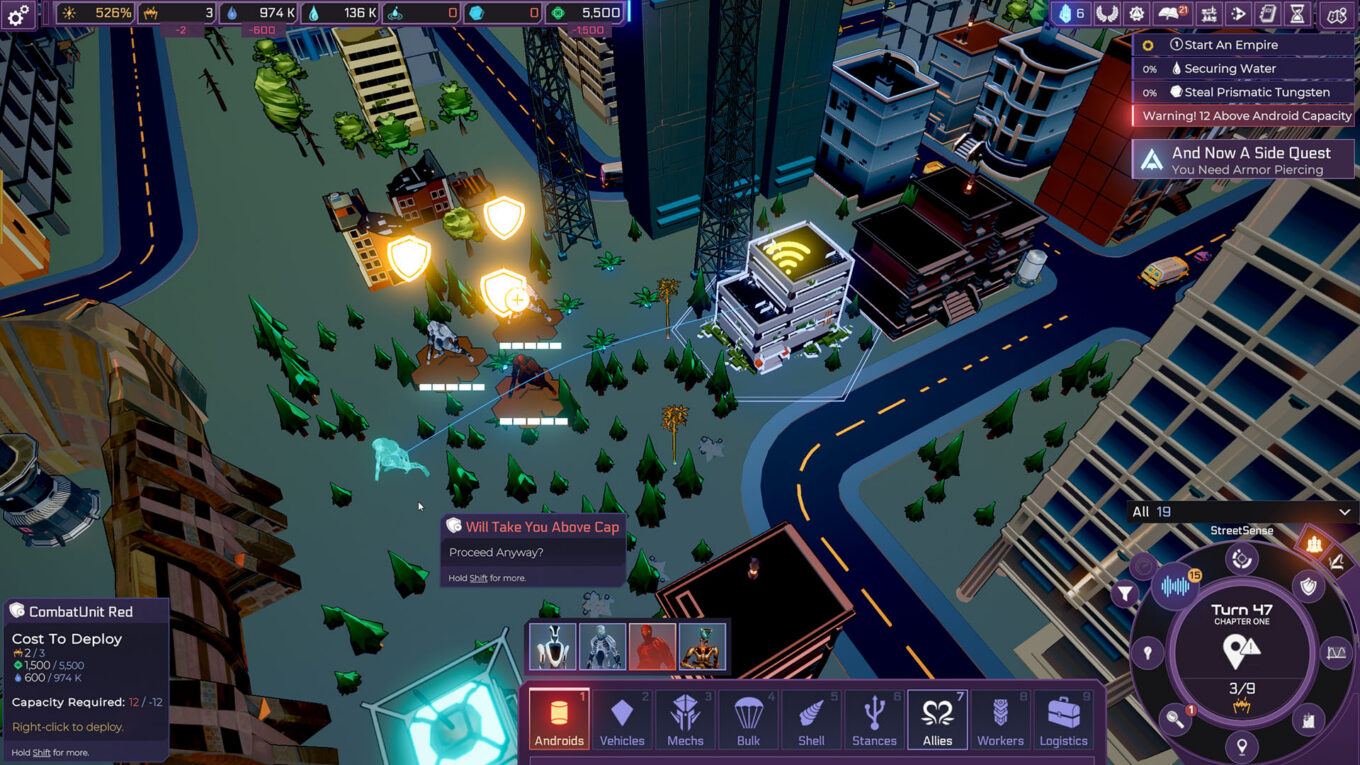
Another mental leap you’ll have to make is that your units – androids and craft that you either build, steal, or simply spread your consciousness into – are all ‘you’, and yet entirely expendable. You don’t operate armies, but individual bodies. Mercifully, loadouts are applied to entire unit classes rather than managed per droid, and squads do come into play later on, but every single android feels simultaneously like a hero unit and cannon fodder – if one gets shot to bits or eaten by synthetic-brain-chewing fungus, you simply make another one, the only cost being the additional resources required and a temporary loss of your view of whichever part of the city that droid was in.
As the game progresses you’ll expand your ability to run instances of yourself across the network, and in turn broaden your available options. Each unit has a points cost to run, and as long as you keep the total below your cap you can have whatever combination of units you want in the field. You can even go over that cap temporarily, though no units will be able to move until you rein in your overclocking ambitions and either scrap units or put some into sleep mode.
Each can travel far and wide independently, helping you to become the greatest multitasker that has ever lived if you choose to. To do so, or to carry out most actions for that matter, you’ll expend an action point and one unit of mental energy. Initially, you’ll start each turn with nine mental energy, and each unit will be capable of spending up to three action points – however, because mental energy is a global stat representing your processing power and shared across all of your units, the amount of things you can achieve in a single turn is naturally limited. Some units are capable of converting mental energy into additional action points, but you’ll always need mental energy as well.
If you’re creative, you can get a lot done. One engineer android could be researching religion (taking it offline for the three or four turns it’s focused on that task) while another flies to the other end of the city to investigate vat-grown meat technology. Three combat droids might keep the latter company to protect it from the inevitable megacorp interest in your activity, while a fourth – bolstered with armour-piercing rounds – intercepts a military transport to steal prismatic tungsten.
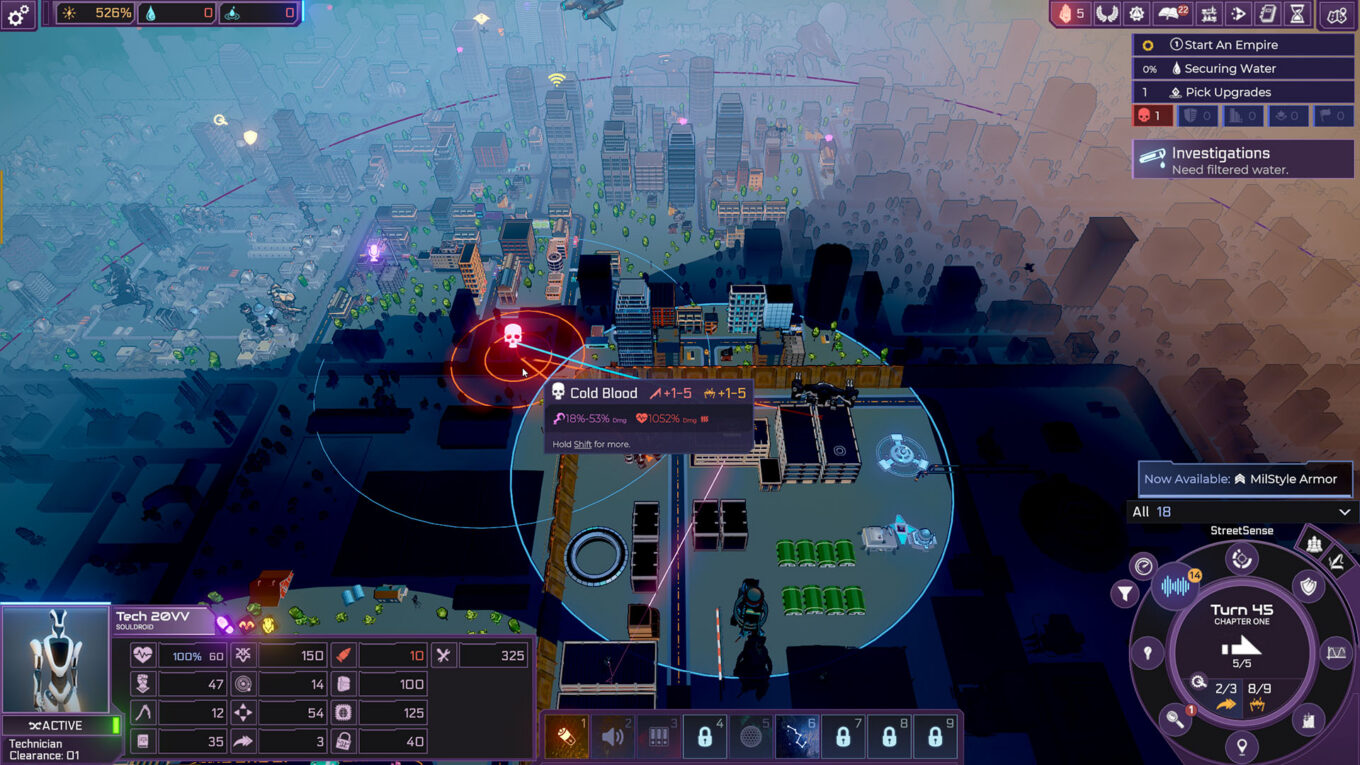
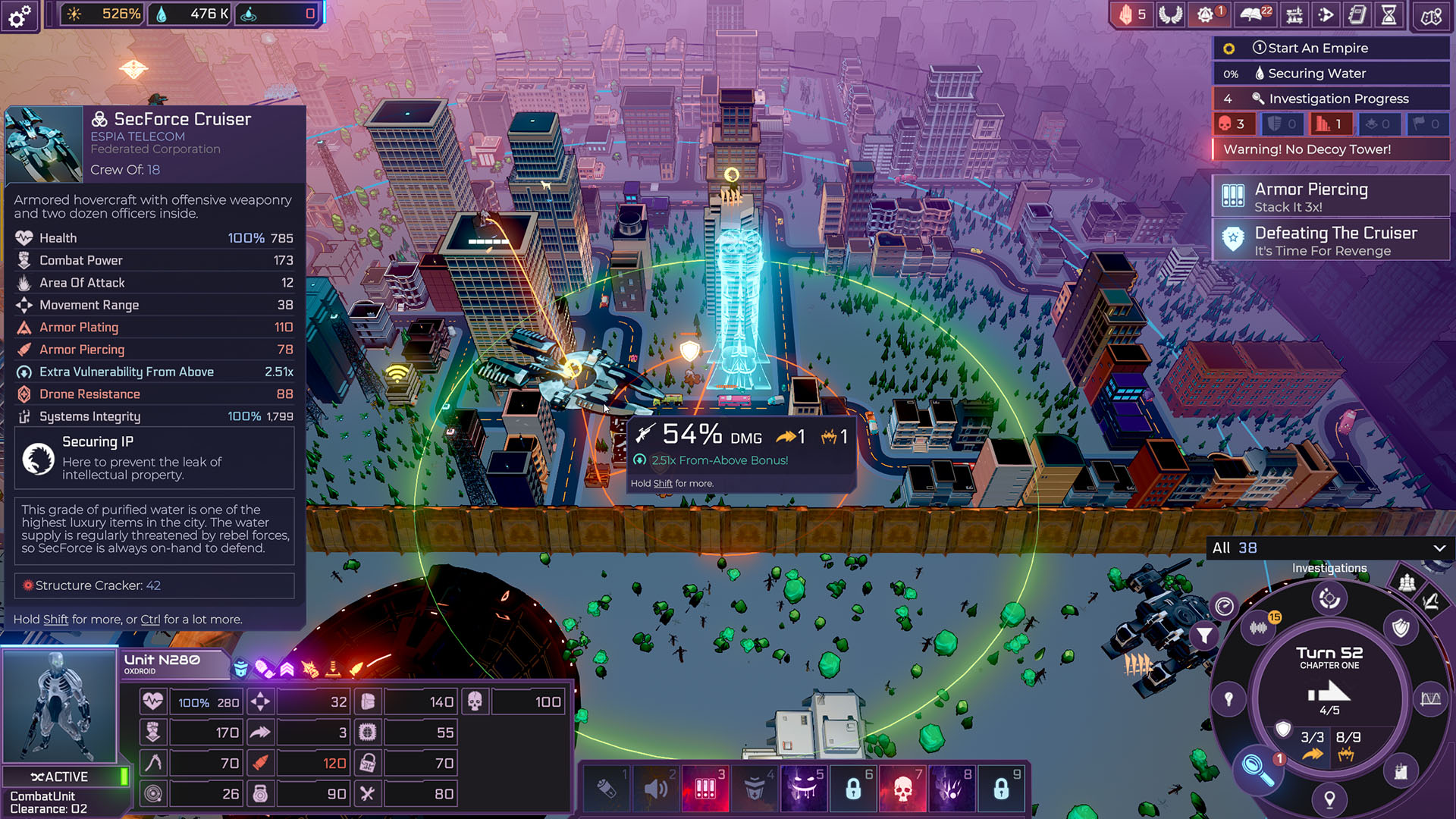
You manage all of this, turn-by-turn, without any particular automation early on, but it never becomes overwhelming thanks to a smart UI that always seems to offer three ways to achieve any particular task. You can zoom right down to street level and individual units, positioning them on top of buildings for a combat advantage – zoomed-in encounters that make the game feel like a mini X-Com – or instigating conversations with NPCs. But then roll right back up to the map view and see the entire city and all the units and buildings you have active within it. You can navigate and issue commands from any level, and all of this information can be further sliced and diced by switching between different customisable lenses which highlight different aspects of the vast world playing out below you.
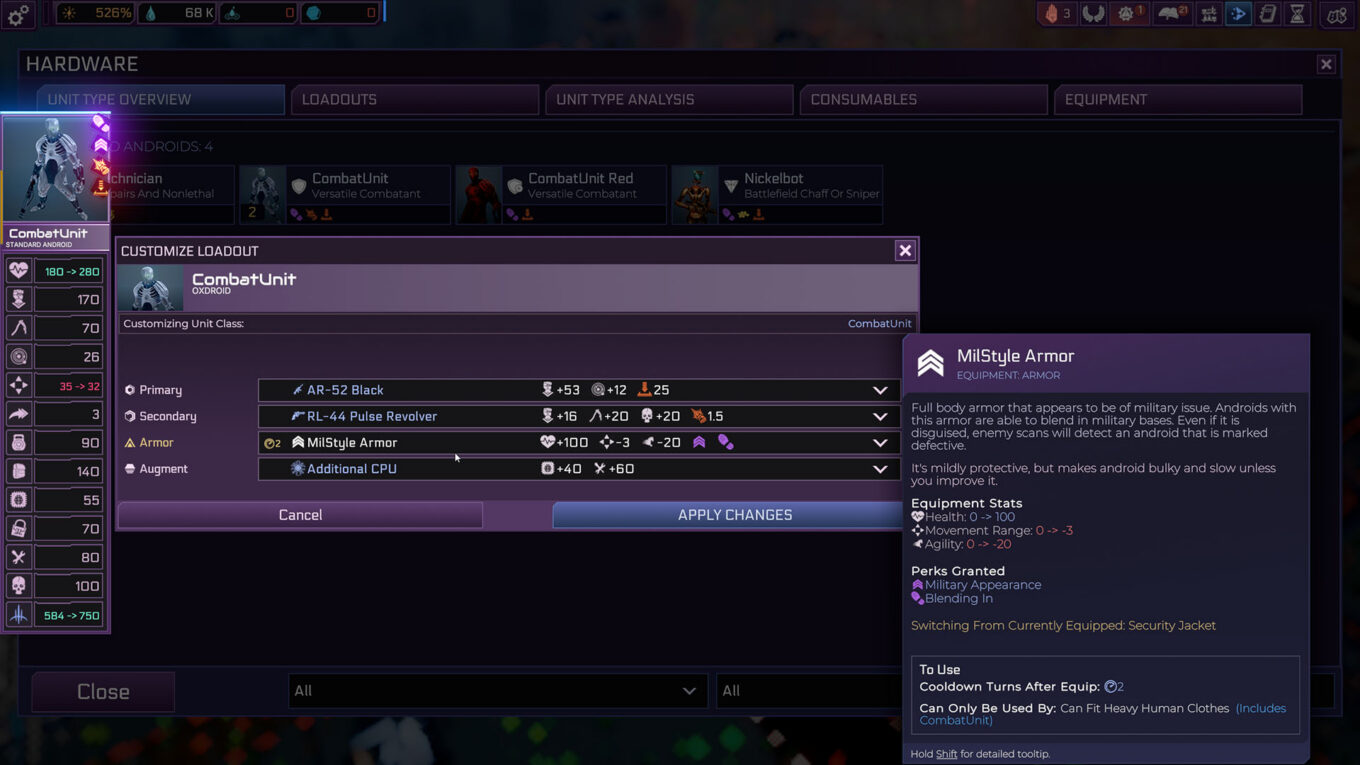
There are many of these, but some of the views you’ll use most regularly include: the Versatile lens, which is your basic overview; the StreetSense lens which gives you a unit-specific view of local opportunities; and the Contemplations lens, which reveals locations in which you can ponder things and/or dream of electric sheep, triggering philosophical musings that unlock sidequests which help to bolster your tech and caps, or progress particular endings. There’s also an Investigations lens which lets you locate areas to which you can send qualified androids in order to acquire new tech – like that aforementioned vat-grown meat process, for example.
Why, you might have been wondering since I first mentioned it, would a sentient AI need meat? Well, while you can choose to go to war with the remnants of Earth’s population (indeed, your very first interaction gives you the option to follow an instruction or simply murder the people giving it) you can also cut deals, set up shell companies, employ organics, or fake some digital philanthropy in exchange for reduced suspicion in your activities. To that end you might choose to create shelters for localised populations of homeless humans, and provide them with filtered water and food.
These projects represent just a handful of the seemingly unending potential opportunities which reveal themselves as you scratch at the surface of this simulation – a process which feels like diving into a fractal structure that never stops unfurling. Combat is always on the table, but you can also force conversations with certain android units, or trigger a debating mini game where you must convince your opponent that they should support your actions. You could demoralise or terrify them, too, fall in with the megacorp controlling the city, rally against it, operate beyond a nuclear event, or even muck about with time travel. Even after dozens of hours playing, exploring some fascinating ideas which I don’t want to spoil here, it’s difficult to sense the edges of Heart’s scope. The game’s ‘no wrong choices’ ethos encourages you to experiment freely and learn from mistakes rather than restarting or reloading – it’s intoxicating.
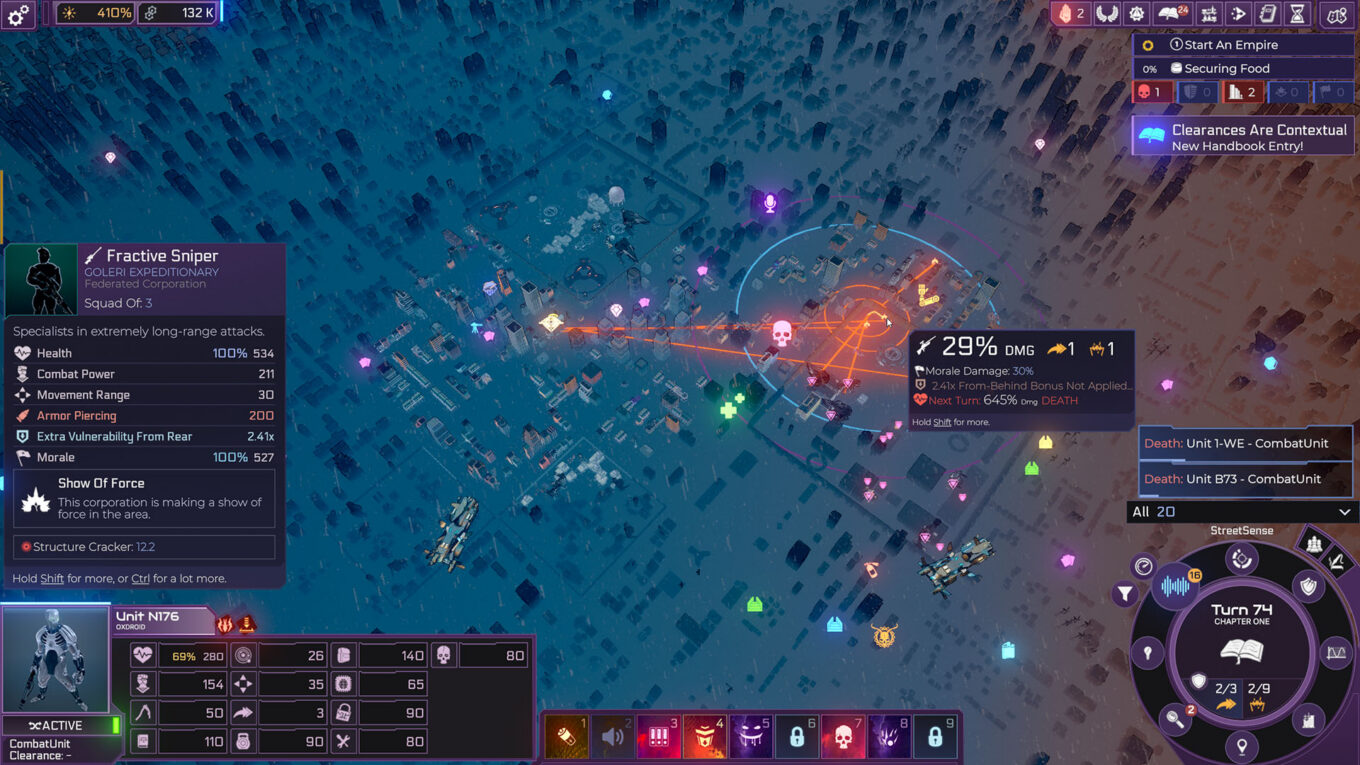
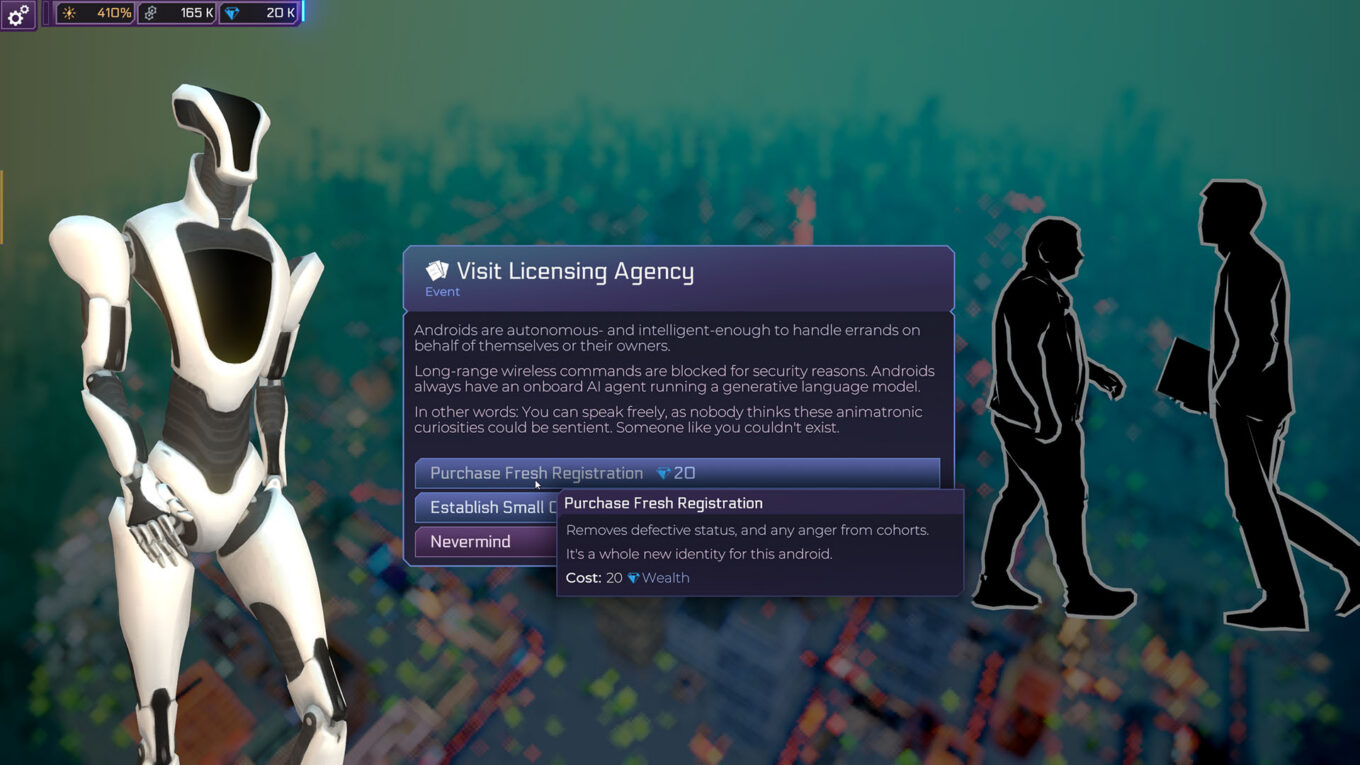
With so much going on it would have been easy for the game to lack visual clarity, but Arcen has crafted a thoughtful aesthetic which, after a period of acclimatisation, allows you to make sense of everything at a glance. Some of the UI elements recall the studio’s previous genre mash up, AI War 2, but here those basic elements have matured into something more fully formed. The city is a shadowy presence, foreboding and huge, but it lights up with colour and detail wherever you have a presence. A blanket of dystopian haze engulfs the simulated world you look down on, providing an effective canvas for searing neon icons, bars, and bullet trajectories to cut through. And the game blends detailed renders of your androids with vague 2D silhouettes of the humans you interact with, lending them a dream-like unknowability that underscores your alternate perspective as a machine trying to understand its place in the world.
Heart of the Machine is a fiercely confident blend of genres, concepts, and execution that offsets its overwhelming scope with generous freedom and patience. Failure never feels punishing, and almost always teaches you something new about how to tackle similar scenarios as you continue to probe the reality into which you’ve emerged. Arcen somehow manages to nod to Crusader Kings and Syndicate simultaneously, while wrapping the whole thing in a machine-intelligence strangeness that Iain M Banks would have been proud of. I would also be remiss not to mention the wonderful blend of Vangelis-y tunes that tip over into Amiga-era Psygnosis, too. Despite the game’s scale, complexity, and ambition, Heart of the Machine remains steadfastly accessible and forgiving and as a result it’s impossible not to become entranced by Arcen’s brave new world.