
Some of the most enjoyable multiplayer experiences I’ve had have taken place in Saber Interactive’s hardcore haulage simulators, MudRunner, SnowRunner, and RoadCraft. They’ve been fleeting, however, because it is difficult to consistently gather three other people who care enough about diff locks, fuel management, and logistics to play regularly – let alone individuals who deem spending ten real-world minutes painstakingly traversing a particularly boggy 20 feet of the route sufficiently entertaining. Which is why Over the Hill, Art of Rally developer Funselektor’s cosy four-player off-roading game, is such an enticing prospect.
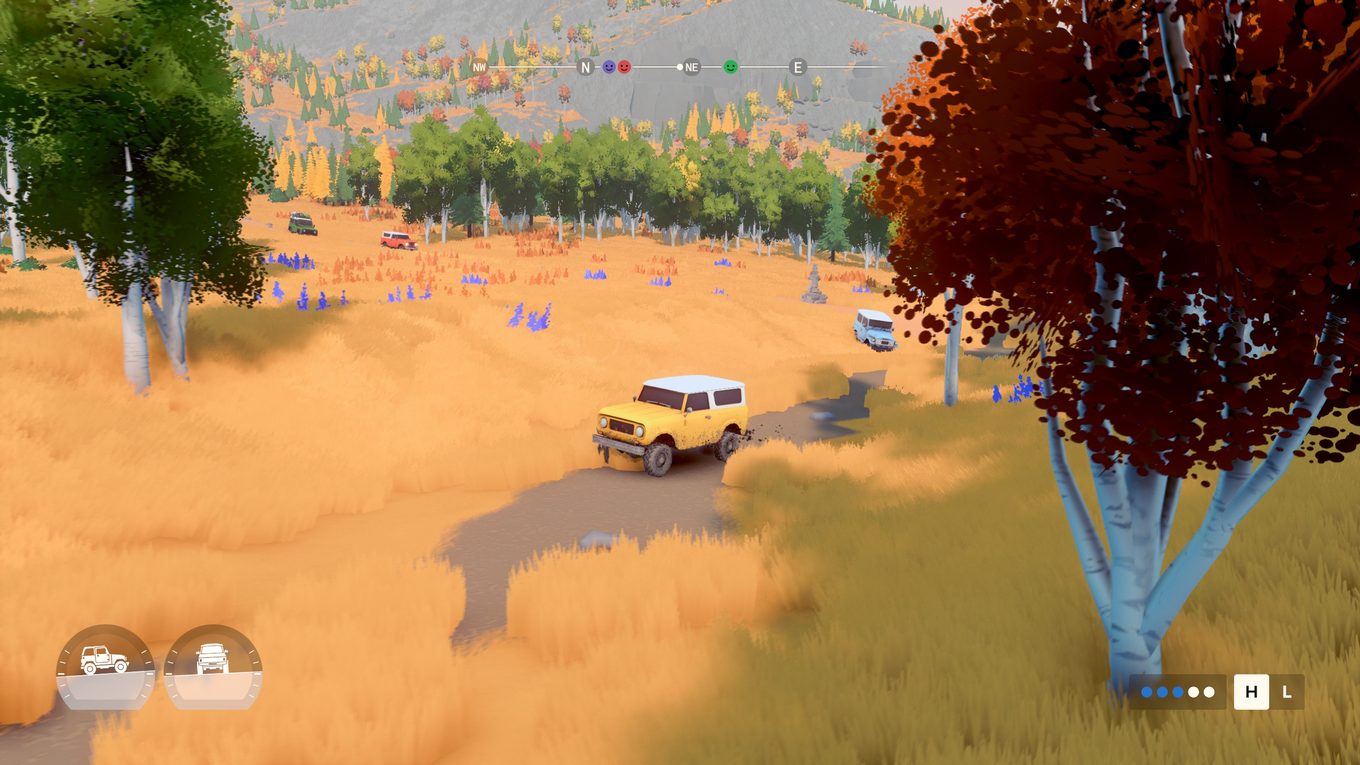
Building on Art of Rally’s free roam mode, Over the Hill shifts the studio’s passion for automotive classics to 4x4s. With that comes a noticeable jump in scope, and while there are only two locations (Canada and Algeria) compared to the previous game’s eight, their scale is monumental. Just like the ‘Runner games, they’re broken down into smaller interconnected maps. Canada is divided into three increasingly large maps, with the going getting tougher and ever more snowy the further into the mountains you head, while Algeria is split across two enormous desert maps, the second making a particular point of spreading its fast-travel campsites out as widely as possible.
Reaching these camps not only provides a fast-travel point, but also an opportunity to rest and shift to either night or daytime, reveal a chunk of the map, and replenish the tools you’re carrying in the boot. These might include a repair pack, a magical bell to clear inclement weather, or land anchors onto which you can harness your winch. The latter prove to be especially useful as the terrain becomes less forgiving, and once I’d upgraded to the full complement of four slots, I tended to keep at least three with me at all times.
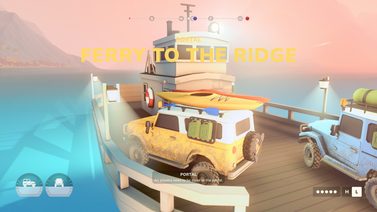
While you have to try quite hard to roll your vehicle or get properly stuck, land anchors do the same job as the self-righting jack gadget while also letting you overcome any slopes and edges that are beyond your truck’s capabilities. Brilliantly, while each is single-use, they remain in the world even after you come back with more, providing additional help for other players but also allowing you to make the most of your payload.
The winch mechanic is another aspect that will feel familiar to ‘Runner aficionados. Funselektor provides both a quick-deploy option that attaches to the nearest available winch point or player, and a manual mode, selected from a radial menu, which allows you to select exactly where the winch is attached to your vehicle and what part of the world you want to connect it to.
But all of this is, of course, peripheral to the driving itself. Funselektor has translated Art of Rally’s satisfyingly weighty Tonka-toy handling to the realm of off-roading and created a joyfully tactile driving game with rewardingly chunky physics. It’s not as nuanced as Saber’s sims – the only technical thing you need to worry about is whether to select low or high gears – but nor is it trying to be. A better comparison would be RedLynx’s Trials series, which thrives on a feeling of 1:1 connection between your inputs and vehicles’ behaviour.
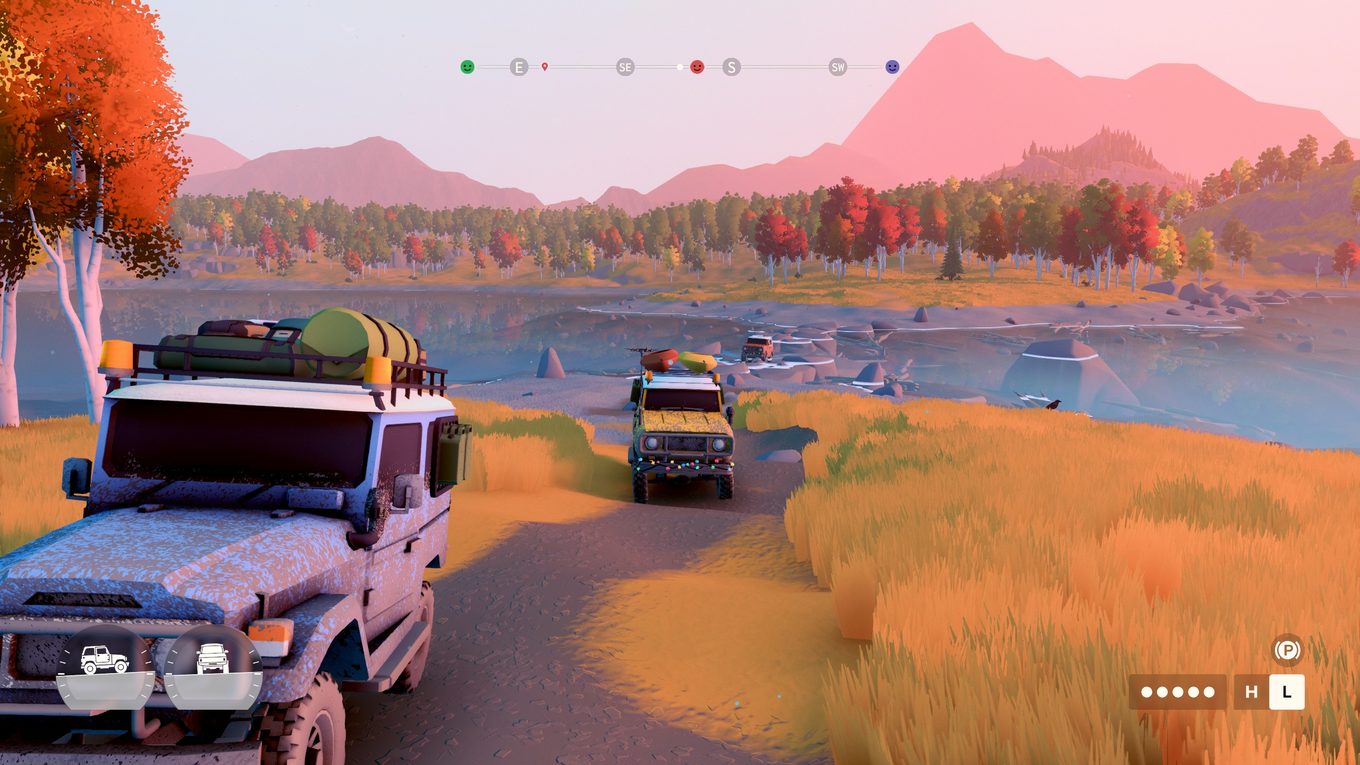
Progress is deliberately slow, mindful even, as you instinctively rumble over deformable mud and sand, jagged rocks, and try to keep your air intakes above water. It feels wonderful, striking a well-judged balance between sim-like challenge and cosy accessibility, and makes every journey, no matter its length, feel involved and substantial.
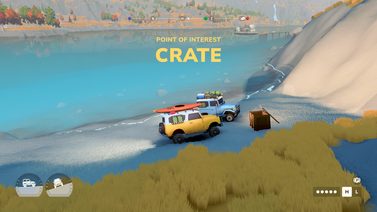
As you explore the world, you’ll find various points of interest, which include crates containing cosmetic upgrades (that’s why you find me with a roof rack full of beer in some of these screenshots), vistas, towing challenges that require you to recover a broken-down vehicle, and trail challenges that ask you to reach a series of checkpoints along particularly spicy routes. You can also go in search of fallen meteorites, which glow enticingly at night, but can also be located during the day by using one of your tool slots for a meteorite compass. These space rocks need to be pulled out of the ground and, as with the towing challenges, the horsepower required to do so scales according to how many players are on the server.
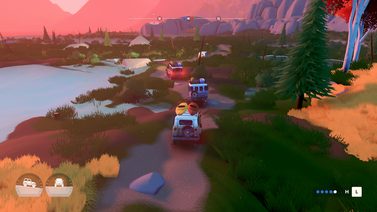
Tottering off the beaten track together in a four-vehicle convoy, the lead driver highlighting particularly hazardous edges and everyone ready with their winches should a member of the party come a cropper, is as pleasant a multiplayer experience as any found in the ‘Runner games. Along the way you might also spot a wild animal, prompting amusing calamity as you try to get the group to stop in time, and not deliberately honk their horns, so that you can snap a photo for your scrapbook before it scarpers.
Finding points of interest, completing challenges, photographing the wildlife, and excavating meteorites earn you pebbles, which can be handed over to Crazy Günther, a roving mechanic who shows up in a particular spot on each map. Here you can upgrade parts of your vehicle, including engine power, suspension height, winch range, or even add snorkels for wading, and also apply, at no additional cost, any cosmetic items you’ve found on your adventures. Günther’s van serves as a useful additional fast-travel point, too, so he’s worth seeking out early.
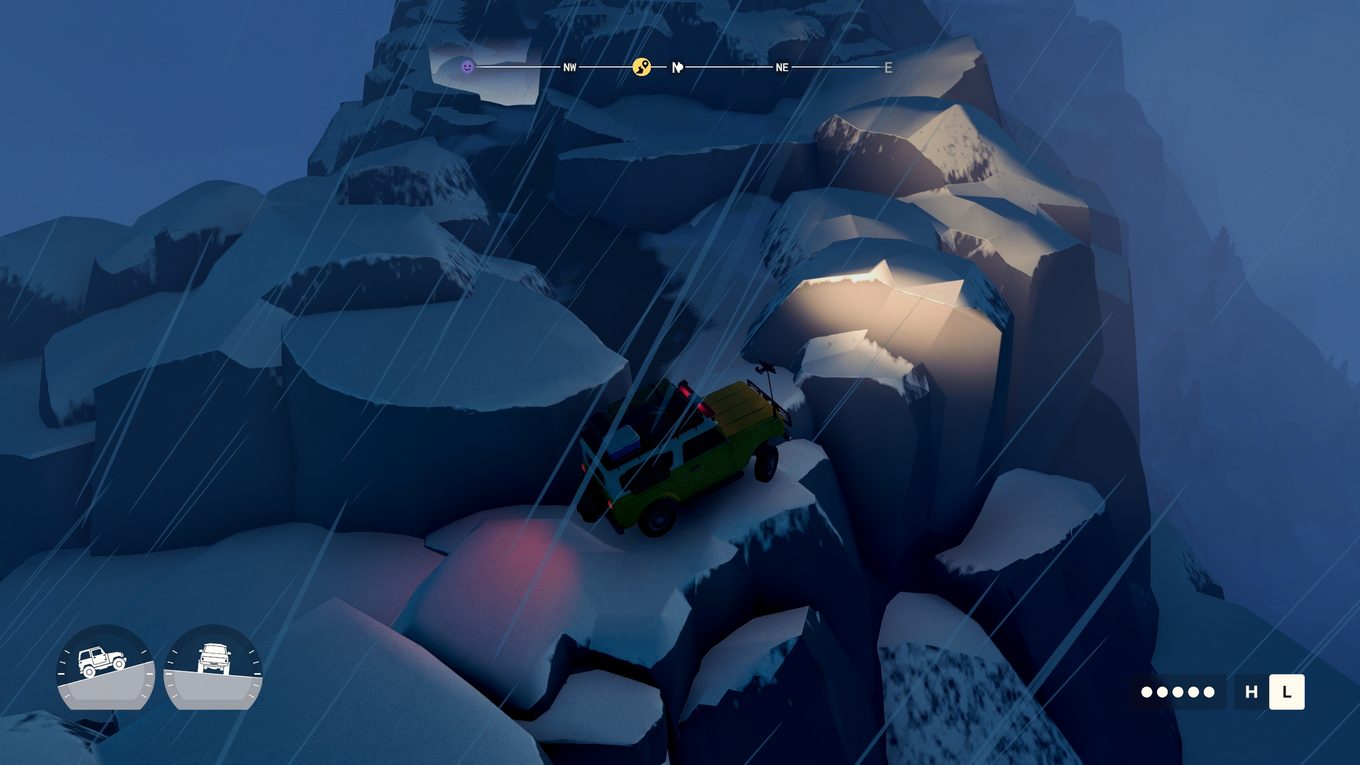
It’s also the only point, other than when you initially load a map, at which you can switch between unlocked vehicles. Just like in Art of Rally, there are a bunch of unlicensed, though clearly recognisable, late-20th-century classics to choose from. Any handling differences are much more difficult to discern than they were in that game, however, and as pebbles are hard-won I found myself reluctant to move away from the Trailrat (based on the International Scout II), which served me just fine throughout the game. You’ll no doubt have noticed that I have the same car in all of my screenshots, and this is my impassioned justification for the lack of variety I’ve provided.
Aside from this small balancing (or should that be unbalancing?) issue, there are a couple of mechanical irritations. As there’s no minimap (an astute choice to increase immersion), you’ll find yourself switching to the map screen fairly regularly. This isn’t a problem itself, but the fact that doing so saps all of your momentum is mildly frustrating and I soon learned never to be curious about my location while climbing a steep incline. There’s also the slightly odd decision to prevent you accessing the radial menu while tethered. I presume this was a deliberate design choice, but it limits creative uses of multiple anchors to get over obstacles, and means you can’t access your camera either. As a result, the world has been robbed of my abseiling wildlife photography ambitions, as is poorer for it.
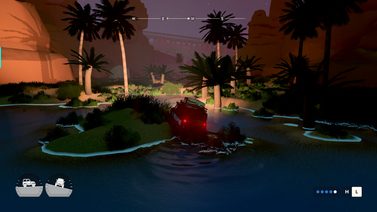
These are minor niggles in a game which otherwise confidently hands you the keys to its world. And what a world: both locations are glorious, blending breathtaking views with intricate terrain design that tests your mettle as well as your metal. The day/night cycle is pronounced enough to make driving in one or the other a noticeably different experience, and the dynamic weather can quickly turn an oasis into a low-visibility sandstorm, or verdant tree-cloaked slopes into a deep snowdrift. Also, it’s perhaps a niche thing to be impressed by, but tyre tracks on any deformable surface go back a long way before fading out, giving a neat impression of persistence.
Taken as a whole, Over the Hill’s stripped-down take on off-roading sims is both its greatest selling point and its greatest weakness. By design, there is less to do here, and far less depth to anything that you do do, which can lead to a sense of repetition and slightness creeping in over time. But Over the Hill, as the game emphatically states, is all about the journey, the joy of exploration, and taking your time. It also promises that every area contains a hidden path to… somewhere, and that vow was never broken during my time with the game – everywhere I ventured there was something to see, even if it was just another lovely view to take in.
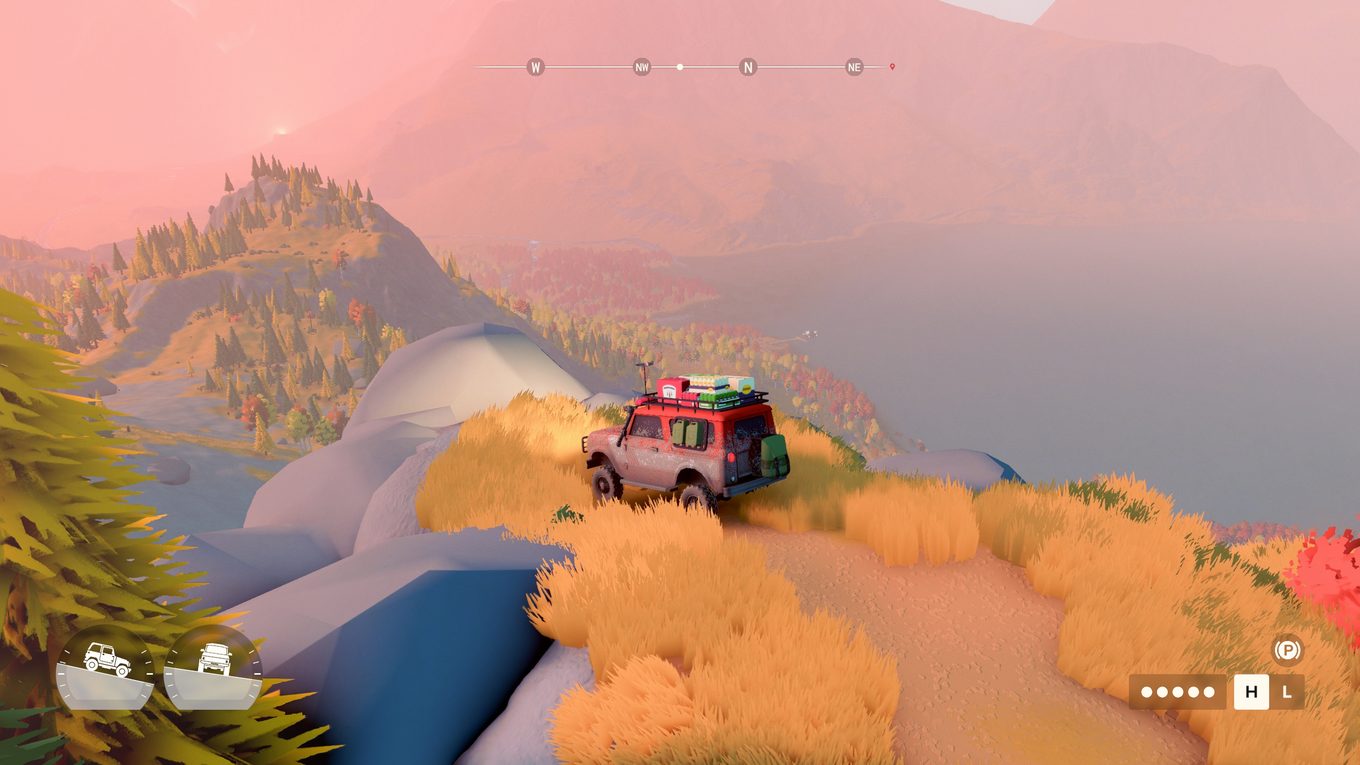
If you prefer the boggling depth of a SnowRunner or RoadCraft, I would entirely understand. But I suspect that, when it comes to finding friends to play with, you won’t find a more effective introduction to the joys of off-roading than Over the Hill.