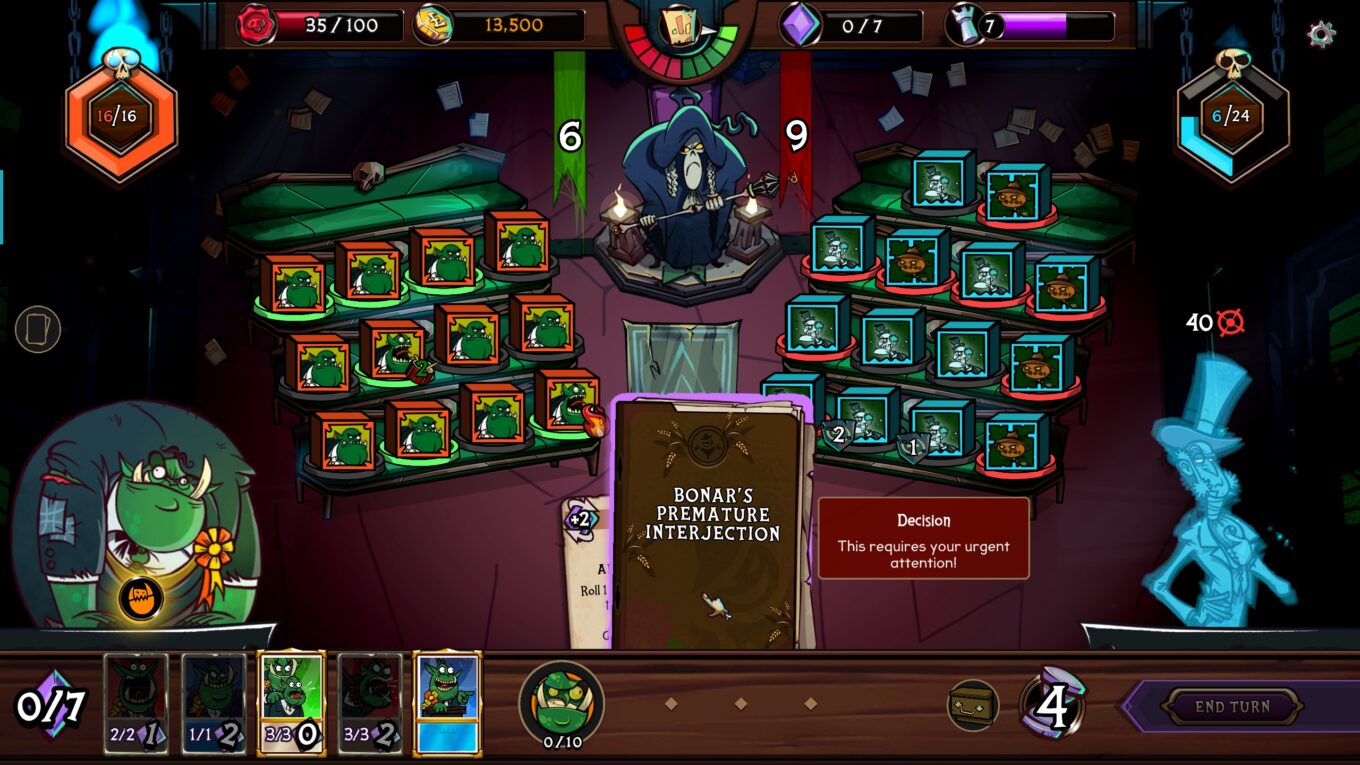
It’s a reasonable rule: dead MPs aren’t allowed to vote. The problem I’m facing, however, is that reanimating (or, in Prime Monster’s world, simply ‘animating’) fallen representatives confers a substantial attack bonus that’s going to help me win a political clash with a wolfy creature that has just obscured my screen by gobbing all over it. If I can avoid reviving any of my dead MPs for long enough I’ll be able to use my Politically Charged party power to turn them into hordes, gaining me additional votes once I finally bring them back to life. But each round I hold off doing so increases the risk that I’ll run out of time, potentially leaving me with a bunch of default abstaining seats and resulting in my ‘freedom of screech’ bill failing. All the clever manoeuvring, heckling, and undermining will have been for naught.
Edge magazine once presciently lamented the inability to talk to malicious creatures in Doom, but Prime Monster lets you debate them. To facilitate this, Cavalier Game Studios has crafted a riotous and richly complex card-battling roguelike from the intersection of imaginary things that go bump in the night and real-world politics (which, often, goes bump in the day). The result is equal parts sardonic and juvenile, as comfortable making jokes about premature interjections as it is mapping satire onto gameplay mechanics. It’s confident, clever stuff, but also highly entertaining while feeling meaningfully distinct from its genre stablemates.
Cavalier has imagined a world in which humanity has been toppled by fiends and beasts who, after a period of celebratory chaos, came to the realisation that they would probably still need some form of government. To that end, they’ve formed political parties and a democratic parliament in which to duel over dubious policies. You take on the role of various party leaders – you can choose from three, each with unique leadership styles and powers – and debate your way through as many terms in office as you can survive.
That’s the broader picture, but in practice there’s a lot to manage. So much so, in fact, that Prime Monster can feel overwhelming at first – there are a great number of stats, mechanics, and management duties vying for your attention. But while the setup initially feels overcomplicated, it soon resolves into an intuitive gameplay loop that has a frankly dangerous level of one-more-go magnetism.
Each time you begin a new run you’ll start as the opposition, and must outwit the current prime monster in a couple of low-stakes debates ahead of the general election. Debates are transposed into turn-based battles in which you and your opponent take turns to deploy attacks, buffs, and defensive measures from a hand of Debate Cards. Each participant has a circular Unity Meter, varying in size depending on their party, which can be filled by deploying cards or abilities that add unity, or chipped away at by opposition attacks. If you fill it up, your party becomes more unified and one of your MPs will change their vote (either moving from voting against you to abstaining, or from abstaining to voting with you) and the cycle then begins again. Conversely, if it’s emptied, you’ll lose a vote. The goal, of course, is to end the debate with more votes than your opponent, fairly or otherwise…
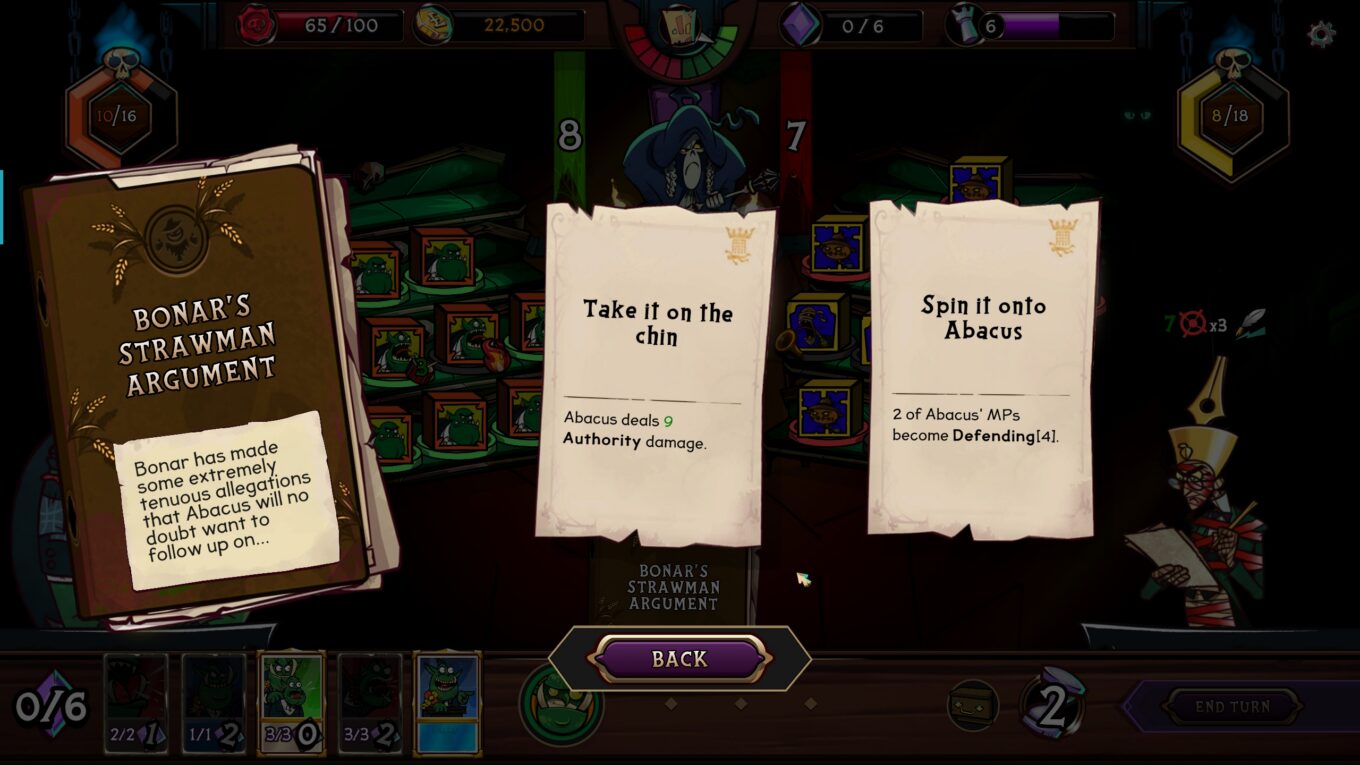
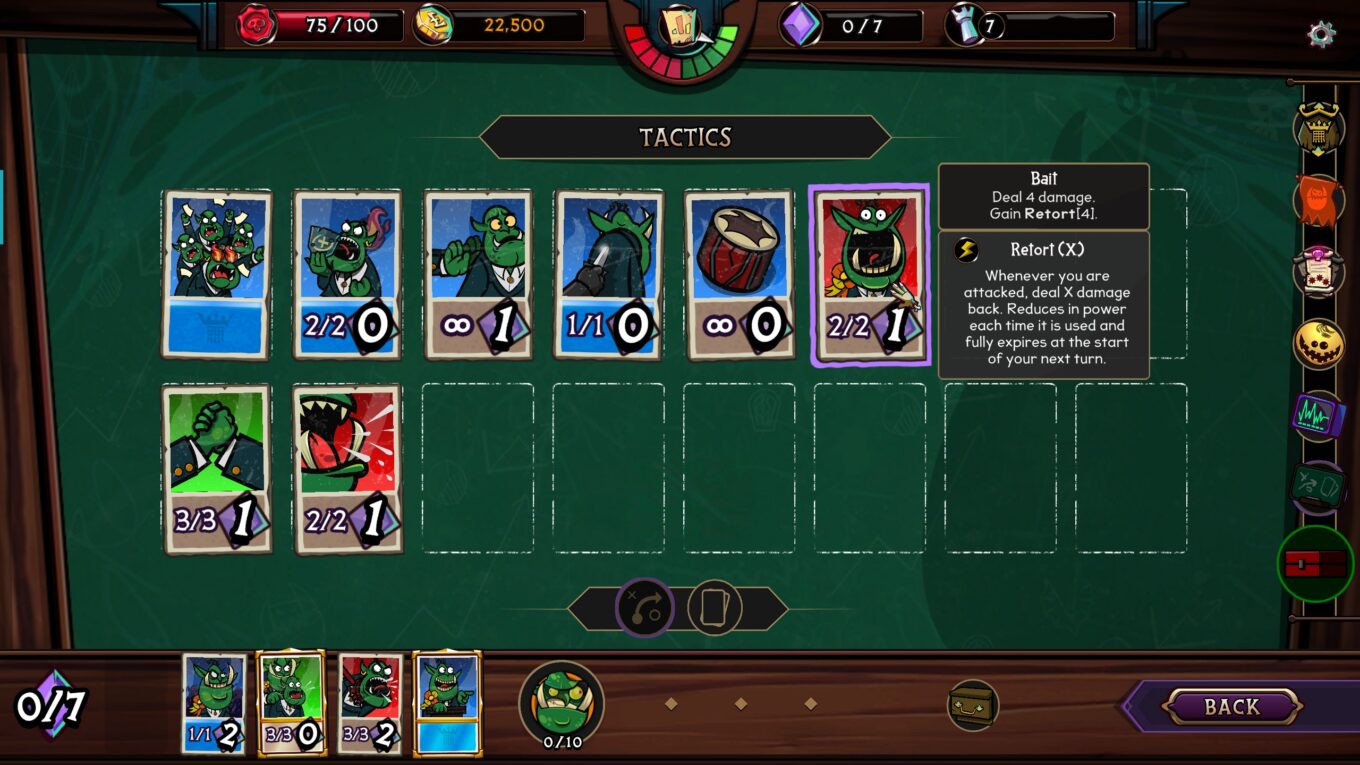
Your main hand is supplemented by Tactics Cards which require Political Capital to deploy. You can gain Political Capital between rounds, or choose to exploit (discard) a card in your hand for its face value. You can hold up to five Tactics Cards and the interaction between these and your Debate Cards generates engaging nuance as you weigh up the merits of playing a card or sacrificing it to deploy a Tactic – this becomes especially interesting once you have a bunch of buffs in play which might make one or the other decision more valuable.
This is further complicated by the particular styles of the party leaders. For example, Chopper Badtone, leader of the Orcs-4-U party, has a special power which doubles the amount of Unity you receive from the next move. He also has the ability to get some MPs to drum up support (they literally start drumming, adding Unity after each turn) and others to become frenzied, generating one extra Unity whenever any is gained. In combination, these stacking buffs can become extremely powerful, and because of this it makes sense to focus on unifying your own party before attacking your opponent as you’ll simply get more bang for your buck. Rotilda De Cay, meanwhile, has an MP die at the beginning of each round and is far more suited to deploying the kind of scaling attack damage scenario I opened this review with.
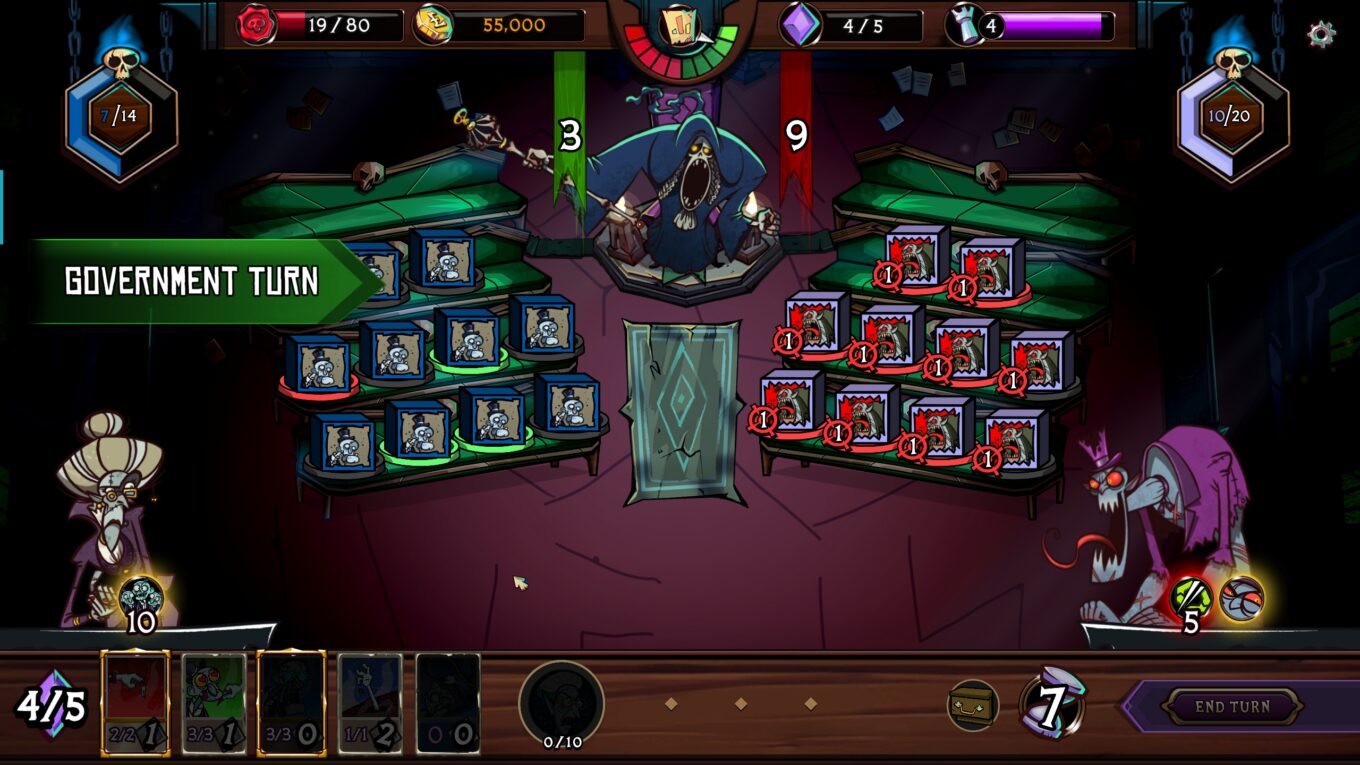
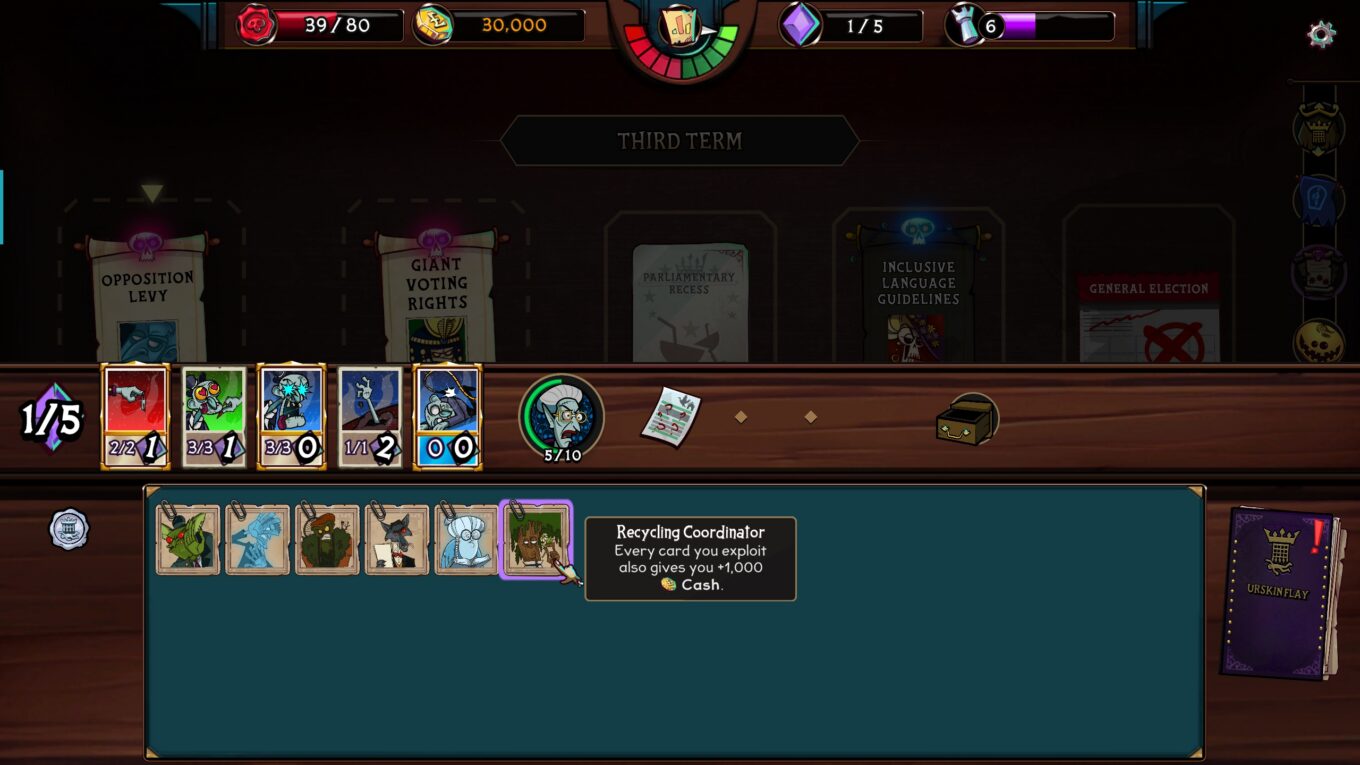
Most of these techniques are above board, but you also have access to Dirty Tricks – particularly powerful cards that can turn the tide of a debate, but which will get you investigated by the Shrieker of the House. The Shrieker always starts with a one-in-six chance of catching you out, and if you get away with some shenanigans those odds are reduced to two-in-six, and so on, until you are caught. Once that happens, one of your MPs will be thrown out of the debate, which can be especially problematic if they happened to be already voting in your favour and buffed up to the eyeballs.
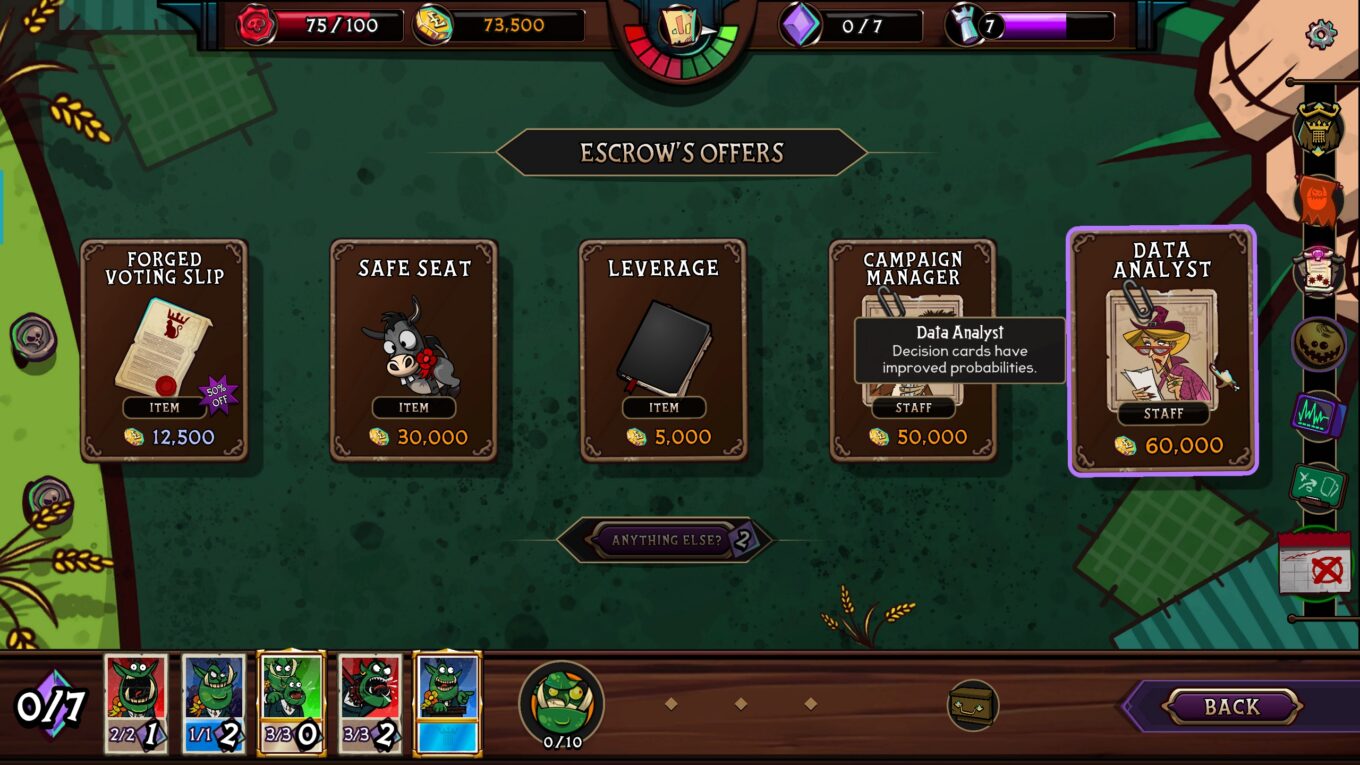
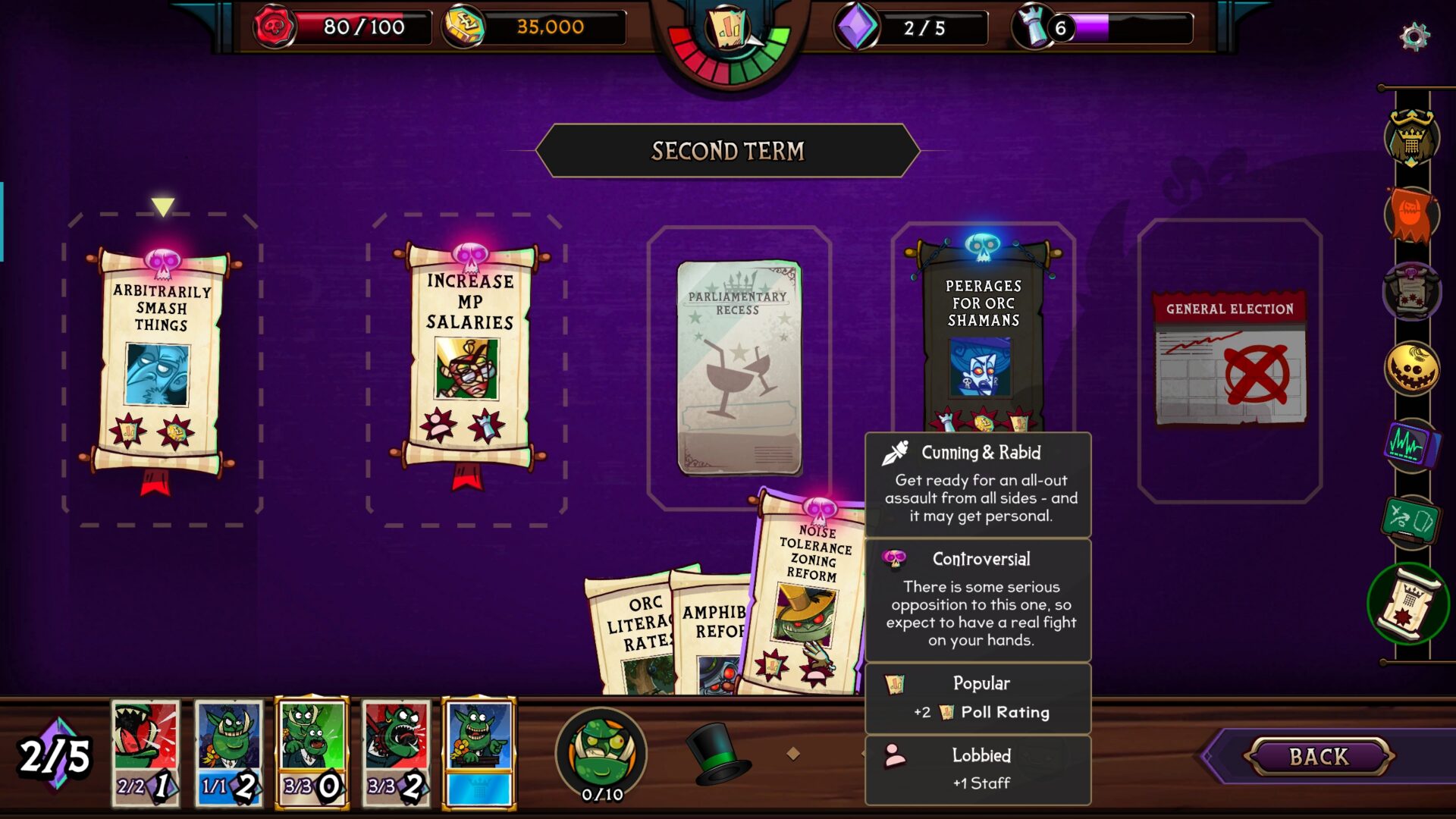
The centre of operations is your party HQ, from which you can review the current state of your deck (your deck is fixed and so you can’t manage it in the traditional sense by adding or removing cards, but you do get the chance to upgrade cards between rounds), select which Tactics Cards you want to take into the chamber with you, check the polls to see your approval rating, review your schedule and select which bills to debate once you’re in government, attend to mandatory decision making matters which may help or hinder you, and shop for single-use power-ups and passive buffs in the form of parliamentary staff.
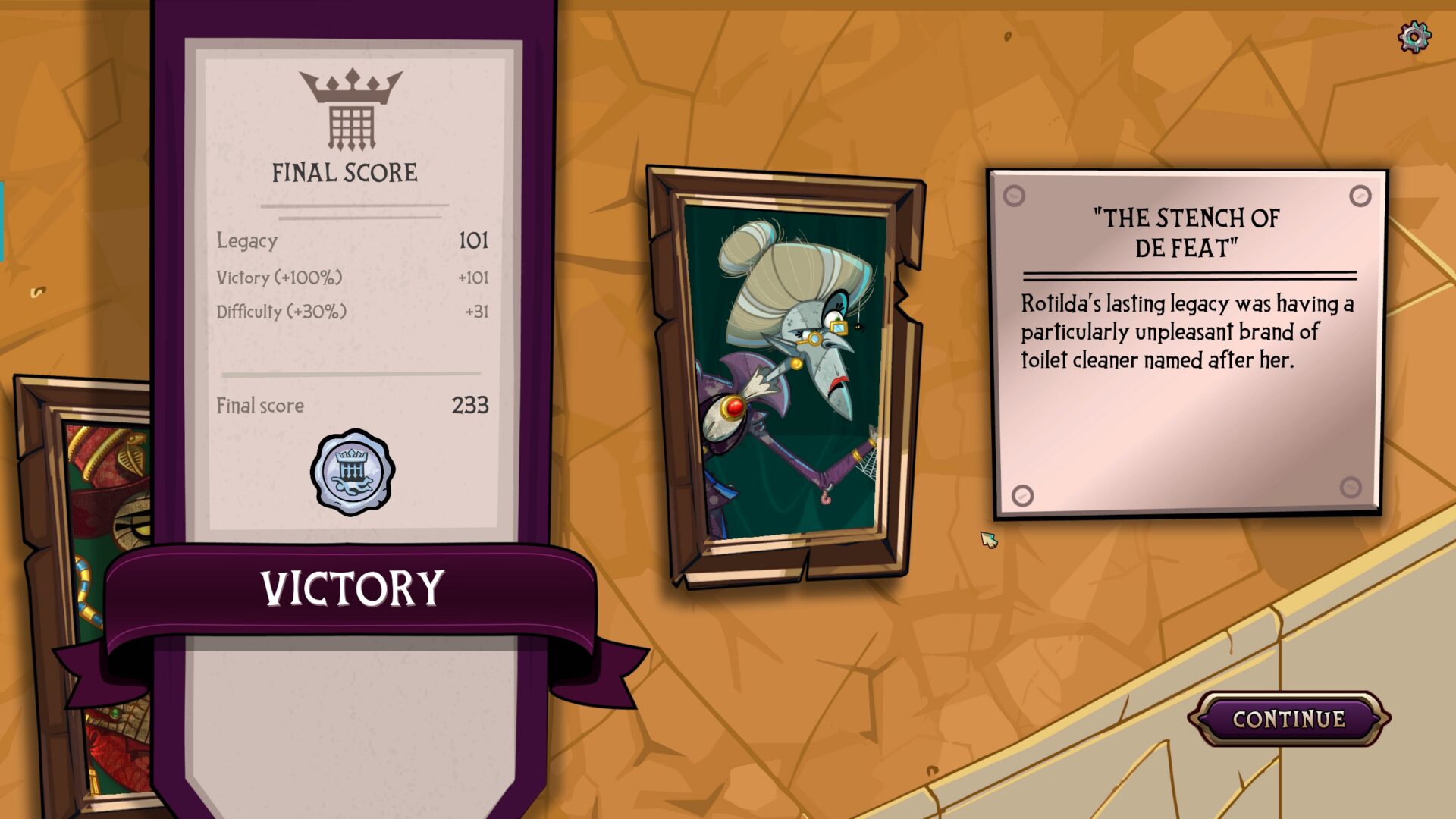
It is a shame, given the variety of debating opponents on offer and their expansive range of tactics and dirty tricks, that the game only provides three playable characters. It’s difficult not to feel a little disappointed when, on unlocking all three, no more are forthcoming. Four difficulty levels and a wide variety of pairings and randomly drawn Tactics Cards ensure that proceedings still feel varied and moreish, but with any luck Cavalier will expand this base offering in time.
Prime Monster initially threatens to collapse under the weight of its overlapping systems, but the density of its ideas – and jokes – ultimately proves to be a winning combination. And by (mostly) relegating run failure to a general election at the end of each multi-debate term in office, Cavalier has reinterpreted the standard roguelike and deckbuilder formulas in a manner that feels uniquely smart, allowing you to come back from the brink of disaster and ensuring every encounter feels meaningful and fraught. Prime Monster turns parliamentary procedure into something that’s equal parts chaotic, strategic, and oddly compelling. Perhaps it isn’t as far removed from reality as that fantasy aesthetic suggests.