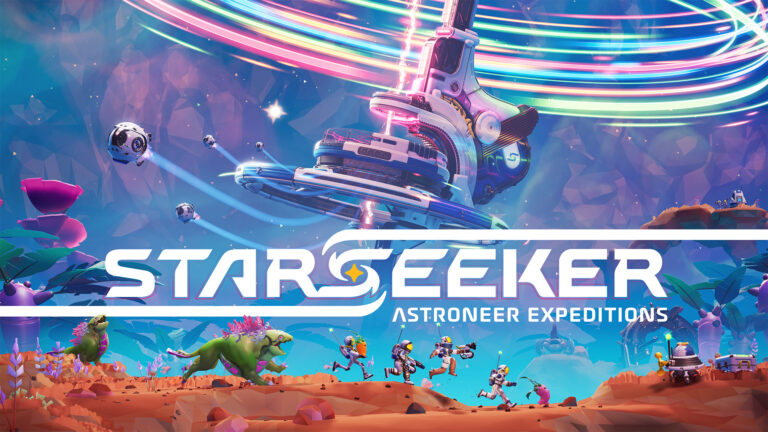

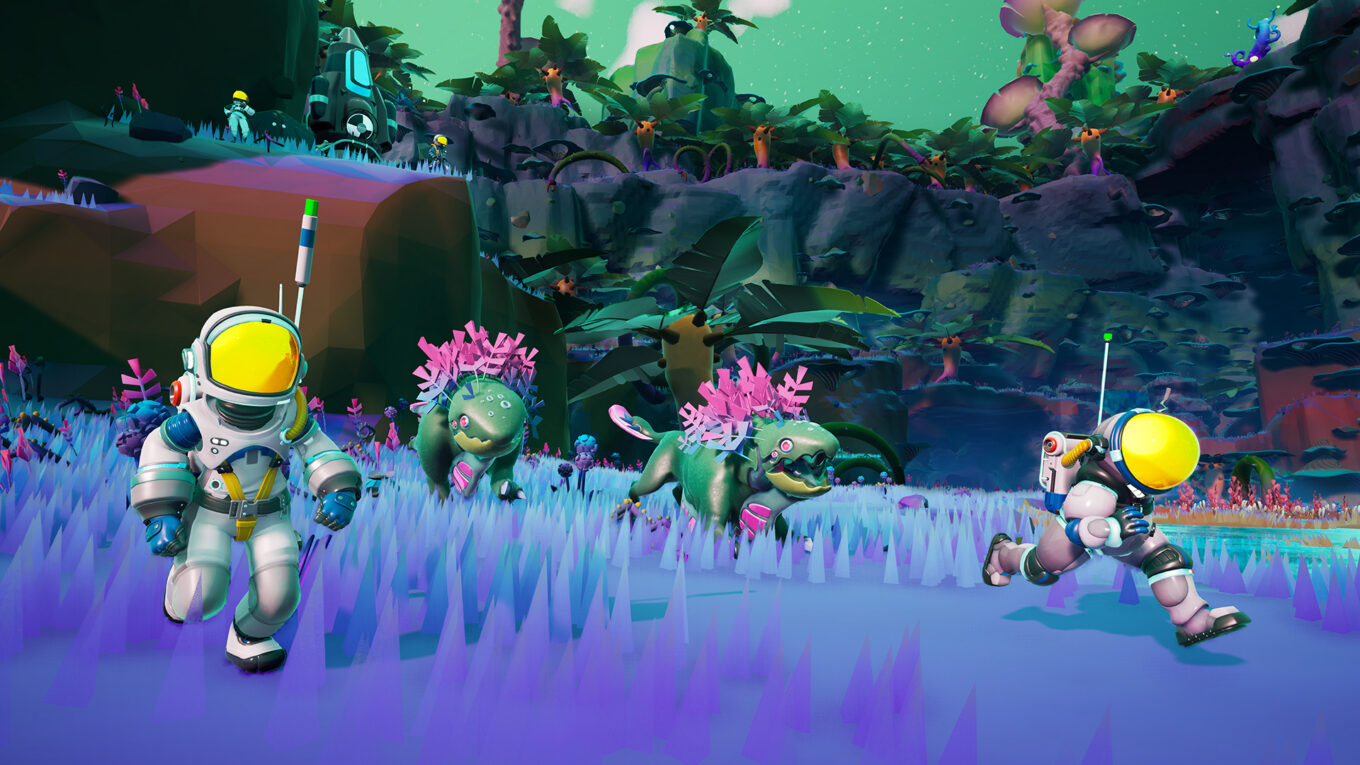
There are five of them now, hulking great beasts that look like muscular geckos covered in colourful blooms. They’re called Bog Hounds, which I learn after scanning one, and bound about with the exuberance and gait of a chunky puppy. Problem is, their apparent high spirits belie a bitey disposition that quickly proves to be fatal if left unaddressed. One way to deal with that is a quick puff of the Air Blast nozzle on my Terrain Tool, after which it becomes possible to approach the temporarily stunned creature and sedate it. That’s all very well when dealing with one of them, of course, but even with our three-person squad it proves nearly impossible to complete the process before another enraged Bog Hound frisks its way over to attack, scuppering our efforts and waking its friend up again in the process.
“We could have turned our Terrain Tools on this thing and killed it,” System Era Softworks co-founder and creative director Adam Bromell explains as we finally get one off to sleep. “But we’re Astroneers, we’re not here to mess up space [and] be little space jerks.”
That’s my cue, it turns out, to accidentally yeet the slumbering creature off a cliff when my finger slips and I Air Blast it again in the confusion. Oh gawd, am I a space jerk?
“Nope, that’s fine,” Bromell laughs. “There’s going to be some chaos.”
What a tonal shift. This gleeful potential for mayhem is perhaps the most striking difference between the notably sedate original Astroneer and the latest entry in the series. The studio’s 2016 (early access) debut was a peaceful affair that featured no combat or enemies – instead, the primary threat was running out of oxygen or power while exploring. Here, the environments contain many more dangers, but this is offset by more dynamic movement and a gleeful sense of planet-wide camaraderie as players adapt to unfolding situations. This is underscored for me during our bog hound struggle by the sympathetic (ish) laughter coming over the radio from a fellow squad elsewhere on the planet, led by System Era COO and executive producer Veronica Peshterianu, who are having a far more tranquil time researching some placid Carrotlings.
“We’ve really tried to make a game that fosters a bond and a sense of community across everybody that plays this game,” Bromell says. “So when I first sat down years ago to pitch it to Brendan [Wilson, System Era co-founder and CEO] it was this game that should feel like it’s massively connected. Co-op PVE, mingleplayer, whatever you want to call it – this is a game where everybody works on the same team even when we’re in different squads. Everything is built around cooperation.”
A problem shared…
To that end, the development team seems to have set about gamifying Trello. “Tasks have shared progress,” Peshterianu elaborates, “so if we complete anything to do with our own tasks or our squad’s tasks, everybody gets progress and a share of the reward. As Adam says, a big motivation is to focus on community goal building and achievement. We want players to run towards each other, not run away from each other, so this is one of the ways we encourage players to stick together and help each other.”
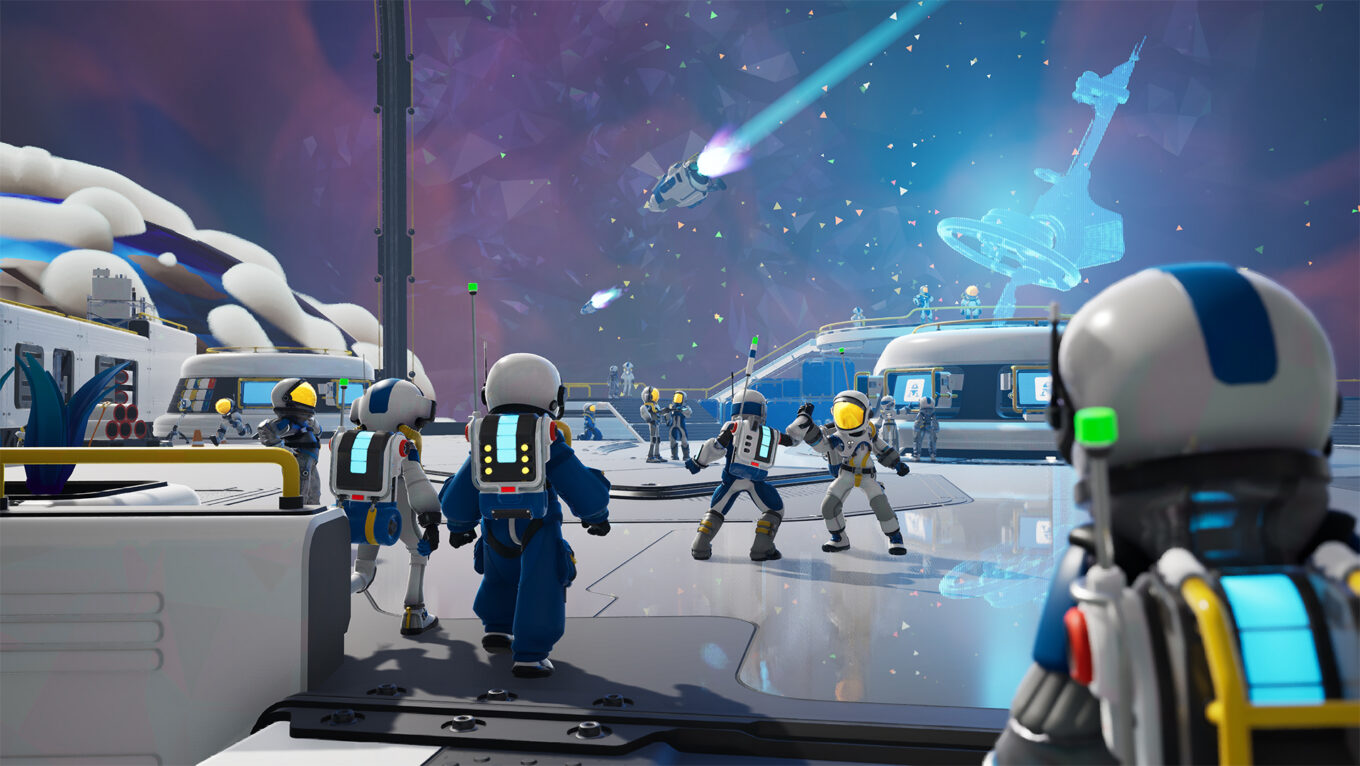
That’s certainly helpful when it comes to post-bog hound mauling revives, but it’s also part of a much, much bigger picture. Interplanetary shenanigans always start on the ESS Starseeker, a sprawling spaceship powered by a mineable resource called Astral Flux which serves as your homebase and means of interplanetary travel. It’s relatively empty during my session, but can support up to 60 players (the team is aiming to push that up to 100 before the game launches) all of whom can form four-person squads before venturing down to a planet’s surface.
Onboard you can interact with various NPC crewmembers, building your reputation with them over time by completing story missions; store collected resources or print more complex ones; craft items and equipment; assign yourself tasks; customise your spacesuit; emote on a pretty groovy looking dancefloor (an irrefutable priority, natch); and hand in Task Tokens, which you earn by completing tasks, at Community Challenge Depot terminals.
It’s this last aspect that reveals the full scale of System Era’s ambitions. There’s a big screen above the terminals that shows how many tokens we’ve collected so far. It’s seven. Seven shiny ticked-off tasks completed as a team on just one sortie, all contributing to our glowing sense of job satisfaction. And if that’s what we achieved on our first trip down, this project should go very smoothly indeed. So how many more tokens do we need to collect? I glance up again. A mere 70,000. Oh…
Set achieveable goals
Even with 100 people working solidly that would take 14.5 days of sleep and mealless back-to-back missions to get through (I’ve done The Maths*). Thank goodness then that our ESS Starseeker is just one of the ship instances chipping away at this mammoth agenda. Any task that is completed across the entire community of players contributes to overall progress, gradually unlocking new landing zones, new continents (like in the first game, planets are fully explorable), and new planets in the local system. When the target is reached and the season ends, the fleet of multiverse ESS Starseekers will jump to a whole new planetary system and set out to explore once again.
“The bones of this game is the extraction loop,” Bromell says. “It’s about throwing all the right items in your backpack, loading up on some objectives with your friends, and then going down on that mission with them to then hopefully find the next landing zone and come back to the station with everything you’ve collected, the information you’ve researched and scanned, and of course earn those tokens to contribute. We call it expedition gameplay because it really is massively cooperative, even though you’re in squads of three or four players.”
This grand social experiment is arriving with impeccable timing. Much has been made recently of Arc Raiders players’ atypical propensity to be kind to each other, and the design decisions that have catalysed that behaviour. There may well be a broad overlap of audiences for both games – despite their wildly different aesthetics, they feature vaguely similar gameplay loops, it’s just that System Era is being more overt in its facilitation of player bonding. That doesn’t mean the team is throwing caution to the wind, however.
“There’s no voice or text chat in the game,” Peshterianu tells us. “We wanted to create a feeling of safety for as many players as possible, so instead we focused on ping and emoting systems that enable you to communicate with people in your squad, and also people you may find on planets or in the ship. You can communicate what you’re up to, what you’d like help with, and what you’ve been able to accomplish.”
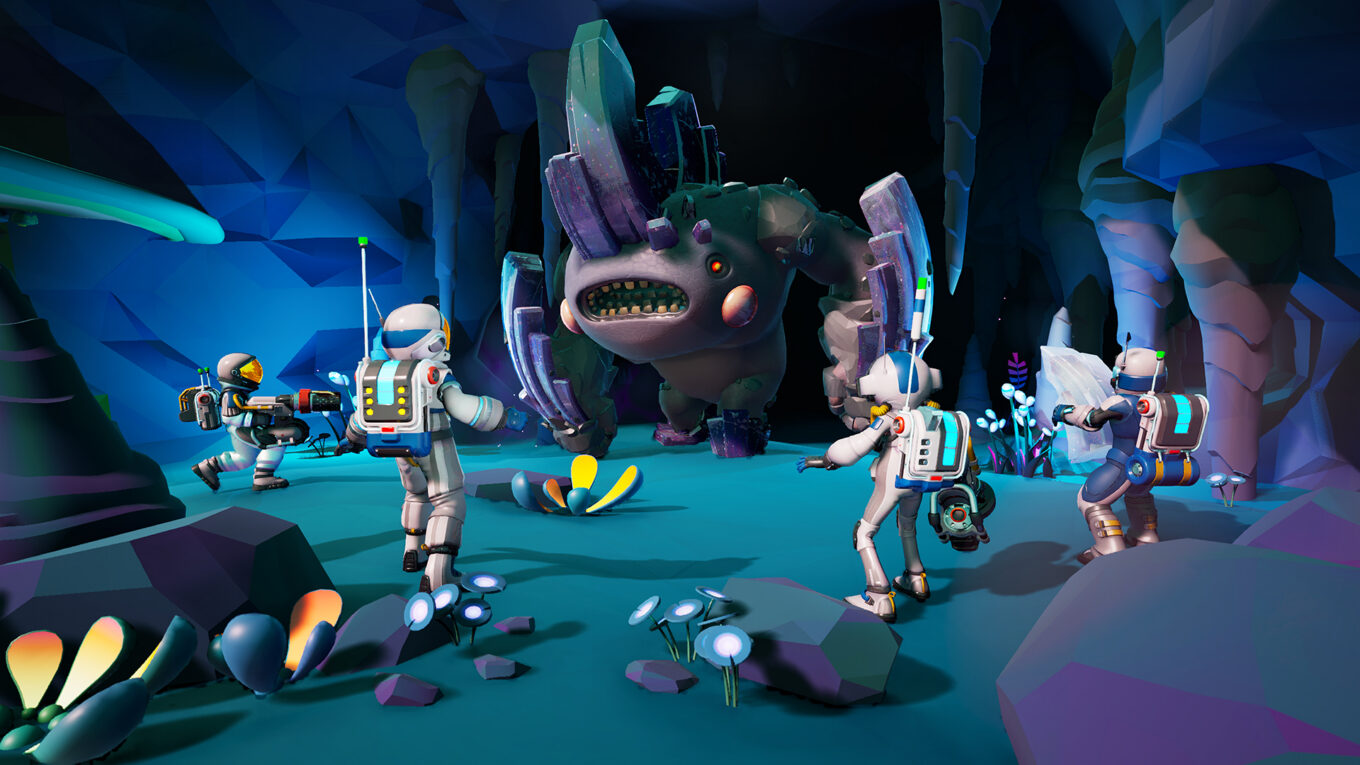
In space, no one can hear you push to talk. Still, it’s an effective system and my squad is able to work together easily to collect Xenocrystals during a time-limited Field Ops mission, one person triggering scans while two of us rush to collect them and then throw the spoils back up a cliff to the device that needs them. Other pings are deployed to point out additional useful resources during this scramble, along with some sleeping Bog Hounds to avoid (we’ve learnt our lesson), and we complete the task quickly and without injury. Chalk one up for HR’s on-the-job health-and-safety training.
Connecting people
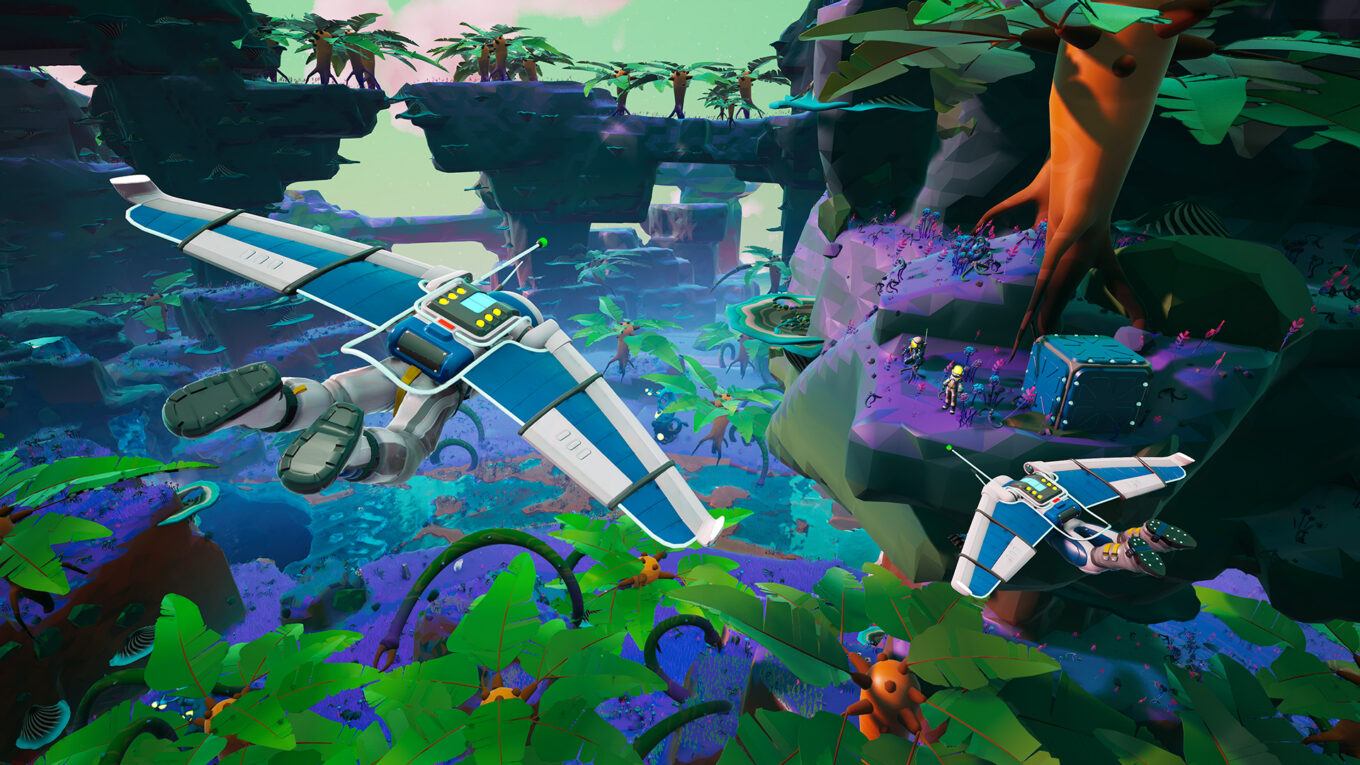
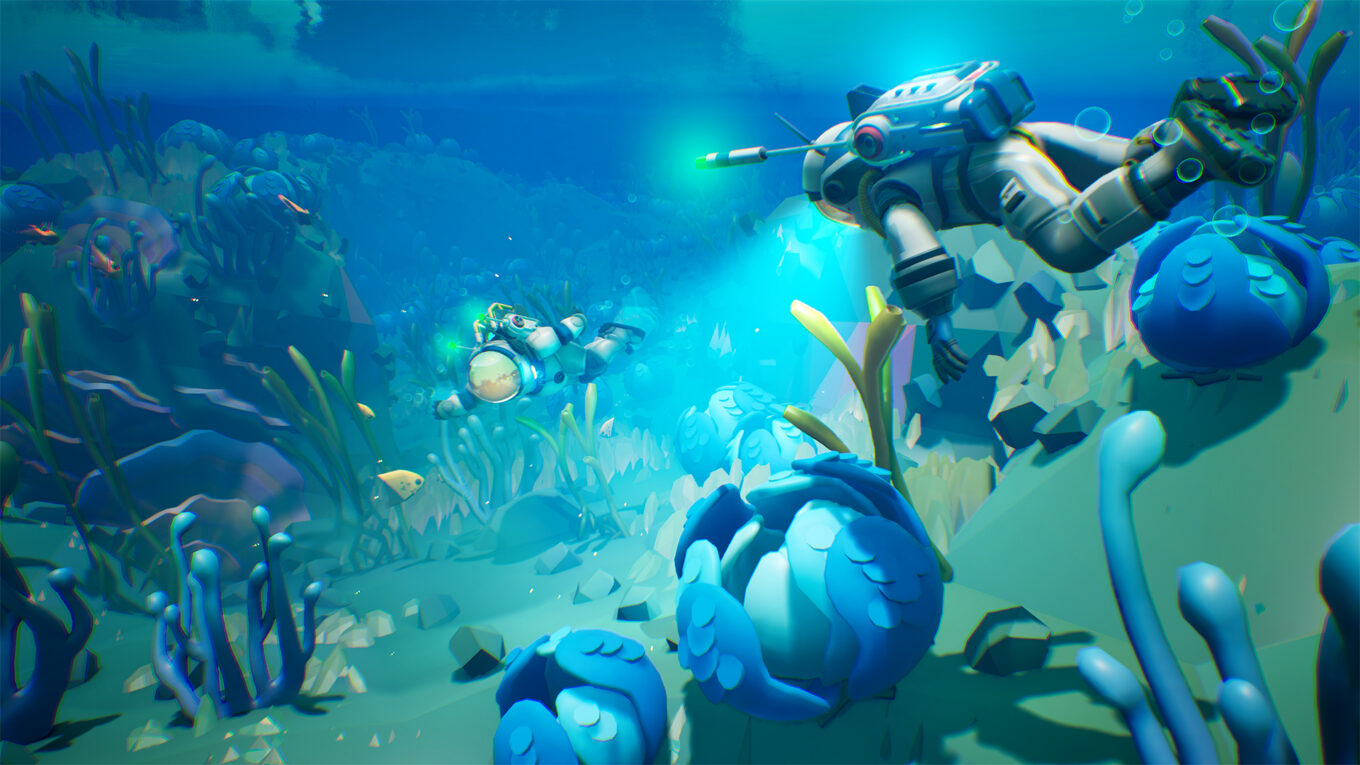
This kind of fast-paced fanning out would have been much more difficult in the first game due to the need to be tethered to your dropship in order to keep your oxygen and power topped up. Breathing remains high up on the to-do list in Starseeker, of course, but this time you have 30 minutes of oxygen in your backpack – represented, similarly to Astroneer, by a depleting blue bar on the back of it – and you’re encouraged to dive in headfirst rather than circumspectly edge further from safety. That doesn’t mean tethers won’t eventually make an appearance, however.
“We’re still tuning that,” Bromell says. “No tethers right now – but they were such an important part of the base-building aspect from Astroneer that, for sure, finding new and fun ways to bring them back to Starseeker as a theme would be great. But for this planet, Tephra, it wasn’t necessary.”
This toss-up neatly characterises Starseeker. The game feels wholly different to its forebear, but still familiar and never incongruous to the experience we enjoyed the first time around. The scale is considerably bigger here, and the studio has gone hog wild packing in more diverse, numerable, and just plain silly things to do, but it’s still possible to imagine almost any component of the first game neatly fitting in somewhere here, too. From this early showing, the sense is that Starseeker expands Astroneer’s universe in a way that is both formidably ambitious but at the same time warmly charming, melding elements of No Man’s Sky and Deep Rock Galactic into a novel sweet spot that is, frankly, absolutely my jam.
*The Maths
Seven tasks completed by seven players in one 30 minute session = average 1 task per session per player
70,000 / 100 = 700 tasks per player
700 x 30 = 21,000 minutes
21,000 / 60 = 350 hours
350 / 24 = 14.58 days
Please don’t email in.