
Go, the ancient and elegant Chinese board game, is often cited as the most difficult tabletop pastime to master. Anyone who has wrestled with the overwhelming torrent of scenario and rule books, flowcharts, campaign sheets, tokens, and status indicators that pour forth from an opened Frosthaven box may dispute that assessment, however. Its complexity is intimidating, but that hasn’t deterred Snapshot Games from attempting to reinterpret its innumerable rulesets as a digital version of the game.

Getting that right is a substantial challenge, but the first part of the journey is nearly over. The studio has confirmed that Frosthaven will leave Early Access on October 15, 2026, and in the wake of that announcement, we caught up with Snapshot Games Head of Production Hristo Petkov and Snapshot CEO and X-COM creator Julian Gollop to dig into the benefits and drawbacks of working with such a cherished property, what tabletop games can teach us about turn-based tactics, and why being right sometimes means you’re wrong.

Hristo Petkov: So obviously there is a huge, huge difference. One of the main reasons that we decided to go with Early Access is because the board game has a very strong fan base, and it’s extremely important to actually please them. Because, of course, we cannot do a one-to-one copy of the board game in digital, but we try to listen as much as possible.
After all, those people will definitely buy the game if we do a good job, right? But it’s a tricky thing to find the right balance that doesn’t make it unplayable for other gamers who are not familiar with the board game. So this was the hard part, because if you listen exclusively to the board game fans, they would want everything to be exactly like in the board game.
So, yeah, it’s very useful. But at the same time, there are a lot of conversations to explain our point of view and why we are making certain decisions. But it was a really great experience to do that. And if I had to make the decision as to whether we go Early Access or not again, I would definitely do it. It was completely useful in our case.
When it comes to an original property, the design feedback is the more important part of the Early Access process – maybe you change some features and so on. Here that is not as important, it’s more about how we present your favorite game in digital space – we’re not changing the physical game. We’re implementing it as closely as possible, but the tricky part is the game interface.

HP: [Laughs]. Yes, but at the same time, from a developer point of view, certainly from my point of view, it’s scarier to go into a project without Early Access because you have one shot, right? And even if you’re good at what you’re doing, even if you’re very confident in the game you’re making, you still need public opinion. If you’re not going with Early Access, you still need to do player tests and so on, so it’s not like you’re completely missing that.
But as I said, there are pluses and minuses because the management of the Early Access is heavy. You need to keep the game playable during the whole period, and you cannot ignore the people because obviously they’re important. So yeah, it’s a lot more management. But obviously we have published a game without using it at this company – Phoenix Point – so it’s completely doable. But even with Phoenix, we were sending builds to backers and we got some feedback from them. So I would normally prefer to go with Early Access, no matter what I’m developing, even though it’s more overhead. I think it leads to a better game.
Julian Gollop: It depends on the type of project, but it is fair to say that with such an enormous and complex project as Frosthaven, that Early Access is really the only way for our small team to manage the final stages of development going into a solid 1.0 release. I am immensely impressed with how our team has managed this, and proves that we made the right decision for a fairly lengthy early access period.

HP: We got the code base of Gloomhaven, so this is built on top of that. We changed just over half of it – so as a base, we knew very closely how it works. We played a lot of Gloomhaven, obviously – we played it in physical and digital, multiplayer and single player. We had four play-session groups in the office, both on Gloomhaven and Frosthaven, with four people playing during work hours.
HP[Laughs]: Not full time, but we were playing almost every day for a couple of hours at least to actually get a good understanding of the game. The game is so complex – not convoluted, but cryptic – let’s put it that way. So for a year and a half after we started, we were finding new stuff that we didn’t know about from our initial analysis. It’s a bit tricky because we didn’t get any behind-the-curtain documentation about it.
We basically got what the players have and – with some help with Isaac [Childres, Gloomhaven and Frosthaven designer], of course. But even with direct contact with the game designer, we had to basically reverse engineer the whole game to actually do it. It was an interesting challenge!
HP: Well, the main takeaway for me – and it’s still a problem now, we’re still working on it – is UI and UX. Basically, Gloomhaven did a decent job of that, but there were some things to be desired there. And with Frosthaven we have an even harder task, because Frosthaven has mechanics that are, let’s say, 50% more complex, and we still needed to present it properly when it comes to UI.
This is basically the reason we have decided to take two more months, just to have more stability, and even more quality-of-life features. But this was the main issue because if you imagine this game at the table, it has so many pieces, so much information. All of that information is available to you, but if I put all of that on the screen, you’ll be completely overwhelmed and have no idea what to do. So this was the biggest concern when we started.
With Gloomhaven they tried to put almost all of it on the screen. But we knew that we couldn’t do that, because Frosthaven has even more [laughs]. So we had to find a way to hide some of the information – it’s still accessible, of course, but that information is for more hardcore players.

HP: [Laughs]. Many! Just to give some perspective compared to Gloomhaven. Gloomhaven has a more structured approach to its scenarios and to its characters, but Frosthaven has way more edge cases. When it comes to scenarios and characters, it’s one big edge case! A lot of the scenarios – we call them quests in our game – are beyond the main campaign, which is considered to end at scenario 64. But a lot of the subsequent quests weren’t designed by Isaac, they were designed by friends of his and so on.
So they’re very creative, and they use the elements of the board game very creatively. A lot of those were really hard to implement. There is one specific one (spoiler!) that is called the Titan. That was really challenging because in the board game it’s described as you climbing a Titan, which obviously doesn’t work in a hex-based grid. We needed to keep the same gameplay as much as possible, but basically we did it like you’re inside the Titan and there is a magnetic field that pushes you down, because in the original scenario you fall if there is nothing below you because you’re climbing. So in this case we couldn’t do it, and we had to change the premise a little – but the gameplay is still the same.
There are also other challenges with multiple-level battles, like going below deck on a ship. There are a lot of these cases that are really problematic to execute in a 2D, hex-based game without hugely changing the engine. It’s not impossible – we did make some of the quests take place on different layers, but it creates a lot of problems with navigation between those layers – jumping up and down, climbing and so on. It takes a lot more work to be able to execute on such things. There were quite a lot of challenges, let’s put it that way!
JG: We very much wanted a faithful adaptation of the boardgame, but inevitably there had to be a few compromises for a digital adaptation. Many of these were small things, to ease the flow of the game, especially when playing with others, such as the resource sharing. The biggest challenge was probably how to implement the puzzle book, which the boardgame players found quite challenging. We changed its purpose, to provide guidance rather than requiring solutions to progress. However, there were also quite a number of small changes to scenario implementation, in some cases improvements on the boardgame, but always with the collaboration of Isaac.
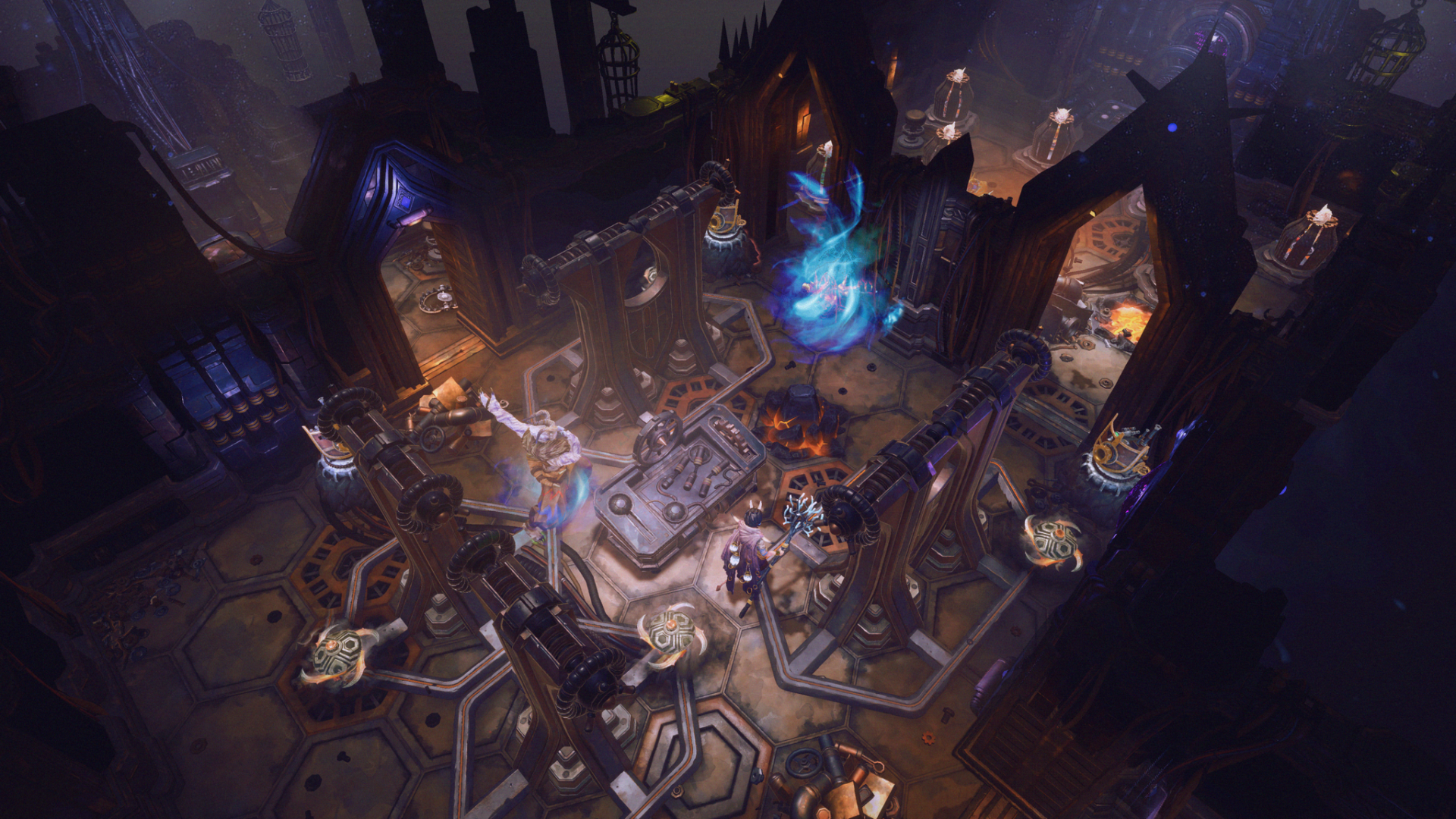
HP: There are some changes, but we are trying to keep them to a minimum. As I said, the game community really likes the game, so they don’t want it to be changed. Where it made sense, we did – but I would say no more than two to three percent of the game. So it’s a very small part.
In that regard we have spoken with Isaac about the fact that when it comes to the board game, you print it and it’s out. It’s kind of hard to patch it. In our case, with certain scenarios where the balance is a little bit off, we might want to make some changes. This is, of course, something that we communicate to the players, and they want it, because it is known that this and this and this scenario have some issues. And players house rule them normally.
We can do those. We’re not focusing on that, but after release we can do those and change them as the players want. But in general our philosophy is that if we’re making any changes that are contradictory in any way, we put them in the options so that you can switch between the two and you can play it however you want. Similar to how you play the board game – basically, you can decide how to play it.
Actually, this was one of the biggest problems we have had with the game when it comes to getting negative feedback. Some negative feedback is people saying ‘this doesn’t work as expected’, but it turns out that the player just played it wrong in the board game!
HP: Yeah! But it’s tricky to explain that to them, because they’re saying ‘your game is too hard’ or something like that and we’re like, ‘but it’s exactly as it’s described’. It’s funny, but it creates a lot of problems. Getting negative reviews because of where the game is an exact copy is kind of bad, but it happens!
HP: Oh, that’s tough! There are a lot of small things. I wouldn’t say there is anything really particularly big when it comes to rule changes… Okay, one small change is to the ruleset on the second scenario, very early on. There is an ally, and if they die you lose the mission.
Normally, in most scenarios where there is an ally there is a way to prevent this damage by sacrificing a card or two from your hand, or something like this. The specific rule is not that important, but there is a rule to prevent damage to the ally. But in this scenario, there is no such rule. It’s very early and it’s very annoying that you’re not able to do that. So we made it so that in every scenario that there is an ally, you can prevent the damage by this exact manner.
As for players complaining about something that they think isn’t working as intended, the most common thing is movement. Because the movement and AI rules of the games are very complex, and normally in the physical game you do the maths, sometimes people do it wrong and end up playing an easier game. So when they start playing digital, they start on the same difficulty and get demolished because the game doesn’t do what they expect it to do.
That’s why we put in another difficulty level that’s easier than the board game. But, even though we changed the name so that it doesn’t sound that bad, nobody wants to play the easiest difficulty, right? To be fair, I really love playing on the easiest difficulty because it gives me more leeway to enjoy the game. If you want to be more tactical, sure, play on whatever difficulty you want. I’ve played on the highest difficulty as well, and it’s a different game, a different challenge.
It’s a different challenge. But you know how gamers are, they don’t want to be the weakest!

JG: One thing that impressed me was that there is always room for innovation. Frosthaven and Gloomhaven employ a unique card driven action mechanic that is at the core of the game play. It is a classic example of giving players limited, but meaningful choices in every turn they take.
HP: Hmm, interesting. Obviously I have good experience with turn-based tactical gameplay from Phoenix Point and even before that. But the design of Frosthaven is a little bit different than the standard way tactical games, like XCOM, are approached. What I mean by that is that it feels more like a puzzle tactical game, because you have a certain number of turns to solve a given situation.
In terms of real life, it’s long – let’s say one mission takes half an hour or more – but that isn’t a lot of turns. It maybe takes ten turns to actually finish a whole scenario. So in terms of my background as a designer, what it taught me is that you can find the right balance to ensure a tactical game can feel challenging until the very end. That’s actually doable.
You know, when you play other tactical games, it is often the case that very early on in the mission you already know how it is going to end. And that’s not really the case with Frosthaven – you can barely lose or barely win every single mission. I would say that’s great, amazing balancing design from Isaac.
When it comes to production, what it taught me is that the hardest part about interpreting such a huge tactical game is the importance of having an overview of the whole game at the same time. It’s not really possible to work piece by piece as everything is interconnected. For us, more time spent on untangling the game early on would have been useful in the long term.

HP: It’s not physical, but mostly because we have hybrid working. Obviously the board game is in the office, but mostly it’s a tons of charts in Google that show the relationship between scenarios, mechanics, and so on. So a lot of tables, a lot of spreadsheets, and a lot of drawings.
It’s part of the design work that is kind of interesting for some, and maybe very not as much for others. Some of it’s a little bit more on the boring side, I would say, because it’s analytical work.
For example, we have huge spreadsheets for narration, for relations between narrations, and pictures for those narrations and so on.
So there are spreadsheets on top of spreadsheets on top of spreadsheets!
HP: So, there’s as much work in either case. But it’s a different challenge. In the first case the challenge is mostly about understanding somebody else’s work, and interpreting it in your own way. And because, in the case of Frosthaven, it’s very big, it’s an exercise of execution. It’s a lot of content: like, 17 characters, 137 scenarios. It’s a huge thing. So yeah, untangling that is really the big challenge.
But in the second case, like you said, it’s better in that regard because you are building it, but the issue becomes about testing it, and knowing that it works. Because with Frosthaven, we know it works – it’s a great game that’s already sold tons of copies. We ‘just’ need to make it for digital, and we know it’ll work. But with an original project the design is always in question.

JG: I am greatly looking forward to Star Wars Zero Company, and the core tactical combat looks like an evolution of the Firaxis XCOM, which of course was an evolution of my original X-COM. I can’t say much about it until I get to play it, but I am very happy that the squad-based, turn-based tactical strategy game is still going strong to this day. May it continue to be the best genre in videogames!