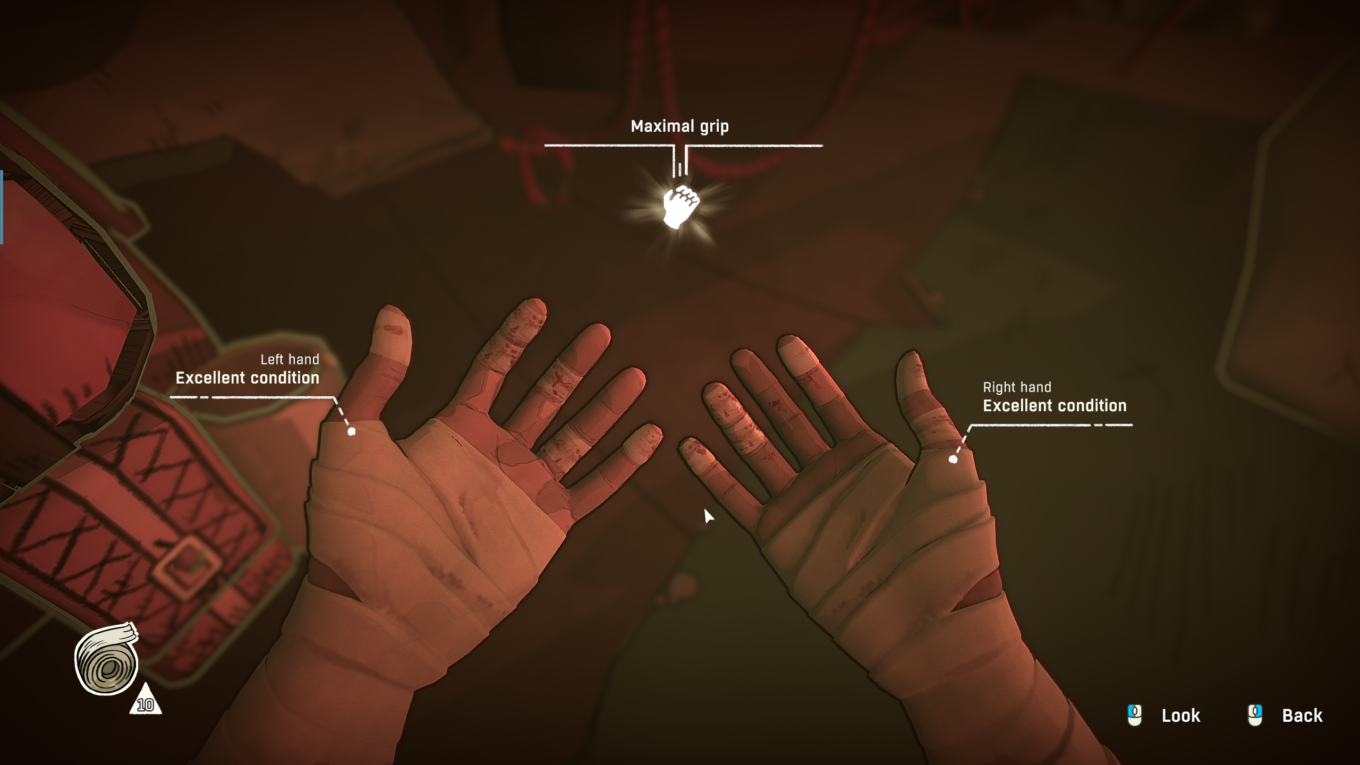
Slow, concentric circles. Each rotation wraps another thin layer of tape around burning, lacerated fingers. The process is delicate, methodical – almost meditative. But it also serves to hide the damage inflicted by an arduous mountain ascent, burying the obvious warning signs in order to stave off having to deal with the cost of a pathological obsession. It’s in these moments, as you painstakingly pivot the left analogue stick in step with the unhurried animation on screen, that protagonist Aava’s dilemma is distilled: continue to chase the only high that’s ever made sense of life, or suppress an unslakable drive not just for the sake of her own wellbeing, but for that of her loved ones, too.
Aava is young and passionate, but world weary – a storied professional climber who struggles with the commercial machine that goes hand-in-hand with her success. Her relationship with partner Naomi is strained by the distance and danger imposed by her career, and she finds it difficult to relate to anyone that doesn’t climb with the unshakeable belief that they will reach the top of the route. It makes her spiky, standoffish, and a refreshingly unsympathetic (at least, initially) main character. And it is against this backdrop that Aava intends to embark on her greatest challenge yet: scaling the imposing Kami, a mountain that has cost the lives of the majority of people who have attempted its summit.
But before all of that, the game begins in a climbing gym. There’s something uniquely exciting about encountering a familiar environment in a videogame. As a UK resident, I’m usually (happily) exposed to other parts of the world or, indeed, parts of other worlds. But along the way there will be little moments of recognition such as gadding about London in The Getaway or Watch Dogs: Legion, exploring a lonely but idyllic Shropshire village in Everybody’s Gone To The Rapture, or hooning around a shrunken Scotland in 2018’s Forza Horizon 4. As someone who has spent the past four years banging their head (and hands, and knuckles, and toes, and shins) against polyurethane resin holds while trying to improve my bouldering grade – even breaking my leg in the process once – this opening location felt like a warm welcome.
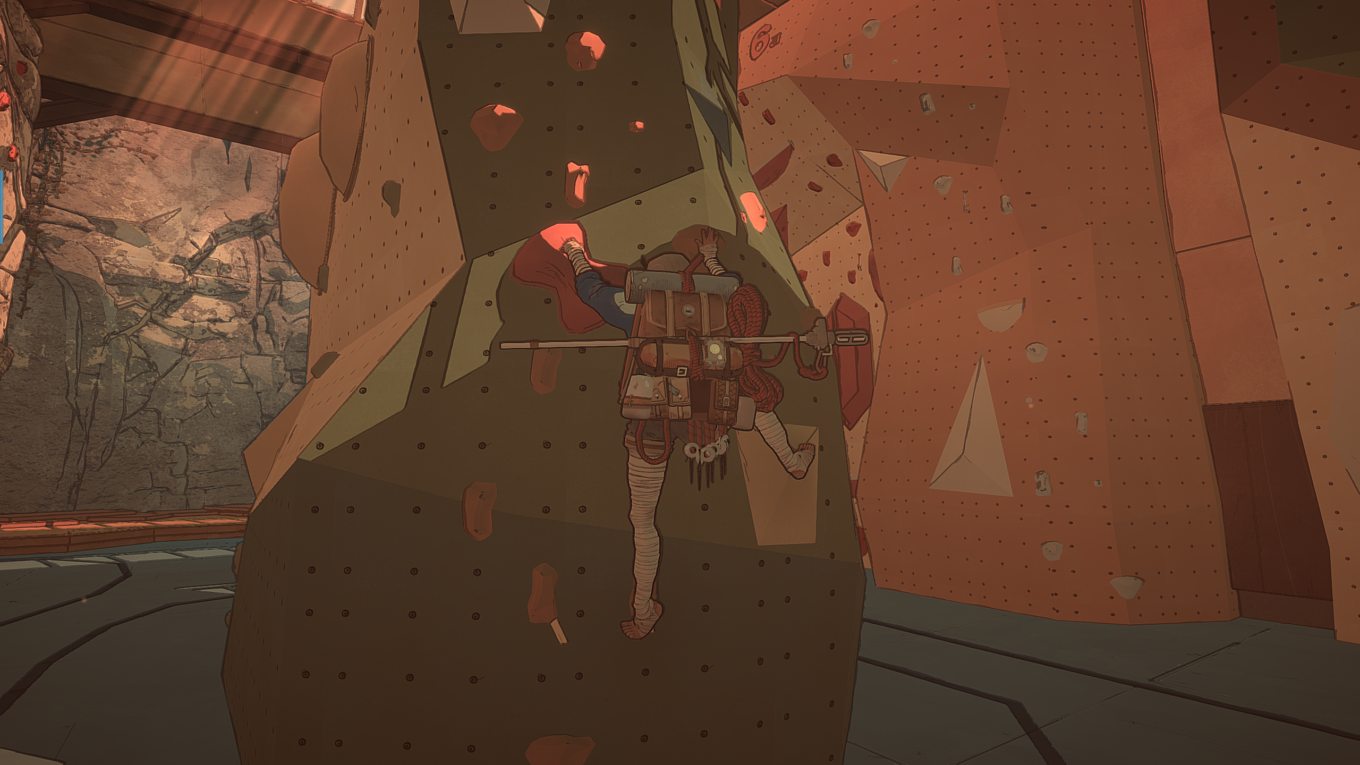
It’s also the perfect introduction to Cairn’s unique twist on an established control scheme. Walk over to any wall and hit X (French developer The Game Bakers, also responsible for Haven and Furi, recommends using a controller for the best experience) and you’ll enter climbing mode, connecting one of your limbs to the wall. The game then assesses which limb should move next based on the forces being applied, and you use the left stick to position yourself before tapping X again to grab a hold or rest a hand or foot against the surface. Unlike many other games that give you individual control of your limbs – think Baby Steps, Mount Your Friends, or QWOP – Cairn doesn’t set out to obfuscate mobility to hilariously frustrating effect, but instead aims to provide you with the necessary precision needed to tackle its daunting challenge.
At first, this setup feels intuitive, but as the climbing became more involved, I often found myself disagreeing with the selected limb. There are a number of alternative control schemes which fix this by allowing you to choose the next limb you want to move while holding RB. Switching on any of these raises the overall difficulty a little, but they work well in conjunction with the standard controls to provide more nuance in your route finding. It’s an enormously satisfying and surprisingly flexible system which, while stopping short of letting you do brash and extravagant dynos, consistently rewards your creativity. You don’t have to stick to obvious holds – you can smear (pressing your feet against featureless sections of rock), crack climb (forcing your hands and feet into the same vertical fissure), and even ascend chimneys (portions of a route with two opposing surfaces against which you can push to shimmy upwards).
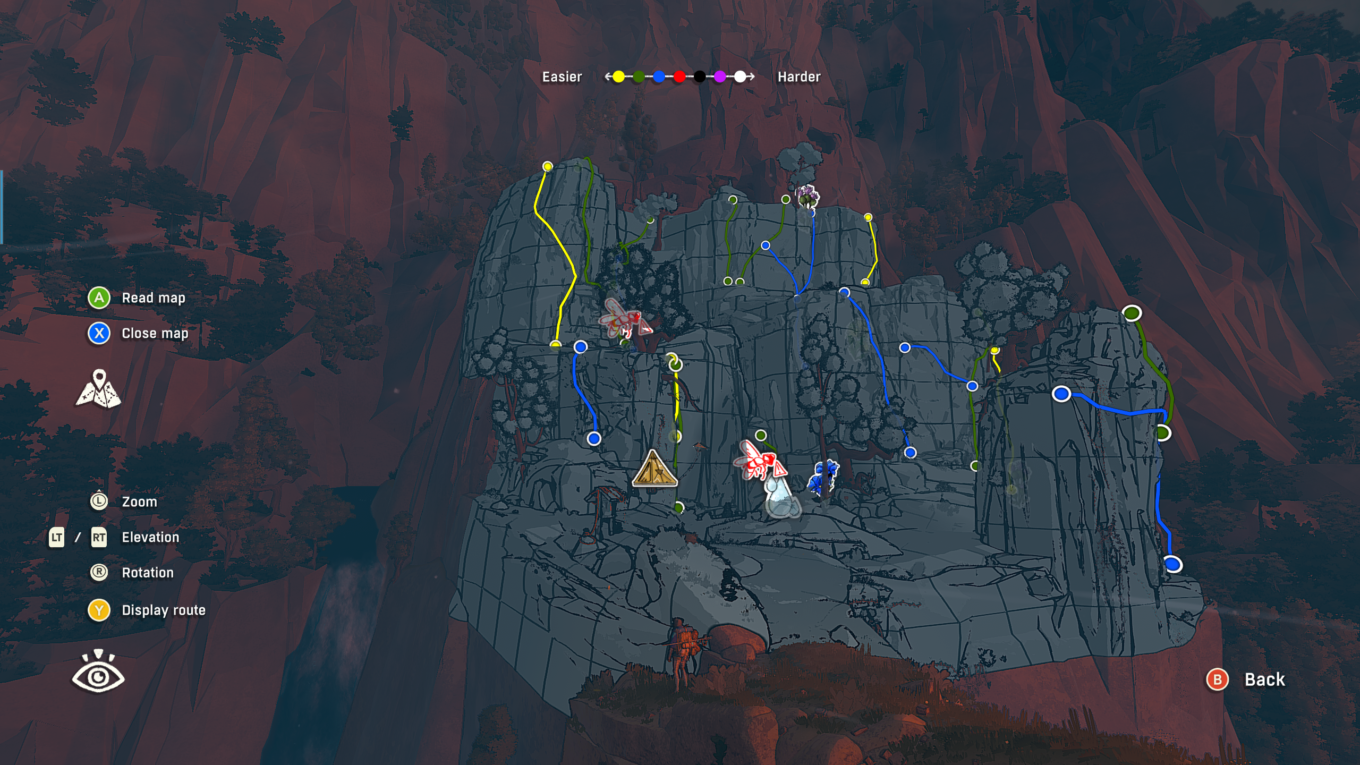
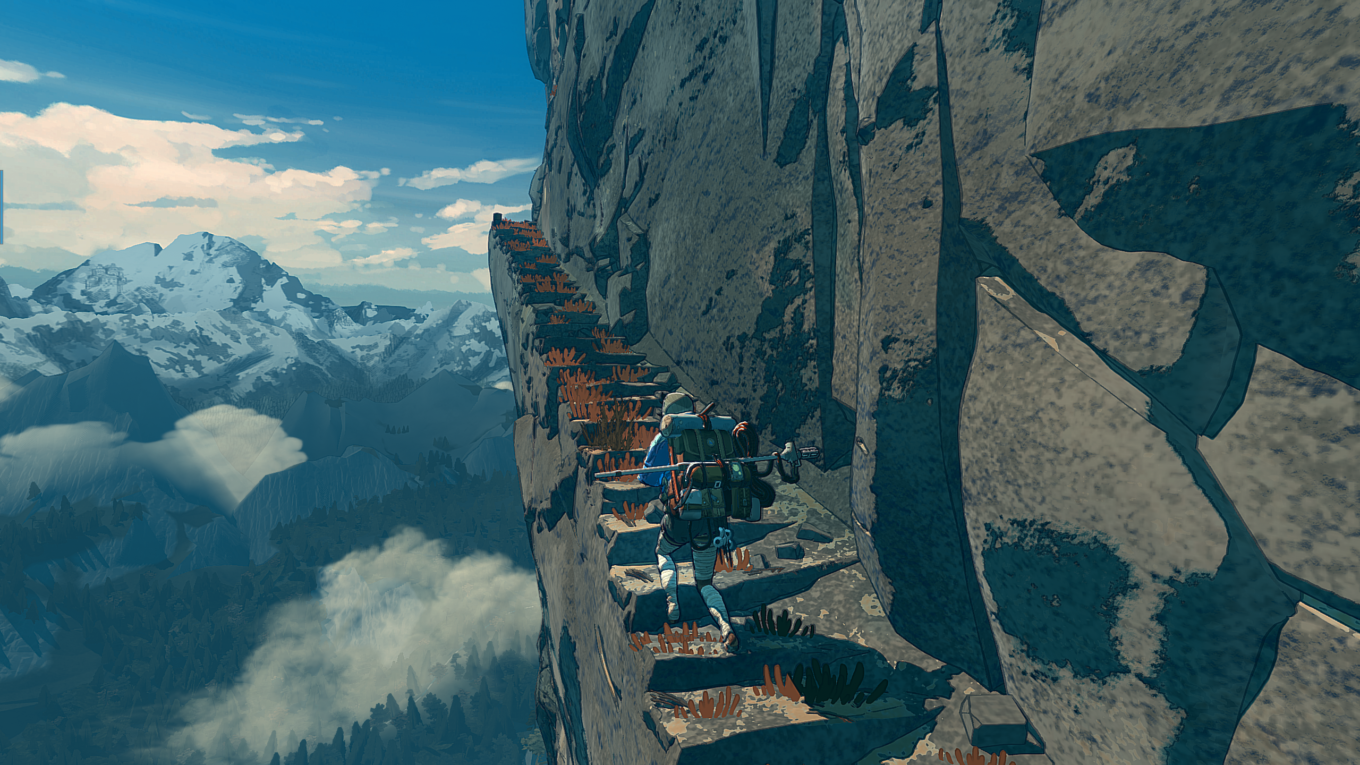
As the range of options available to you becomes clear, Cairn starts to feel like an unusually generous sandbox. This is underscored by the fact that Kami is rendered in its entirety from the off (a particularly lovely touch is that you can switch to a route view at any point and see your whole path) and that every portion offers a range of routes at varying difficulties. You can curate your own experience, even shortcutting some of the climbing by trekking at points – though this usually comes at the cost of taking a less direct route, and Aava has to lug a heavy backpack so can’t run for long.
While my fear of heights means I stick to low-altitude bouldering in real life, Aava is significantly braver. This means tackling inordinately long pitches of rockface, and as such, it’s helpful to clip in at points by drilling a piton into the wall. You do so by tapping a button as a bar moves left and right – stop it in the sweet spot and you drill it in perfectly, miss it by various margins and you’ll either bend or break these precious resources. Nailing a minigame becomes the stuff of nightmares when your grip is slipping, and adds even more pressure to every moment you spend on the wall. You can carry half a dozen pitons, and they function as mobile save points of a sort (actual save points are found at specific points on the rock face or plateaus), meaning you only fall so far if something goes wrong.
Off belaying also allows you to rest and recover stamina, as well as access your backpack to have a snack – it’s important to maintain Aava’s hunger, thirst, and warmth levels as if any of them drop too low you’ll find it much harder to accurately drill in pitons or grip the wall, and you may even blackout. Not ideal while thousands of meters up a cliff.
You have a little robot helper to act as your belayer, and it will go and retrieve pitons for you, but they’ll often come back damaged. This multi-function marvel can repair them using gathered parts, however, as well as create grip-improving chalk from litter you find or generate, and even take messages – during your ascent you’ll regularly receive calls from Naomi, along with your exasperated agent Chris, a man with the kind of personality that makes a fatal fall seem appealing.
There are sections of the climb where you must traverse rock that is simply too hard for pitons, turning the game into a nailbiting free-solo experience. And because of breakages, you might find yourself in a similar position to me, having used the only three pitons you had left just a fifth of the way up The Peril, a prolonged and aptly named pitch which is completely exposed. What followed were 15 minutes of terror and hard-won progress as I made every move in the knowledge that falling would set my progress back to a spirit-sapping degree. It was at this point that I genuinely considered getting my real chalkbag out to help grip a now ridiculously sweaty controller.
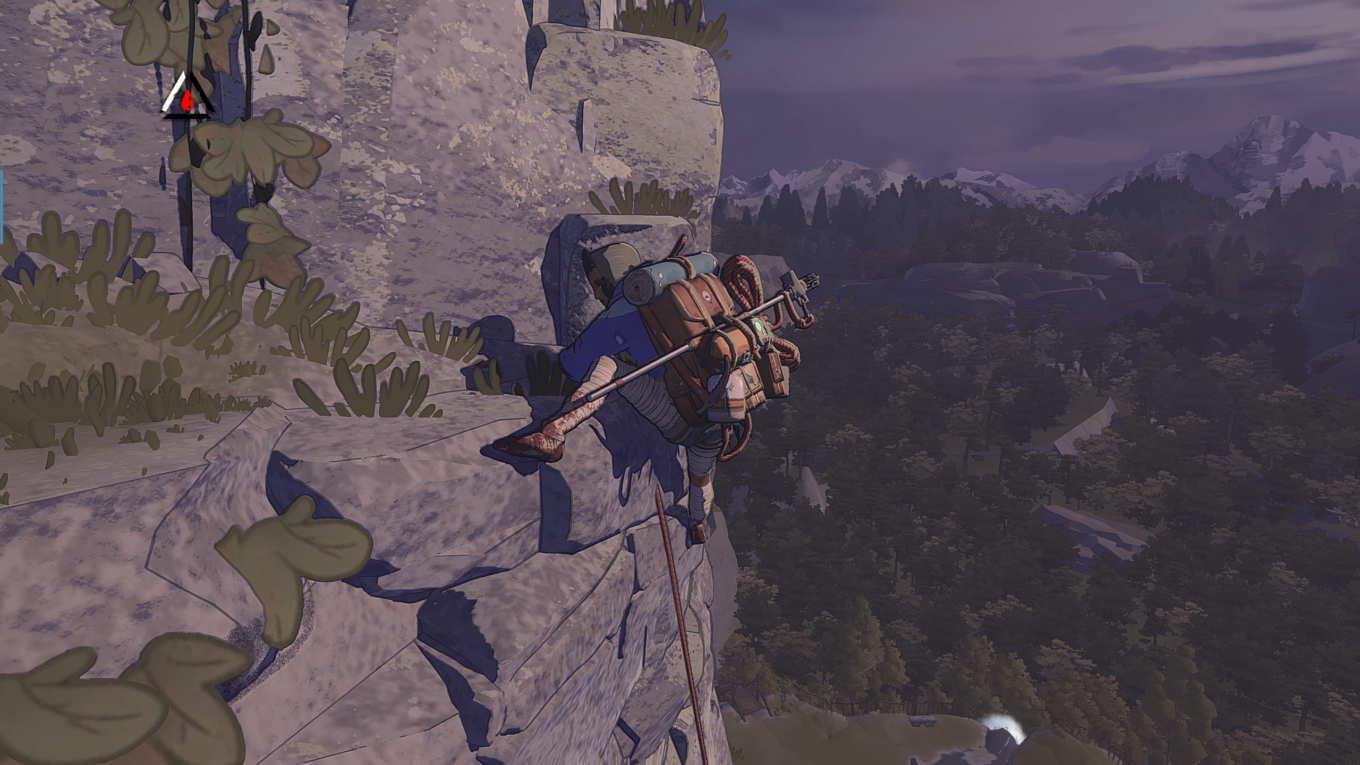
Which is a good moment to mention the profound sense of relief and achievement you feel any time you crest a plateau or reach some form of safety. Cairn asks much of its players, but pays back that investment with some of the most rewarding moments in any videogame. Aava’s stress on the wall is telegraphed not via UI elements, but through her wobbly limbs, little footslips, and pained exclamations – the sense of urgency this generates in such an unhurried and methodical game is remarkable.
Cairn’s various elements don’t always gel perfectly. Aside from those limb prioritisation issues, there are points where you find that you have folded her into physically impossible and quite upsetting-looking stress positions. And there are moments when Aava fails to realise that you have reached level ground and continues to cling to the wall for dear life, like a fawn taking its first steps, adding a bit of accidental comedy which chips away at the otherwise immaculate atmosphere. You can also shake out limbs to reduce pump – a great mechanic that must be carefully managed – but the game is a little too generous with it, allowing you to buy time even in situations when all of your limbs are in terrible positions.
These are minor complaints, however, arising from a bold and innovative control scheme that performs brilliantly for the most part. And besides, the game has a way of making you feel guilty if you exploit any of these loopholes – Aava’s commitment is so inspiringly complete that you feel like you’re letting her down if you don’t also give it comparable welly.
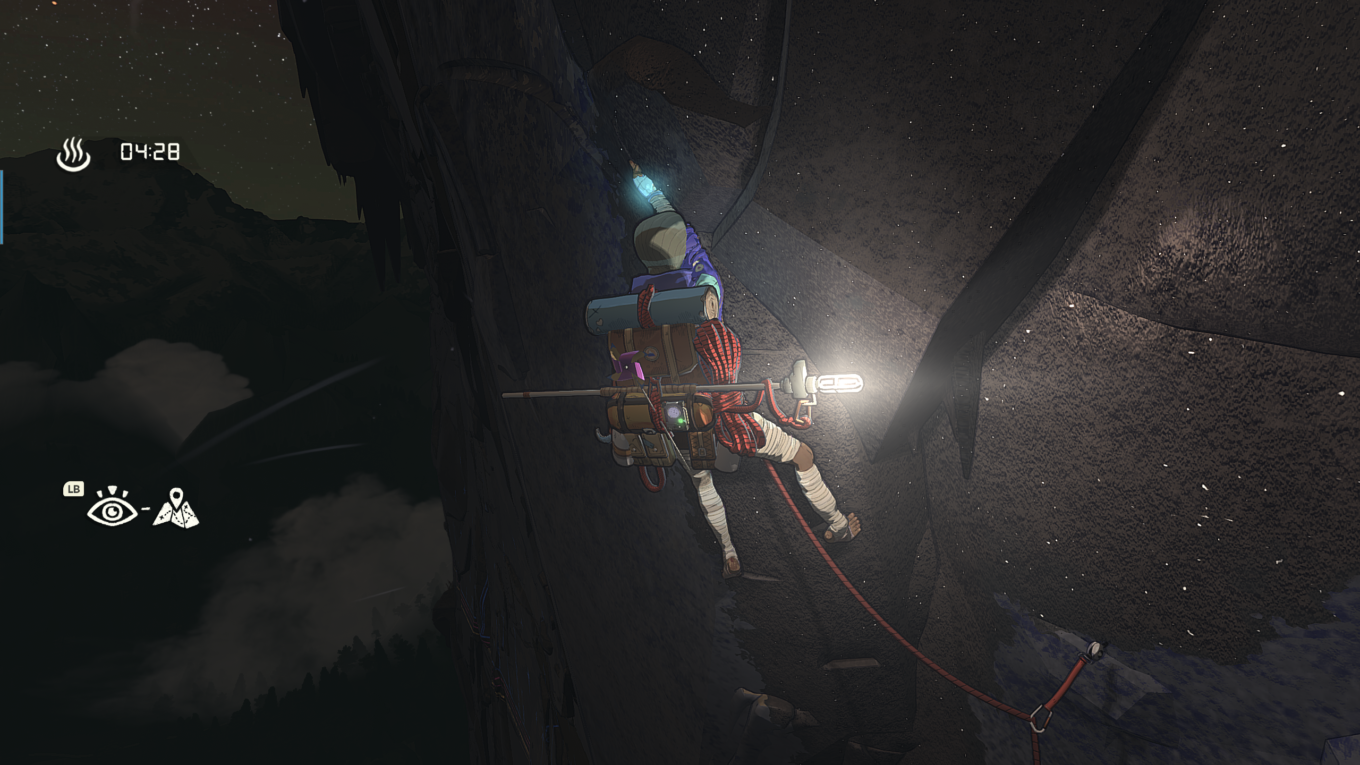
As if all of this wasn’t already challenging enough, Cairn throws in a day/night cycle and weather conditions to deal with as well. It’s much harder to spot holds in the dark, and you may want to consider sleeping until first light in a bivouac set up at one of the save points. If you’re feeling brave or impatient, though, you have a backpack-mounted light (and curious climbers may be rewarded with other light-giving items if they explore off the beaten path…) to dimly illuminate the way. Fog creates similar issues, of course, and rain makes an already arduous task even more difficult as the rockface becomes perilously slippery.
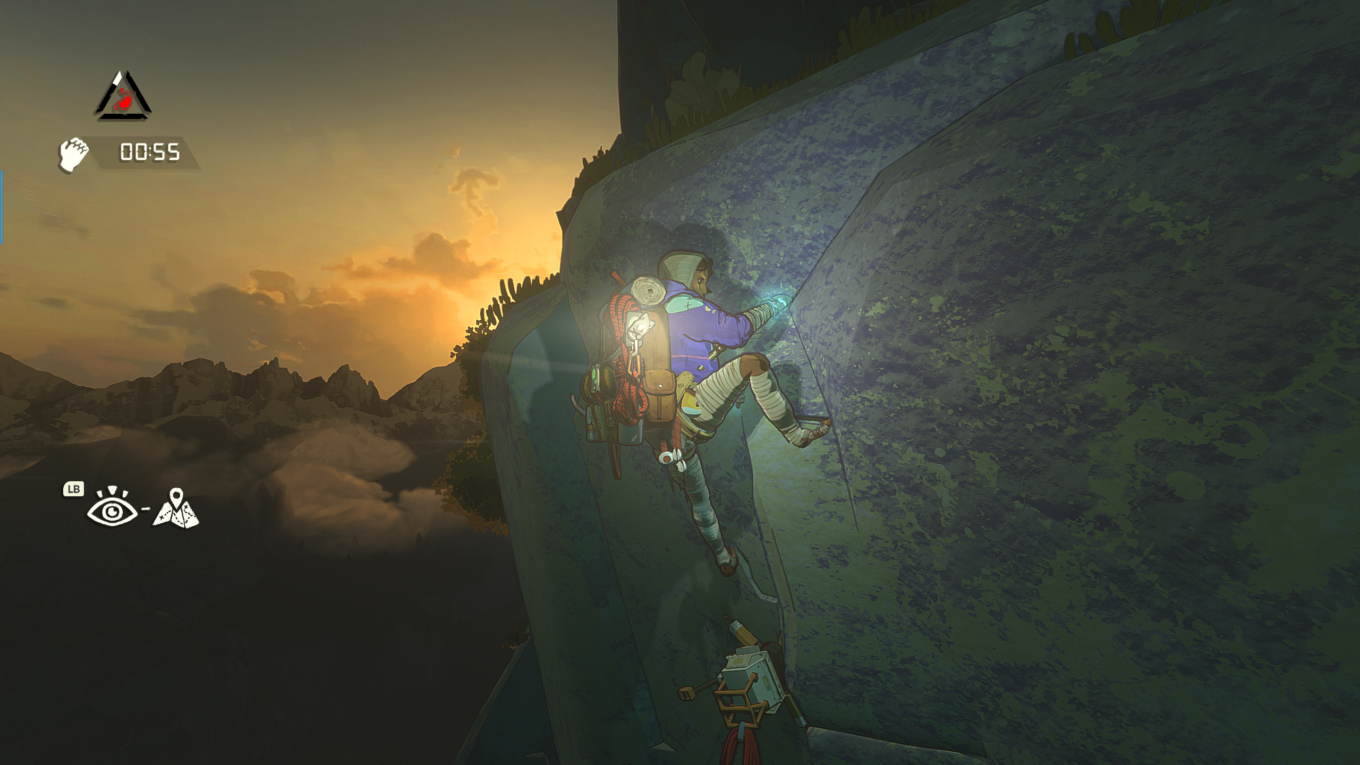
Climbing isn’t the only focus, though. You’ll need to seek out sources of water to keep your bottles topped up and cook food in your bivouac, regularly check in on the condition of your hands and assess if more tape is needed, and manage your backpack (within which items tumble about freely and must be shaken up to make space – a refreshing change from the usual grid system). You’ll meet a few other characters along the way, too, but it’s best to avoid spoilers there.
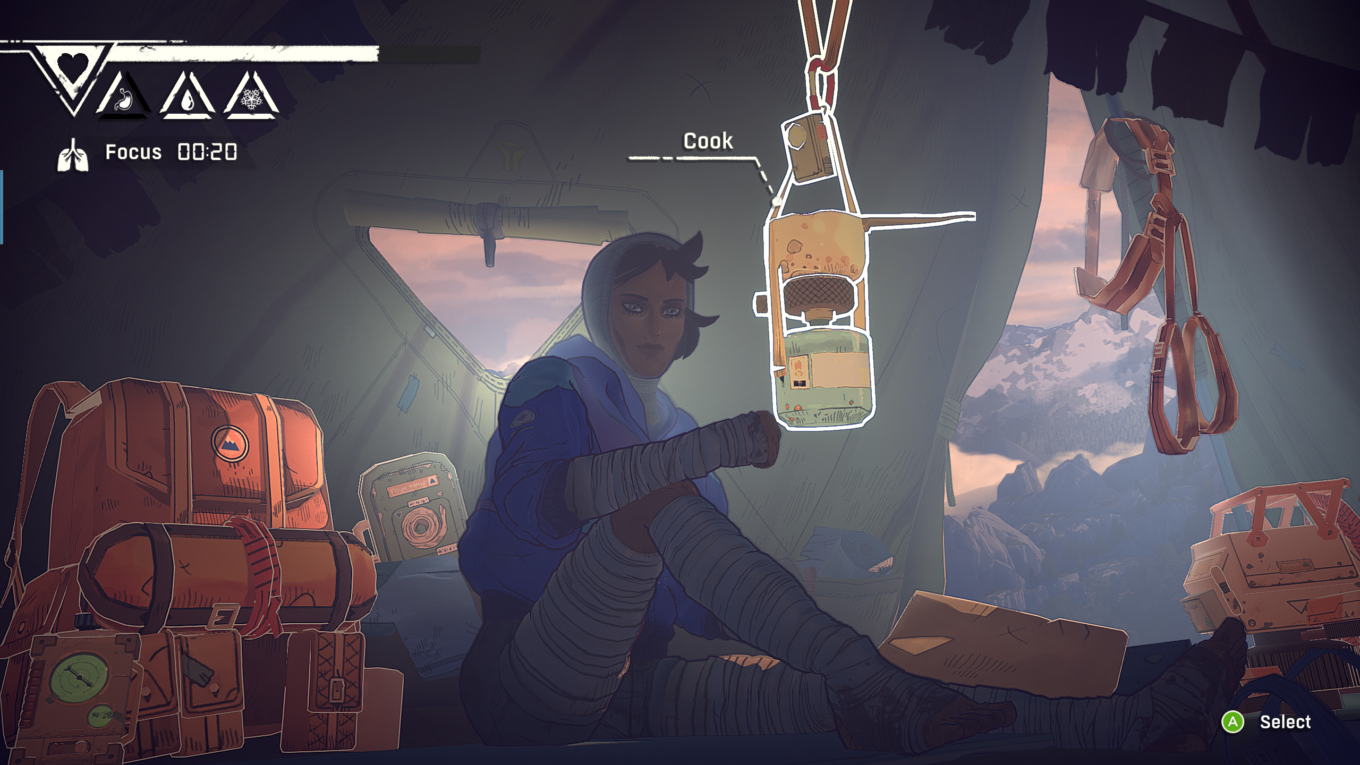
There are also regular resting spots that let you take in the gorgeous views (or even launch some fireworks, if you’re feeling particularly antisocial) and which showcase Cairn’s magnificent visuals. The game is consistently beautiful, whatever the conditions, and delivers an art style that manages to balance an earthy, naturalistic aesthetic with genuine readability. I was particularly taken with the LOD effects which, when gawping across long distances, make the game look like a ‘20s Art Deco poster. The sound design deserves a special mention, too, created by a team headed up by Martin Stig Andersen, the talented chap behind Limbo and Inside’s audio.
While the game builds on a number of established ideas that we’ve seen elsewhere, Cairn still manages to feel like something entirely new. Your connection with Aava is uniquely effective, to the point I ended up day dreaming about how this control scheme could be applied to other games in the future. Kami is also memorable, whether because of its sheer scale, its rendering persistence, or the exceptional level design that has gone into crafting its simultaneously intricate and imposing construction.
Cairn makes you feel supremely powerful and dangerously vulnerable all at once. In striking this balance so apparently effortlessly, The Game Bakers has succeeded in creating a game that is brutally unforgiving but which rarely frustrates. Everybody should give it a go, and as a result you might even find that the call of the climbing wall becomes impossible to resist, too.