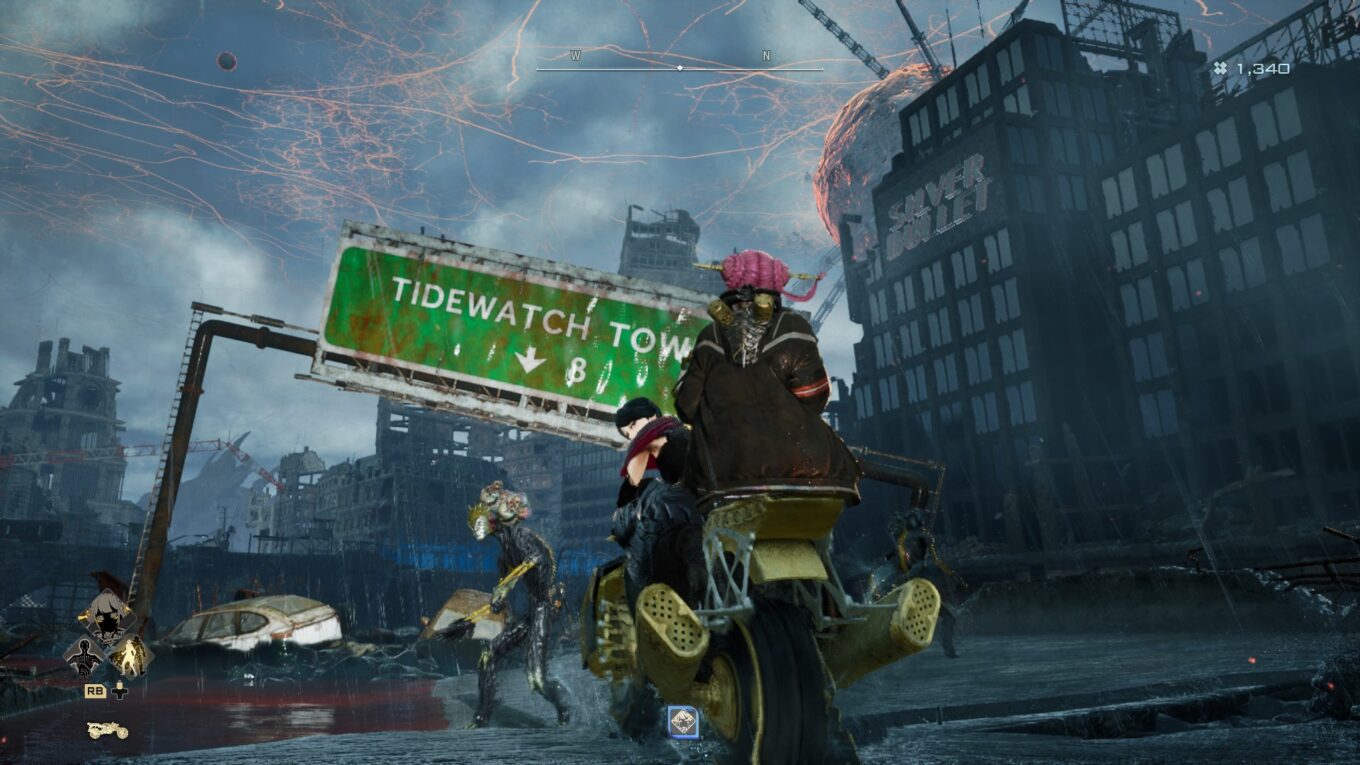
Code Vein 2 has the odds stacked against it. For one, it is not a narrative sequel to 2019’s Code Vein. Instead, it borrows some of the same ideas—vampires called Revenants, a modern post-apocalyptic setting, a colorful cast of sexy bloodsucker allies, its central mechanical concepts—and ports them into a new world. Secondly, it is one of the first “Soulslikes” to take more after Elden Ring than Dark Souls. Like From Software’s foray into the open world, Code Vein 2 gives you a swift mount (a motorcycle in this case) to traverse its vast plains. It also spreads its dungeons out, hiding them in worn cliff sides or decaying skyscrapers. It’s hard not to be charmed by its dazzling ambition. With From Software moving into online multiplayer games with Elden Ring: Nightreign, perhaps there is space for a game that tries to take the throne. Yet, Code Vein 2 is too unfocused to be any serious competition with the greats it borrows from. It has flickers of originality and its own janky charm. But it is hard to wonder why one shouldn’t just play Elden Ring again instead.

To be fair, Code Vein 2 is in a curious position. Many of Dark Souls’ imitators occupy the space which From Software used to occupy: charming jank with a cult following. Yet, when From Software developed Demon’s Souls and King’s Field, it was competing with other sicko dungeon crawlers and cult classics. Games like Code Vein 2 compete directly with their inspirations. Just a few moments with Code Vein proves out how much smaller its budget is than Elden Ring. It feels a bit unfair to compare it to one of the most successful games of recent years. Nevertheless, Code Vein 2 leans into the comparison. The only weapon it and its colleagues use to differentiate themselves is novelty. Lies of P and Steelrising drench their worlds in clockwork Victorianism. The Surge and its sequel offer sci-fi body horror and cybernetic augmentation. Code Vein 2 drapes itself in Hot Topic goth aesthetics. It’s easy to write off this novelty as superficial. It is also rare that any of these games reach the heights of From Software’s classics. Yet, Code Vein’s charms come directly from this novelty. It is its devotion to Elden Ring’s design that damns it.
Playing With Blood
In premise, Code Vein 2 follows directly from Elden Ring. The player is a vampire hunter, rescued from death by the Revenant Lou. They are then recruited into the Revenant organization MagMell. The org’s island base is the equivalent of Elden Ring’s “round table hold.” To prevent a future apocalypse, the player must find and battle corrupted vampire heroes from the island’s past. Lou’s time-travel abilities let the player character interact with the past versions of these heroes and find where their corrupted selves linger in the present. Thereby the essence of the game’s arc is similar to Elden Ring’s. Each area of the island is associated with a particular boss. You’ll explore that area, fighting other bosses along the way, until you find the location of your ultimate goal.

However, that structure is the source of one of Code Vein 2’s big differences from its inspirations. Out in the open world, Lou or another ally will join the player. When they travel back to the past, the hero they’ve been sent to find will accompany the player. Each of your allies, as well as many of the bosses you fight, give the player “blood codes.” Rather than leveling up individual stats, players equip these blood codes to inherit an entire build. This lets them swap strategies more or less on the fly. You can switch up your build in Elden Ring, but doing so requires paying a cost and unlocking the ability. Elden Ring encourages you to be thoughtful about every decision you make with your character. In Code Vein, each level-up grants you a flat bonus to the player’s basic stats. If one Blood Code doesn’t suit, the player can always change it.
This is a dramatic change, but far from a thoughtless one. It was also one of the successful elements of the game’s predecessor. Code Vein 2 leans on the “action” of the “action RPG.” It is far more about putting powers in a swift and devastating combination than the deliberate combat of Souls. Making its builds interchangeable lets players experiment fast and lets the game lean on its expressive combat. There’s still plenty of room for RPG customization. Code Vein 2 just makes it light and fun, rather than ponderous and deliberate.

The trouble is that Code Vein’s action fundamentals are meager, especially in comparison to its inspirations. Elden Ring has plenty of flash and bombast, particularly in more spell-casting builds. Yet, its basics are weighty. There is the sensation of a body in movement. Code Vein 2 boasts a diverse array of weapons, but they all lack impact. Some builds are swift, but weightless, like using a bread knife on butter. Others are slow, but without punch. Outside of bosses, it is far easier to stagger or stun enemies, meaning that most encounters are quick work even when the player is at lower levels.
Corpse Worlds
Code Vein 2 is a lot wordier than Elden Ring. After one long proper noun laden cutscene, Elden Ring drops you right into its world. In fact, much was made of how easy it is to miss the game’s tutorial entirely. In contrast, Code Vein 2 walks the player through each of its many systems with a stultifying deliberateness. Souls’ reliance on item descriptions and visual storytelling are more or less absent. In its place are exposition-heavy stretches of dialogue and treacly tragic backstories.

In structure, this is not a bad thing. One could build a compelling action RPG with plentiful cutscenes and little to investigate. What Code Vein 2 underestimates is how much mystery is key to Elden Ring’s design. In one part of the early game, I explored a tower on one corner of the map. Within it, I found an elevator that would not activate. Just a couple hours later, I learned that it was part of the main quest and the elevator magically opened. Decisions like this actively discourage the player from exploring the world. When one can merely waste time, why do anything but what the game explicitly asks players to do? And in that context, why have an open world at all? It matters that Elden Ring trusts the player to make discoveries and to draw their own conclusions about the world. Code Vein 2 offers no such trust.
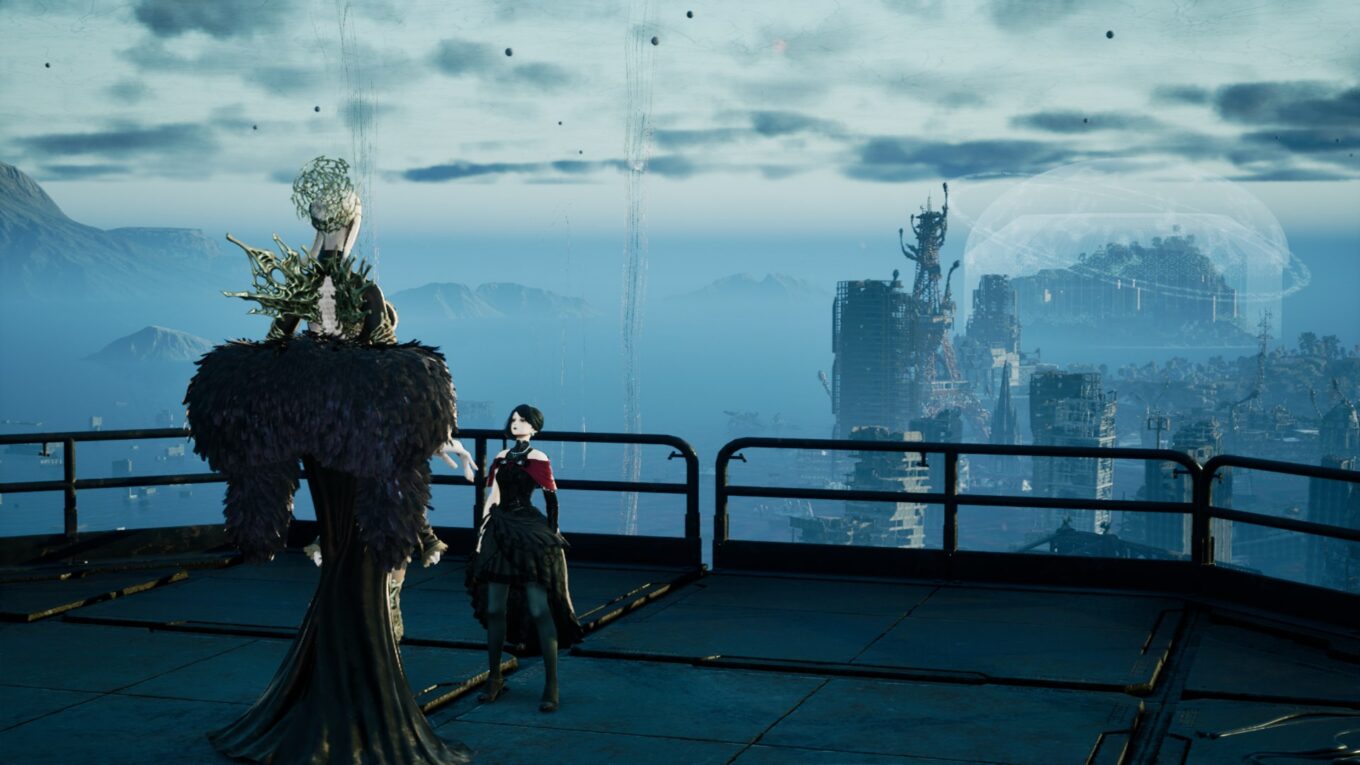
Elden Ring’s Lands Between is a place worth exploring, one that teases your curiosity and provokes serious questions. Code Vein 2 has scale, but it lacks Elden Ring’s Romance (yes, capital R). Elden Ring hovers between a celestial grandeur and a depraved profanity. In contrast, one could see Code Vein 2’s barren steel high rises, its rusted out cars, and its mossy ruins in The Last of Us or Fallout. When the player spends most of their time wandering the wastes, these kinds of aesthetic questions matter. Code Vein 2’s characters have a mall goth charm. But the rest of the game is just the mall. In other words, Code Vein 2 imports Elden Ring’s systems capably. But its designers seem to have no understanding of what makes Elden Ring sing. That lack of awareness results in a tiresome and hollow open world.
Are You Even Really Goth?
Even the game’s novelty has limits. Setting aside the goth aesthetics, Code Vein’s Revenants might as well be wizards or elves. They function as magical beings with combat powers. Their consumption of blood is almost incidental, something rarely commented on. The player’s objective is to save the world from zombifaction. There is no real moral question to being a Revenant. Most of the time, vampires and humans work together against a common threat. In most horror fiction, becoming a vampire, or encountering one, pushes one off the edge of the rational world. It draws you into the existential questions. In Code Vein, being a vampire (or a vampire hunter) is mostly Shonen-anime posture.
To be clear, this has its benefits. Code Vein 2’s “Jails,” special weapons, are flashy and ornate. Its character creator is best-in-class and maybe even worth the price of admission on its own. Part of the appeal of this sort of game is making a cool guy. This is a pleasure that Code Vein 2 has in spades. Yet, when Code Vein 2’s vampiric subject matter is only superficial, it is hard to say how it actually innovates on Elden Ring at all. What pleasure can you find here that cannot be found in From Software’s oeuvre?
Elden Ring carries some of the same problems as Code Vein 2. The more you explore its vastness, the shallower it can feel. While Demon’s Souls and Bloodborne are masterpieces of narrow design, Elden Ring blows up its world, such that the simple joys of clear levels are diminished. Players spending enough time with Elden Ring will find the way it repeats enemies and the limits of its expansiveness. Yet, its pleasures are deep and multifaceted. Its world is mysterious and strange. Its tragedies are veiled and vast. Code Vein 2 has some immediate joys. But it is a mere mirror of better things, perhaps best shattered and left behind.