If you have any interest in Fogpiercer, you don’t need me to tell you it has fierce competition. But even if you are a deckbuilding fanatic, this one is worth a look. Fogpiercer is not exactly innovative or novel, but it is thoughtful, structuring each of its plentiful ideas with more than a little care. Its combination of board-game-esque tactical positioning with the fervent engine creation of deckbuilding is inventive and lean. The result is a sharp puzzle which delights the brain, even if it can’t manage to stir the heart or eyes.
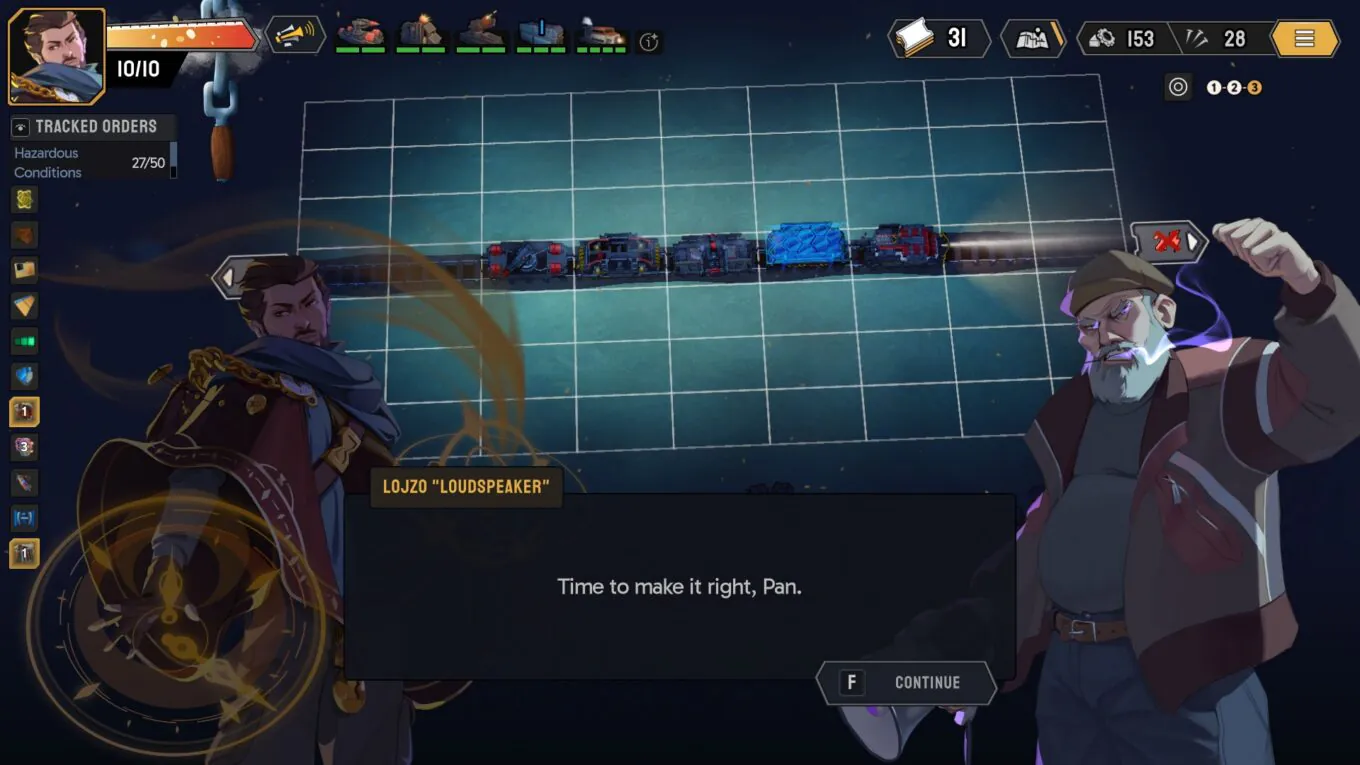
Fogpiercer’s title is a cheeky reference to Bong Joon Ho’s film Snowpiercer, which also features a train blasting through a weather-wasted, post-apocalyptic landscape. That is where the resemblances end. Here, the train is heroic, rather than dystopian. The titular fog is some supernatural menace, an existential, environmental threat, which the player is attempting to push past to a better future. X-Men-like heroes conduct the train through the mist. The bosses that await at the end of each run are larger-than-life villains, almost perfectly mapped to counter the heroes. The enemies are typical end-of-the-world lowlifes who swarm the train. Think Mad Max: Fury Road if the big rig were a locomotive.
That train is the engine of Fogpiercer’s best ideas. At each run’s start, you’ll choose a conductor and what train cars to attach to your locomotive. In turn, this determines what cards your deck will start with. Before the run even starts, you are already making juicy decisions which will determine your strategy for the rest of the run. This also makes the experience much more granular than something like Slay the Spire. You can even ban specific cards and modules to make it easier to attempt specific builds. This piecemeal approach makes it easy to experiment. Additionally, only your locomotive must survive for you to continue on your run (other carriages will get one health restored at the end of each battle).
Granularity is only one of Fogpiercer’s ideas; another is classic tactics and positioning. Battles take place on a grid. Playing cards, or moving your train, costs action points which reset every turn. You can shift the train back and forth along the track, but, as you might guess, nowhere else. Despite limited options, positioning is still important. For one, some grids have cliff walls or yawning abysses which you can toss enemy vehicles into. But even when no such options are available, you can push or pull enemies so that they’ll attack each other or cause traffic stopping collisions. You can even ram enemies with the front or back of your train, killing them instantly. The AI is not especially vicious or smart, but enemies swarm in later round with compounding abilities. Weaving your plan such that no car is damaged or so that you destroy a fearsome enemy in one turn is a compulsive thrill. This is a game where watching your deck work is as beautiful as building it.
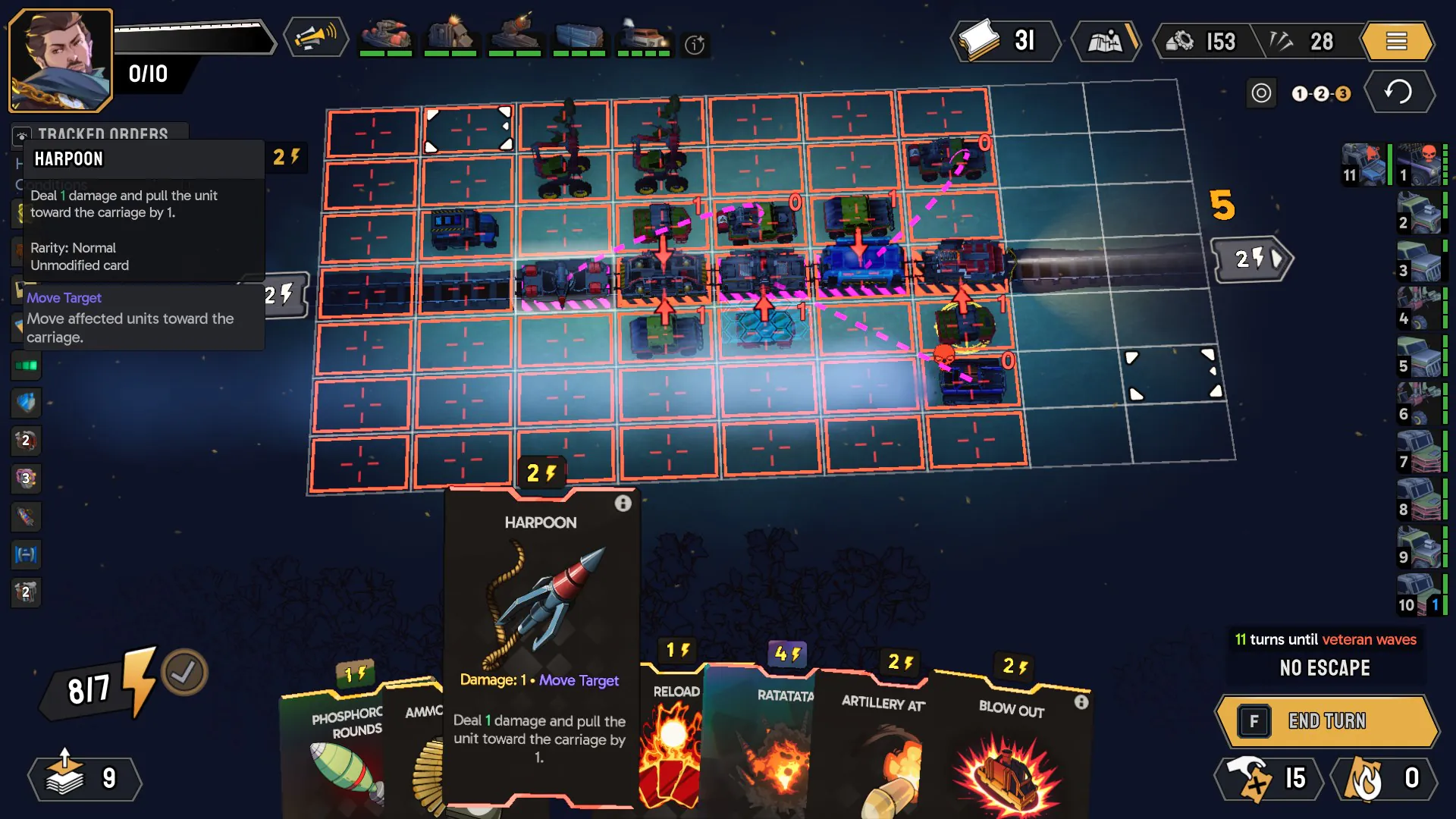
That thrill is created as much through constriction as possibility. Many cards have an associated range of effect, which in turn is affected by where you’ve placed the relevant carriage. For example, the Protector car can shield other carriages from damage. However, it can only protect cars directly in front of and behind it (at least at first). So, do you position the Protector close to your locomotive, to best prevent outright losses, or do you slide it between more offensive cars to protect your firepower? The answer depends on your exact strategy.
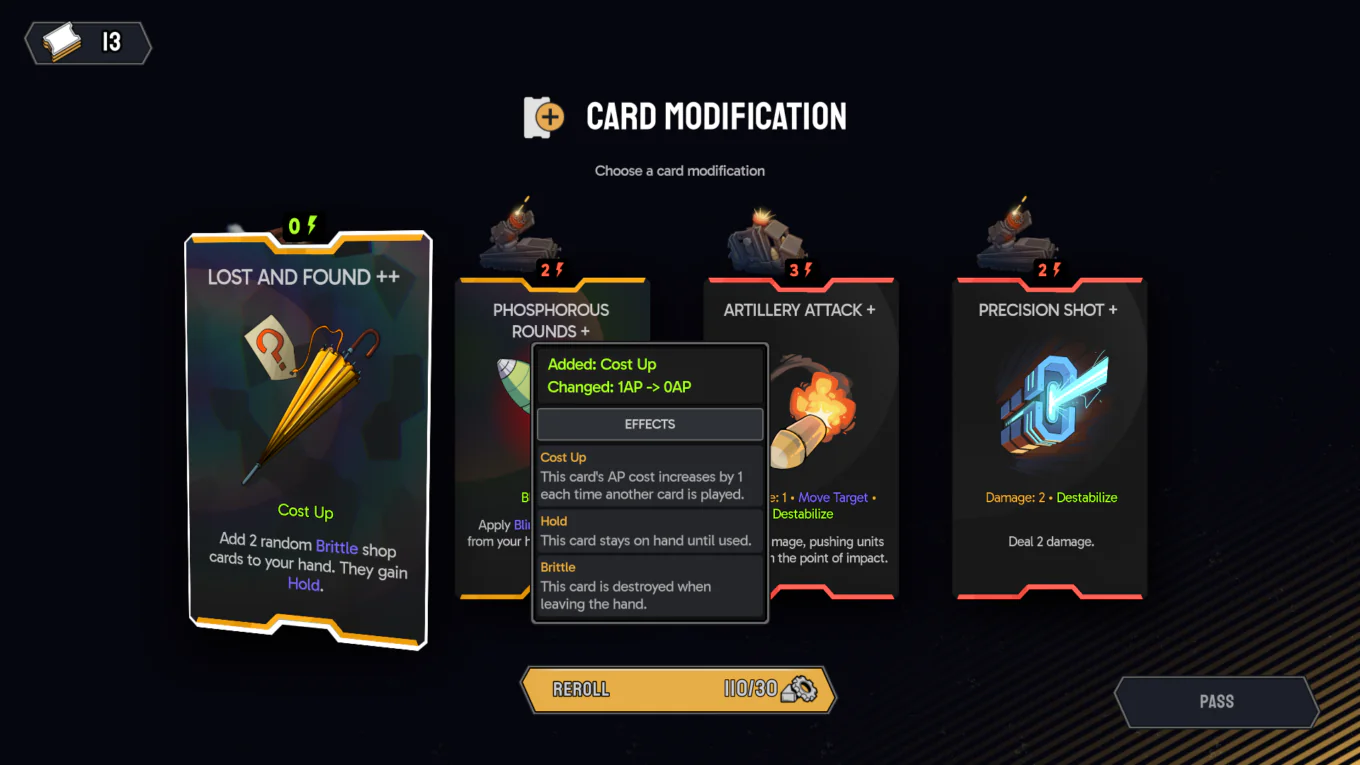
Generally speaking though, Fogpiercer is generous with new cards and upgrades. Most of the cards you can select after each battle (yes, this is a “choose-one-of-three-things” game) are drawn from a pool associated with the carriages and locomotives you chose at the run’s start. You can buy additional carriages at central stations, but that instantly adds a few cards to your deck (as well as expanding your hand size and action points). If you are wanting to keep your deck concentrated, you might think twice before adding another car. But with each new addition comes more tactical possibilities.
Still, adding more length to your train can make it vulnerable in another way. If enemies destroy a train car, they also will destroy every carriage connected behind it, removing the action point and hand size increases associated with them. Fogpiercer is expert at this kind of push and pull. The Artillery and Harpoon carriages are essential for moving enemies around, but can’t deal sheer damage the way the Minigun carriage can. You could forsake the Protector entirely, leaning in on an offensive defense, but that makes wrong moves all the most costly.
At its core, each turn of Fogpiercer is built around a few central questions. How do I best avoid damage, while maximizing damage to enemies? What order do I play cards for the best effect? Even in trivial battles, these questions never get stale. The puzzle is so tautly designed that even small battles require careful thinking to get through. Fogpiercer’s puzzle is not as sprawling as others in the genre (more on this later), but it remains tight even after dozens of runs.
Unfortunately, Fogpiercer has a dearth of interesting things to look at. Its character designs feel like Avengers D-listers. The cel-shaded look is handsome and readable, but never striking. The train is always jetting through the same snowy stretch of track, no matter what “biome” you find yourself trekking in. This can make even the game’s strangest ideas feel more rote than they are. The presentation lacks the verve its tactics offer.
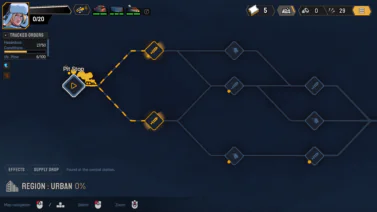
That lack extends to Fogpiercer’s writing. Narratively, the game is sparse. There is the implication of history between the heroes and villains, as well as some background as to how the world became covered in a horrifying fog, but it is limited to scarce moments. This is far from a serious problem. Anyone playing Fogpiercer is not here for a narrative experience. But the game is less for feeling so barren of narrative interest. Several of its competitors fare better here. Slay The Spire has sheer weirdness. Into the Breach, one of Fogpiercer’s clear influences, also has only flickers of serious narrative, but manages to conjure much more with its pieces. Fogpiercer’s world is too bound to cliché and too clean aesthetically to stick in the mind the way its tactics do. However, the music is something of an exception. It is propulsive, underlying even the most slow and thoughtful turns with a sense of immediacy. It helps keep the game electric, when it could be ponderous.
Which brings us to the big question: why play Fogpiercer instead of any other deckbuilder out there? Admittedly, Fogpiercer is still less expansive than its kin. There are lots of ways to change Fogpiercer’s central puzzle, but none as transformative as Slay the Spire’s classes (and that’s setting aside the countless mods which exist for both the original Slay the Spire and its sequel). It’s easier to get to the heart of Fogpiercer’s puzzle quickly and fewer surprises await you once you do.
However, this is only a problem if you intend to be playing Fogpiercer for hundreds of hours. A game like this doesn’t need to replace the massive influence of something like Slay the Spire. It succeeds on its own terms as a clever expansion of what surrounds it in the genre space. If you are looking for another timesink or an aesthetic feast, Fogpiercer could disappoint. But as a pure tactical puzzle, it is as driven and competent as any other game of its kind.