
The assertion that video games are art has become such a ubiquitous critical reflex in this industry that its sincerity can feel suspect. A maxim so undeniably true yet the need of so many to repeat it verges on insecurity. Yet, to step into Helix Descent N Ascent, the debut title from Badass Mongoose, is to encounter a visual world that has more claim to the aphorism than most. Its stark monochromatic palette, through which Helix represents its central tenet of duality — often unsubtly, a literal Yin and Yang symbol soon makes an appearance — is a sketched world that blends an instantly recognisable visual art with the best traditions of our more interactive medium.
Helix’s is a ruined world. Stacked with crumbling masonry, flickering monitors, and curiously pristine arcade cabinets. Even in the flat confines of its 2D art one can sense Helix’s incipient decay. Yet, it is a world progressively overtaken by shades of grey. These seldom appear in the world itself, but are persistently evident in Helix’s design where, after an initial incandescent burst of ideas, they settle into a less vibrant, ultimately desultory, attitude.
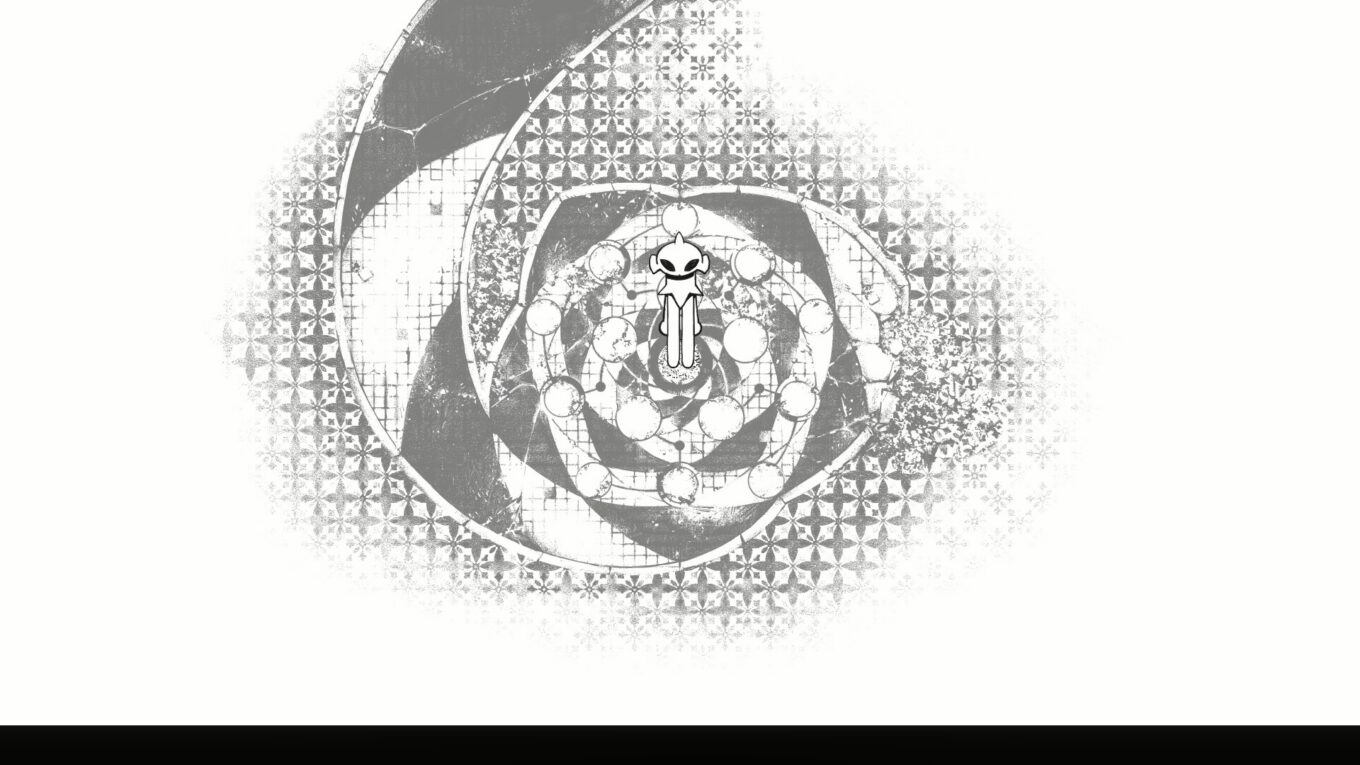
That black and white world is not just evocative, it also simulates light and darkness – an inversion you’ll later be able to control. You begin as a white sketch reversed from a black field within the dark underground. Your first task: to conjure blocks to cross gaps and weigh down switches to reach the surface.
Emerging into the overworld, the screen flashes with an arsenic light as you become a black image on a white page. It is the first of many of Helix’s interesting ideas as you navigate three key maps, solve puzzles, and acquire runes with which to throw open the gate beyond Helix’s hub. Your tools to do so, including block conjuring, range from genre staples like a grapple to curiouser ideas: a ball that captures crabs and insects and a floating projected head that can interact with distant switches. All represented by runes of a combination of them.
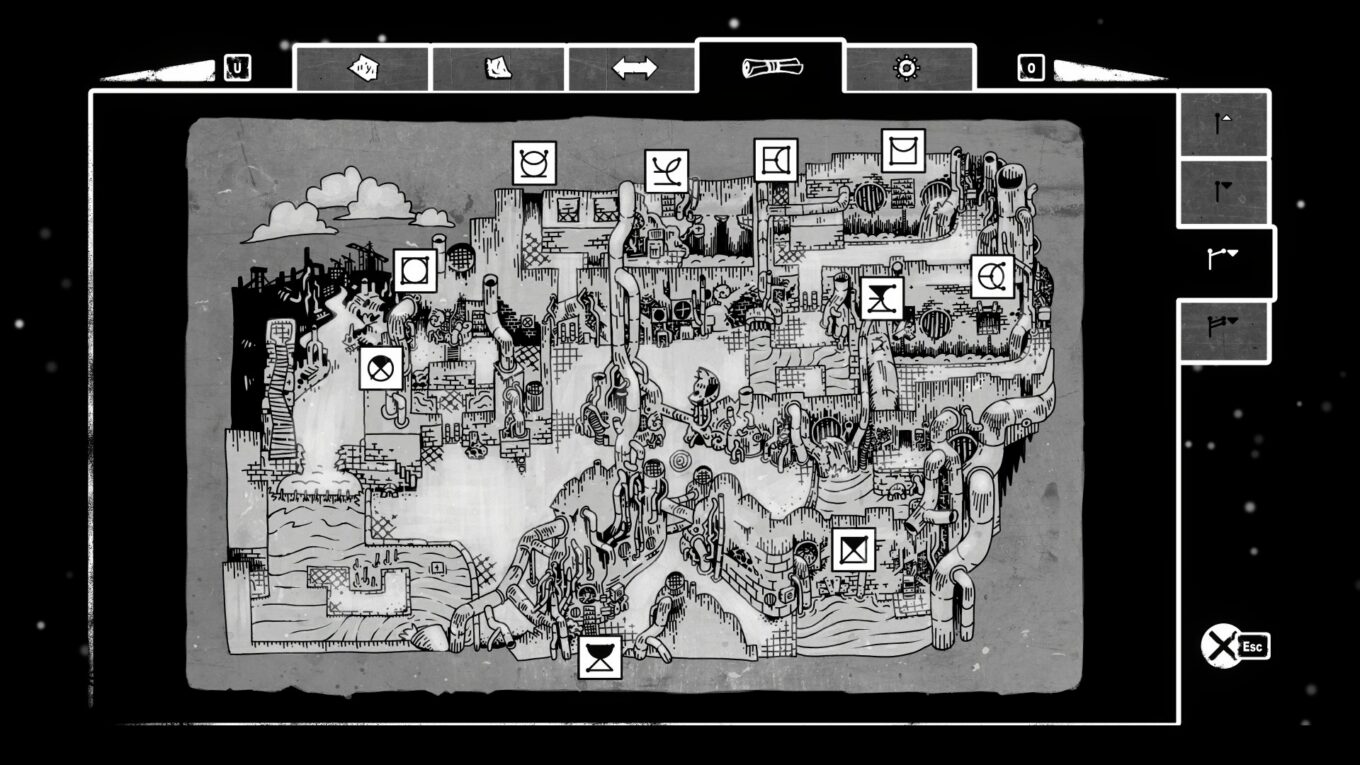
Maps – which you pick up early in each area – show, using those same runes, where you can deploy skills to open up brief dungeons and reach further runes. This is initially difficult to parse, not least as there is no indication of where you are on the map. Once you’re familiar with the overworld, however, they offer some direction in a game with precious little otherwise.
That’s no bad thing. A lack of direction forces you to explore and note your initial roadblocks. Something which also leads you to discover scraps of paper, Helix’s collectibles, that show moments of narrative, history, and runic codes. The latter can be entered into arcade cabinets that act as locking mechanisms throughout the game. They can be skipped. But they also come with unlocking minigames, stylised versions of Donkey Kong, that serve as welcome diversions from wandering around Helix’s map.
Helix enjoys its most enjoyable puzzle solving, however, in its second overworld in which it shifts from offering new skills to synthesising them. For instance, the ability to shift between light and dark worlds can be combined with block conjuring to allow you to fire them across the screen where once you could only place and push them. A more enjoyable combination is the grapple becoming a bouncing projectile in the light world. One you must ricochet off the walls to hit inaccessible objects around corners. The theoretical library of puzzle solutions that arise from this system is mouth-watering for puzzle freaks (like me). Yet, all are underexplored — even as you move through a post-game that combines three, sometimes four, skills at a time.
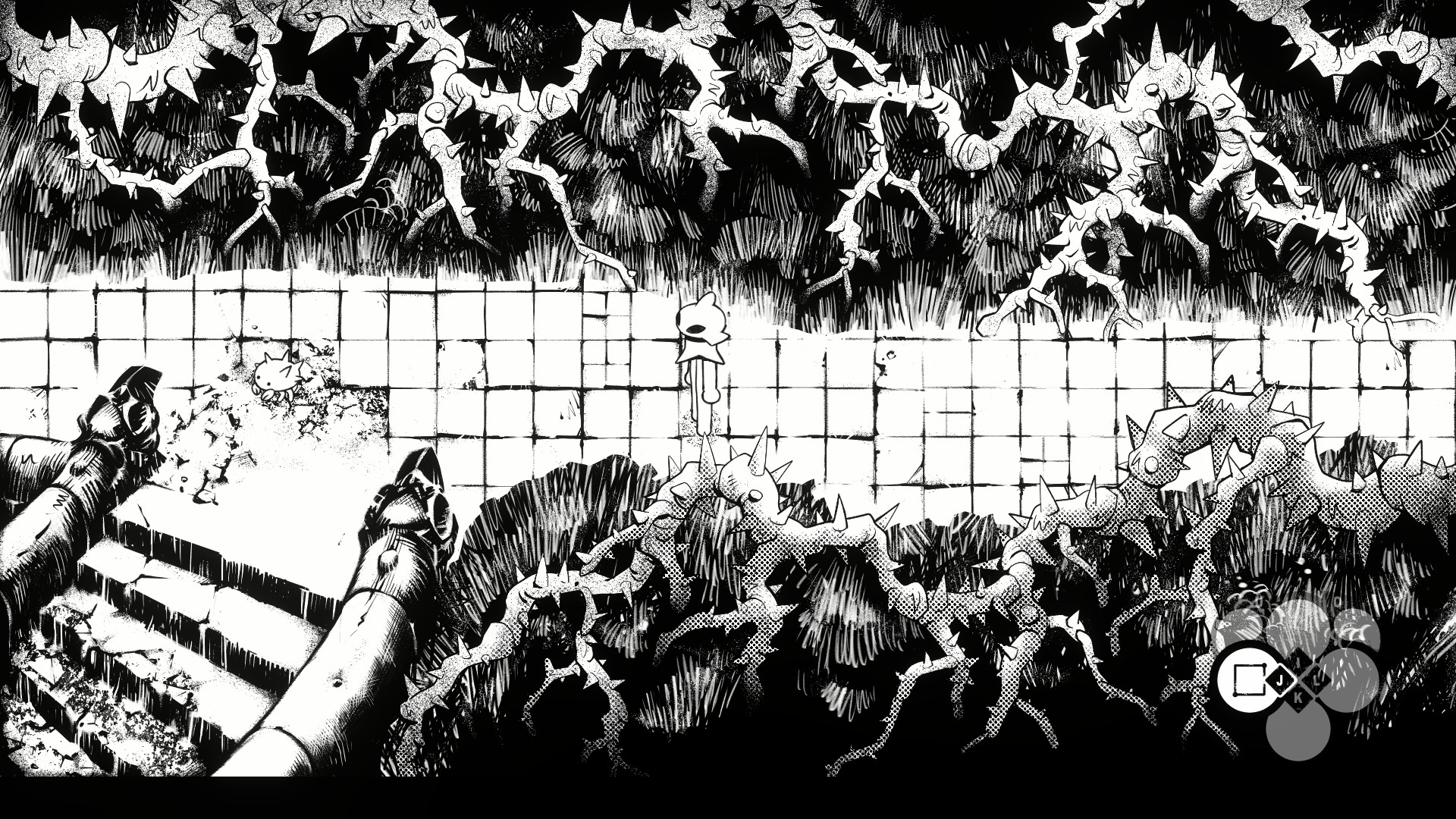

Indeed, you’ll likely spend most of your time with combinations you don’t enjoy given these are attached to the most confusing, desultory, and often bugged puzzles in Helix. One combination allows you to attach the grapple to your projection to reach objects from otherwise inaccessible angles. It’s an interesting solution and yet needs repeating multiple times as approaching movable elements from the right angle isn’t enough to move objects the sufficient amount.
A lack of precision that filters through Helix’s visually cluttered world, in which what represents background and foreground isn’t always clear. This manifests as being unable to use your grapple because something you can’t see is blocking the way but being able to pass through seemingly solid walls in places. Elsewhere, it’s being unable to hit a switch because you are too high or too low, with little visual representation of that verticality.
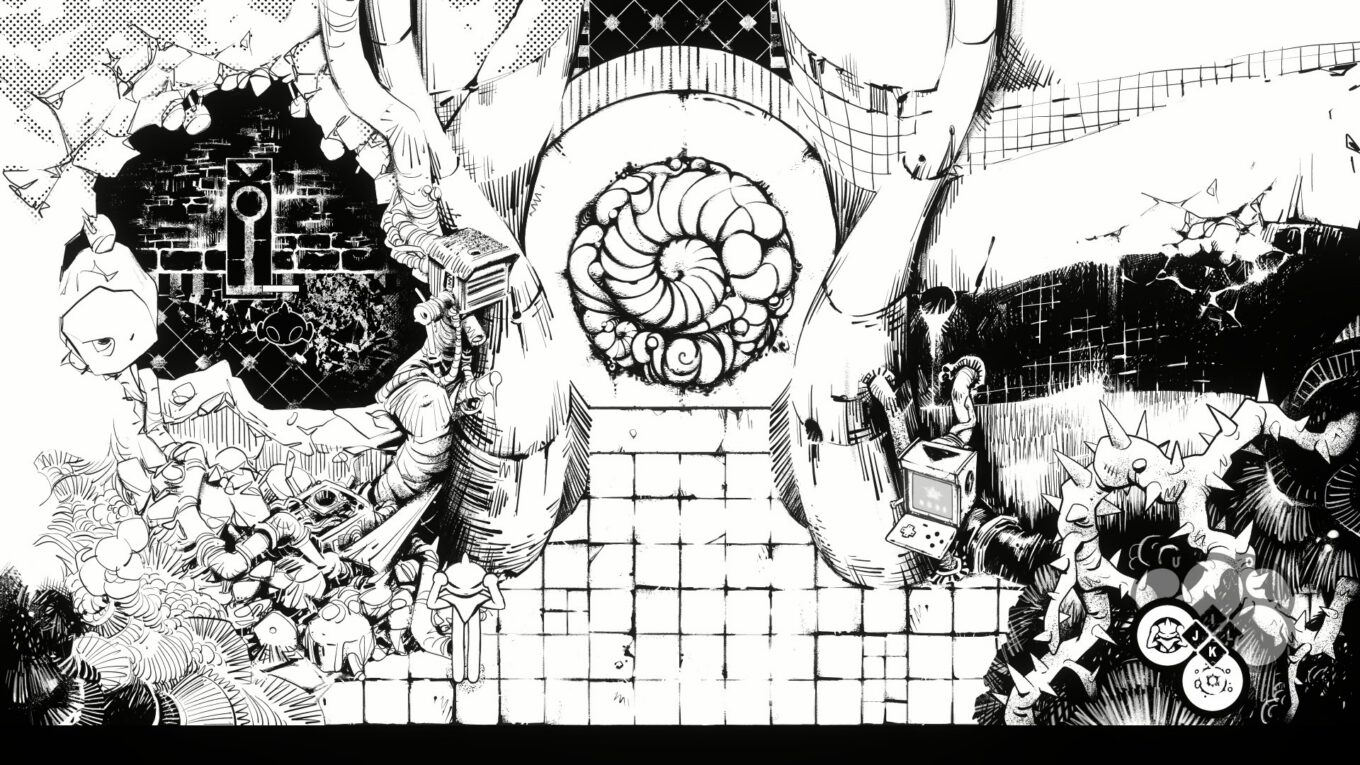
In one particularly jarring episode in my playthrough, I immediately intuited that I needed to attach my capture capsule to my projection to reach the height and distance necessary to catch some flies. Something that took upwards of ten attempts because the reticle wouldn’t lock on because I was either too close or too far away.
It informs the fundamental frustration of Helix: repetition. That’s not all bad. Backtracking and repeating motifs are a hallmark of top-down adventures. Helix’s is a world, however, in which you explore the same map over and over with the only difference being what skills you take with you. That’s an interesting concept on paper; in practice, the repetition involved quickly grows stale.
This is best represented in the need to constantly return to an underground chamber to equip skills. Picking the wrong set of skills for a certain area means traipsing all the way back for the right ones and that only becomes more laborious when you enter the third map. A more expansive post-game that sees you combine even more skills to traverse open, snowy biomes and dank sewers that, while beautiful, offer much longer walks back and less delineation between skill-gated areas. (There is an argument that, given its improved scope, this should have been the main game).
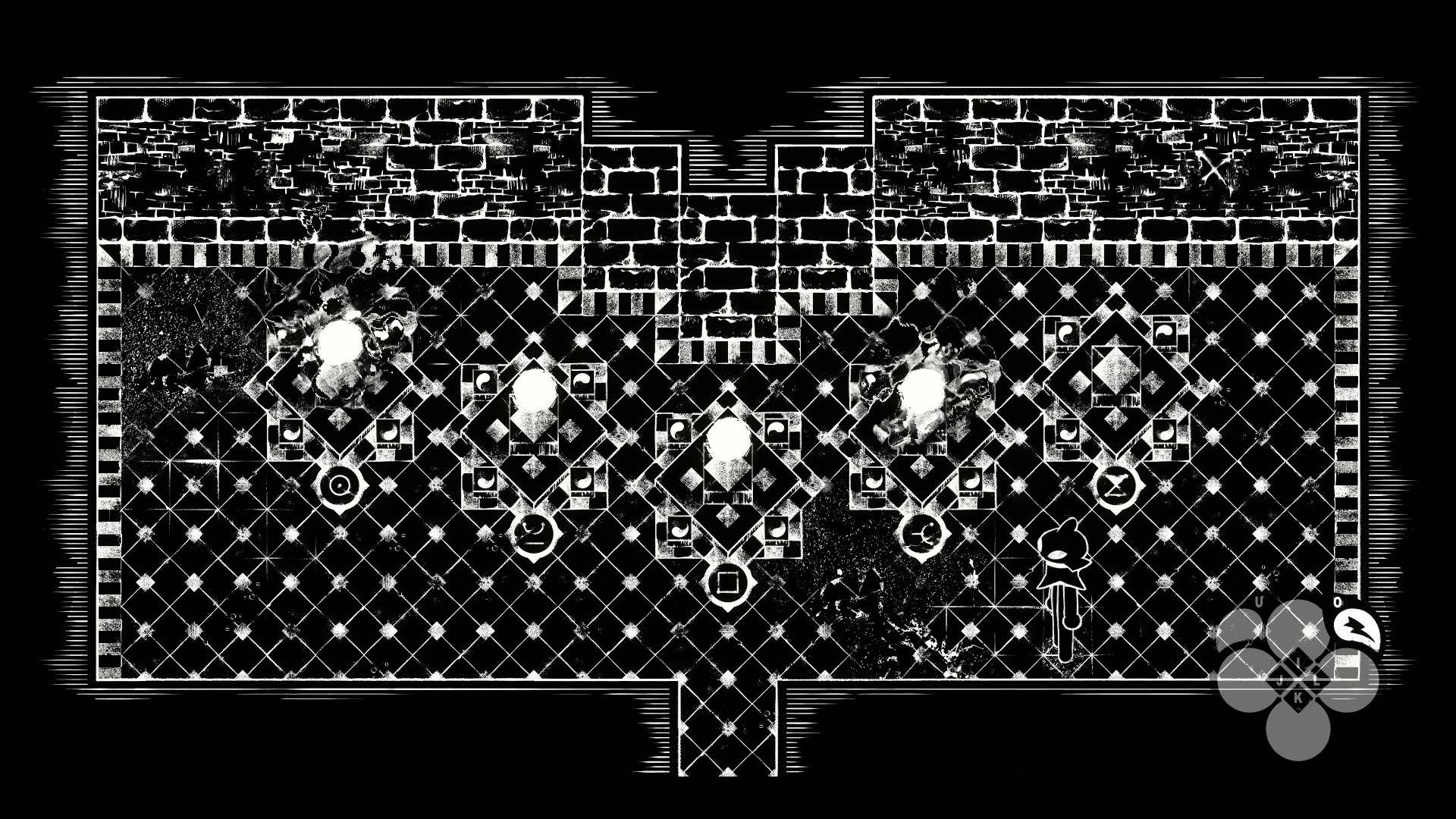
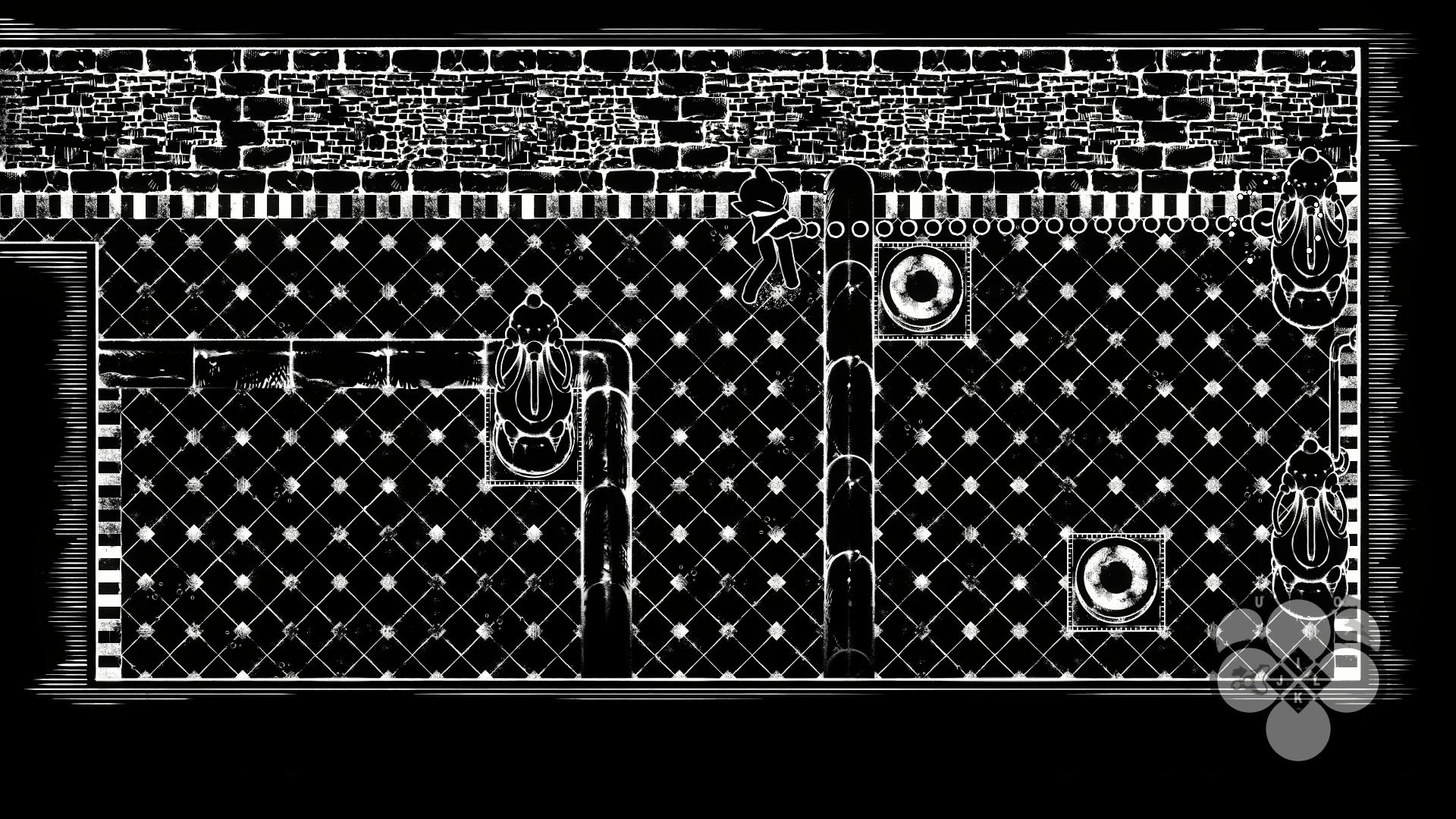
Add to that loosely defined environments and increasingly buggy puzzles, and the need to constantly repeat puzzles to which you already have a solution only increases the sense of being stuck in a loop that repeats ad nauseam. That cyclical nature might have been forgivable if it was integrated into Helix’s sparse narrative – circular motifs are common. But exploring the third map, I quickly found a door that shut behind me. Something no other door had hitherto done. It prompted the need to repeat the simple, yet laborious, multistep puzzle that opened it and made me to realise how quickly Helix had run out of ideas.
A sense only doubled when I became stuck on a puzzle that required stopping a block on a switch before it plunged into the abyss beyond. Finally, I thought, I’m going to see these ideas truly synthesise. Perhaps I had to quickly switch to the dark world to arrest a block’s momentum or race to the open gate while the block briefly touched the button? Instead, the solution – at least as far as I could make it out – is to stack blocks in an awkward diagonal until one stops on the button. It felt inelegant, uncompelling, and at this point typical of Helix.
Nothing highlights this poverty of ideas more than the dash ability. Gaming intuition suggests this is a mode of navigating gaps in the landscape; it would have made a fun solution to the above puzzle. Outside of making your perpetually-walking avatar move slightly faster, however, it has no active function. It does not combine with other skills, you cannot dash over thin chasms, and you upgrade it twice. It feels like it’s there just because other games in the genre include it. Worse, the post-game offers a second skill that looks even more like it should help traverse holes in the ground (both are mapped to the shoulder buttons) — it doesn’t.

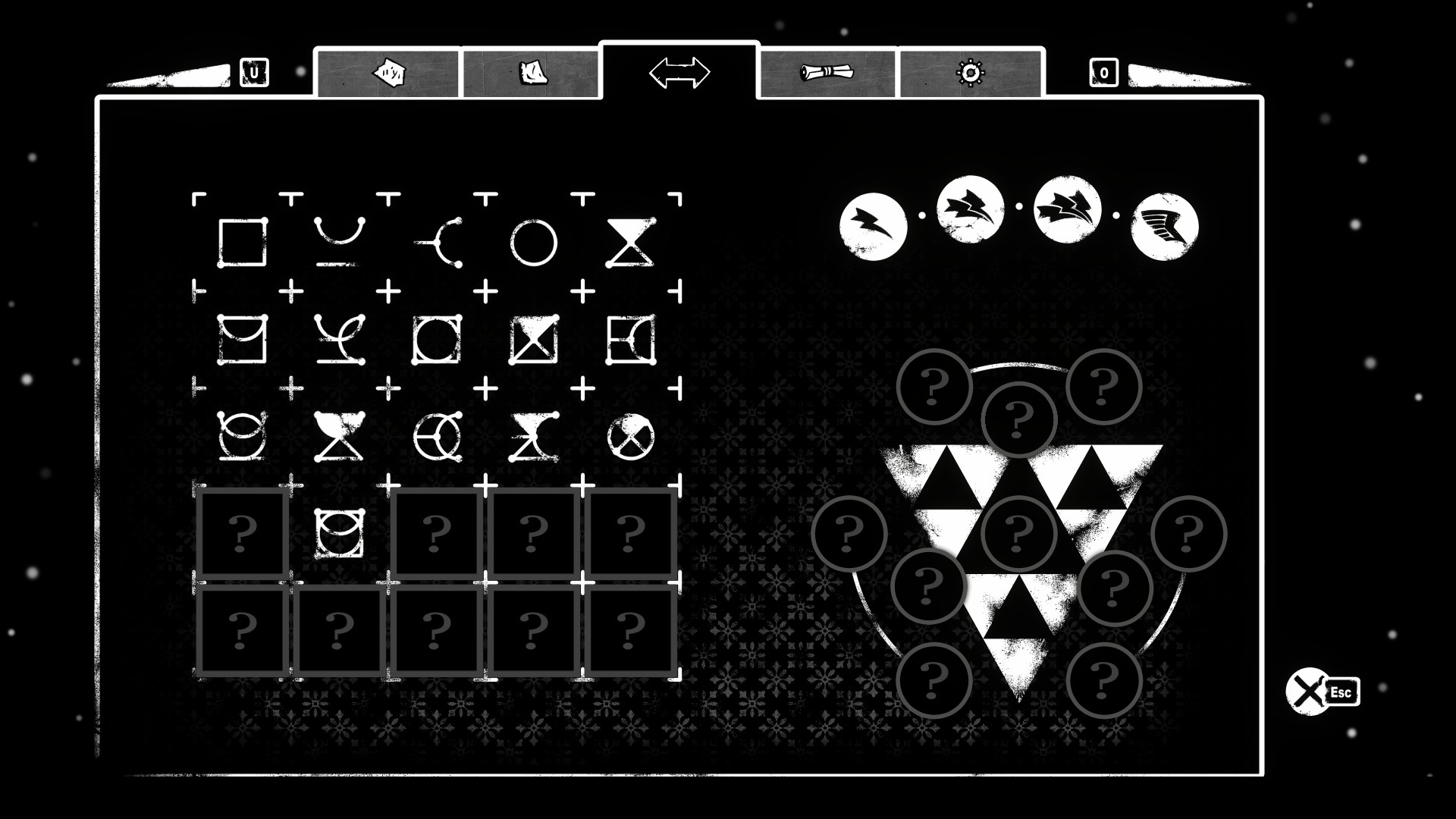
These are the small, yet multiplying, frustrations that drag Helix out of its early promise into far more desultory territory. Its early reliance on Yin and Yang symbology is apt, visually at least, as Helix quickly becomes a game of two halves. The first, a curious, visually arresting, top-down adventure. The second, an uninspired and unintuitive puzzler bloated with input-heavy puzzles in lieu of imagination.
The ending of which only cements a dearth of ideas. Once you assemble your runes and walk through the final gate to conclude this series of mechanical explorations, what’s inside is told to you via a slideshow of sketched comic strips. In a game that, whether you think it successful or not, has been about experimenting with combinations of interactions your final act is being unable to do a thing.
There is a good game hidden in Helix. It can be beautiful and artistic, propelled by an initial burst of ideas that give little indication just how loose and detached the gameplay will become. By its end, however, Helix feels like a brilliant yet unfinished sketch discarded on a desk. One that portends Badass Mongoose’s potential; but potential that may be realised in the next game, or the one after, rather than what you’re playing right now.