
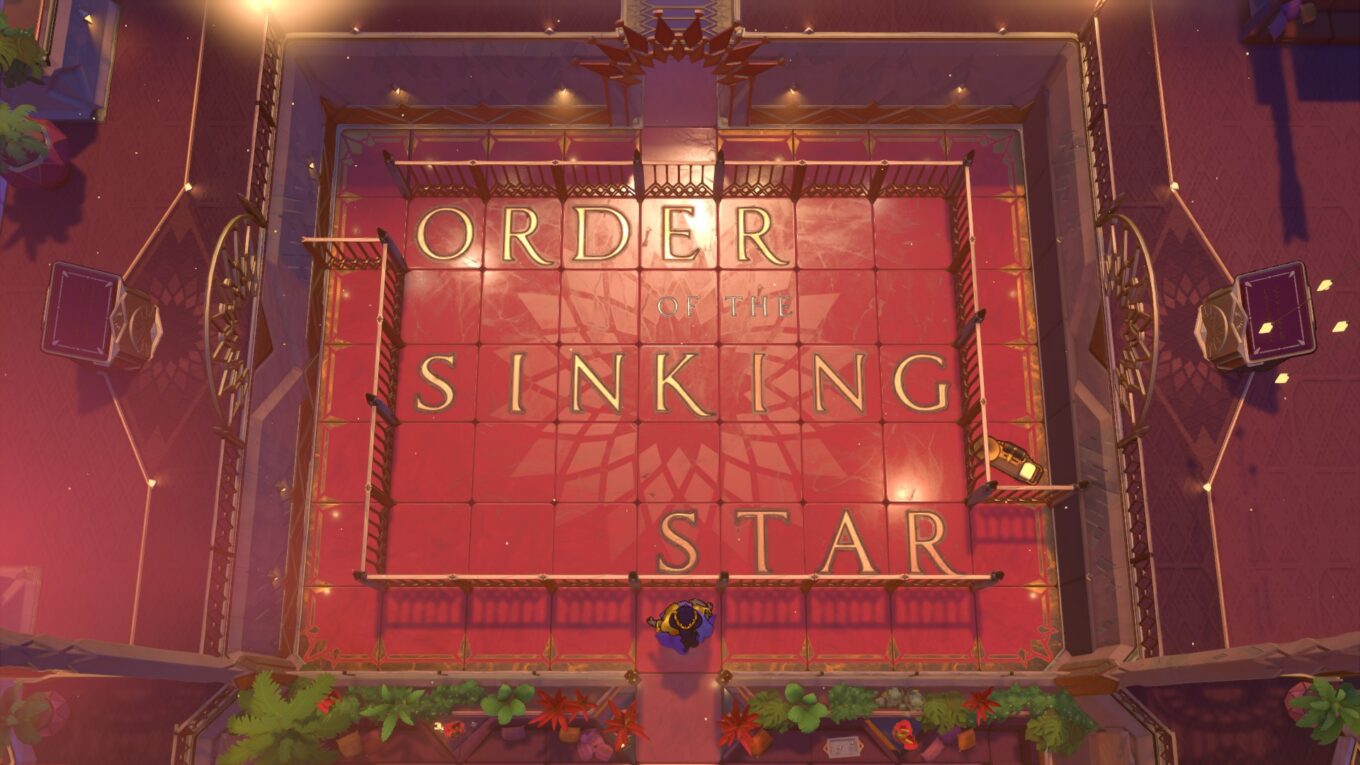
Order of the Sinking Star, from Thekla, Inc., provides an affirmative answer to a question I, a puzzle lover, never thought I’d ask: is there such thing as too many puzzles? The game, marketed predominantly under its director’s name, Jonathan Blow, is a conversation starter for sure. Not least about auteurism, in which projects are erroneously credited to one person at the expense of all others.
In this case, they are Alan Hazelden, Jonah Ostroff, and Sean Barrett: three puzzle designers par excellence whose games Thekla has recreated, malformed, and then aped. While Blow’s name fronts marketing copy, theirs are relegated to the bottom of the same description and obfuscated in-game. A crediting issue that has been simmering under existing controversy (all three have since distanced themselves from Blow).
Beneath that, however, is the game. One that needs to be judged on its own merits (even if it’s not always clear whose merits those are). A game which, after all that, is a bloated and brackish take on Sokoban devoid of the joy of puzzle-solving.
For those unfamiliar, Sokoban is a simple, diverting game developed by Hiroyuki Imabayashi and released on the NEC PC-8001 in 1981. It has you control a warehouse worker (“sokoban” translates to “warehouse keeper”) moving boxes to storage areas. Some players may more readily recognise the concept from Pokémon’s strength puzzles.
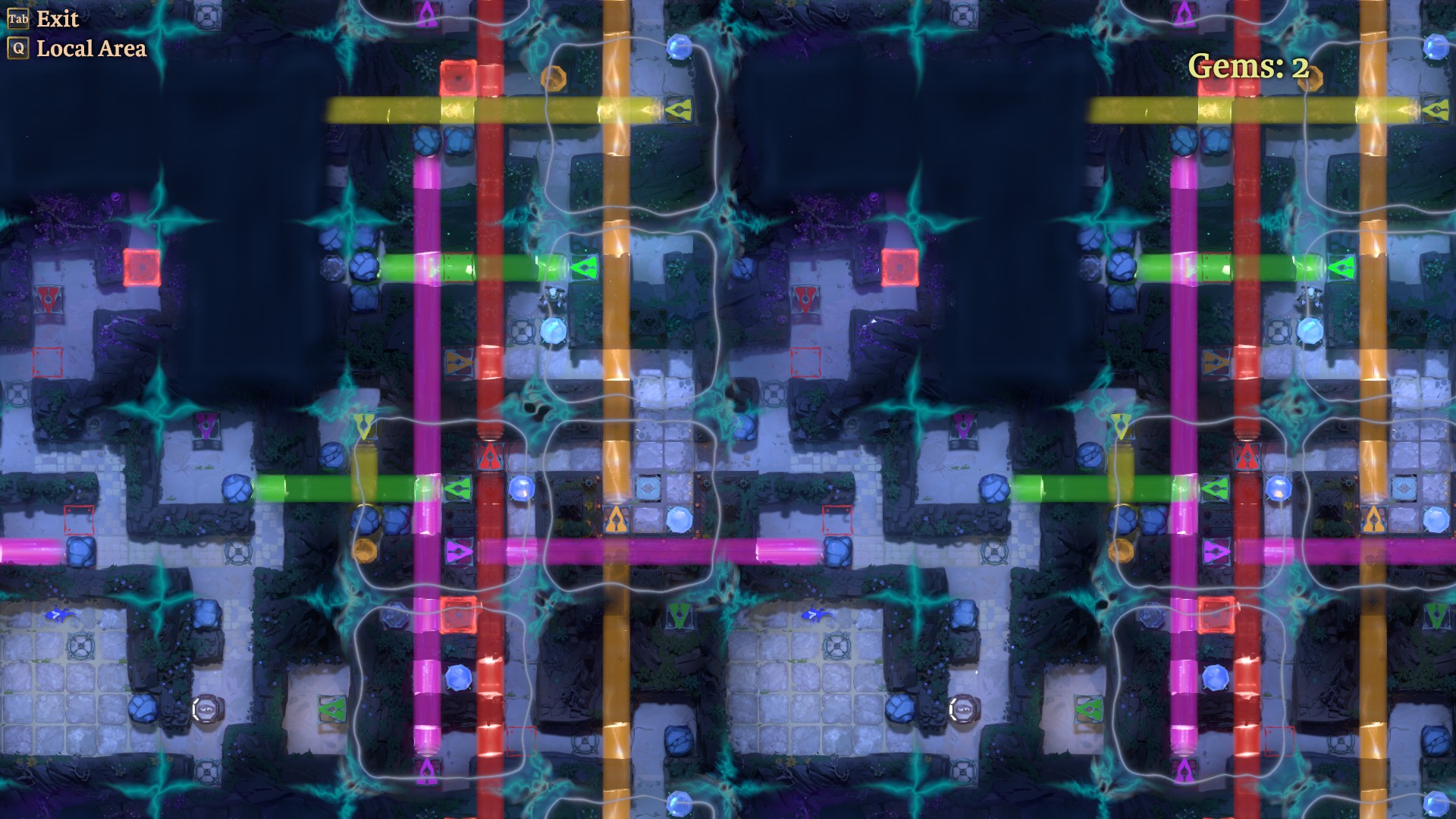
Sinking Star eschews that simplicity for something more cumbersome. You begin by dragging a queen around a grid lined with stars. Each star leads to a puzzle, then another, and another – to the tune of, allegedly, more than 1400 – which occasionally open cages containing the means to open yet more puzzles.
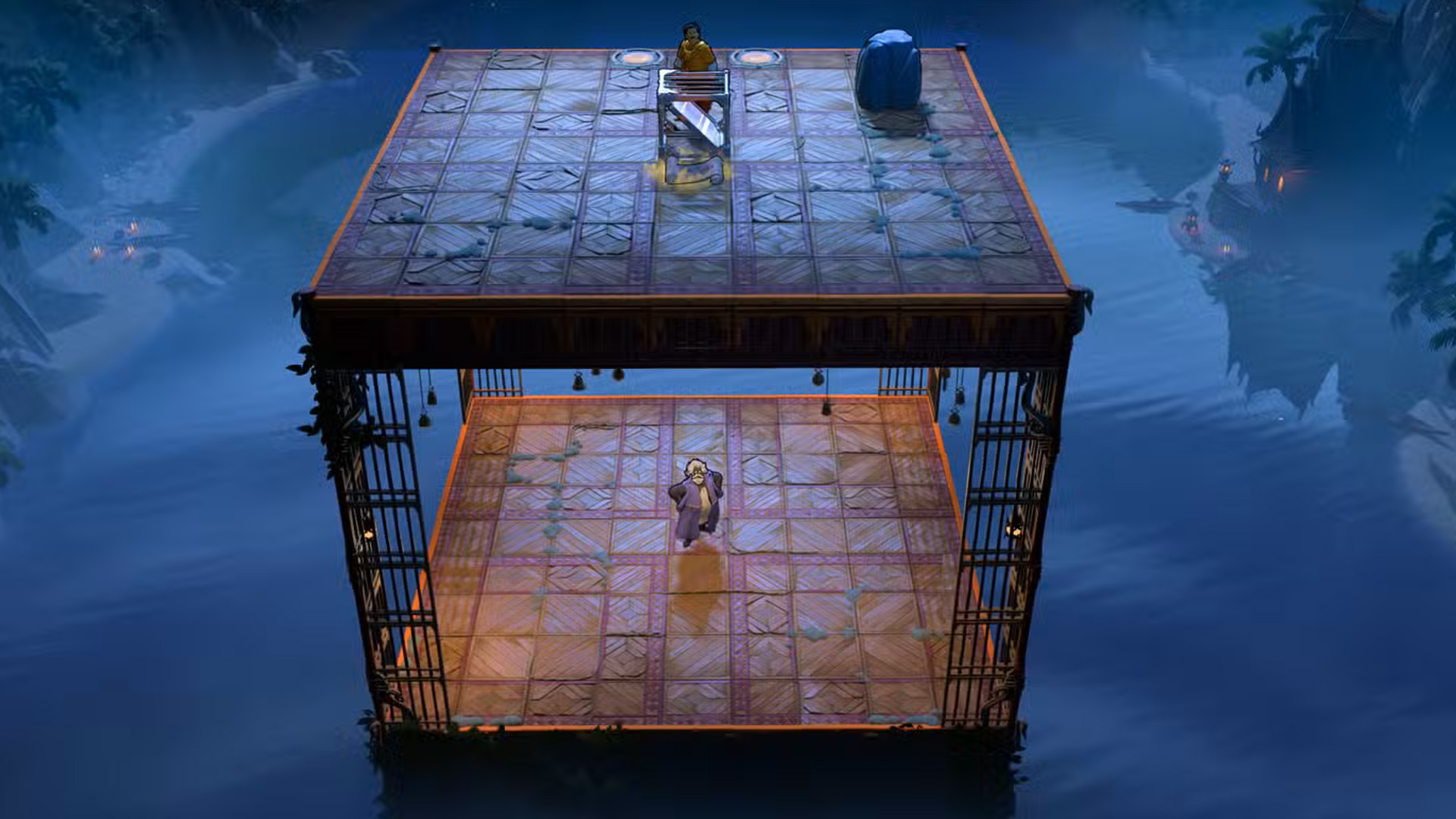
Therein you control someone who can push blocks and another who pulls them. A wizard can swap places with whatever he’s looking at and another turns plans into blocks and back again. A bard enchants everything around them. One character phases through mirrors. Yet another talks to boats and, elsewhere, we meet a man who wears a big suit and– is underground.
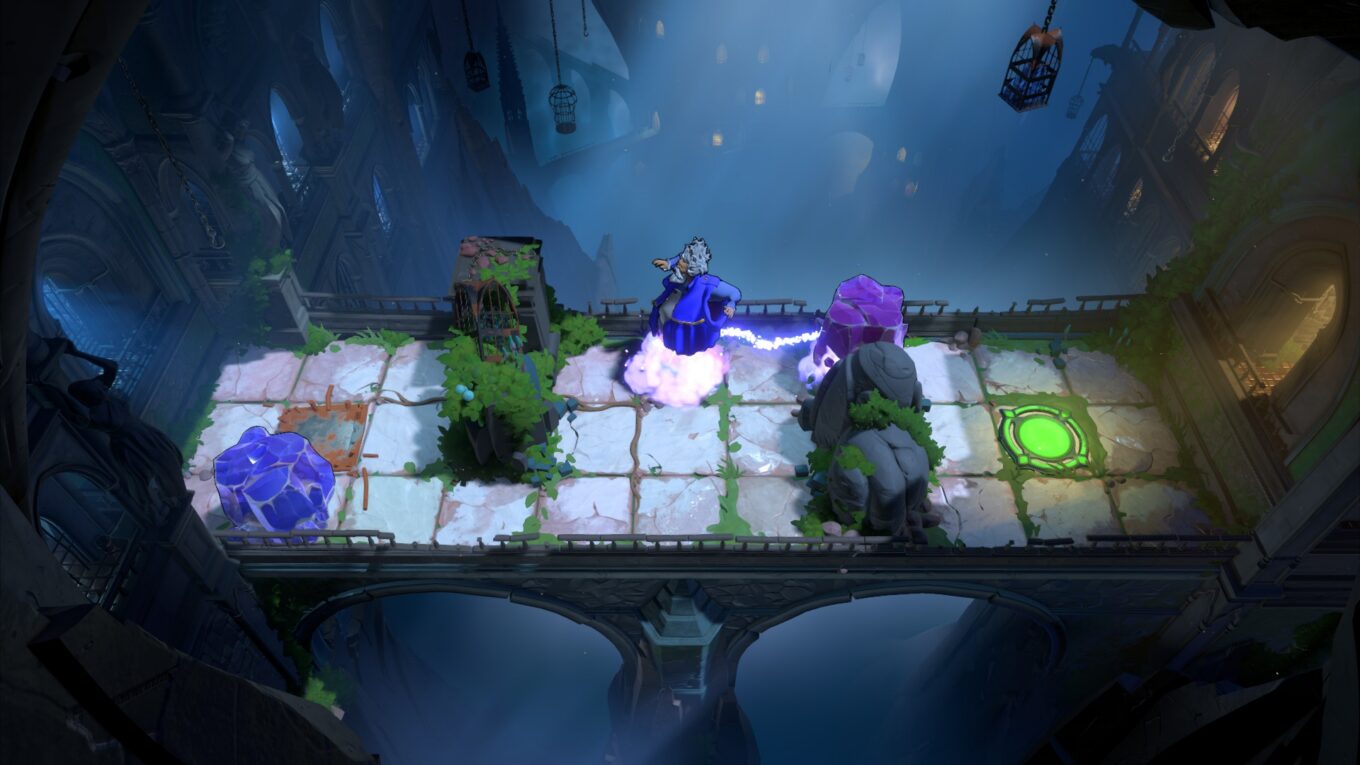
If that sounds unwieldy, it’s not even the complete cast. Characters are initially contained in specific areas corresponding to compass points. All deliver tepid missives in robotic voices from an even more robotic, and quasi-intellectual, script. Seemingly from an attempt to knit those disparate points together with an overarching narrative whose writing ranges from smugly bland to incomprehensible.
More interesting: those compass points converge and so do puzzle solutions. They add verticality and a collision of opposing mechanics which force you to rethink what early areas taught you. It’s a remarkable conceit.
As a puzzle lover, you’d think I’d be thrilled by the scale. Regrettably, the threshold to these colliding worlds also signals a Rubicon between puzzles that feel well-designed and Thekla’s clumsier takes on Sokoban’s formula.
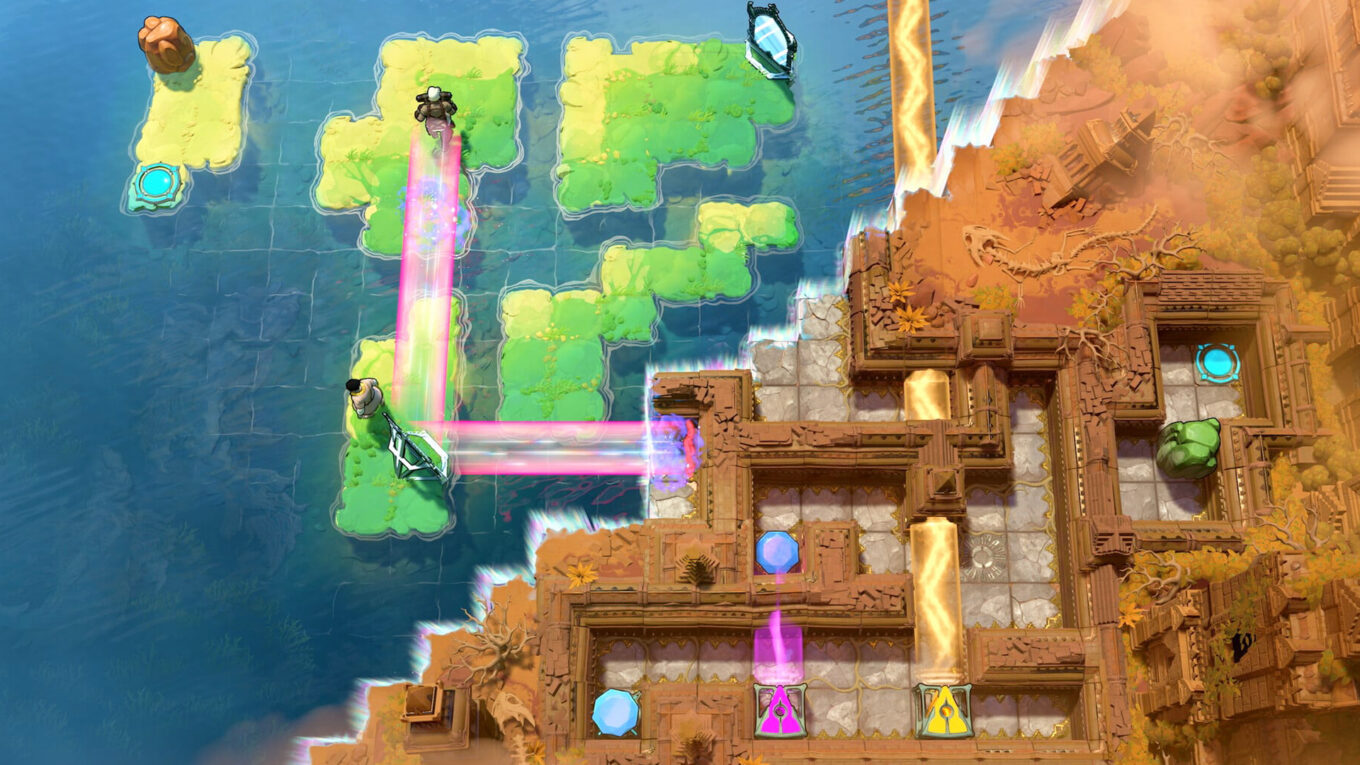
It’s an easy separation to understand. Thekla has not just licensed multiple games as inspiration. In the north, you play, in near-facsimile, Ostroff’s Heroes of Sokoban. To the east and south you’ll find Hazelden’s Mirror Isles and Skipping Stones to Lonely Homes. Gently gated by the suggestion you tackle it last, the west expands into Barrett’s Promesst.
Thekla makes minor changes to many of the puzzles. Though, doing so relinquishes the originals’ character and ingenuity. Even as they expand and combine, Sinking Star’s puzzles feel like playing a photocopy of a photocopy. There’s a resemblance but the detail, the quality, has inexplicably been sanded away.
Perhaps that’s an attempt to distance the game from its inspiration for unexpecting players. There’s certainly an effort to do so with the naming of these areas. Heroes becomes “The Happy Heroes of Hauling” (unfortunately not the only alliteration in the game). At the time of writing, Skipping Stones to Lonely Homes and Mirror Isles are retained, but shortly before the embargo lifted Thekla changed “The Promise” (née Promesst) to “The Vault of the Beamcasters.” No reason was given.
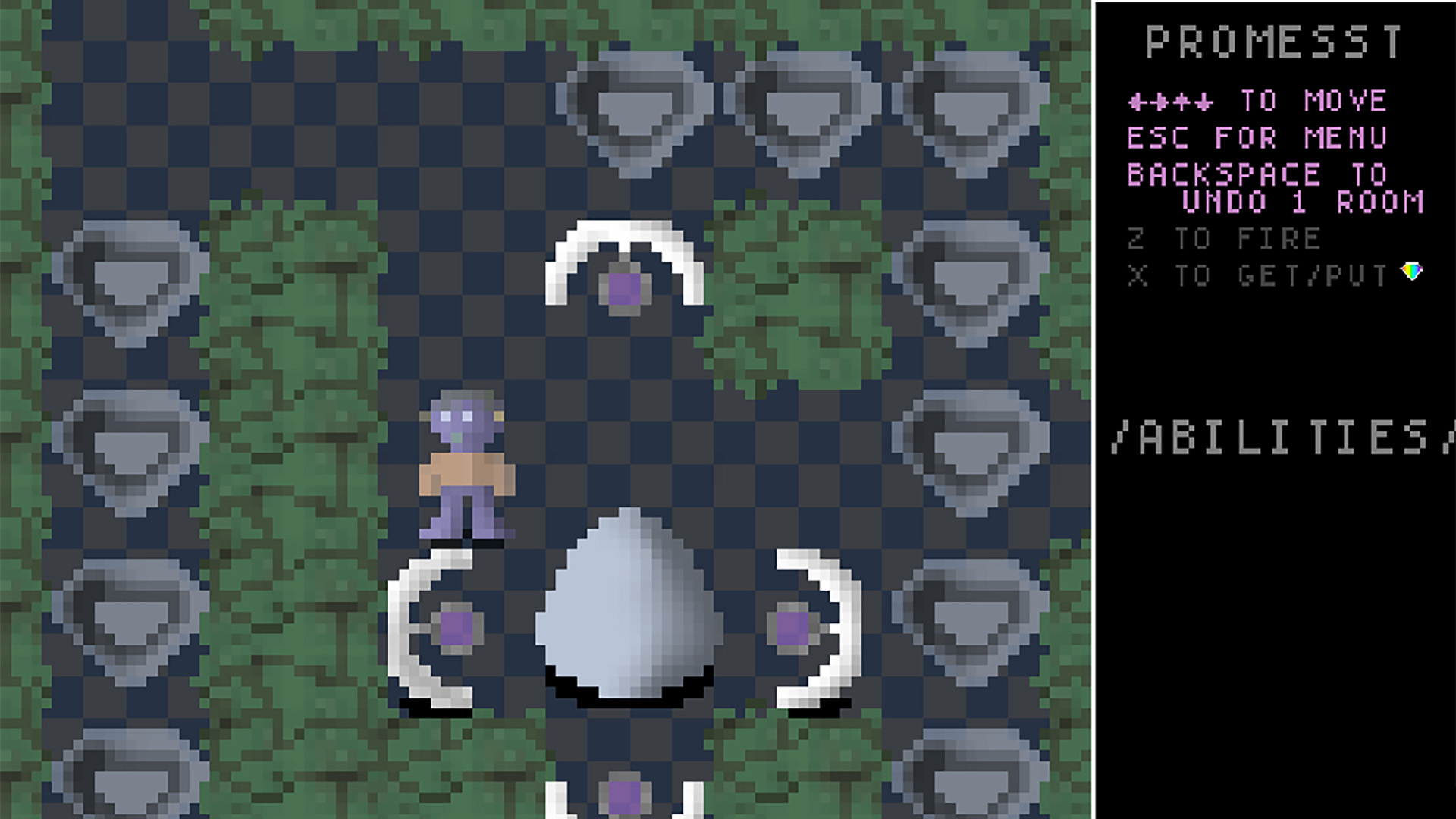
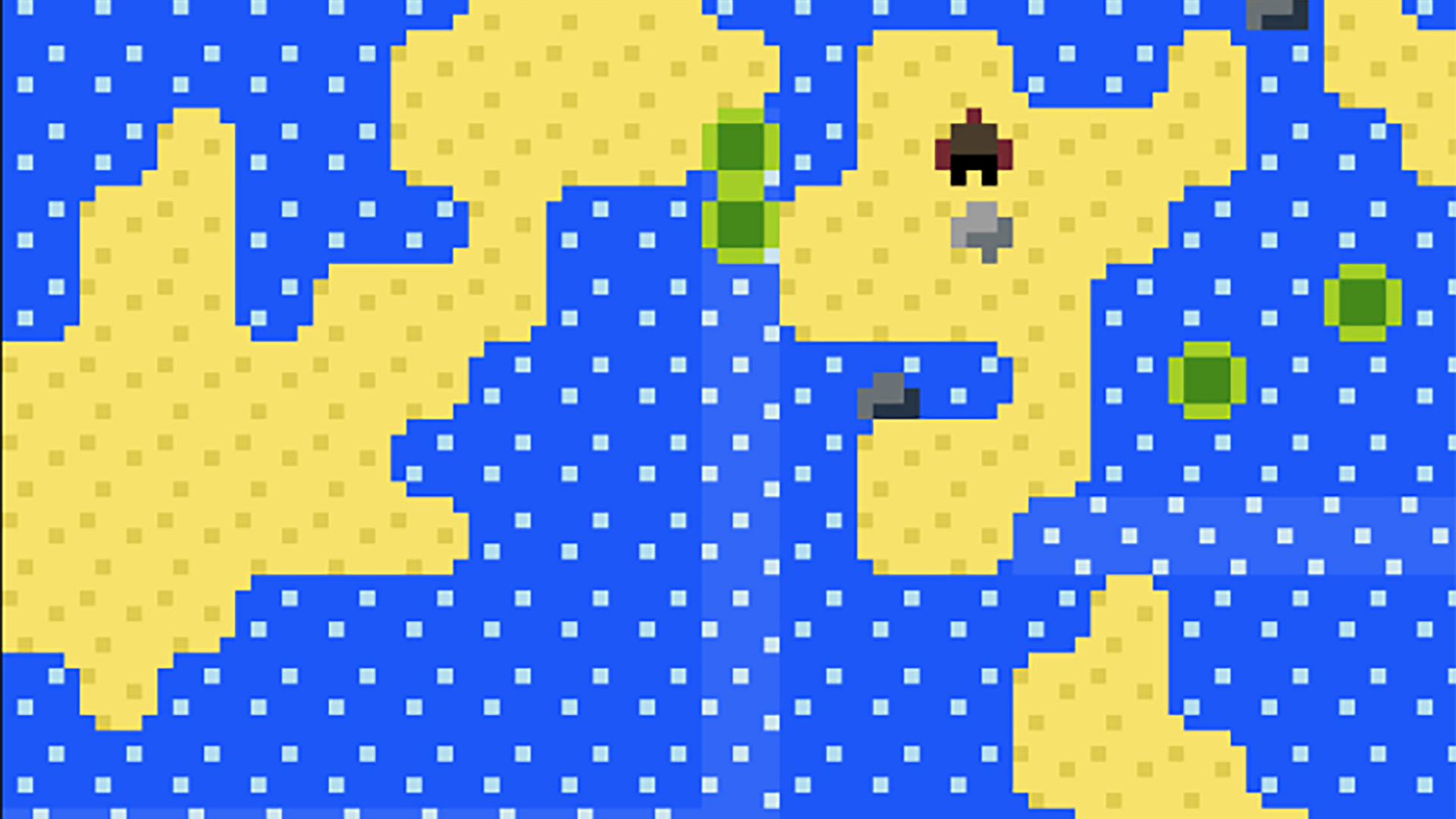
It’s a confronting position. Hazelden’s, Ostroff’s, and Barrett’s games are nimble; they feel good to play and move as you’d expect: like tiny hunts through mazes whose walls are yet to reveal themselves. In response, Sinking Star asks you to walk multiple orbits around crystals while switching characters, in sluggish and clumsy movement. None are especially hard to work out but the steps to reach a solution are laborious. Where’s the joy gone? What’s the reward? All that awaits is more puzzles: hundreds of them. Sinking Star makes its puzzles feel like a job; less enigmas to reveal than a lengthy logistical punishment.
It took me a while to realise what this reminded me of. As I watched hundreds of animations of doors opening, listened to the pretentious utterings that punctuate every level, and moved between increasingly ropey puzzles (all of which artificially elongated an already overlong game) my mind bent to mobile shovelware. It’s the same loop: mindless and unsatisfying, contained within a seemingly neverending grid of levels (or stars), and constantly interrupted to inflate playtime and, by dint, a perception of scope and engagement.
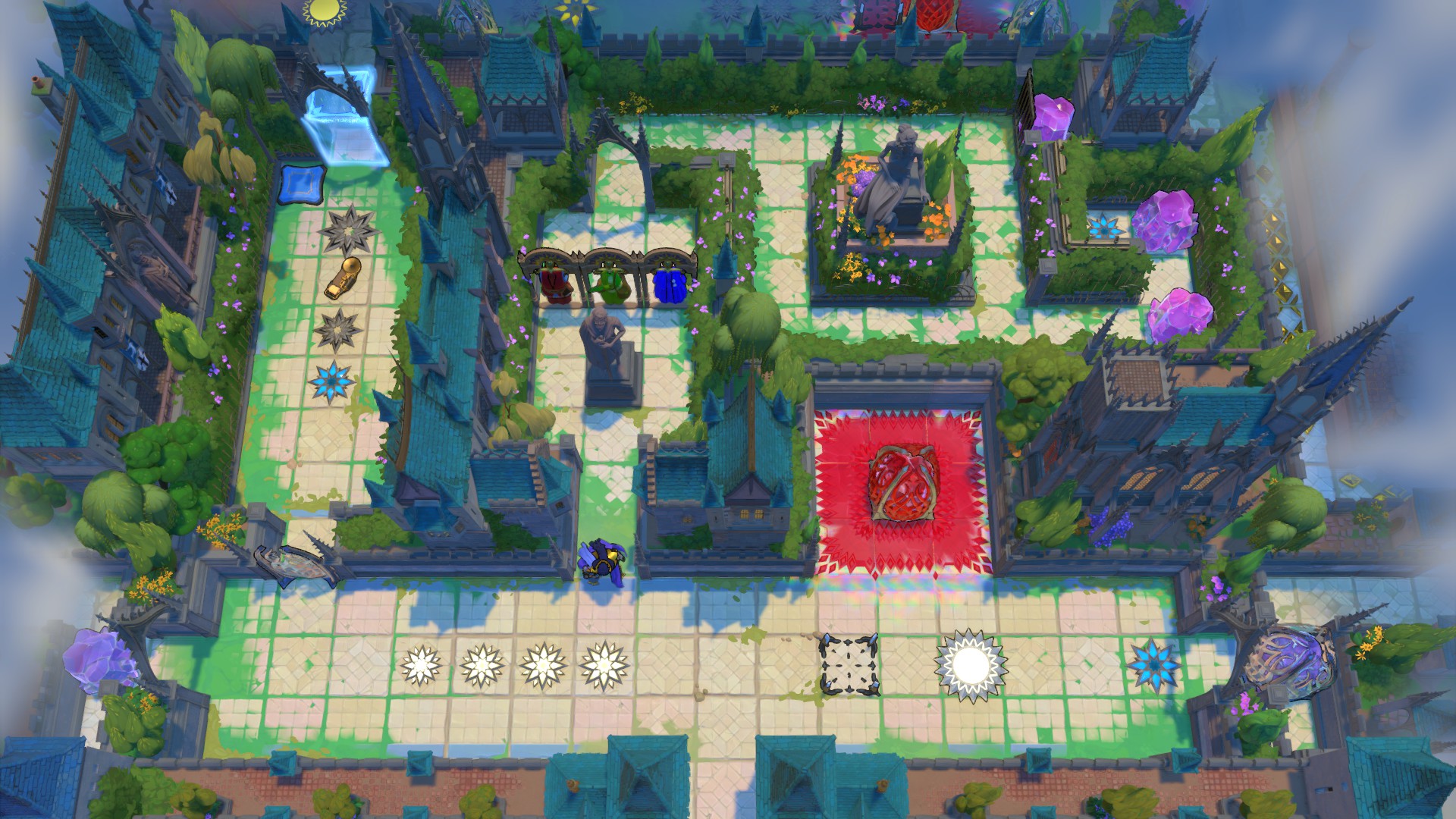
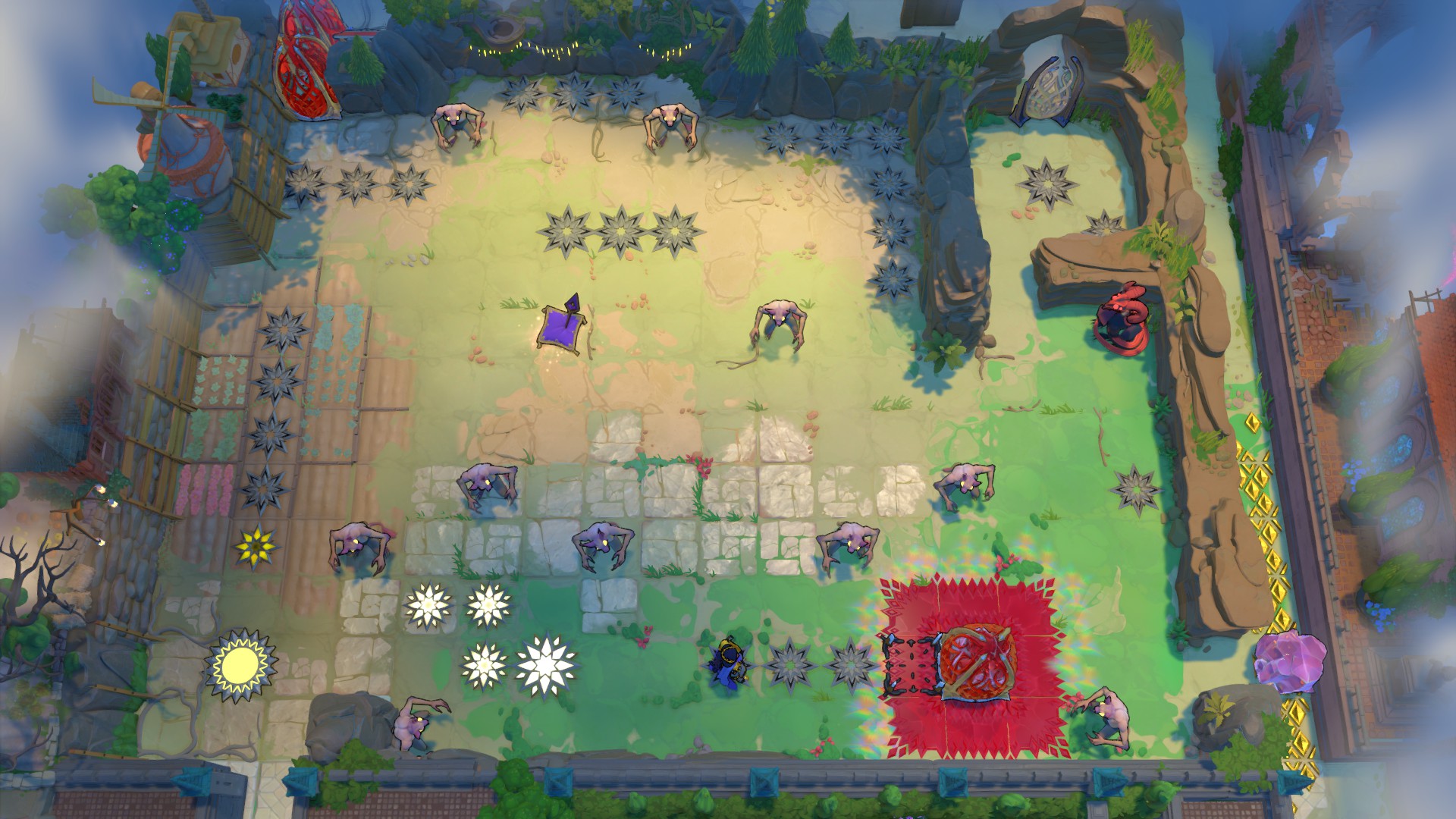
That dilation is only exacerbated by Sinking Star’s perspective. It shifts Sokoban’s intuitive top-down movement to a 45-degree angle that, paired with art direction lifted from Braid (though, I was often reminded of Trine), makes movement and parsing uncomfortable. You can rewind and restart puzzles – this, too, lifted from Sokoban – but this is also laborious given how far back your mistake might be, particularly on the overworld. Not least in the Promesst section, which sends you back as much as 30 minutes of progress if you reload (you can, however, rewind your restart).
It’s worth focussing on Promesst for a moment. Heroes, Mirror Isles, and Skipping Stones all share a DNA by which they can comfortably co-exist in this collation of cadged capers (see, Sinking Star, we can author annoying alliteration as well). Promesst is a different beast: broader, simpler in puzzle design, yet more ambitious in how you address them.
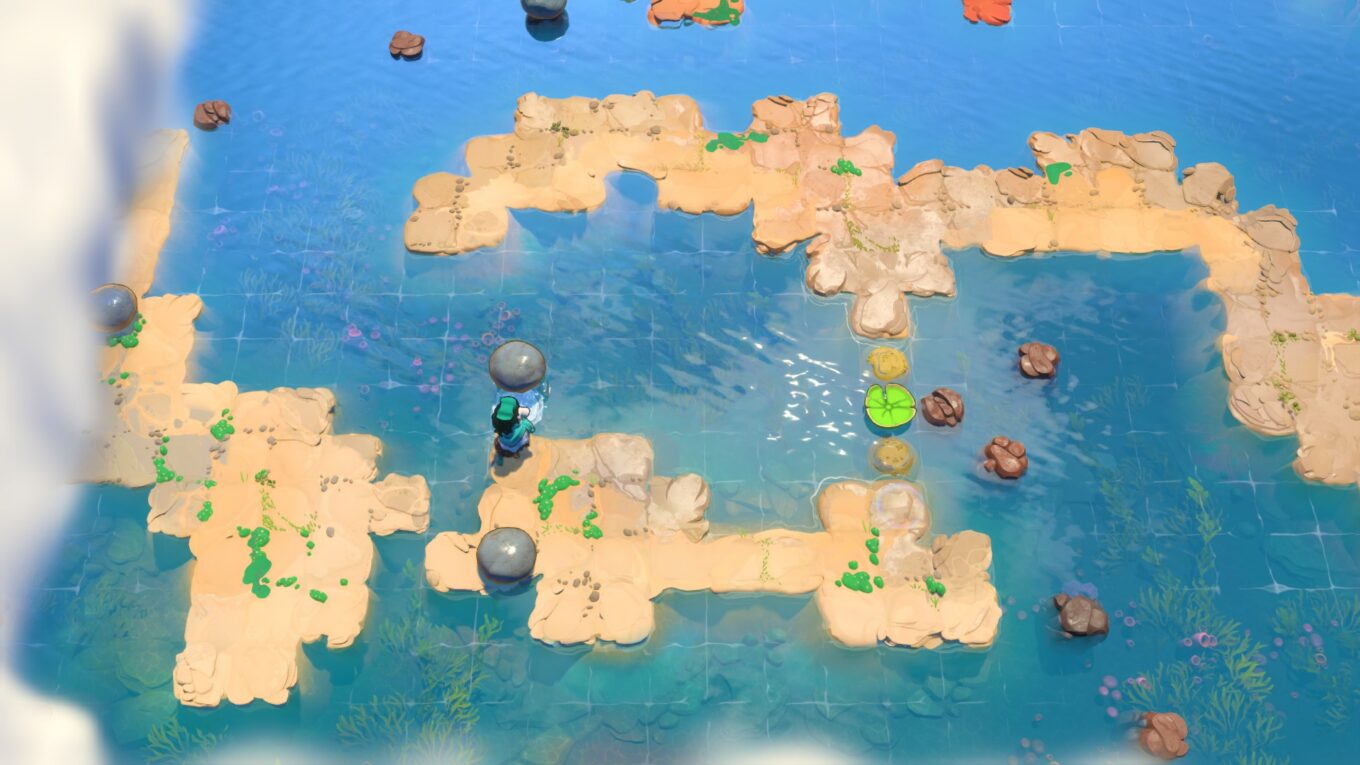
I fancy the reason Sinking Star begs players not to go there too soon is not its stated difficulty but the hope that progress in the game will make it feel less jarring; more like gameplay advancement rather than a failure to integrate the four games. A lack of integration that only became clearer as Sinking Star goes on. Which is a shame because Promesst translates best into Sinking Star’s uncomfortable perspective and is probably the best advert for the game: contained in visible walls and removed from the stars that make navigation of the overworld a chore.
It’s hard to see what Sinking Star adds to this genre. I can commend the experiment, even if it’s unsuccessful, and the scope, even if it amounts to little more than a number. Amazing, too, that its writing can get so much use out of a thesaurus in 2026 (and yet say nothing of substance).
All that, however, makes the games on which Sinking Star is based even more interesting. They develop this formula; grow it and wend imagination into its concepts to find new avenues to satisfaction within. I find it fascinating that despite that DNA being present throughout Sinking Star, the game’s response is not only hundreds of shaky derivations but to neuter its facsimiles too.
I’m reluctant to lay these issues on Thekla wholesale. I’ve worked on enough books for authors let down in the middle of a project to know how creatively constricting it is to work to someone else’s rigid blueprint. There are talented puzzle designers involved in Sinking Star. But the fizz is already out of the bottle. Even if I can applaud Blow’s vision, overblown as it has become, other designers have already perfected these concepts. Recreating their work, with slight edits like a teenager copying an essay, has done nothing to elevate that.
Sinking Star is tiresome. Honestly, it made me feel unwell at times. But I’m not frustrated at the developers under Blow but for them (and the poor souls that have to write guides for this).
I don’t know if I played 1000 puzzles in Order of the Sinking Star. It felt like it. More damning, it felt like I played the same puzzle 1000 times. Some especially credulous people may find that number impressive. In which case, would you be interested in buying the Brooklyn Bridge?
I’d love to tell you that there’s something in that number that makes it all worth it: a surprise that validates the bloat. The best I can offer is encouraging you to explore Heroes of Sokoban, Mirror Isles, Skipping Stones to Lonely Homes, and Promesst instead. Perhaps some will find moral motivations in response to Blow. In all honesty, however, I suggest it only because those games are more accomplished, better conceived, and more fun.