Project Songbird is, at its core, a meta exploration of the uphill struggle which goes hand-in-hand with the process of creating anything beautiful or meaningful. It’s about imposter syndrome, the tyranny of a blank page, writer’s block, and how emotional trauma can open or close the floodgates of inspiration without warning.
Some of these are challenges that I wrestle with (perhaps not so much the emotional trauma bit) each time I sit down to craft a piece of writing which, I hope, will be entertaining, informative, and readable. Knowing how difficult it is to create anything at all can make criticising those efforts uncomfortable – doubly so when, as is the case with Project Songbird, the creator interjects just a few too many times to ask if you’re having a good time. And so it is with deep regret that I find myself starting this review by mentioning how annoying it is that the red doors, on which the game’s mystery centres, open outwards instead of away from you.
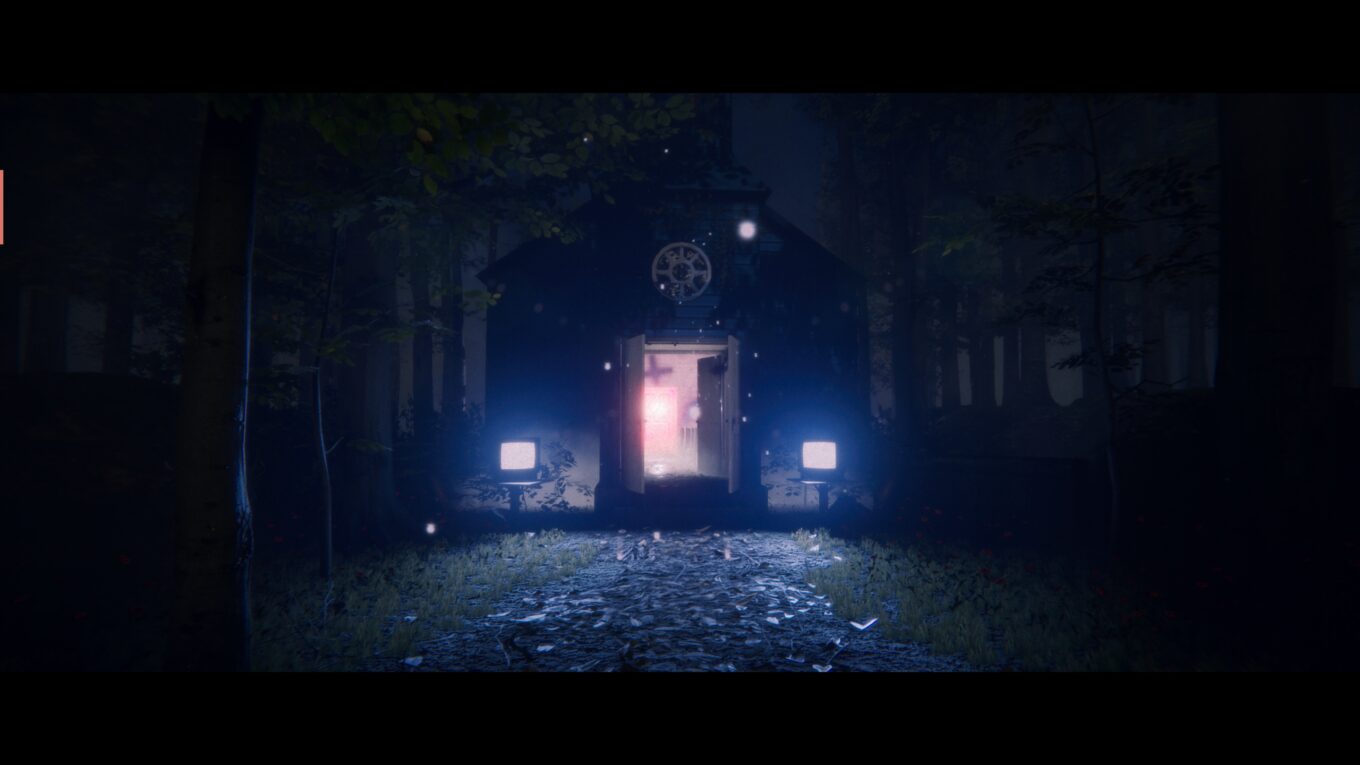
They push you back, you see, inserting a moment of awkwardness when you should be feeling the momentum of being drawn inexorably into the unknown. Yes, it’s an insubstantial niggle, but it’s one of many in a game that boasts some genuinely mature storytelling but often struggles to marry it up with being, well, a game.
The story kicks off in a messy flat belonging to protagonist Dakota, aka Neon Songbird, a successful indie musician known for her synthy, guitar-driven music. More recently, though, she’s found herself making more introspective acoustic stuff as a result of an extremely difficult bereavement. The fans aren’t keen on this new direction and pressure is mounting from the label to come up with another commercially successful album. In order to springboard this opus, her agent Rob suggests she go full Bon Iver and stay at his friend’s remote cabin in the Appalachian forest to rediscover her muse.
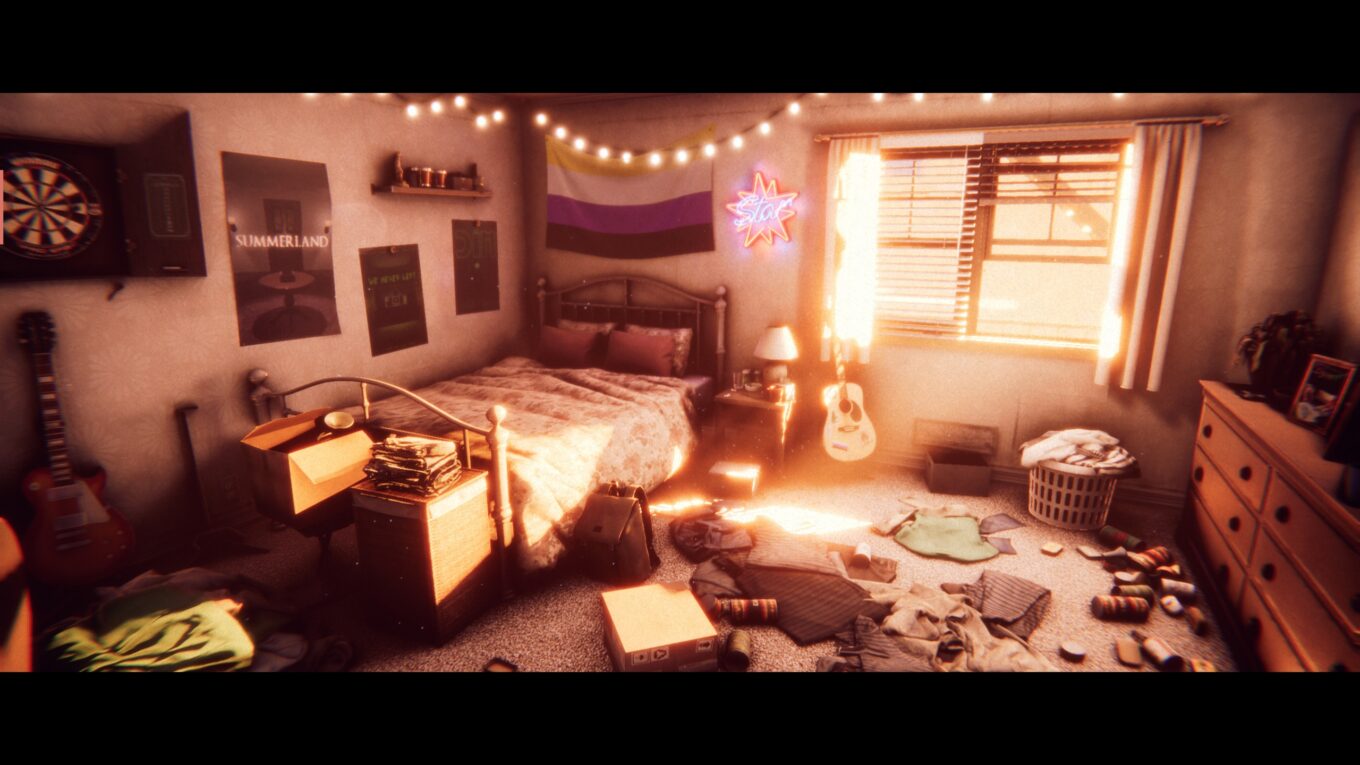
Initially this means a sedate meditation on isolation and healing, in which you explore the local area, chop wood, ensure you have a working source of fresh water, and listen to the collection of real-world vinyl albums you’ve brought with you (a really lovely touch, which comes with interesting tidbits on each band from Dakota). You learn how to use your camera to take snaps – which collect on a table next to your bed – and a sound recorder with which you can capture environmental noises that might just serve as effective texture in the music you’re planning to write.
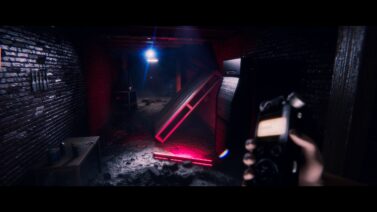
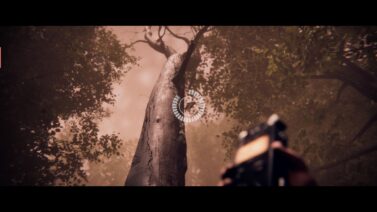
Soon enough, proceedings devolve into something far less comfortable. Strange noises wake you in the night, the local legend about a witch who lurks in the nearby abandoned mines starts to feel less like hearsay, and then that red door appears and draws you into nightmarish, not-quite-right versions of important locations from your past. Within them, you must solve various simple, but often pleasing, environmental puzzles as doors and rooms shift around you whenever you look away, all while avoiding the creatures which stalk the hallways.
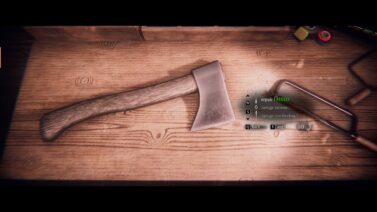
You’ll encounter two enemy types: ent-like wooden creatures with concerningly sharpened forearms, and a creepy Weeping Angels-style problem which only moves when you turn your back. You can block and stagger the first type with your axe, and even take them out with the handgun or rifle you acquire, but avoiding combat and sneaking past is usually preferable. Unfortunately, both combat and stealth feel a bit woolly, struggling to telegraph the information you need to be consistent.
The second enemy type can’t be killed, and despite its Dr Who familiarity, is genuinely terrifying thanks to the heavy breathing and high-pitched sound effect that builds whenever it’s chasing you. It’s particularly effective when deployed in combination with puzzles that force you to turn your back – playing a sequence of notes on a piano, for example, or turning a heavy valve – and causes some genuine moments of panic.
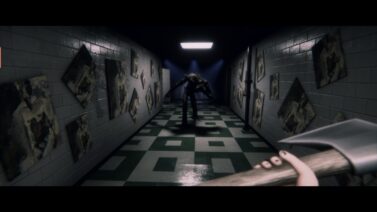
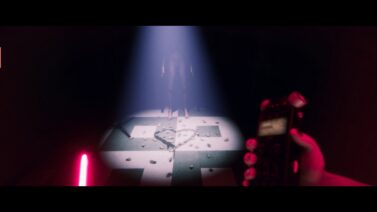
The audio recorder and camera are also recontextualised here: the former helping you locate enemies or, during one particularly traumatising puzzle, figure out which route to take in a looping sequence of corridors; and the latter standing in for your torch when you’re out of batteries. Creeping your way through a maze of manikins or desks while intermittently firing the flash to see what’s in front of you is stressful to say the least.
Fittingly, given its focus on the creative process, Project Songbird wears its influences on its sleeve. There are elements of P.T. and Layers of Fear in its shifting domestic environments, The Witness and Eternal Darkness’s fourth-wall breaking winks to camera, and Firewatch’s remote relationship-building in the time you spend chatting to Rob via a walkie-talkie. But there is also – often to its cost – a heavy dollop of Kojima-style filmic ambition.
The game is presented in a combination of optional widescreen and 5:4 (ish?) Instamatic formats, lending it an immediately cinematic aesthetic which frames its bloom-heavy, vaseline-blurred visuals well. There’s some striking use of colour and framing, and all of this is paired with a great script and voice acting equal to it.
It’s just that it feels like you spend half of the five-hour run listening to it or watching cutscenes rather than actually playing. There’s a moment where, after a lengthy cutscene, you’re tasked with walking from your bed to the door of the cabin in order to then watch another one. And when your walkie-talkie crackles into life you’re no longer able to pick up items, are slowed to an agonising crawl, and hemmed in by invisible walls, unable to do anything other than wait.
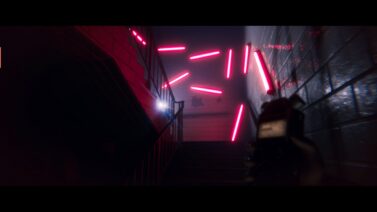
It’s more incorrectly hinged red-door moments – the player stepping out of the way of the creator’s vision rather than being welcomed into it. As a result, the story and the game often feel like separate entities, and this is compounded later on when a commendably brave narrative twist further chips away at Project Songbird’s cohesiveness.
It is clear that there is a great deal of talent behind this project, and even more passion besides. There are moments where this surfaces, and some memorable twists on established horror tropes, but too much of your time is spent battling with the game’s systems rather than experiencing them frictionlessly. There’s an intriguing short film here, I’m just not as convinced it comes together as a game.