Rome has fallen into corruption, decay, and chaos. These are the words I’m first met with in developer Lion Shield’s city builder, one of a flurry of recent releases focused on the ancient Italian capital. But, it’s also not Lion Shield’s first rodeo in the city building scene, releasing Kingdoms and Castles back in 2017, to great success.
Nova Roma has entered early access and, as the name suggests, you’re to build a new Rome. One so good that the old Roman Empire will sneer jealously at it and ultimately attack it in bouts of envy. By this point though, you’ll have built a durable, broad-shouldered city that can withstand such force, protecting the freed citizens now residing there in peace. Hopefully.
It’s a wonderful basis for a city builder and one that rings eerily similar to that of Ubisoft’s Anno 117 that I played fervently towards the end of 2025. In Nova Roma though, you’re handed a modicum of control straight off the bat that feels empowering. You can generate the island that you want to inhabit, whether that’s small, medium, large, or ultimately choose to roll the dice for a random pick, all while scoping out the landscape before committing fully.
You’ve then got the opportunity to pick how you want to play it. The casual laidback Easy mode will present you with only a few challenges. Opt for Peaceful if you want to fully relax without fear of attackers, focusing instead on building, resource and city management. And quite honestly, I love the idea of living a long, abundant life in Nova Roma’s Peaceful mode, differing from Nova Roma’s creative sandbox mode with achievements unlocked.
But, for the sake of submerging myself into the new setting and going full Romulus, I opted for Normal, hoping to grow my city into a bustling metropolis with the usual dynamics of city building life throwing naughty little curveballs at me. Harder mode, if you’re up for it, is ultimately a lot less forgiving. Weaved into these decisions is an important feature of Nova Roma’s design and unique gameplay and that’s the wrath of the Gods.
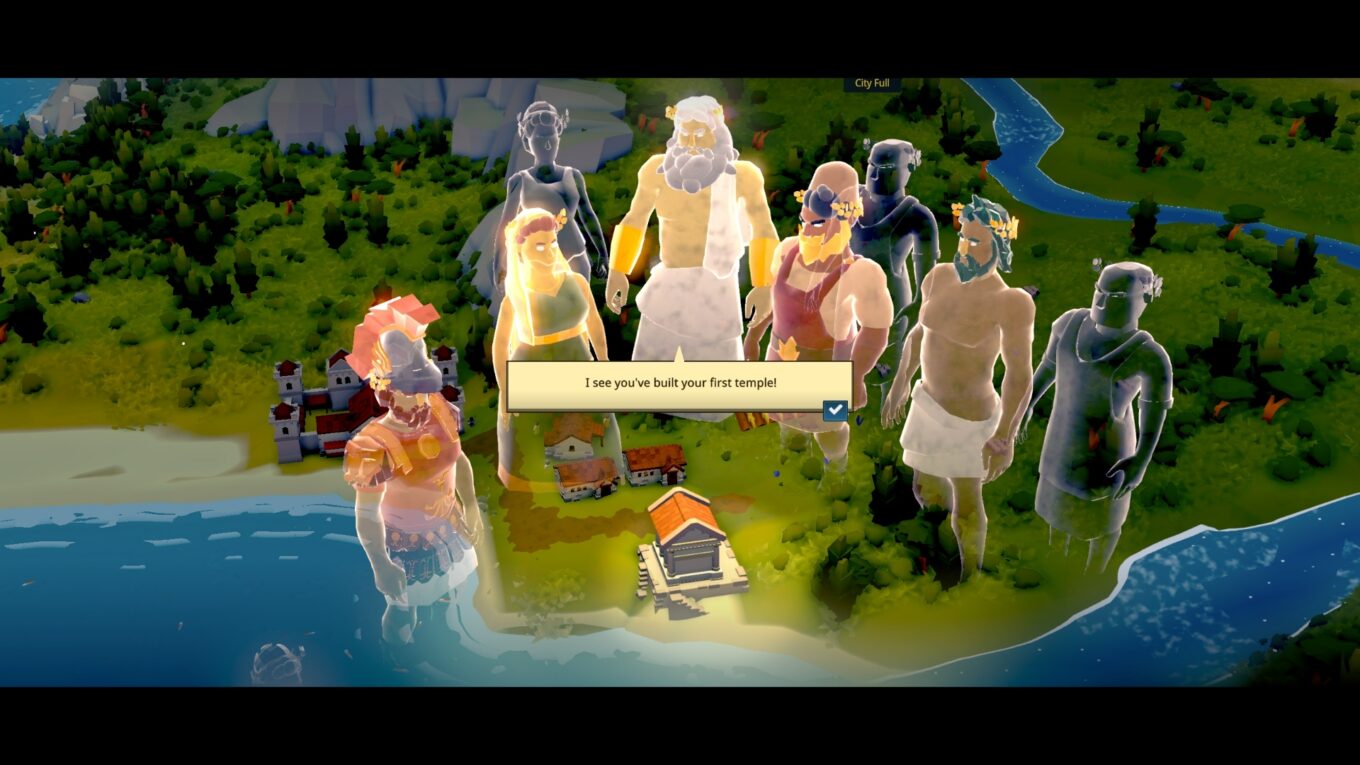
The Gods demand your attention, your resources, and your praise. You’re not only building Rome, you’re appeasing them. From the outset, you’re building temples to dedicate to the five Gods currently in the game, though I’m told more will be added throughout its time in early access. In fact, you can see three ghost-like bodies amongst the ranks not yet unveiled.
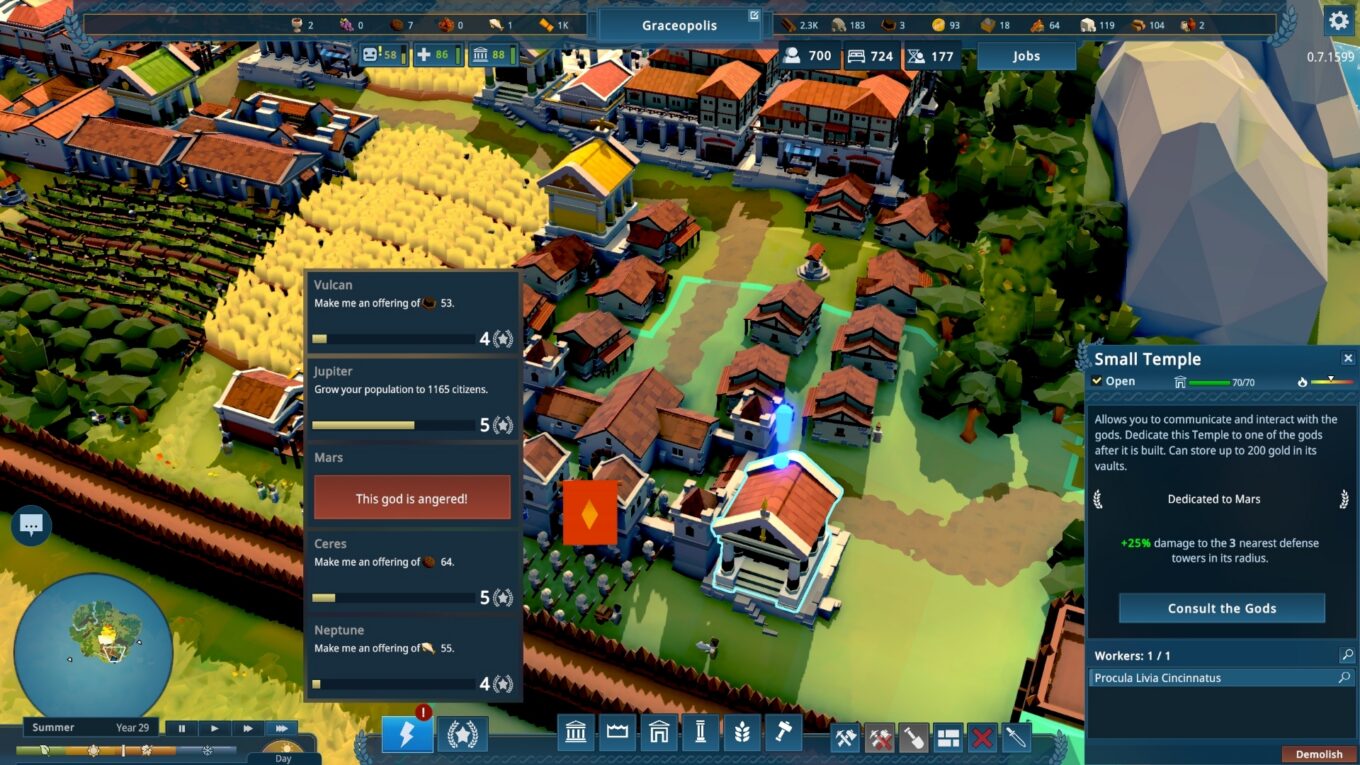
Build small temples, reap the rewards of a God in the surrounding area, and fulfill their Divine Tasks to earn Favor, which is then used to unlock the 85+ buildings in the technology tree. Fail to complete the tasks, anger the deities and face their wrath, like Jupiter raining down lightning bolts on your city. Fail to build a larger temple to praise them angers them even more. If you’ve ever been to Rome, you’ll know the city is laced with temples, and I’m not surprised considering how much the Gods will bother you for their own throughout your time playing.
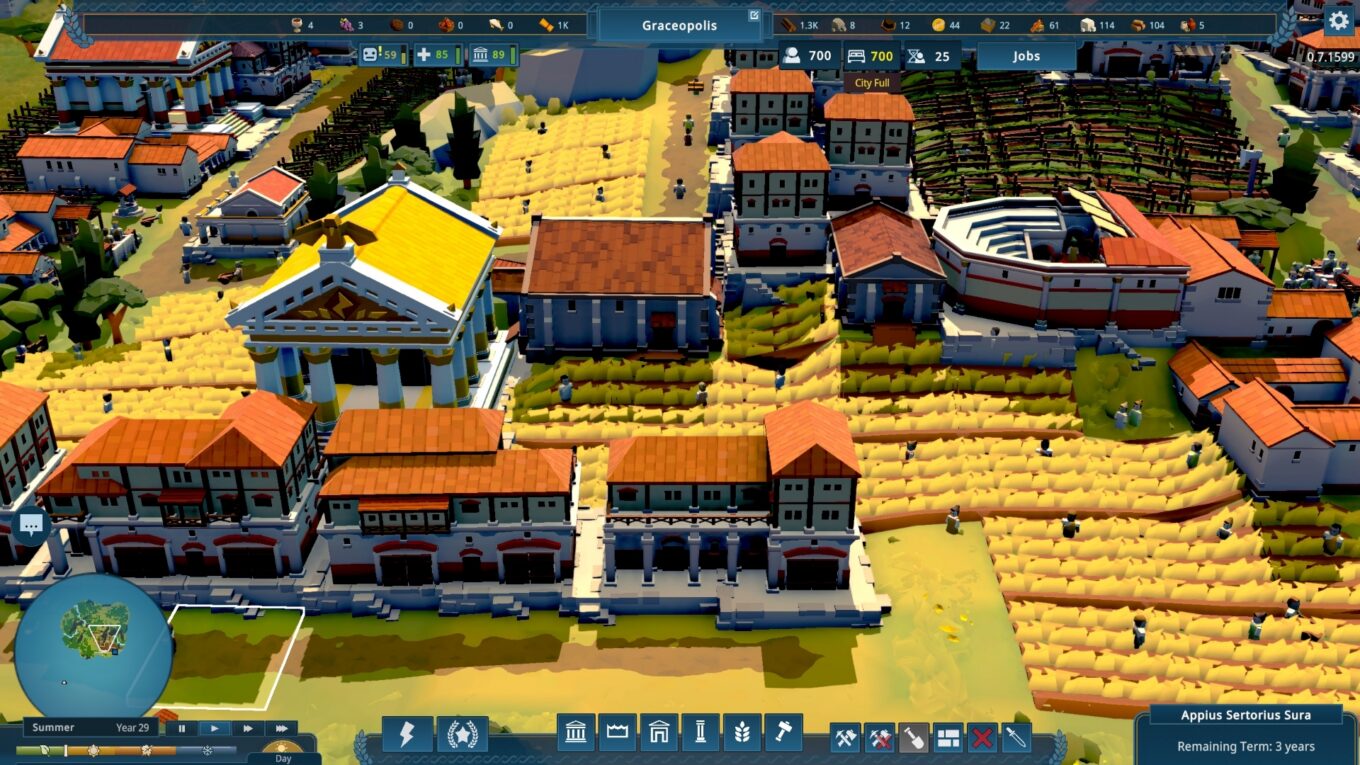
It starts as any good city builder starts, with a barren land desperate for you to populate it and fill it with buildings, perpetuating a complex supply chain that keeps it all ticking over. My time with Nova Roma then was primarily focused on building up a city I’m proud of. Wood was harvested from the Forester, resource management was in full force with farmland and fishing feeding my people, and a sudden demand for pottery had me building Pottery Workshops to appease my grumbling citizens.
Rome wasn’t built in a day, and it certainly took me a lot of in-game years to get it ticking over nicely. Even when a fire, drought, or cheeky ravaging plague threatened to topple all my hard work. But that’s the beauty of a city builder done right. I’m chilling out one minute, watching my resident ants swarming through my hard work, only mildly bothered by a few disgruntled citizens who don’t live close enough to their workplace. Next thing I know, like an alien invasion in SimCity, I’m suddenly perplexed, saddened and rebuilding after an unexpected event like a city-destroying flood (which I’ll expand on shortly).
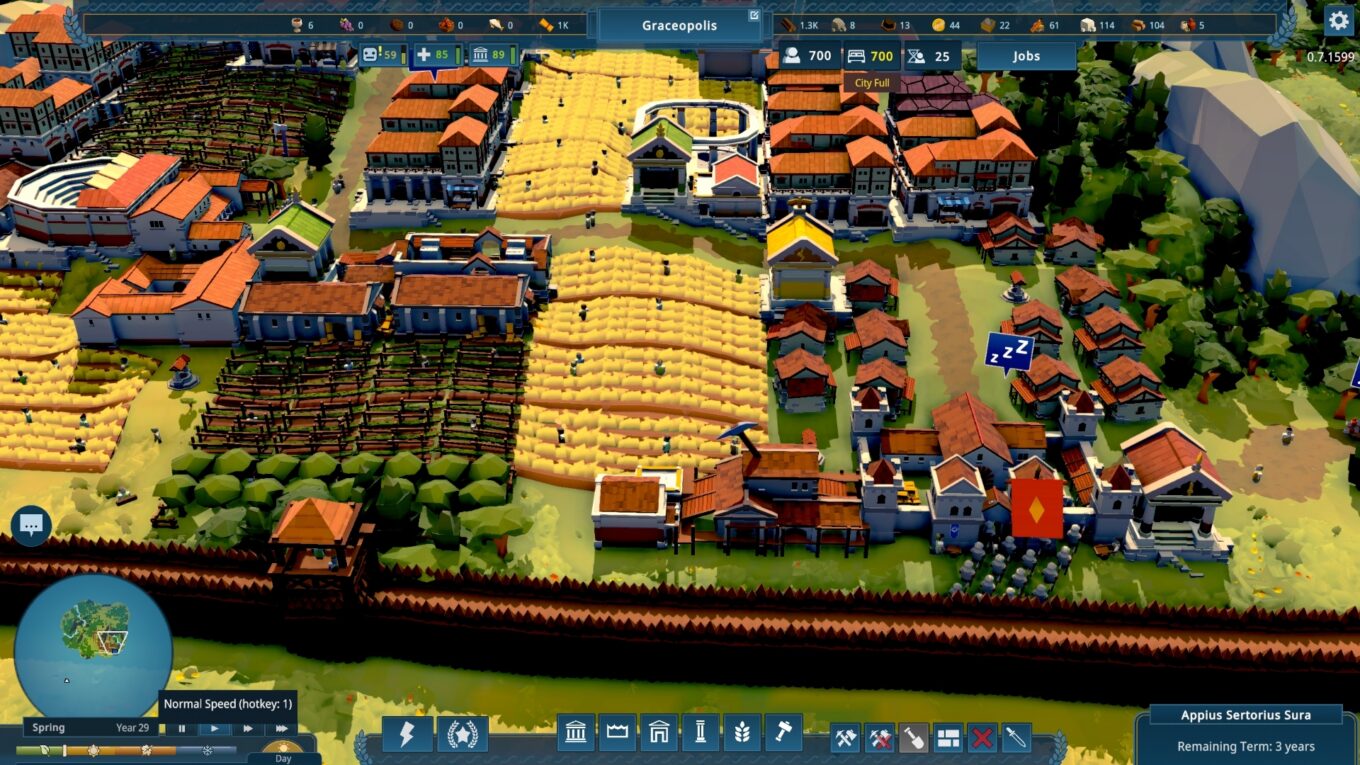
And while it took me years to feel that I’d built my Rome, or Graceopolis as I so egotistically called it, the years go quickly. Too quickly. One of the things about Nova Roma that differed from the usual city building flow felt to me like the speed of time passing. The seasons tick by in minutes, so while my crops were looking lustrous one minute and the autumnal harvest left my residents happy and abundant, the winter hit in seconds and everyone’s mad at me again. My citizens are falling down wells and dying or getting too cold and just keeling over in the middle of my once abundant wheat field, yet it was sunny just a moment ago. And then, as the heavens opened, rain descended upon Graceopolis and flooded the city I’d so hastily built on the bottom of a rather large mountain peaked with water.
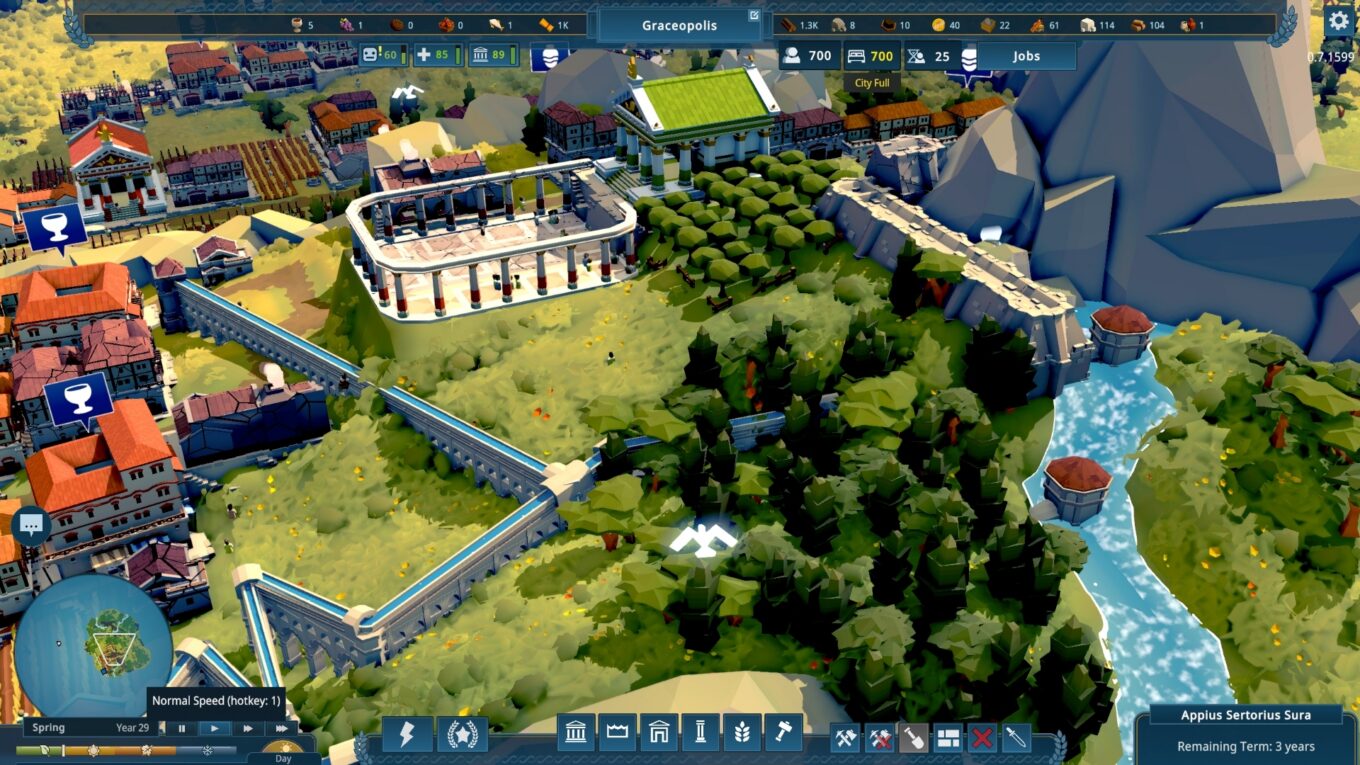
And this is where another of Nova Roma’s intriguing and unique mechanisms comes into play – the gravity-based water system. Aqueducts are at the core of building a strong civilization, diverting water as you see fit to fuel bath houses for pleasure and water towers for residential thirst. And you’re building dams to divert city-shattering floods away from your population. My first dam project saw me totally abolish the annual flooding issue by directing it down another part of the mountain and away from me, which was a wildly clever addition to the game. Once you’ve unlocked the technology tree far enough, you’ll even get access to full terrain redevelopment.
It also made me reprioritise. A city under the peril of water made me question if I’d built my city in the worst place on the map, only to discover on another playthrough based on an entirely new map that, while the water was a problem, I had been very smart to place it near a stone quarry. Because, it turns out, you need a lot of stone. Setting my citizens up to clear land, build, clear more land, and build led me into a perpetual cycle of resource gathering. But, here’s where my dedication to the Gods came into play in a positive way.
While there’s no deep narrative to your time in Nova Roma, the Divine Tasks set out for me from the five current Gods available in early access gave me a much clearer path laden with achievements that I could follow. Would I have built so many watch towers if I wasn’t trying to appease Mars? Probably not. Did it help my city grow? Absolutely.
The tasks gently feed into each other, as you’d expect from the genre, but sometimes it became more aggressive when the Gods started to threaten me with not doing enough. Throw in the medium frequency of droughts, floods, fires, and food consumption and you’ve got yourself a fragile ecosystem waiting for one little thing to make the rest come tumbling down. Continue to appease the gods and enjoy the favor they give you in return, including increased happiness of your citizens, higher food yields, and more.
But, there’s something else that can sway the entire city in your favor, Gods aside, and that’s electing a governor once you reach 40 citizens. Three governors campaign for the job on a three-year termly basis with different positives and negatives they bring to the table. They could make your citizens happier, but they could also make merchant ship costs more expensive. People will eat more, but your buildings won’t suffer from as much degradation. And every three years, you elect someone new. Or, stick with who you’ve known and take a reduction on their traits based on citizens becoming weary of their reign.
Amongst the politics and God-appeasing, you’ve got the bones of the city building to contend with. Heavy on the expansion of your new Rome to begin with, and then narrowing down to managing what’s going on and planning your next move towards a new part of the map. However, the residents are needy little mites, and one way to make them exceptionally happy is to give them more shops. In Nova Roma, it’s a little different. These shops function as part of a mixed-use building with apartments on top and shops at the bottom, which is a lovely unique feature of the city planning.
Fortunately, with all these moving parts and plates to spin, Nova Roma never gets too technical. Whilst I don’t mind keeping track of the analytical outlay of the world I’m building, I also quite like that Nova Roma just lets me watch the organic growth. Instead, I can judge by a citizen’s perception of my city on how it’s going. Feedback is delivered on the side of my screen and the floating speech bubbles above my residents’ heads, but if immigrants are deciding to settle with me, then I must be doing a good job.
Playing on Normal mode meant that I saw a lot of fires and fury, but not a lot of invasions. The first test of my city’s defense system was a few years in, and an angry boat floated on by, lighting one building on fire, and then leaving. 15 years later, there were armies on foot that came a little more aggressively, but nothing the militia at my Outpost couldn’t handle. Notch it up to a harder mode and these invasions become more frequent.
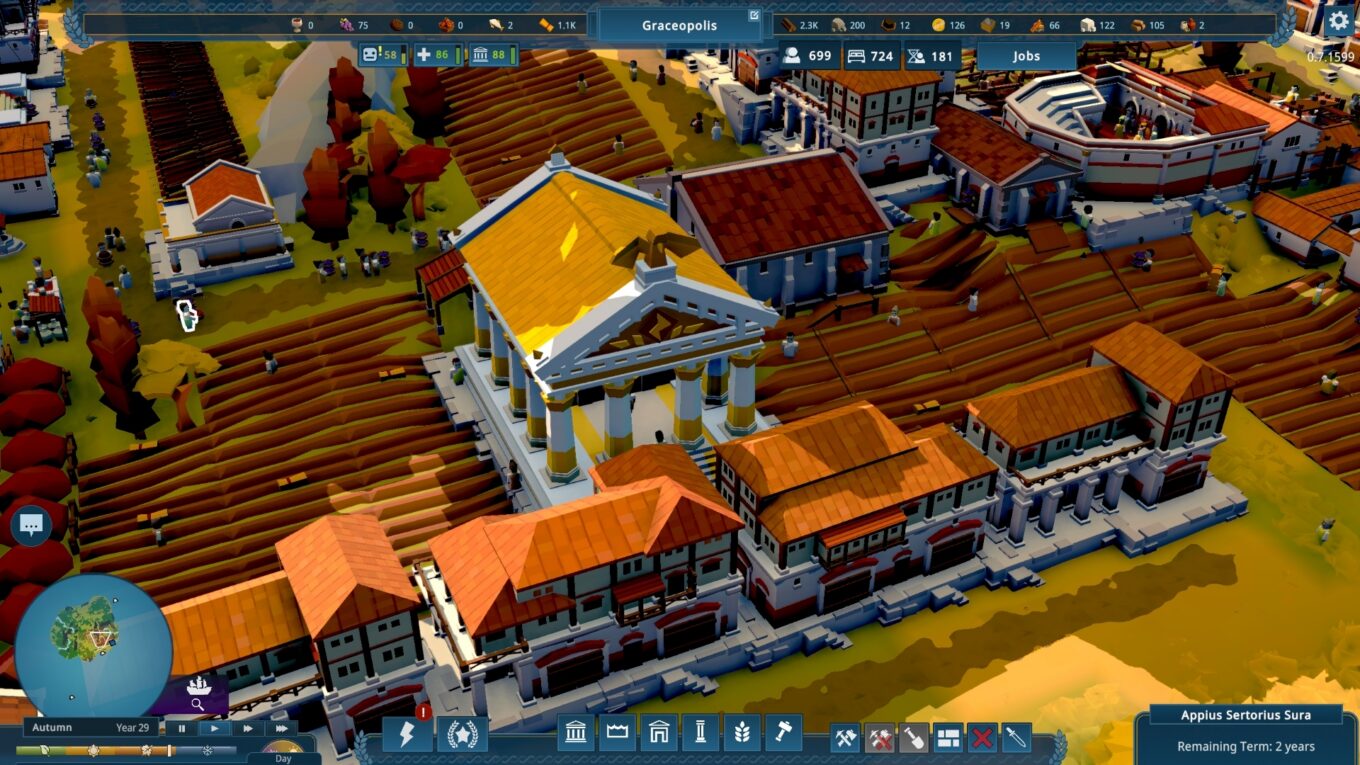
It’d be easy to argue that Nova Roma is somewhat simplistic in its city building nature. It’s soft on the eyes, and my villagers and buildings certainly don’t have much detail to them. But, I’m not looking for a game that’s doing too much. Nova Roma hits the markers of a decent city builder while still managing to find unique ways to make it different. What Lion Shield does so well is create an experience based in the world and not in the menu screens. Instead, numerous challenges await and the pantheon of Gods continue to lay on the pressure.
It’s still early days for Nova Roma, but it’s certainly coming along nicely. You don’t need to have your hand held to watch your city unfurl and thrive under a well-planned aqueduct system, but there’s plenty to learn as you go. I’m certainly excited to see what the game rolls out next with plans for more Gods, mechanics, technologies, politics, and more. For now, if you’re a fan of city builders, Nova Roma strikes a wonderful balance between complexity and fun.