Religious fervour can do strange things to people. Sometime in the 1980’s, the cult leader Ayah Pin – who claimed to be a reincarnation of Buddah, Jesus, Shiva, and Muhammad – began construction on Sky Kingdom. The compound would eventually boast, among other structures, a two-storey teapot said to perpetually fill a similarly massive vase with holy water. The 1534 Anabaptist Münster rebellion saw one religious leader end up with his severed genitals nailed to the city gate, usurped by a 25 year old who claimed heavenly visions. He immediately made polygamy compulsory, took sixteen wives for himself, then started renaming other people’s children.
Which all sounds like great fun, but I’m trying to run a business in hellish management sim Sintopia. As such, I can’t have random people suddenly declaring themselves saints – not least because their immunity to sin renders them unprofitable. The obvious solution for any self-respecting celestial being would be to pick them up and flick them into the ocean, or at least engage in some light afternoon defenestration. Unfortunately, there’s no way to interact with them directly.
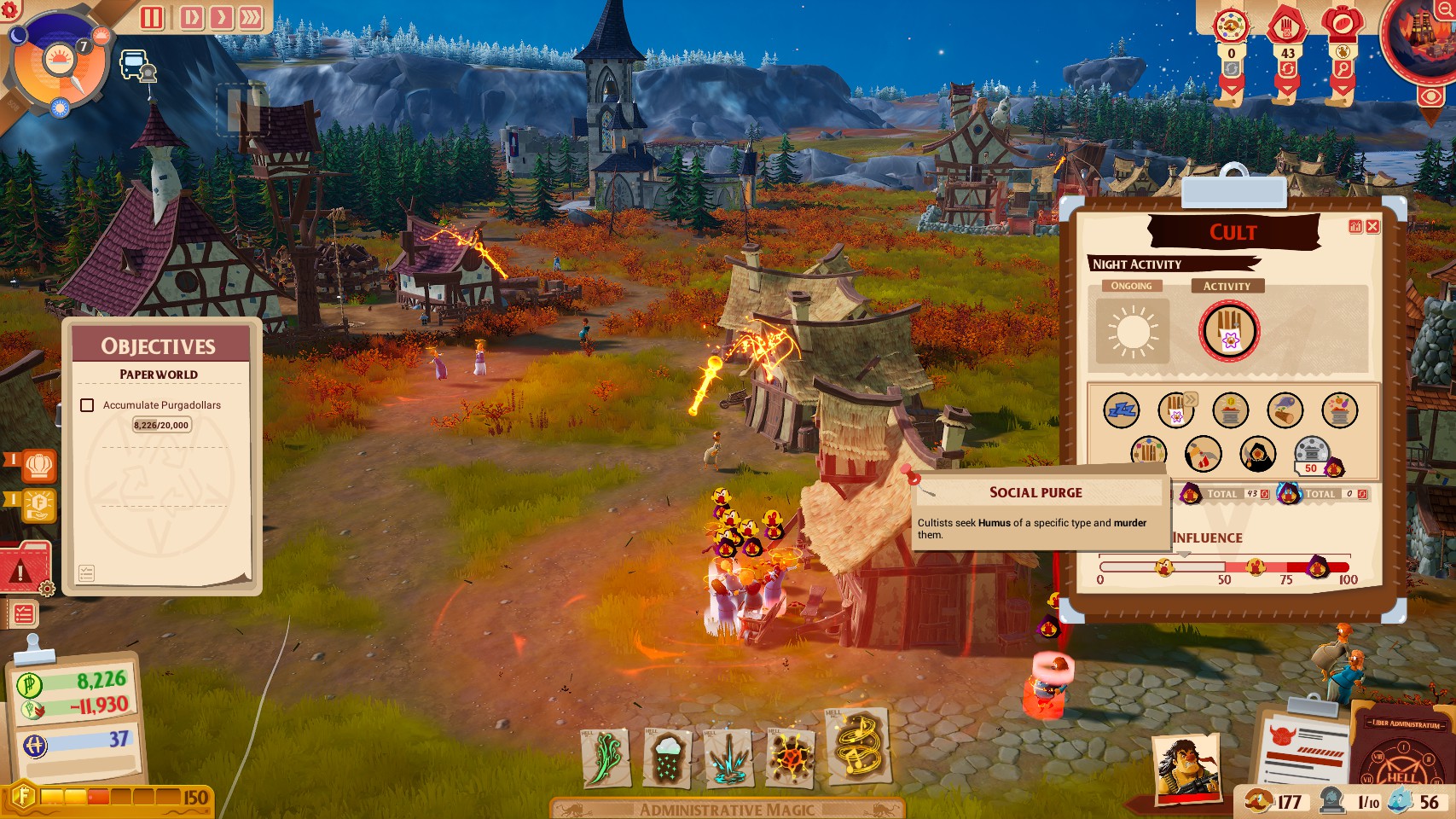
The solution, it turns out, is to repeatedly cast a spell that summons ethereal flute music and inflicts anyone in the vicinity with dancing madness. Atheism is difficult when you’re being compelled to jig by unseen forces, and they’ll eventually form my absolute favourite kind of cult – one in my name. After that, I can command the cultists to spend their nice evenings hunting down and the saints and murdering them. Cults are great, actually.
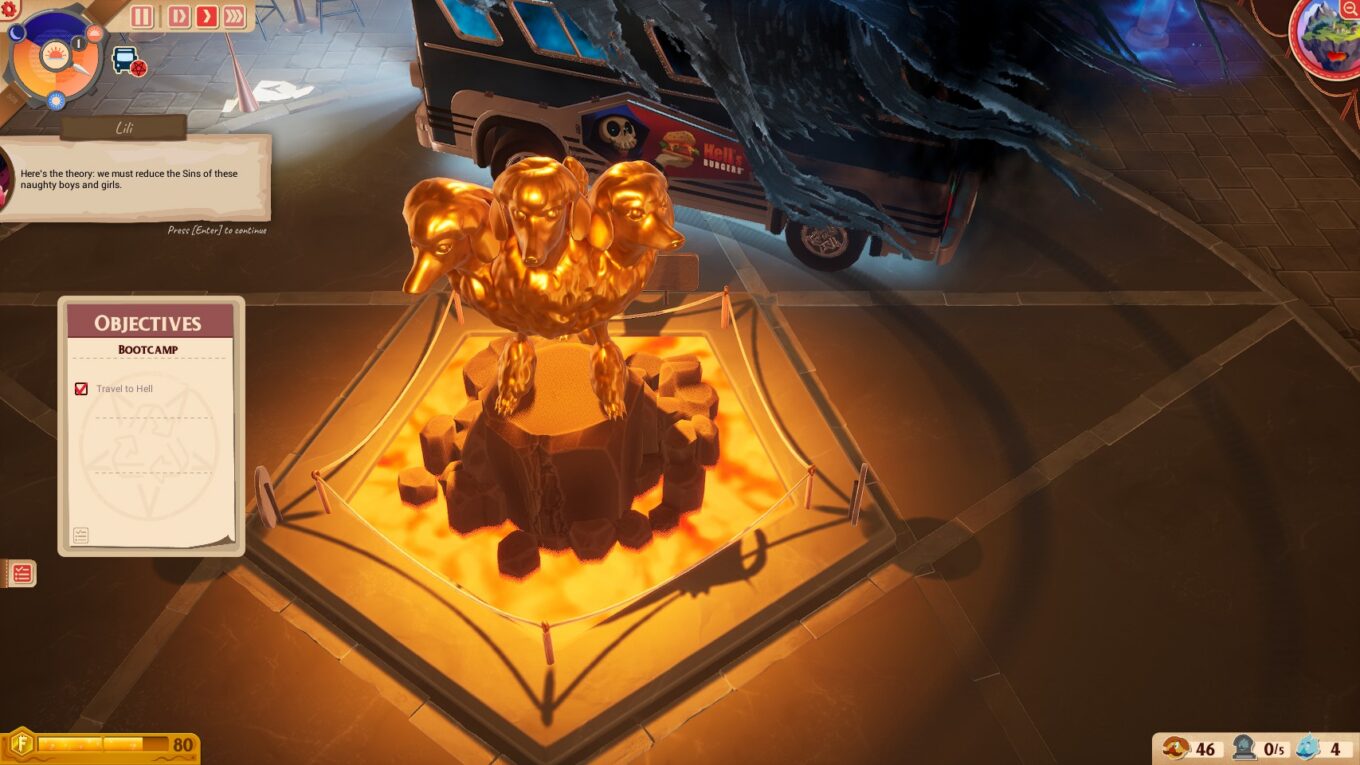
I’m five or so missions into Sintopia at this point, and I’ve just about got a handle on things. I’m making sure to build waiting booths to prevent souls being corrupted by hell’s atmosphere while they queue to have their sins punished by imps. I’ve learned that if their souls reincarnate cleansed of sin, I’ll earn coins to research upgraded buildings, or more powerful spells. And I’ve certainly learned that keeping my population’s sin count in check has benefits. I could really do without having another fisherman get so wrathful he summons a Balrog-like rage demon that rampages through the overworld, slaughtering the villagers and clogging up my neat waiting lines with a glut of fresh spirits.
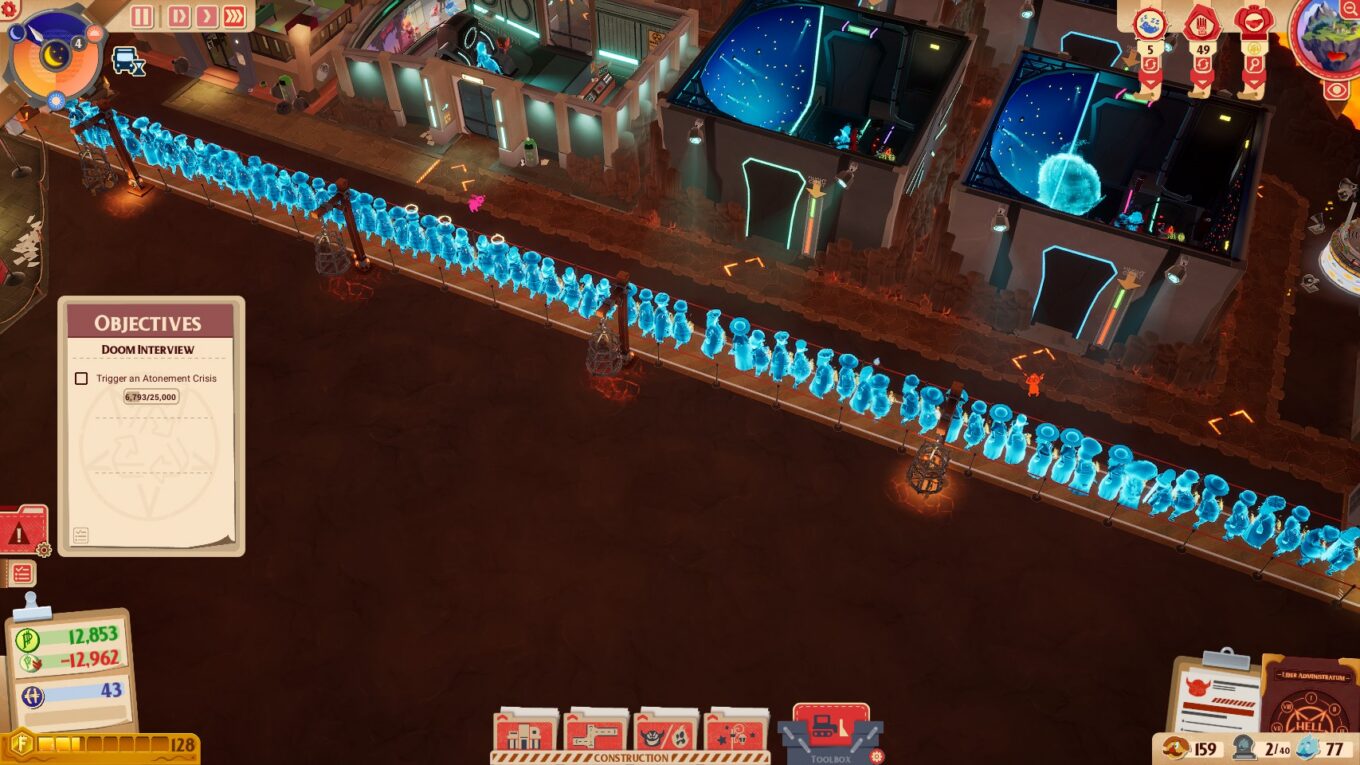
So, as I said, it feels like I’ve got a pretty good handle on how Sintopia works at this point. I assume the campaign will throw a few obstacles my way. Maybe a natural disaster or two. Perhaps a demon attack I can’t prevent in advance. Then, I’m informed by my advisor Lili that my objective for this mission is to raise that cult so they can rescue Satan from an army of giant Aztec lizards. Once that’s sorted, we can get to overthrowing god. Sintopia goes places.
Sintopia is not perfect. Its general vibe and visual gags are charming, but many of its attempts at character humour are incredibly tedious. Its management systems are barebones, and it’s so stingy at the start of missions that you’re forced to expand at a snail’s pace, or else risk tanking your economy while you deal with lengthy staff strikes. Hell’s system of one-way streets, crosswalks, and programmable logic gates allow for some truly ingenious layouts, but it’s supremely frustrating to watch a single glitching soul gum up your entire operation.
But there is so much creativity in Sintopia’s rapid-fire systemic nonsense, and so many quirks and tiny details to its simulation, that it’s not hard to overlook its flaws. Scores of strange ideas – often thin in isolation – compliment and support each other in such nifty ways that this homage to the Bullfrog-era often ends up far more engaging that it’s inspirations. At its best, it feels like the sort of thing Peter Molyneux might have made if Peter Molyneux made the sort of games that Peter Molyneux said he was going to make, in the days before Peter Molyneux went completely dog-raisins.
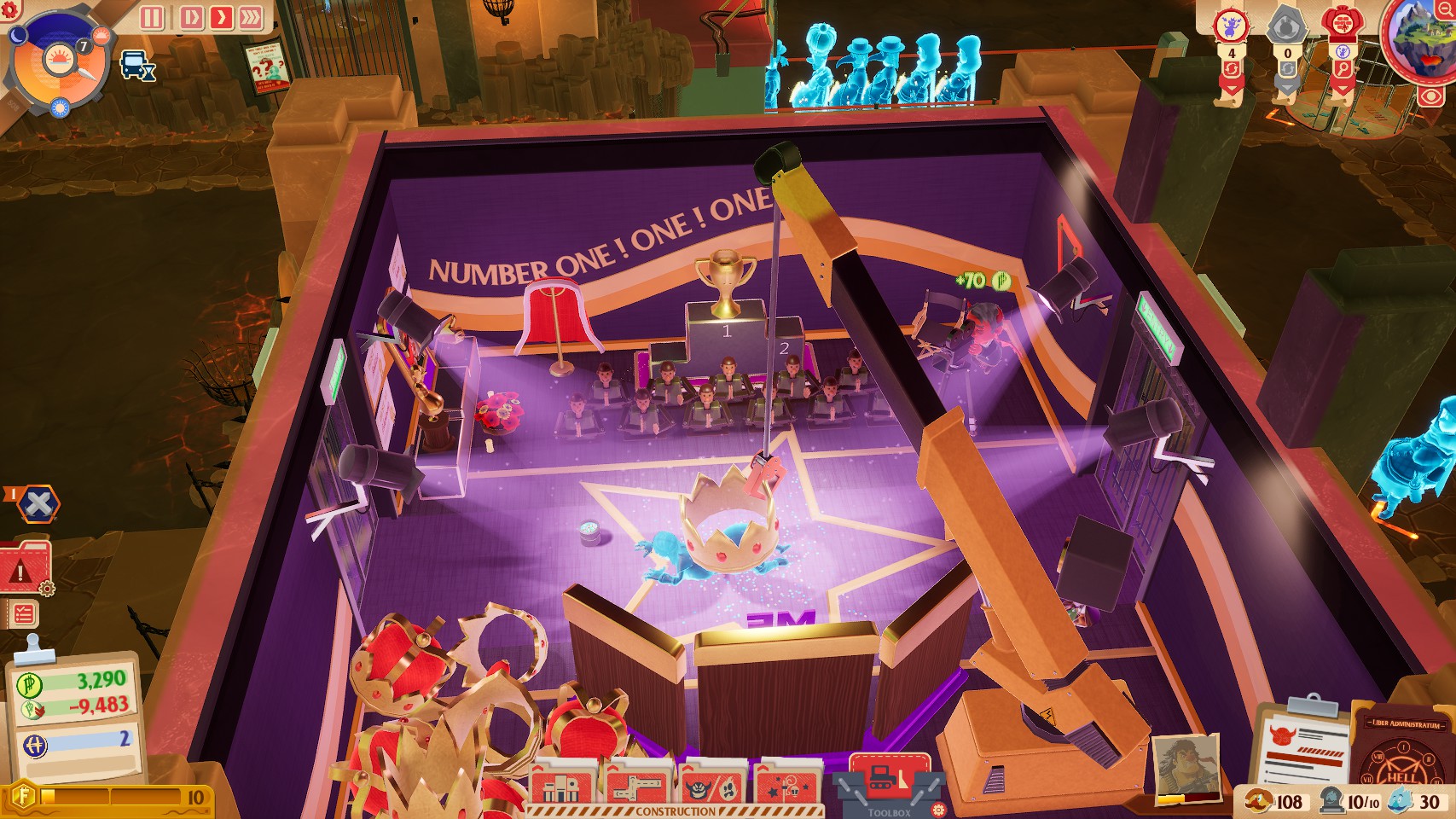
You’ll divide your time here between hell itself and a bucolic, medieval overworld populated by a species of nominally sentient creatures named ‘humus’. Humus live, work, ‘shaboink’ and reproduce, get ill, worship, and eventually die, at which point their souls float around a graveyard, waiting to be bussed to the underworld by the grim reaper.
During their lives, they’ll have built up scores for each of the seven deadly sins depending on their environment. They’ll become gluttonous if they can’t get enough food, for example, or wrathful when they witness death. Unless treated, sins accumulate between reincarnations. This doesn’t affect much until an individual sin hit a certain value, at which point the Humu becomes a deviant, spreading that sin to Humus around them. Hit the maximum, and they’ll summon a demon, who’re fond of camping outside the settlement sending waves of attackers until they’re dealt with. Offensive spells can help prevent this, as can your cultists, but if the attackers chew through your defences, they’ll eventually destroy your temple – game over. Once you’re powerful enough, you can beat up the demons and force them to work at your tollbooths, but that’ll take a while.
When a soul arrives at hell, you’ve got a few options on how to process them. Omnisin buildings cover all the bases, but you’ll need specialists to target individual sins above a certain value. This all earns you cash, which you’ll need to expand and to pay your workers at the end of each day. Workers need breakrooms, and you can plonk down totems to keep them motivated, or souls moving through hell at a good clip. There’s also another building chain that extracts a resource called faithcoins, and a few others that you can use to influence your overworld civilisation.
Hell management is, as I said, fairly light. The challenge comes in through both wrangling layout logistics in a generally limited space, and how well you manage the flow of souls coming in from the overworld. Logic gates placed at crossroads can be programmed to, say, send overly lusty Humus towards the lust treatment building, or only allow souls out of hell once they’ve been sufficiently cleansed. This all pushes the feel of operating hell more into the realm of a factory sim, which does strip away some of the thematic fluff in favour of logistical crunch. Still, there’s some real depth here in the possibility to create absurdly complex Suessian Sneetch machines. There’s plenty of fluff in the overworld, anyway.

What sets Sintopia apart here is your lack of direct control over the Humus’s lives. You can’t build building, assign workers, manage their economy, or do much of anything you might associate with managing a population. You don’t play an omniscient leader with the first and last say over everything that occurs. You can’t even pick the Humus up. You can move the Humus though, and that’s where those faithcoins come in.
Your Humus civilisation will always have a monarch, recruited from the general population, whose personal traits guide the direction their growth. Perhaps they were once a soldier, so they’ll strengthen the military at the expense of other buildings, and might make the general population more vulnerable to wrath. Ah, but what if they’re also an unrepentant, gluttonous deviant? They might spread their gluttony around, which you might not want. Perhaps you want to keep sins low generally, or maybe you’d rather have a prideful king so you can eventually hire some pride demons to speed up your hell queues? This is fine, actually. You simply drop a massive flaming boulder on his head.
Spells are great fun. Bank balance getting a bit thin and need an influx of souls? Use a wind blast to send several entire families directly into the sea. Lizardman raiding party? Electrocution time. But your most consistent and reliable way of influencing the Humus is through that cult. Alongside murdering saints, they can directly influence the Humus’s sins, defend the town, or simply spread cult propaganda. Having the equivalent your more traditional management menu for this half of the game reliant on how much time you spend recruiting cultist is a great touch that encourages a hands-on approach to compliment hell’s automation.
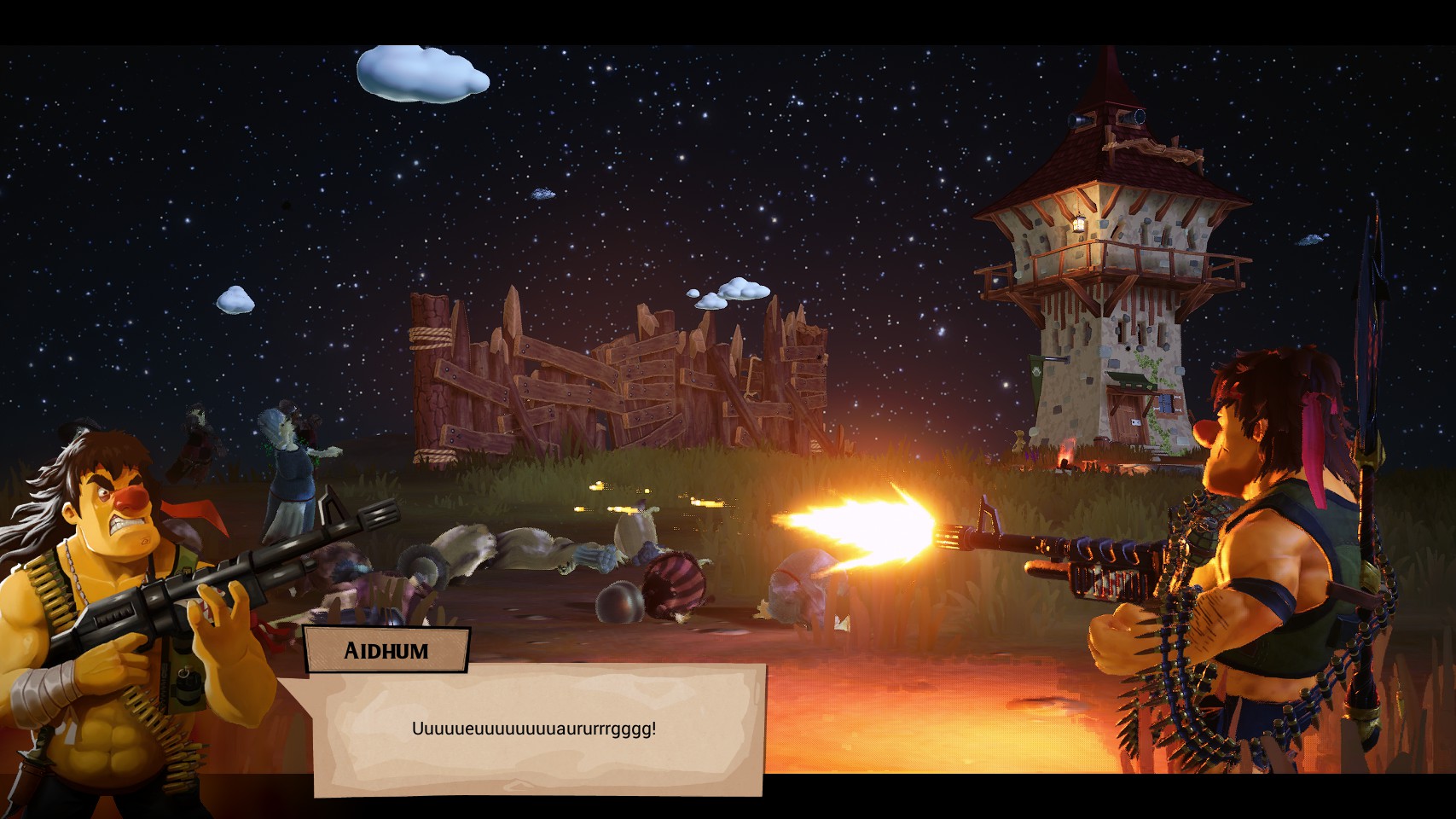
I think I’ve probably covered maybe half of everything Sintopia does at this point. I haven’t even mentioned the zombies yet. Or Rambo. But I’ll leave you to discover some things on your own. It’s impossible to capture the essence of any game simply by listing its features, although Sintopia is one case where such a list at least offers a glimpse into the madness powering the machinery, purely by virtue of its size.
And this sheer breadth of systems feels like Sintopia’s greatest trick. While there’s plenty of ways you can influence the overworld, so many of its inner workings remain autonomous. As such, watching your Humus go about their lives feels a little like watching ants carry leaves through a glass colony. It’s something entirely designed and fabricated, but still a little bit wild; a little bit unknowable. If Sintopia’s writing was half as witty as it thinks it is, I may have found a new favourite management sim. Still, it’s a real treat to play something this incautious and bizarre, but still largely successful, in an increasingly safe and derivative landscape. It’s a damned good time.