For Zero Parades: For Dead Spies, we are trying out a different review format, in which two reviewers discuss (without spoilers!) their impressions of the game, and what they like – or abhor – about the game.
Ben: Before playing Zero Parades: For Dead Spies, I really wanted to write to you without mentioning Disco Elysium at all, to meet this game on its own terms without the burden of comparison to its predecessor. ZA/UM took this out of my hands, however, as the game feels sosimilar to its progenitor that I can’t help but feel like it started life as something set in Revachol rather than Portofiro. I figured the gameplay would be similar, but everything from the amnesiac detective spy to the dice rolls feel borrowed, recycled. Substitute the eponymous disco for an L-pop groove and you’ve got a striking resemblance that can’t be interrogated without referencing the cult hit.
Zero Parades is, nominally, about spies. You’re Hershel Wilk, codename CASCADE, caught up in a political mission you don’t really understand. Your first job is to work out what your mission is, and why you, a bottomless pit of self-loathing, have been chosen to complete it.
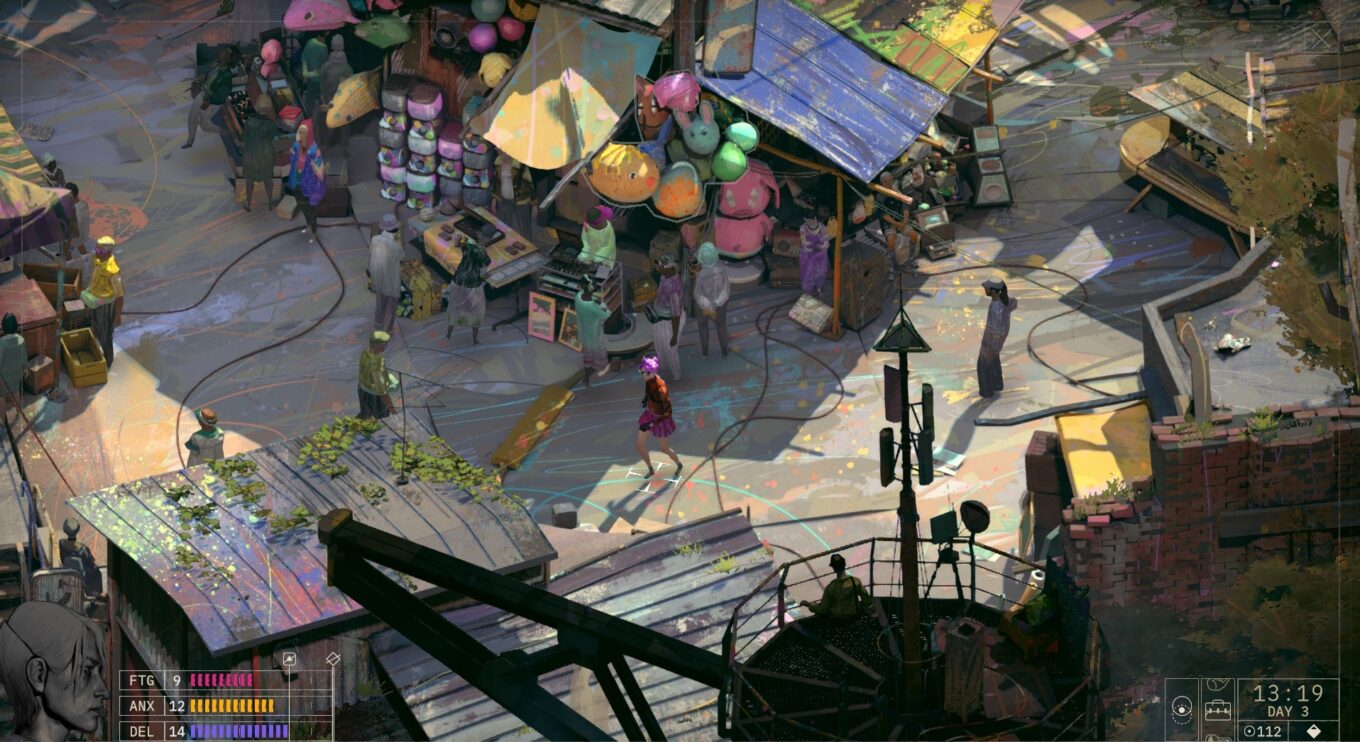
You do this using the same investigation mechanics as in Disco Elysium. Two dice, rolled for checks, aided by a judicious application of alcohol, cigarettes, and schnapps. Detective-based skills you can pour points into as your level increases like whiskey into a glass. Stress metres, albeit representing different sensations. There’s even a pseudo-Thought Cabinet for internalising political messages and human behaviour. Most of these are iterated upon in subtle ways, but the latter is particularly interesting.
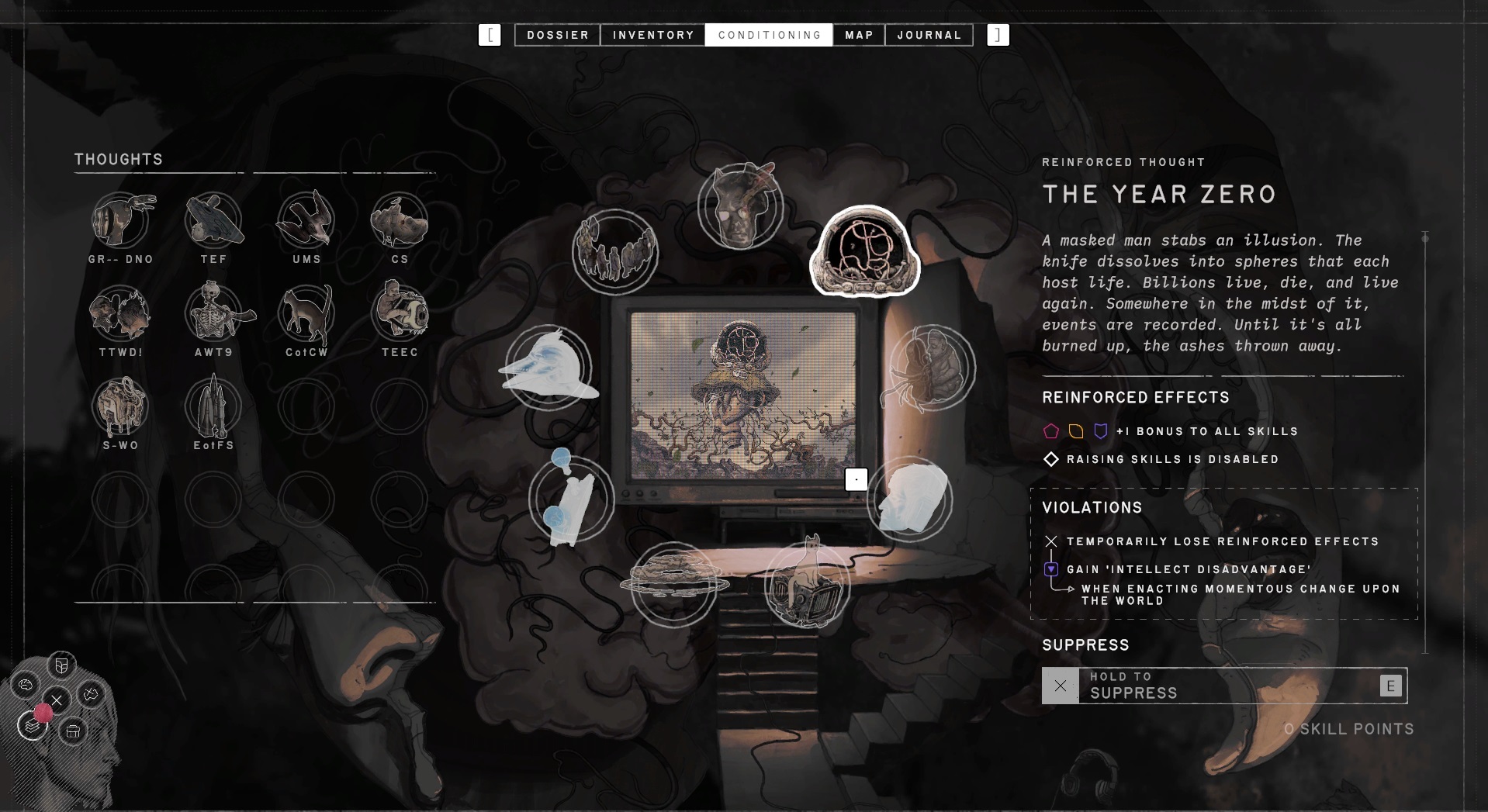
Whereas Disco Elysium’s Thought Cabinet solely offered bonuses, Zero Parades’ Conditioning forces you to interact with the game’s themes, to consider your dialogue choice, or else risk a debuff. Say you internalise a thought about supporting the communist regime and way of life. If you then select a dialogue option praising the free market, not only will you lose your Conditioning bonuses for a period, but you may face disadvantage on related skill checks for the next couple of hours, rolling three dice and picking the two lowest. This ludonarrative resonance is a clever iteration, forcing you to match your dialogue to the ideals Cascade is internalising.

For a game that is ostensibly a political thriller, it fails to interrogate its politics in any meaningful way. Zero Parades throws around a lot of jargon, but it feels like there are communists thrown in because, well, Disco Elysium had communists. The fascist state spreads propaganda but feels largely impotent and is generally considered ‘just bad’. The same goes for drugs and alcohol, which the ill-effects of can largely be mitigated by, you guessed it, different drugs or alcoholic beverages.
The stars of Zero Parades, however, are the supporting cast. I care little about Cascade, mostly because she wallows in her own misfortune to excess, but her former crew are brilliantly realised characters with a range of serious personal issues stemming from a single event five years prior to the game’s setting. They alone will get me to replay this game, because you can’t find or help everyone in the same playthrough, and I simply must listen to their stories and bear the brunt of the repercussions from our previous, catastrophic fallout.

Zero Parades gives the overwhelming sense that it’s trying to be a meaningful followup to Disco Elysium with the IP filed off. However, it’s the parts of the game that veer away from the patented du Bois formula that shine the best, and I wish ZA/UM had the confidence to go all-in on the fresh ideas. Those are the areas that are most rewarding.
Khee Hoon: The inevitability of becoming compared to Disco Elysium is perhaps Zero Parades’ greatest curse, including its finely-tuned cerebral system, its crisp, delectable writing, and even the way the text and portraits are laid out. You’re right that there’s a staggering amount of similarities: the game’s use of faculties—Action (big muscles), Relation (big empathy) and Intellect (big brains)—appears to be a crude mimicry of Disco Elysium’s attributes. There’s the way Cascade’s skills will pipe in, vicariously, when she’s faced with a dilemma and even trite encounters. Then there’s the game’s discussion of politics—one that, I have to admit, feels way too multi-layered to comprehend in a single playthrough.
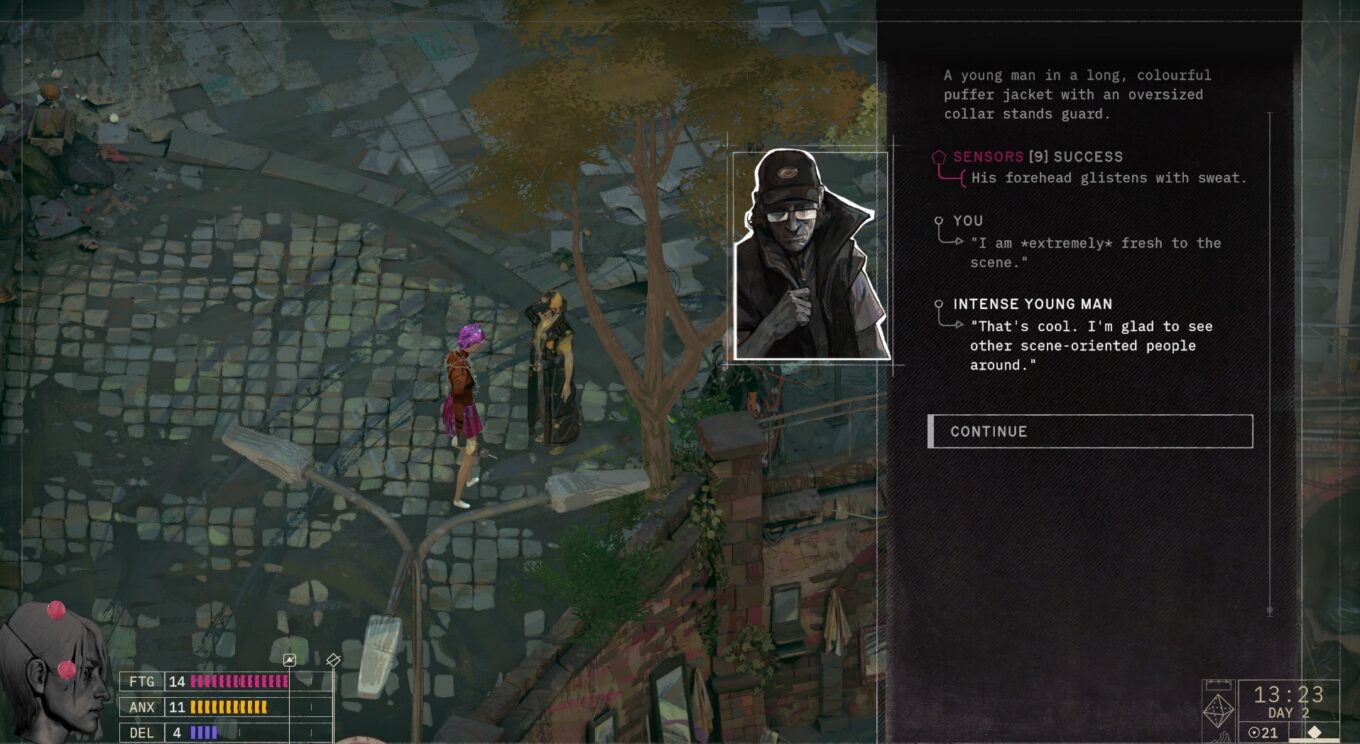
To start from the top, Zero Parades’ stats function like that of a tabletop RPG, in the sense that conversations and debates function very similarly to combat rounds; you commit to an action, make some dice rolls, and see if these checks succeed. The key difference in this system between Zero Parades and Disco Elysium, however, is that these faculties have an additional meter tied to these stats: fatigue affects Action, anxiety affects Relation, and delirium affects Intellect. Rake up too many points in these meters, and they can negatively impact your rolls through status effects. That’s the issue that you’ve succinctly pointed out in your letter; Zero Parades seems, at first glance, a Disco-lite. It feels like its developer ZA/UM is making little tweaks to the tried-and-tested Disco formula, afraid to venture beyond what made the seminal RPG so loved and celebrated.

The tendency to compare Zero Parades to its antecedent is unavoidable—I find myself doing it constantly, really—but I’ll suggest another way of looking at this. In the wake of Disco Elysium’s success, a cottage of Disco-likes (can we just call this sort of cerebral RPGs Disco-likes for now?) has emerged: Rue Valley, Esoteric Ebb, the upcoming Shore of Jord, and many, many more. This trajectory feels inevitable for such a beloved game, and Zero Parades is simply another title joining the ranks of this burgeoning genre. In fact, I would venture to say that it’s an exceedingly compelling Disco-like. Like you, I adore Zero Parades’ Conditioning feature for the same reason, even though it bears a similar symmetry to Disco Elysium’s Thought Cabinet.
There’s also another layer to this consideration: even if Zero Parades could mimic Disco Elysium’s systems, mimicking its pizzazz would be a tall order. Fortunately, Zero Parades has plenty of its own. There are times where Cascade’s dialogue and actions can seem particularly du Bois, like her inclination to self-flagellate for her past mistakes. But her quips are all her own; one of my favourite lines is when she’s talking to a sad doctor on a boat—“The boo-boo boat is becoming the boo-hoo boat”—or when one of her skills mocked her for being “one of life’s great untouched”. I guffawed at both.
The writing in Zero Parades is particularly incisive and eloquent, and therein lies its capacity to draw intrepid videogame readers like you and me. This, too, extends to the rest of the Zero Parades cast, who are wonderfully ridiculous and human, from the sleazy purveyor of illegal goods called Goat Eyes, to the self-absorbed and extremely deranged Dr. Gonza. And here’s where I have to disagree with you, Ben, on your nonchalance for Cascade: I like her. We can agree to disagree!
The truth of the matter is that Zero Parades owe a debt to Disco Elysium. That said, while Zero Parades’ narrative experience does carry shades of its predecessor’s brilliance, this is also ancillary to the tale that it’s telling about Cascade and the motley crew that coalesce around her. And then there’s the city of Portofiro, where Zero Parades is set in. There’s so much to poke at, so much details to excavate, that it feels like its own, distinct locale.
Ben: We’re largely in agreement about most things here, despite not communicating at all through our simultaneous playthroughs. You’ve made me wonder, too, about Cascade—was it my dialogue choices that made me tire of her misery? Have I accidentally told on myself, revealed something about my personhood or how I play RPGs?
I want to echo what you said about the writing. ZA/UM quickly and easily gives a great sense of character to even the most minor NPCs, and Portofiro itself is practically a second home at this point. I ended up shunning fast travel just to wander the streets more often than not. I will say that, on occasion, the portraits failed to match the description (Goat Eyes is great, but a decrepit teenager—perhaps that’s a life of crime catching up to him).

Zero Parades’ narrative, characters, and setting are its greatest assets, and they owe little to its predecessor. I’m already making space in my calendar for a second playthrough, and I’m envious of everyone about to embark on this mission for the first time. One tip for those imminently heading to Portofiro: don’t race an old man down a bunch of dark stairs. It’ll go worse than you could possibly expect.
Khee Hoon: One of my favourite things to do in Portofiro is to dawdle, to gape, to gossip. There’s always something to remark on within its winding streets, like the boars that graze lazily at discreet corners, to the racks of colourful, counterfeit products sold at the bazaar. Like Cascade herself, these places are haunted not only by memories of a past dictatorship, but also the troubled lives of the residents who sought to etch a living in this breathing city. I love seeing the crumpled bodies of drunk salarymen, the beatniks that seek refuge in dilapidated buildings, and the tuk-tuks that litter the roadside.
Have you been to Bangkok, Thailand? The vehicles, the bazaar, and even the pavements of Portofiro feel so reminiscent of this place. As Cascade, I pretend that dawdling here is just part of my very legitimate spy duties, but the truth is that I love walking along alleys and stumbling upon new conversations. I also love collecting cheap, plastic wolf cups, and once begged someone, with zero shame whatsoever, to give one to me. I ain’t leaving Portofiro anytime soon.