Steam is crowded with rogue -likes and -lites which have little to do with their namesake. Several riffs on run-based, “permadeath” games have spiraled into their own subgenres (to take one example, how many games steal the structure of Slay the Spire?). Perhaps it was inevitable that Hades would have its turn. Clockfall, a roguelike which is about to launch into Early Access, takes that game’s twitchy, action-forward formula almost wholesale. With a few time-related twists, Clockfall makes a noble effort to differentiate itself. However, in this early stage of development, it does not offer enough to supplement its influences.
Clockfall’s take on the formula, predictably, has to do with time. Every time you start a run in Clockfall, a timer begins to tick down. At the start, you have only three minutes to get as far as you can. You can extend that time with special upgrades during runs and with more permanent improvements in between runs (more on this later). Additionally, Clockfall’s levels are not randomly generated. You are not besting unpredictable combat challenges, but instead trying to navigate places you already know with maximum efficiency. It’s an action roguelike by way of speed-running.
This has some obvious advantages (and equally obvious problems). Giving each area a bespoke, designed touch lets them operate as a plot. In Early Access, Clockfall’s narrative touches are bare, but wandering the bloodied ruins of a festival or a pirate-infested coast grants the game some character. It also lets each area function as more traditional video game levels. There are hidden crannies, different battles tucked away in corners, and a clear escalation from area to area. The levels in games like Hades or Slay the Spire are broad and staccato. Clockfall has crescendos.
But you are also going to be replaying the same places over and over and over again. Hades was almost comically replayable, with challenge settings that remixed/reduced your abilities to make practiced runs brand new again. Within a few runs of Clockfall, the opening segments of a level are as rote as brushing teeth. You do eventually unlock backdoors which take you further right from the start. But in my experience, you only get there well after an area becomes a slog to wade through.

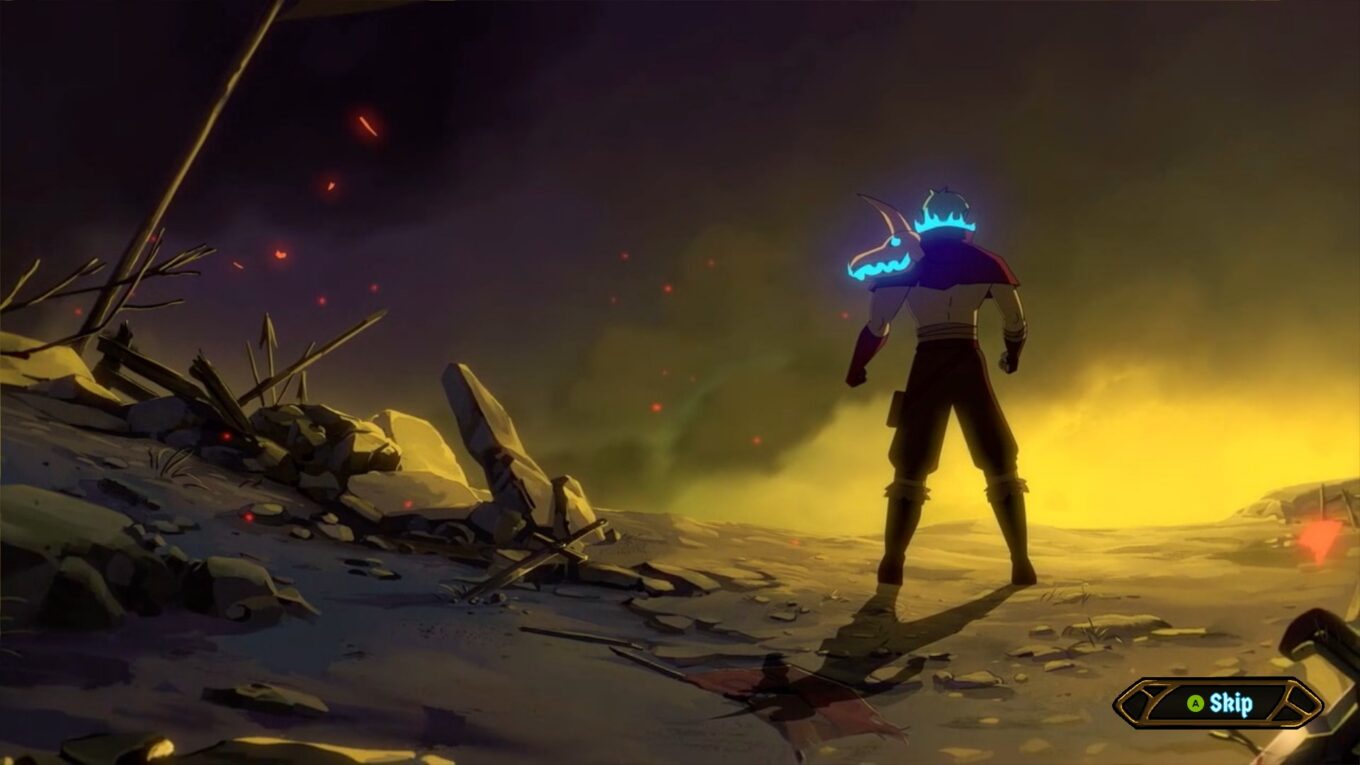
The other primary twist is in its meta progression. Like Hades, you can buy boosts between runs to improve your chances, but you can only earn the best upgrades by facing “the nightmare.” Clockfall’s protagonist, Wilbur, was adopted by a kind-hearted village from a battleground. But the war that consumed the child protagonist’s life comes home. The game opens with him arriving too late to save his village from slaughter. The “nightmare” means teleporting back to the moment of the massacre and fighting it until you fall. During your initial run, if you die or fail to find a counter-fate token, you’ll start back at the beginning. But live until the time runs out, and you can attempt to face the nightmare.
In effect, this is the second run. All your upgrades carry over from the first attempt. You can find things to upgrade your defenses as you explore the world. As you might expect, enemies come in waves, escalating in difficulty. The longer you survive, the more fragments you’ll get to spend back at the village. This is a novel addition to the basic formula. Even terrible runs can produce a solid attempt within the nightmare, and its structure provides a distinct challenge from the more speedrun-oriented flavor of the rest of the game. However, it does get repetitive quickly. I also mastered it fast, routinely outlasting every wave by my fifth or sixth attempt.

Clockfall does have one clear advantage over Hades: its currencies are simple. The original Hades had a plethora of spendable items for individual upgrade types. There was a specific currency for improving relationships, another for buying cosmetic changes for your home, yet another for the RPG-esque improvement of the player character, and more I will not recount. Hades 2 doubled down, introducing timed farming minigames, crafting, and region-specific resources. In contrast, Clockfall has just two: gold and the time shards you earn from facing the nightmare, as well as a couple of tokens which you can exchange for one-time benefits during a run. This clarity makes it easy to focus on what Clockfall does best. If future updates maintain this leanness, it’s easy to see how additional flourishes of character could strengthen it.


In equal turn, that leanness can feel like a limitation. Most of the upgrades you find out in the world are simple stat upgrades, i.e. moving 10% faster or dealing 20% more damage. I never felt inventive when constructing builds. Even more importantly, I found it hard to make serious mistakes or miscalculations. Clockfall’s more transformative upgrades, found at statues rather than treasure chests, have clear synergies. I found it easy, once I unlocked enough time to progress further into a run, to make powerful builds that would dispatch bosses and lowly grunts alike with ease. Each of Hades’ runs offers a sticky puzzle to chew on. Clockfall lets you get very powerful, very quickly, almost without thought.
But Clockfall’s greatest woes are aesthetic. At this stage, despite a charming opening animation, there is almost no narrative beyond the premise. Going back to base, getting new drips of the story told to you, was an undeniable part of what made Hades so popular and compulsive. It’s easy to feel its absence here. To take one example, you find upgrades in either treasure chests or statues of a man praying. This is so simple that it is almost anti-thematic. In contrast, most of Hades’ upgrades were boons offered by the gods of Olympus. This made the various potential builds of Hades feel both clever. Hades’ recreation of the Greek pantheon may be a set of cartoon cliches, but they are also characterful and boisterous. Clockfall’s lone, featureless statue praying to a nameless god cannot have the broad, wordless appeal of Aphrodite or Hermes.

If, like me, you found the wholesome, romantasy tone of Hades tiresome, Clockfall takes itself seriously. But it also has the dubious benefit of being edgy. It’s not subversive or shocking. Instead, it’s a kind of boilerplate dark fantasy, perhaps best exemplified by fantasy shows like The Legend of Vox Machina or games like Final Fantasy 16, which find it amusing to make elves swear or watch armor-plated heroes dismember foes. From its depiction of the massacre onward, Clockfall trades in a similar cheap edge. In the nightmare, the ground is blood-drenched and our hero fights accompanied by chugging guitars and double-bass-pedal drums. It doesn’t have enough teeth to be offensive, nor enough aesthetic verve to chafe. It is just boring. While I have my own gripes with Hades’ vibe, it is hard to say that it has nothing interesting to look at.
At the moment, there’s not that much to do in Clockfall. Within three hours, I began to run into the limits of Early Access. It’s hard to say what is enough to buy an unfinished game. Part of that purchase is the knowledge that you are buying something incomplete. Relatedly, some of my frustrations are things that Clockfall will likely address in future updates. The game will become more expansive. It will add more narrative elements. There will be more bosses and enemies to fight. Still, if Clockfall is to stand the test of time, it has to be unafraid to stake its own ground. If it can’t, it will be doomed to be the lesser cousin of more popular and beloved games.