Content Warning: The following review discusses suicide, drug use, and forced euthanasia.
Dystopicon has forced me to contemplate the nature of video games as leisure. We can all understand that games are fun: a temporary diversion from the drudgery of everyday life. Yet, many of us are more than happy to have the travails of our day-to-days replicated within them -managing shop, tilling soil, decorating houses. We can draw as much escape from a leap into a fantastical world as a seemingly mundane facsimile of our own. Though, even that may have found its limit in Dystopicon, Palitroque’s “uncomfortable” time management simulator.
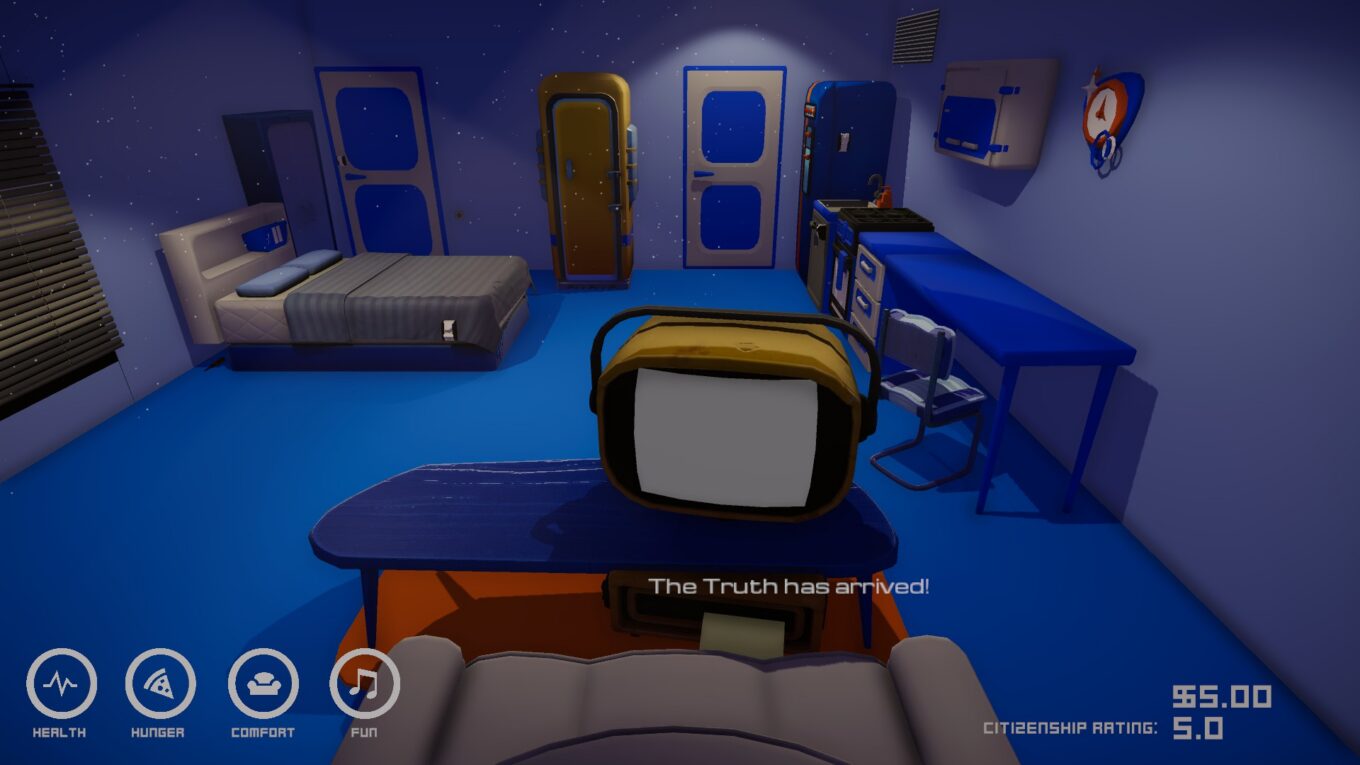
Sporting a presentation, scope, and tone that belongs to Newgrounds in 2007, Dystopicon imagines a world governed by The Trinity, an authoritarian government steeped in the instantly recognisable trappings of Orwell’s Big Brother or V for Vendetta’s Norsefire. Its subjects live in constant servitude, monitored by the state, and in perpetual paranoia.
You’re one of the lucky ones. As reward for toiling in the fields, you’ve been granted a new home and mandatory access to broadcast television. Both are part of an inescapable micro-economy in which every interaction – from flushing the toilet to taking nap – is taxed. Your chief way to cover those expenses? Watching television. In an online era in which every other advert promises income just for surfing the web, it’s a timely setup and model of late-stage capitalism.
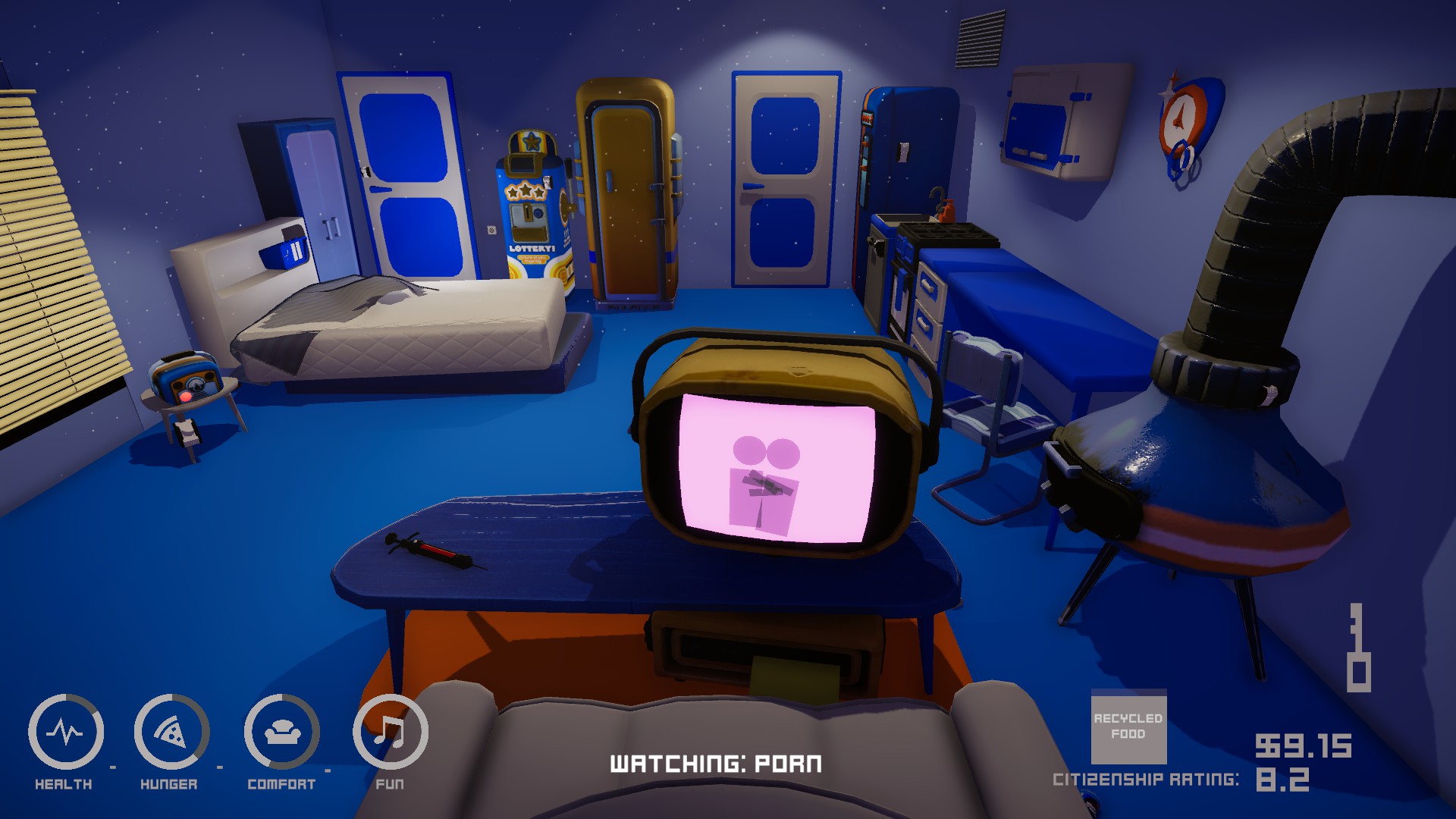
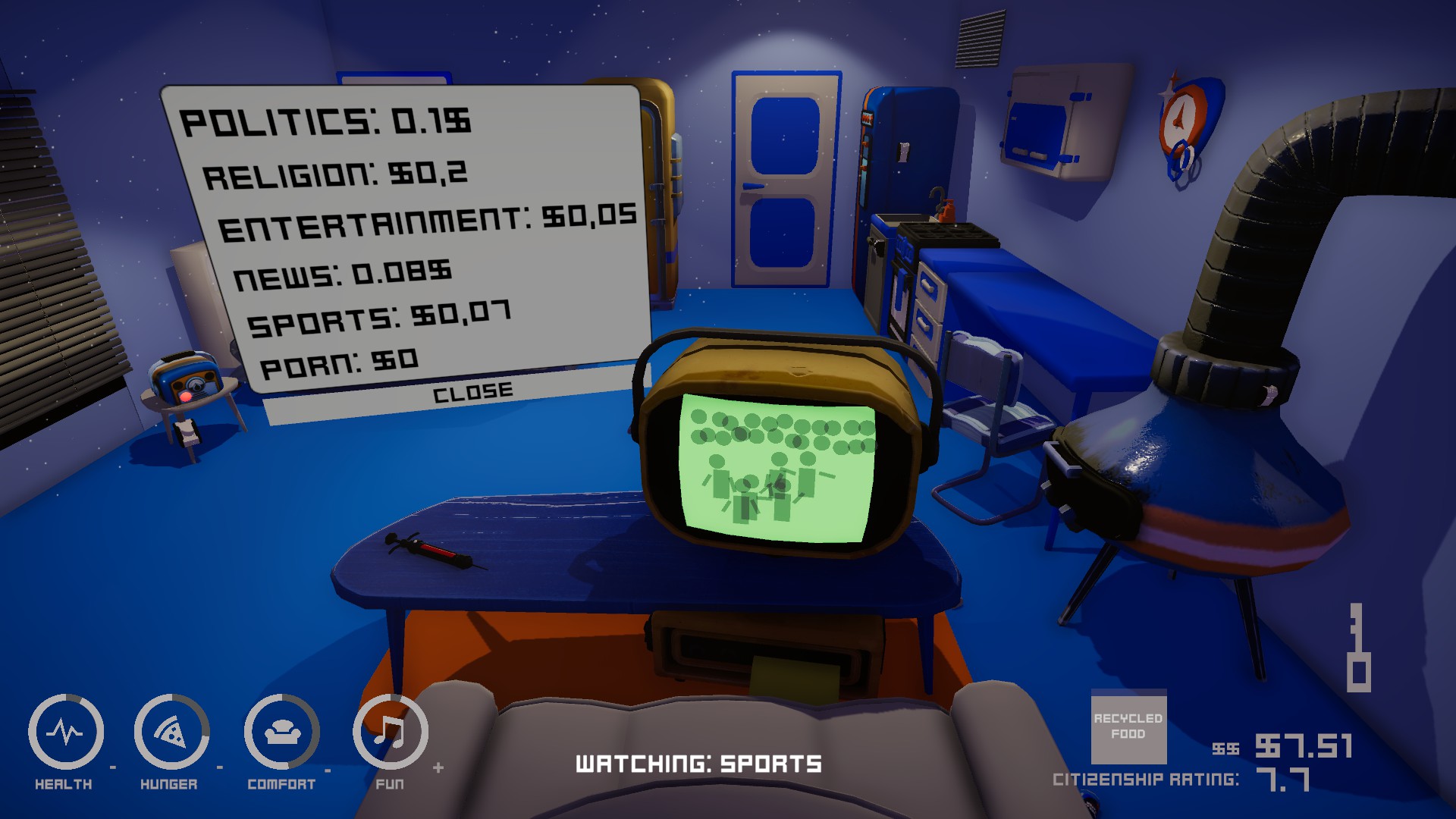
The revolution, however, will not be televised. You navigate state-controlled TV channels -politics, religion, news, sport, and pornography – designed to keep you from noticing increasing unrest outside. As dissidents riot in the street to the tune of stock sounds of sirens and babies crying, The Trinity delivers daily bulletins informing you everything is fine as you stare at the screen.
Each channel offers varying quantities of penalty and reward. Watching religious programming grants you a regular dividend of $0.20 but is boring. Sport is more exciting but only nets $0.05. Pornography, while abundant in “fun”- one of four values you must top up to stay alive – offers no monetary reward. When a shower costs $5, you’ll need to balance your viewing habits to maximise your income. Pornography
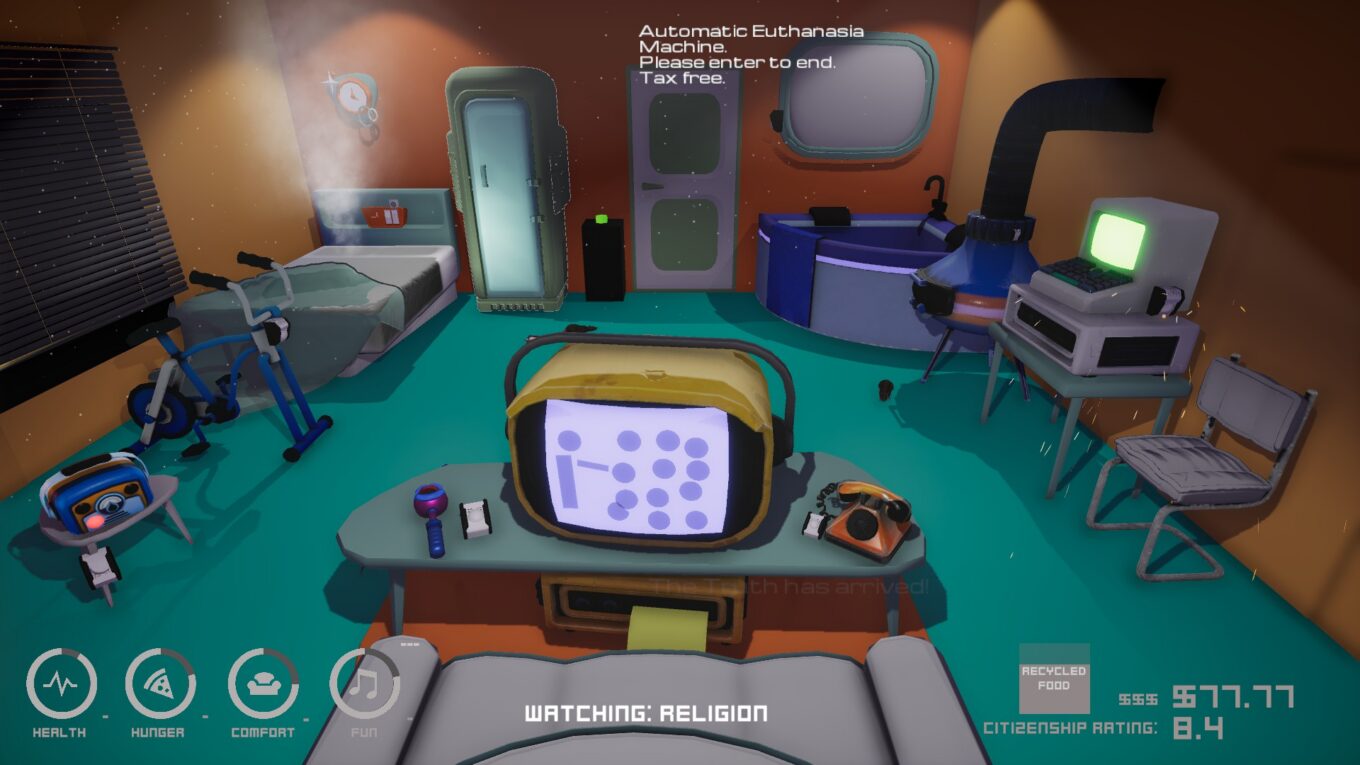
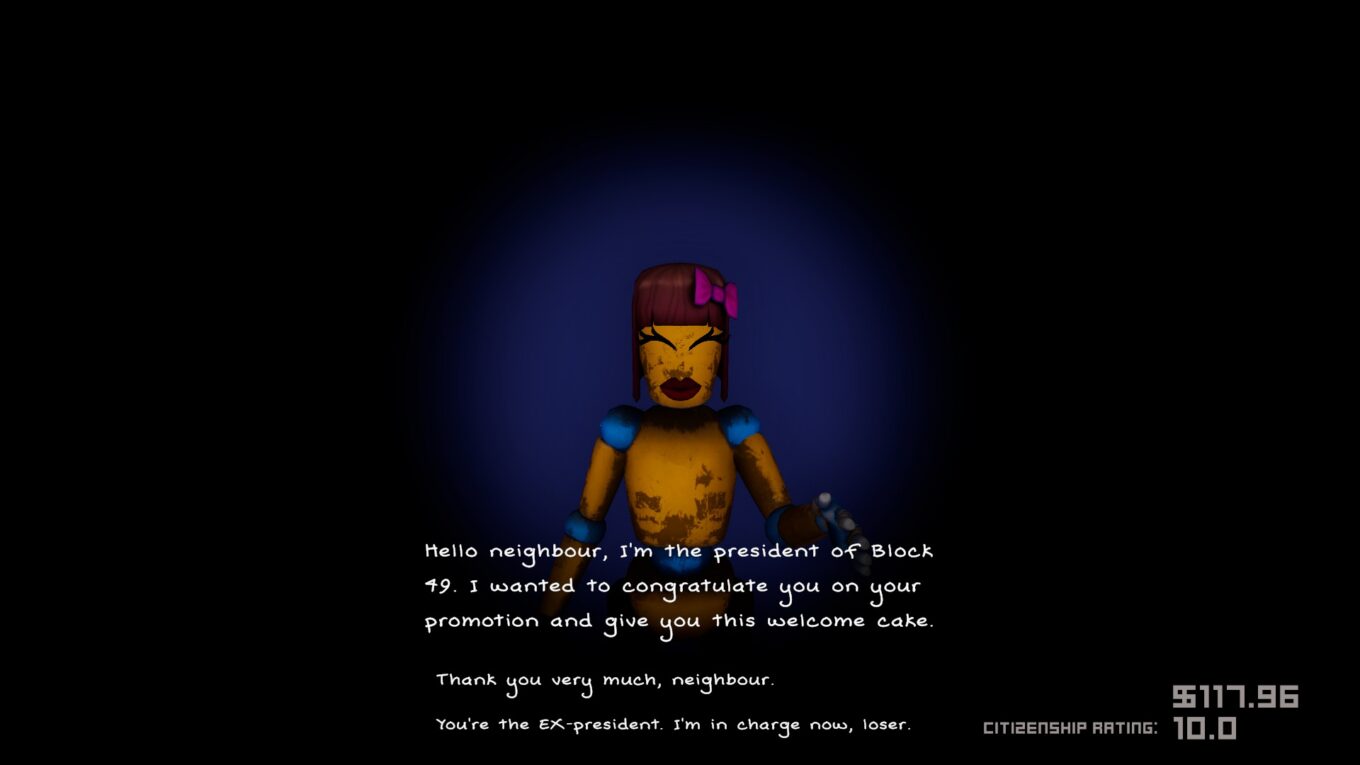
While glued to the TV, you’ll also engage in a series of mini-tasks that include interacting with objects around your house for more immediate relief (that shower will improve your “health” and “comfort”), kill rats for a dollar, and, eventually, begin purging your neighbours by entering codes into a clunky terminal. All of which is relentlessly interrupted by knocks from “neighbours,” wooden mannequins keen to gauge your loyalty, whether to The Trinity or its enemies.
Your alignment is controlled by a “citizenship rating” which rises and falls depending on your level of compliance. Acting against the interests of The Trinity will see you sent to a “re-education” room while adherence to The Trinity – which amounts to “no pornography” – leads to promotion.
It’s an intellectually ambitious setup on paper. Though Dystopicon’s mechanics quickly signal the imaginative poverty at the game’s heart. This starts with the most basic of interactions: the television. Built on keeping your eyes on the screen, Dystopicon sure turns the TV off a lot — if you take a shower, buy a lottery ticket, even when you kill a rat. Something that instantly undermines the core concept Dystopicon barely tries to maintain.
At the same time, many actions tied to that same input – the left click – do not turn the TV off. The breadth of that inconsistency is difficult to ascertain, as loose hitboxes in crowded rooms often saw me clicking things accidentally which would also turn the TV off. It reaches a point where you can never be truly sure what your inputs will do.
Though environmental glitches are the least of Dystopticon’s problems. When a coding terminal appears in your room for the aforementioned purging, you must interact with it by clicking, clicking again, typing (the only occasion the mechanic is used), then clicking once more. A string of inputs a more considered developer would have streamlined.
Dystopicon hints there may be more to the computer through a series of notes in your room. Pieces of paper are your only real link to Dystopicon’s light and desultory narrative. None of the steps described did anything and the game offers so little across its seven endings to encourage further experimentation.
That lack of consideration continues, however. Dystopicon’s loop isn’t difficult. You can get into a rhythm of watching high-paying TV and topping up your fun meter easily enough. It’s rendered even more straightforward if you can find the poorly-hidden screwdriver in your room (another of many hints that Dystopicon has secrets that never really pan out).
With it, you can open the vent that leads to a surveillance room and a form. Tick a box and you’ll return home to a care package of money and food while sticking it to the man. There’s nothing stopping you repeating the trick, however. You may lose citizenship points, but you can also turn the camera in your room off to avoid the penalty.
Not that you need to. You don’t accumulate citizenship points by watching state-friendly programming, but by changing to that channel. You can simply click the channel a few times to bring your rating back up. Those vents don’t go anywhere, however. There’s no payoff to the discovery. As significant as the surveillance room initially appears, it only leads back to your room.
It’s an accumulation of neglected details that make Dystopicon’s choppiness feel less like a representation of the chaos hidden inside monotony than a lack of design consideration.
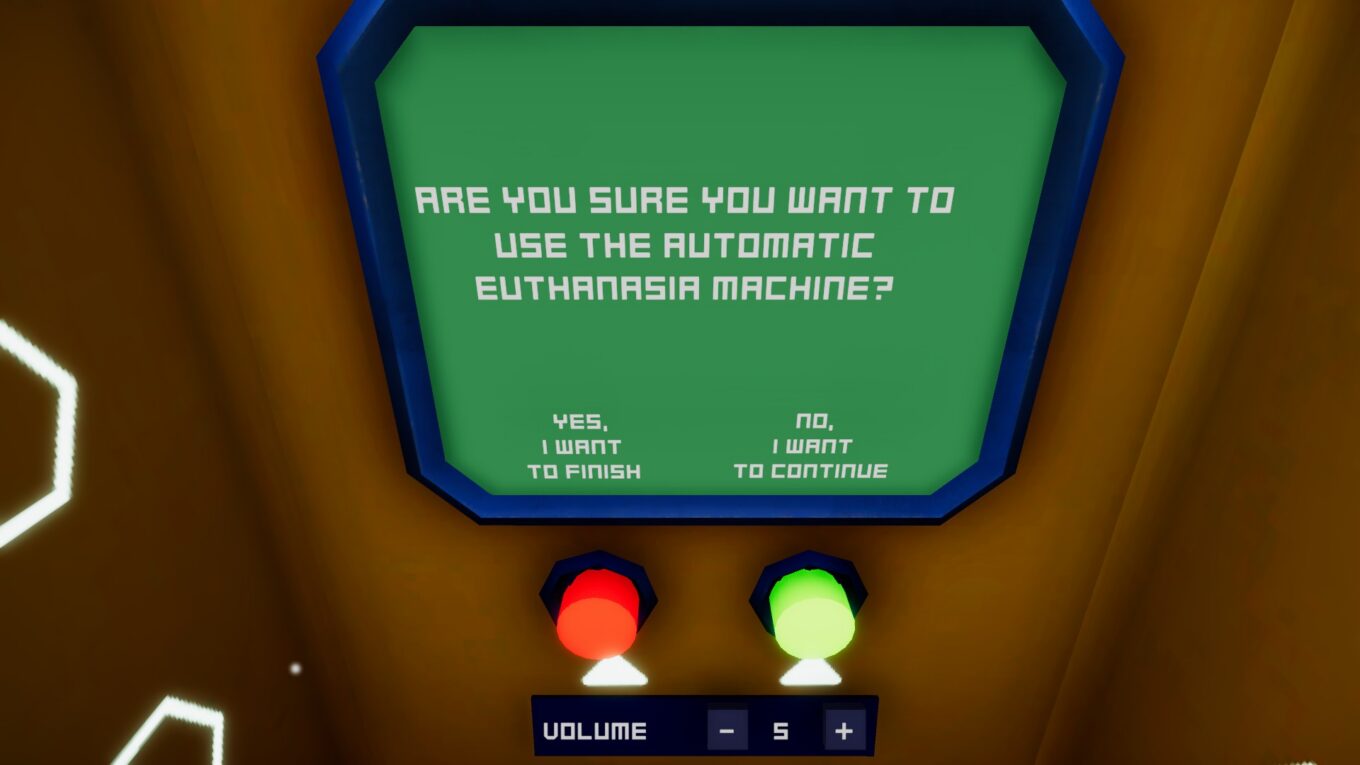
The carelessness that haunts Dystopicon’s design isn’t contained to its mechanics, either. Instead, it crystalises into something more philosophically troubling as the game engages its core concept of death. You are, at all times, staving it off: be it from starvation, discomfort, or boredom. Yet, The Trinity reminds you from the start that you are disposable. This is illustrated by the “automatic euthanasia machine” planted in each room. A machine that’s not just “legal” and “ethical” to use, but which you’re encouraged to utilise – it’s your civic duty.
Despite this, the first thing you will see travelling through the vents is a neighbour who has hanged themself. This: in a game that includes no in-game content warnings. There is a thematic way to incorporate this scene into the threads of commentary Dystopicon has pretensions of weaving. It would take, however, a far more sensitive and considered approach of which Palitroque, based on the evidence in Dystopicon, appears incapable.
As you move into new rooms, framed as promotion despite being identical in gameplay, you will encounter more of these scenes. Damningly, these take the form of unimaginative references and gags, suggesting the deployment of a hanged character for shock value, already trivialising deep trauma, is similarly meant as a joke. It’s a similar lack of thought Dystopicon applies to drugs, authoritarianism, and, well, everything.
There is promise in Dystopicon’s fundamental concept. But if the roots are already rotten, one of its endings highlights just how insincere its fundamentals are. Once you reach the status of first-class citizen, breaking through increasingly dilapidated lodgings, you can ascend to become a leader of The Trinity. This entails managing your building: keeping your residents’ quality of life just good enough while fielding requests via yet more knocks at the door. The euthanasia machine is, at this point, gone. There is a way out of the monotony of authoritarianism in Dystopicon, becoming a tyrant yourself.
It’s not surprising that so shallow a finish line awaits in a game in which dystopia is a delivery system for immature gags (channels, including pornography, are rendered as short sequences with stick figures). A game in which sex, suicide, and drugs are played exclusively for laughs where a keener eye would have used them as tools of building a wryer, more self-confident narrative. Here, it appears most of these elements are here simply because they’ve been included in previous dystopias, imitation marked by twisting them into juvenile props.
These things make Dystopicon easy to dismiss as low-effort. Yet, the real failure here is an inability, even an unwillingness, to makes its own story feel authored with genuine conviction or completely reject the need for commentary if the game was remotely dedicated to being, as Palitroque suggests in the game’s Steam listing, “uncomfortable.” Instead, without soul or motivation to explore what little it does offer, Dystopicon just ends up feeling unpleasant – and, worse, uninteresting.