
Corsair Cove opens with a sweetly-sung rendition of a 1694 buccaneering propaganda ballad, indulgently titled A Copy of Verses Composed by Captain Henry Every, Lately Gone to Sea to Seek his Fortune. Whether the captain actually penned the song is debated, though it’s fair to say that Every found his fortune, since he’d later manage to skirt a global manhunt after earning a bounty of around £100,000 in modern doubloons for plundering an imperial Mughal convoy. He was also supposed to be a pretty handy sailor, navigating with – according to this brilliantly vintage-internet blog – an “incessant application to mathematics”.
I knew Corsair Cove had properly stuck its hooks into me when I noticed myself pondering how best to untangle my cassava bread distribution system over lunch. ‘Distribution system’ is, admittedly, a grandiose term for the savaged yarn ball of planks and pulleys I’d rigged to ferry the bread halfway across the island, but a combination of needy sailors and sparse salt deposits had me desperate.
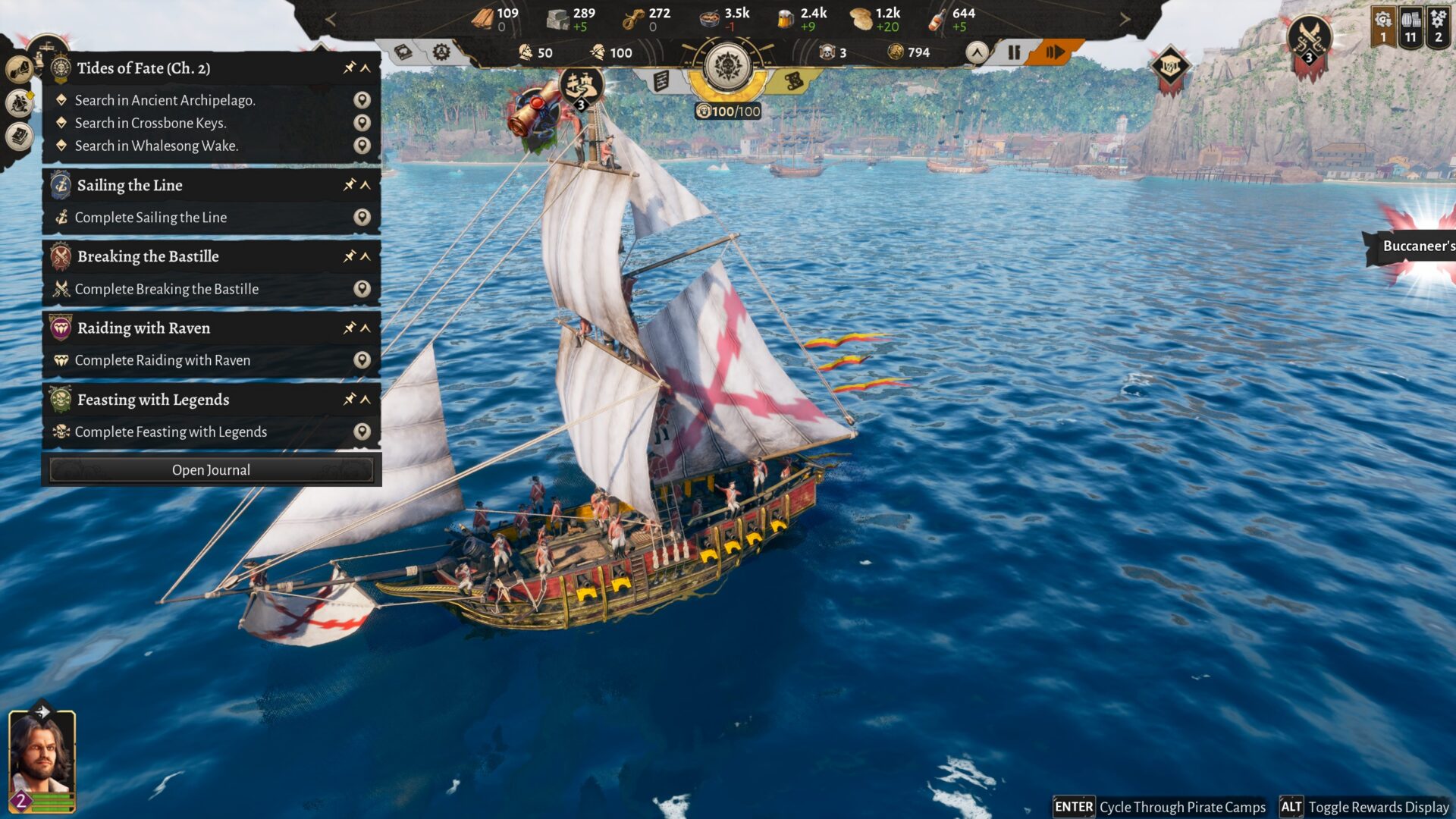
Soon enough, the pipeline had clogged up due to a production penalty resulting from some sickly pigs, and I found myself starting down the musket barrel of a mutiny. 300 pirates, it turns out, cannot live on grog alone. Apologies, Every. I’ve tainted your legacy. I’m not only a second-rate pirate, but I’m also deeply rubbish at maths.
The first thing you’ll likely notice about this town builder’s island topography is how hostile it seems to the notion of actually building a town on it. Flat ground is sparse and everywhere interrupted by jagged stone teeth, jutting cliffs, and rushing inlets. But through interconnected ladders, ziplines, elevators, and walkways, you’re able to construct vertically and directly on the the cliff faces, making use of every inch.
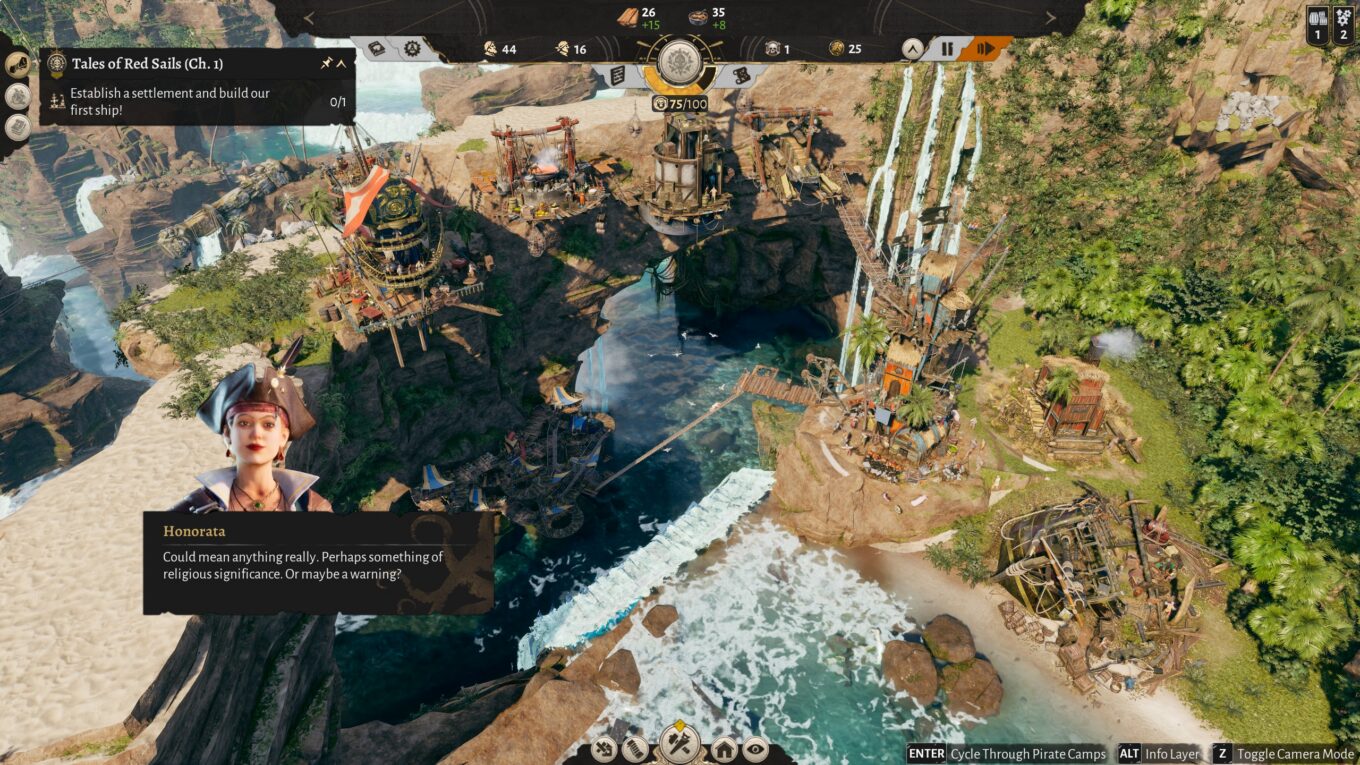
Everything you build needs to be connected to your pirate camps, and I love how these snaking wooden paths feel and look to assemble as they snap into place, clunking like chunky fridge magnets. But I especially love how this system allows Corsair Cove to work into its environments the sort of geological contortions and natural unruliness you’d expect from a real island, but would need to be flattened and homogenised in most builders.
The conceit here is that you’re nailing together your town from the cannibalised remains of your shipwreck and, fair play, buildings do look very much like they were slapped together by rum-sozzled heatstroke victims with skin problems. But the way they follow the curves of the crags and outcrops looks almost symbiotic, so you’re treated to both the Sims-like aesthetic joys of making something beautiful and the Tetris-esque pleasures of tucking everything together neatly and efficiently.


Things move more into puzzler territory once you’ve set up the basics like food and shelter, and need to upgrade to advanced production chains, which often require resources you can only get from certain sources. These constraints are how Corsair Cove balances out the freeform building. Nature is no obstacle, only the grubby whims of your greedy pirate heart.
So, let’s say you want some gunpowder. You can pop your charcoal burner down anywhere, but the wood it needs can only be gathered from patches of fertile ground. You’ll also need seagull poop, which means finding and building on top of a guano deposit, while also stretching your belief far enough to accept that seagulls are at all fussy about where they shit.
On top of this, your pirate camps take manpower to set up, meaning you’ll need to be sparing about where you place them. So you’ll often find yourself ferrying a resource long distances to wherever its needed. In gunpowder’s case, that might be a defensive turret across the bay. Why would you need defensive turrets? That’d be the other half of the game, lurking across the water.
The reason I’d gotten myself into a tangle with the cassava bread was that I needed to feed some Scallywags. While the crew for your basic pirate ships only require an upkeep of grog, advanced vessels are more demanding. You’ll unlock new ships by performing piratical deeds – some sensible, some irritatingly grindy. Once you’ve built the ship, you’ll gain access to the buildings needed to supply its crew. Crewing a ship also eats into your manpower, which means finding a balance between keeping your island running and having a strong enough fleet to progress through quests.
The quests range from the sort of stuff you’d expect, like attacking merchant ships or performing smuggling runs, to the wonderfully colourful, like getting sloshed on psychedelic grog and hallucinating a skirmish with zombie pirates. As varied as they are, they all use the same system – a simple but satisfying resource management game that has you trying to meet specific objectives while preserving your own ship.

You might, for instance, get waylaid by a giant whale while voyaging. To escape, you’ll need to complete several scenes without getting yourself sunk. One might have you defending for three turns, countering the whale’s attacks with defensive cards. The next might have you trying to put distance between you and the blubberbeast, balancing movement cards with abilities that prevent you losing crew members. More powerful cards cost more supplies, and if you run out, you’ll need to take either health or crew damage to restock.
It’s not an especially deep system, but there’s some room for customisation through pairing unique captain skills with crew bonuses and ship categories to specialise in different types of mission. Still, it’s a good time, doesn’t overstay its welcome, and – like much of Corsair Cove – is paired with some delightfully chunky sound effects to make everything feel nicely tactile.

All city builders come with a certain amount of stress. It’s a genre promise, and one of the things that makes them interesting. Much of the challenge comes from knowing when to expand without overextending, completely ignoring your instincts and expanding anyway, then spending a hectic fifteen minutes trying to put out all the new fires you’ve started. That stuff is here, but I get the feeling Corsair Cove is more committed than most to letting you enjoy island life at your own pace. It’s pretty leisurely at the default speed, and while you are periodically attacked by the hateful narcs in the Spanish royal navy, you’re mostly free to relax. Zoom in, listen to some shanties, and enjoy the variety of playful pigs the developers have snuck in.
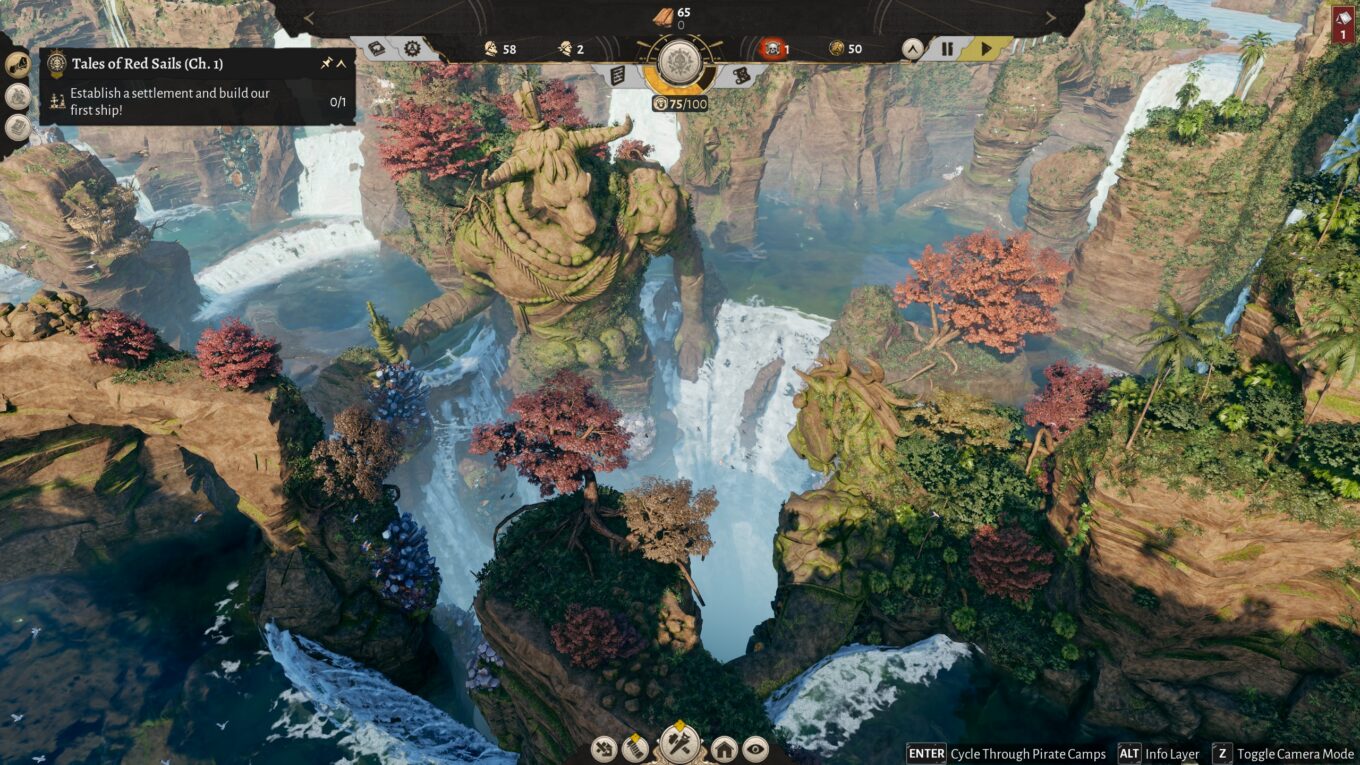
Another common genre feature is having this tension and complexity come on in waves – lulling you in with easy tasks then gradually ratcheting up the mental bandwidth until your eyes go blurry from plate spinning. Corsair Cove does this too, but it also offers tools for keeping your head above water. Aside from a few niggles like the inability to easily browse multiple buildings of the same type, the UI is excellent. Coloured paths denote the efficiency of your transport routes, and unobtrusive pop-ups let you know when something isn’t working quite right – a building that’s stopped producing resources due to full storage, for instance. As I said, it means you can relax most of the time, pausing to untangle problems before getting back to enjoying the shabby ambience.
It helps that it’s a very pretty game, although my PC suffered for it. I’ve recently played through Black Flag Resynced, the new Doom Expansion, the next gen Witcher 3, and Kingdom Come Deliverance 2, and none of them have made my PC whir in protest as violently as Corsair Cove. Strategy games can bear low settings more than most, but when I’m getting scared of my fan noises on anything but the lowest, it might be worth checking if your creaky tub could maybe trim the sails.
I also ran into a poo issue. Specifically, one of the guano deposits on one of the gorgeous free mode maps is placed so awkwardly it wouldn’t let me make any connections to it. Consider this an official Wand Report request, Limbic Entertainment: please fix your poo pipeline immediately. Also, as mentioned above, some of the tasks you need to complete to unlock ships feel arbitrary. At one point I built 50 ziplines because that felt like the most efficient way to progress to the next ship tier. It’s beautiful outside, and I am sat here squandering my free will in ways that would make god cry.
Issues aside though, this is a solid bit of piratey city building that doesn’t reinvent the ship’s wheel, but nails the basics with a good handful of its own character and flair. The loop of building higher tiered ships with more demanding pirates to finish more difficult quests, then doing it all again, can feel like a treadmill at times, but some pleasantly silly writing means those quests always feel worth seeing. There’s probably a perfect pirate pun to end on here but I’ll spare you. Yaaaaar, and so on.