There’s a seam of rich and rather untapped thematic gold running across the games industry’s otherwise brutally fracked geology: the concept of going inside the code. Don’t get me wrong, there have been several games to explore this concept, and from various angles too, but they tend to have remained on the fringe. The likes of Introversion Software’s brilliant 2001 hacking sim Uplink and fruitier follow-up Darwinia both placed you in an uncomfortable and unfamiliar place neither in the game world nor sitting at your desk, but instead lost somewhere in between, in the lines of code that create the illusion of a game world.
The same’s true of Quantic Dream’s debut title Omikron: The Nomad Soul, although it’s probably better remembered for its improbable David Bowie soundtrack than for the ‘you’re being sucked through a portal in your monitor into the game world’ conceit.
And so it is that in 2026 a game like Net.Attack() feels a bit fresh, despite tracing so closely over the lines of Vampire Survivors. The setup is this: you’re a hacker, and in order to steal data you enter a realm of PCBs where hordes of enemies patrol.
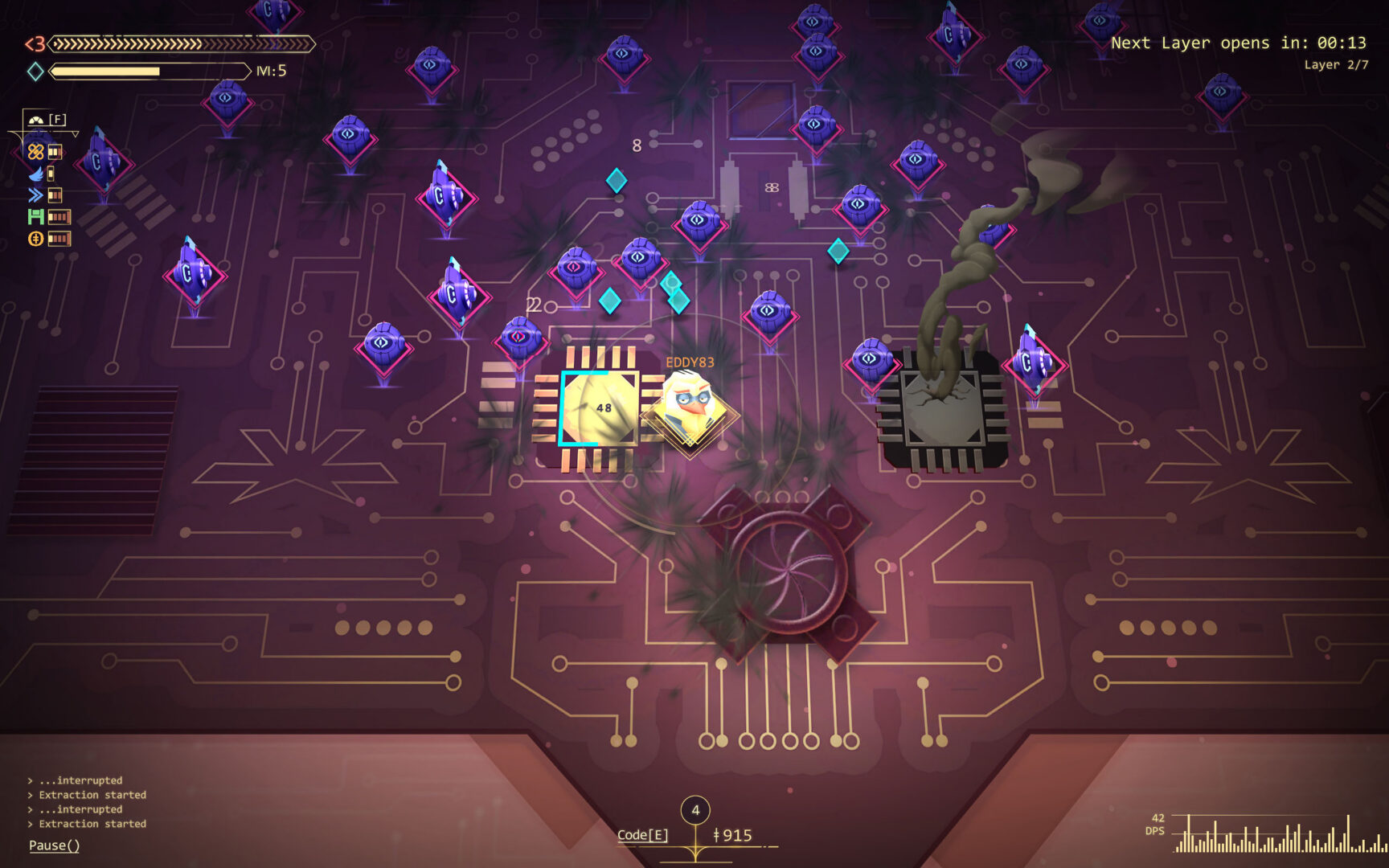

There are really only two discernable differences between the two games, as far as I’ve been able to tell during my time with the Early Access build, and they are as follows: you’re a software agent hacking your way through metaphysically confusing mainframes, not a vampire fighting off the undead, and you can use coding elements to modify your build. That list of differentiators isn’t long, but it is significant.
So if you love that genre – bullet heaven roguelikes? Top-down auto-shooters? – and also coding, well, this article’s a bit redundant for you, isn’t it? You’ve probably already put 110 hours into this game. You’re probably reading it with a fact-checker’s scrutineering eye, not an indie explorer’s curiosity. Still, here we are. I’d better tell you about it anyway.
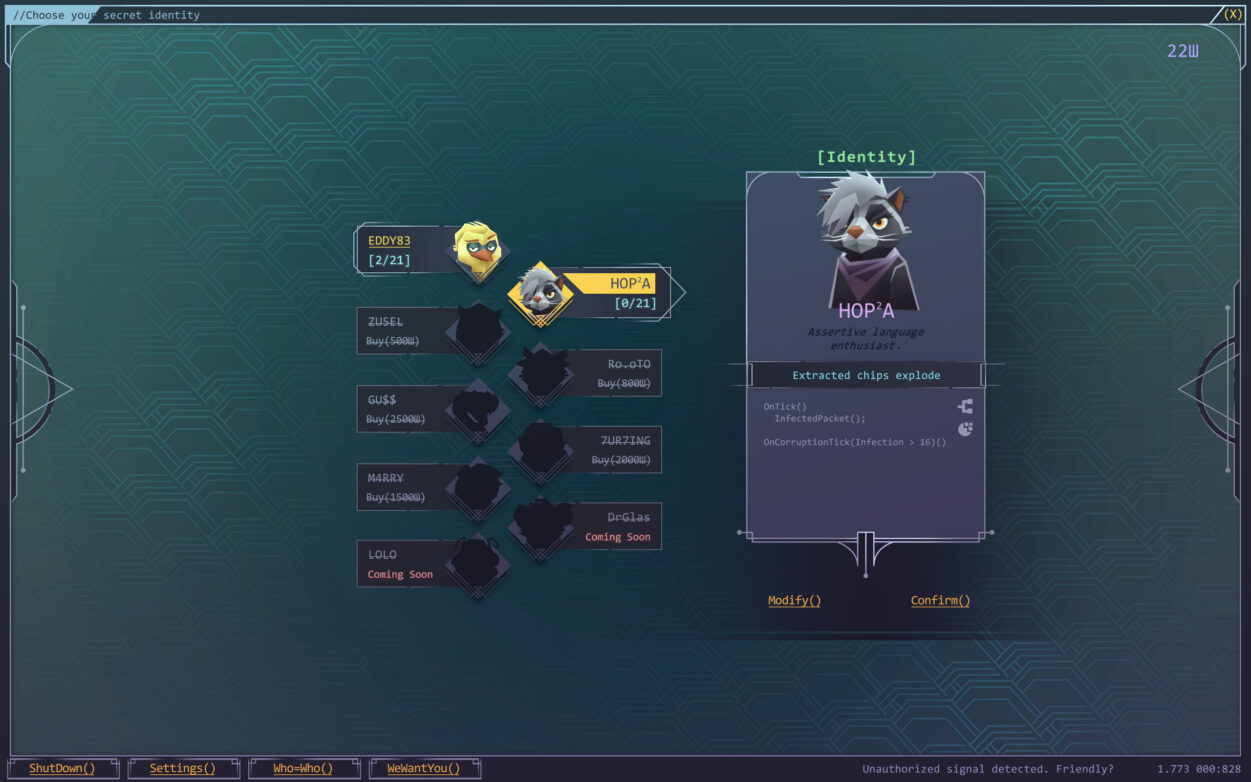
I’m still grappling conceptually with who and where you are in this game. It begins with a sleek, exciting set of menus that make you feel as though you’ve stumbled into some corner of the internet you shouldn’t have (much like the aforementioned and venerable Uplink), then throws you into a series of circuit board-like levels. Your onscreen avatar? Why, a duck, of course. At least initially, until you unlock more cartoon animals.
That’s a challenging set of elements. If you’re hacking, why do you appear to exist at a hardware level on a PCB? And, the big question for me, why, on this circuit board inhabited by robotic drones, are you an animal? Probably because controlling a sentient app across various Windows backgrounds wouldn’t have looked as nice, but it’s still a confusing metaphysical construct.
It feels like developer Byterockers left something on the table with enemy design. While all elements of the visuals maximise readability to help you out during the chaos of deeper runs, your foes feel generically drawn and aren’t terribly distinct from each other. Endless varieties of drones await, and while their behaviour and properties do get you thinking about your placement, movement and build, they don’t do much to immerse you in the game world conceit.
Your avatar fires weapons automatically, as is customary in the genre. They must survive for a certain amount of time before an exit appears, as is also customary, while harvesting ‘data’ from destroyed enemies and using it to level up, bolstering your attack damage, rate, movement speed, healing rate, data harvesting range, and so on. The curveball: you’re also amassing currency which can be spent on nodes.
Press ‘e’ and you’ll enter a hacking menu, which basically functions as a code processing flow chart. This is by far the most complex, involving, rewarding and confounding aspect of the game, and the early tutorial absolutely rattles through it without allowing you enough time or space to iterate or experiment, leaving you – alright, leaving me – to learn the hard way through teeth-gnashing trial and error.
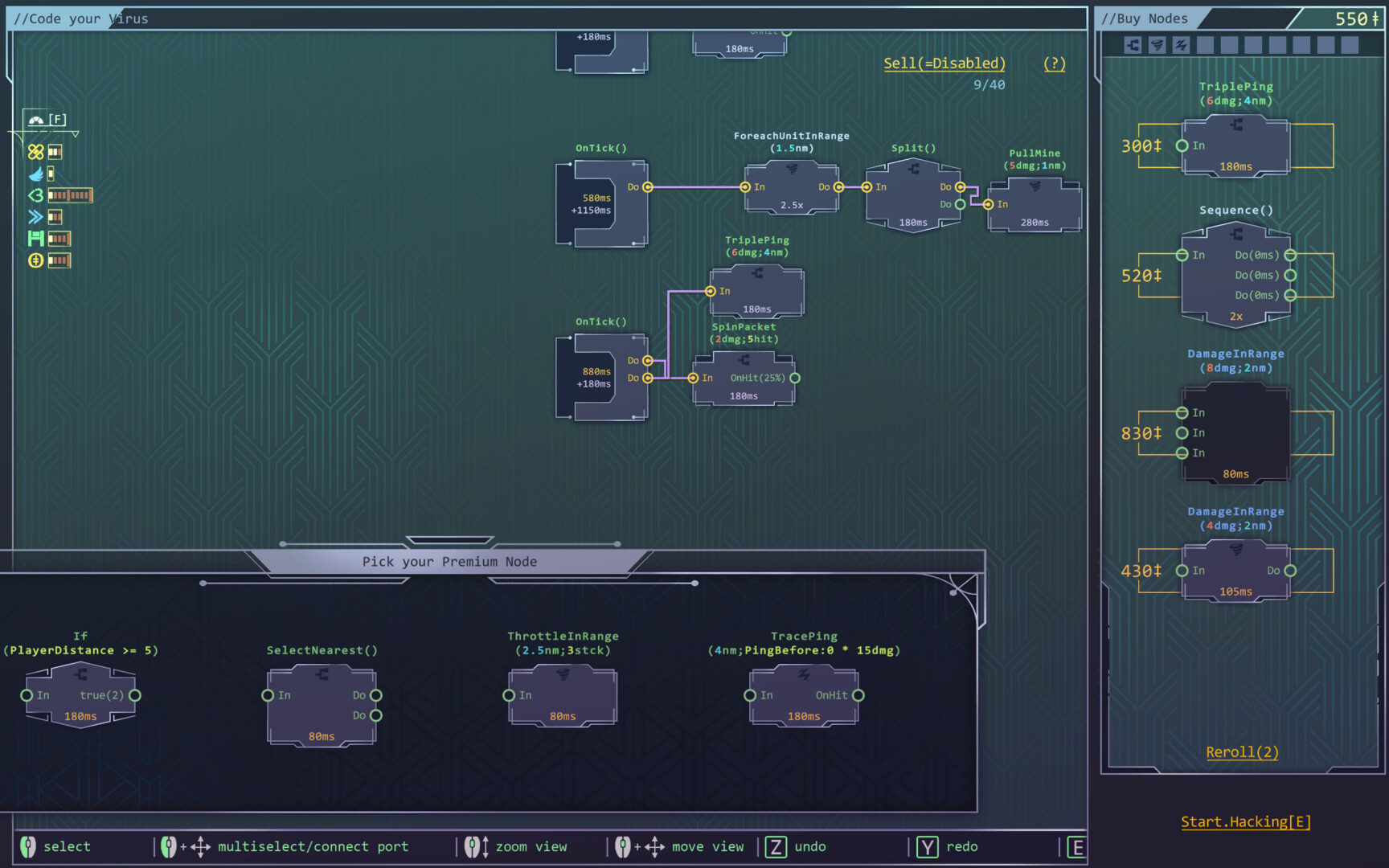

This layer of character-levelling is a proper distinguishing feature for Net.Attack() in what’s now a rather crowded genre. It takes away a lot of the RNG that you depend on to have an optimal run in Vampire Survivors, Deep Rock Galactic Survivors, Soulstone Survivors et al, but the tradeoff is you need to apply some basic coding principles. I know. I’d rather have just had the RNG back too at first.
It didn’t click for me until that first magical run where I felt ahead of the game from level two. I kept adding modifiers to my radial laser attack. Five minutes in it was healing me per hit, multiplying itself, dropping mines and then giving me still further buffs when those mines went off. I’m still not sure exactly what I did. I just know it felt absolutely amazing, and that I felt slightly more agency over the character build than when playing Vampire Survivors.
Often I learned by simply connecting nodes together and then observing what happened in-game. That felt easier than reading the descriptions of each node and trying to figure out the optimal order and connection paths. It meant a lot of self-applied damage while I experimented with mines, and eventually a pretty dominant combination of self-healing and chained explosions.

Still, the hacking menu remains a slightly mysterious and daunting one, where currency piles up and where I’m not sure how and where to spend it without upsetting the semi-accidental alchemy of buffs I’ve somehow created in there. I do not, if it isn’t apparent by now, come from a coding background. Your mileage may vary if your expertise extends beyond writing custom HTML for your Myspace page in 2005. It’s a particularly nice idea that this game might make learning code more achievable and accessible for kids, though I don’t have anything like the knowledge to assess this game as a learning tool.
No, I can only judge it as a game. And when a game sticks so closely to a genre template, you can’t help but keep subconsciously comparing it to the titans of that genre. The health drops that enemies leave when they expire. The rings of constricting health sponge enemies during more stressful waves. The feeling of being absolutely invulnerable for 99% of your playthrough, and then suddenly totally screwed. The incredible builds you chance upon and struggle to commit to memory. These are all experiences that Vampire Survivors and its genre stablemates have given us before, and with more charm.
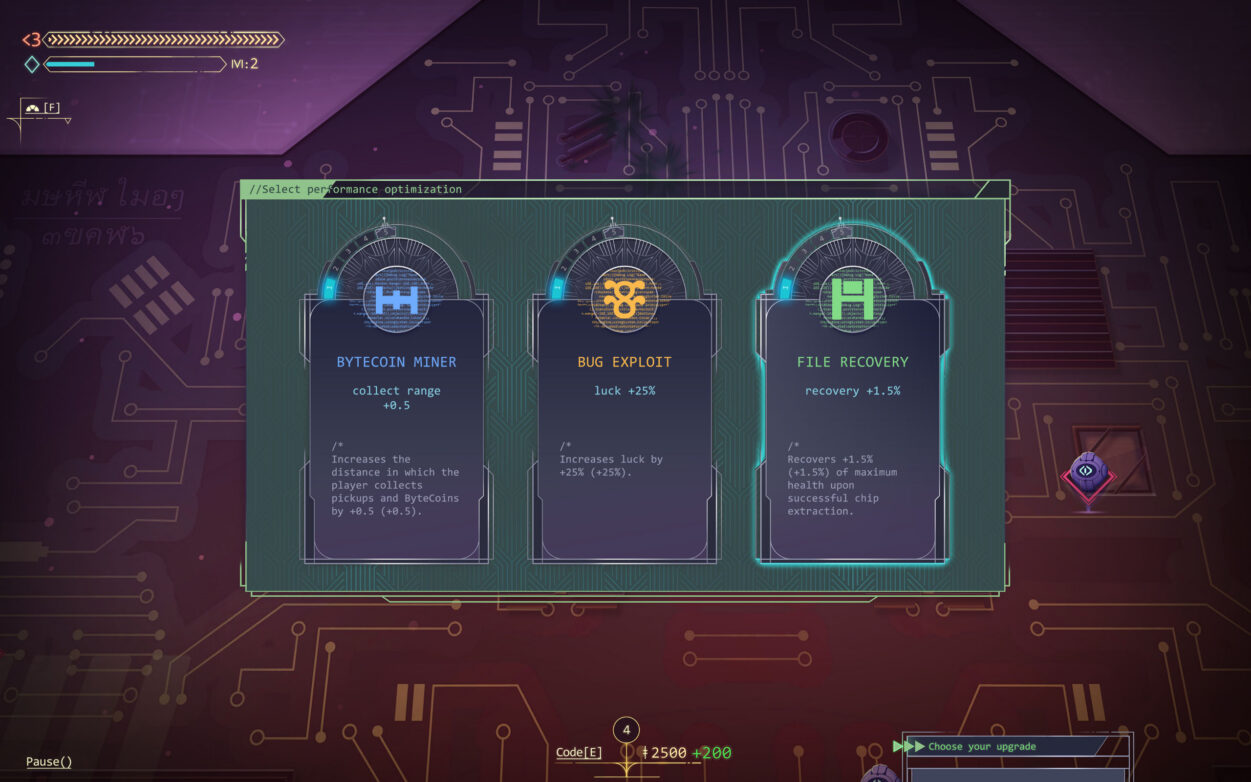
In the place of the 16-bit pixel art that usually conveys the chaos, there’s the ‘Steam game’ aesthetic. That clean, sharply drawn animation style that has Newgrounds in its DNA and seems to characterise 50% of all indies released on Valve’s platform on a given day. It’s readable and performance-friendly on all specs, but it doesn’t conjure the atmosphere that the genre’s best manage to do with retro 2D visuals. And given that this is thematically relatively untrodden ground, it’s a shame that it doesn’t feel like the concept of going inside the machine to steal data has been embraced in every component part of the game. The soundtrack is energetic, but it’s not evocative of the theme. The visuals serve the gameplay well, but they don’t build a distinct visual language that tells you you’re code battling code.
But what it does have to repel those criticisms is the node-building character progression, something I’m still fascinated by, experimenting with, and learning. That means there’s something here that’s worth exploring, whether or not you’re a genre aficionado.