We so often turn to video games to escape life’s mundane realities. When you need to hose down the car, give the laundry due attention, or unpack that one last box of miscellaneous items left over from your house move of a few years’ past, the temptation to fire up your PC and escape to a fantastical world can become irresistibly tempting.
In recent years, however, we have seen ‘chore core’ games emerge as an established genre, subverting the conventions of escapism by focusing their players on toil and labour. The likes of Unpacking, Powerwash Simulator, and A Little to the Left have proven that repetitive, even tedious chores can be powerfully meditative – when the work itself isn’t from your own real-world to-to list.
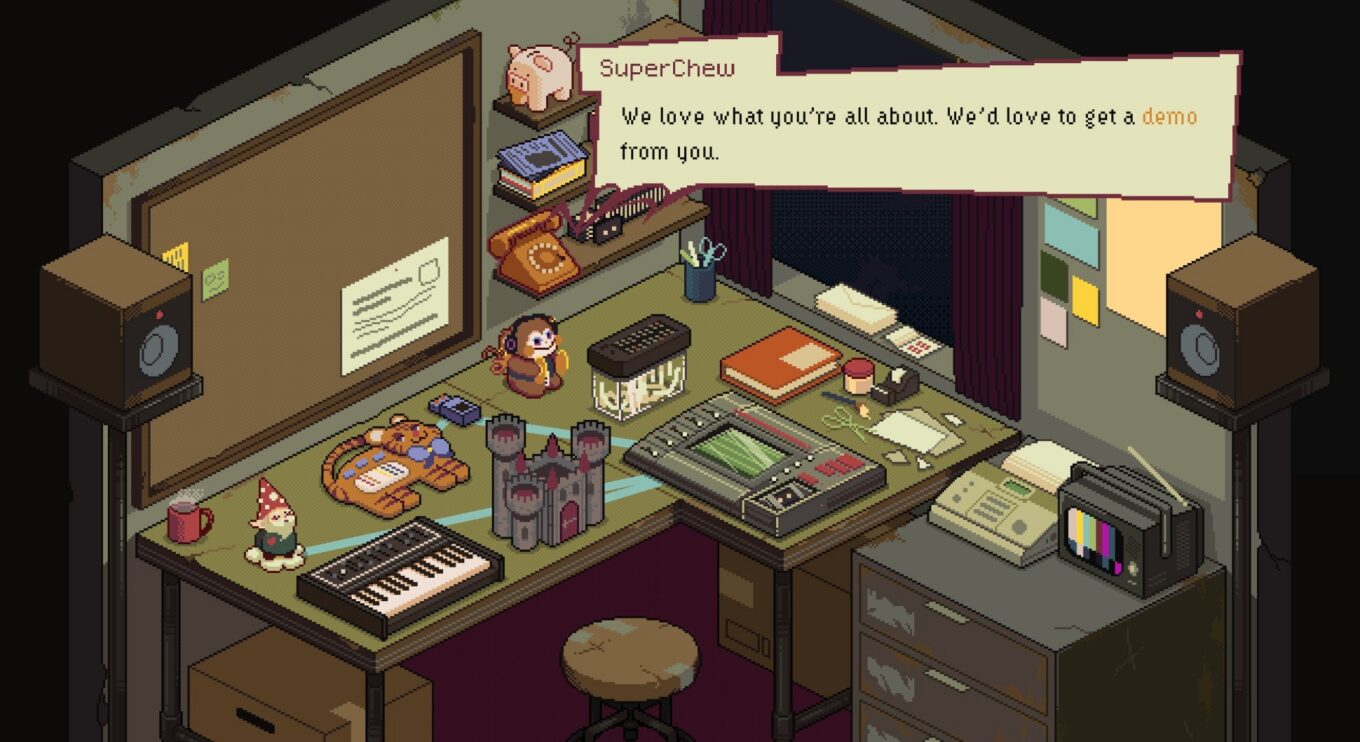
Now the team at London microstudio Whetstone Games have turned their attention to chore-core, and taken the whole concept to a tantalising new place where the work you do actually produces real results. Their new Early Access release of Offbeat sees you settle into the seat of a desk of a budding freelance music producer, and sets you on the task of composing tracks for clients using a growing collection of eccentric electronic instruments.
What makes Whetstone’s creation so fascinating is that as you play, you find yourself learning the craft of music production, for real. That is because Offbeat additionally stands as a functioning music production studio, where every track you make – be it for a fictional client or your own pleasure – can be exported as an audio file to share as you wish. You might, for example, choose to publish your creations to Spotify; something Whetstone has already done to showcase what is possible. You could even hook up your PC to a cassette recorder and release an obscure noise tape, or actually get that track you’ve wired on pressed on a vinyl. Or you can keep them all imprisoned inside your PC, purely for your own listening pleasure.
That ability presents a thrilling proposition if you’ve ever been tempted to learn music production, but found the process overwhelmingly technical, costly, and saturated in jargon. Offbeat’s concept is near irresistible; but is it any good as a game, and a music creation platform?
You’ll spend your entire time in Offbeat’s Early Access iteration sitting in a singular small home office space – which serves up an authentic experience that will ring true to almost anyone who has lived the freelance life. That room is realised in a gorgeously crisp, detailed, 32-bit isometric pixel art style that’s rather evocative of Unpacking. But here, rather than neatly arranging belongings, you’ll gather and lay-out an increasingly elaborate horde of contraptions that each increase the breadth of what you can compose.
You start out with a sequencer gifted by an uncle in need of a new ringtone. If you’ve no idea what a sequencer is, you’re perfectly ready to enjoy Offbeat, because this is a game that wants you to play your way to better understanding of the concept of music production. It isn’t an educational experience – never instructive nor teacherly – but it knows how powerful play can be as a means to discover and learn.
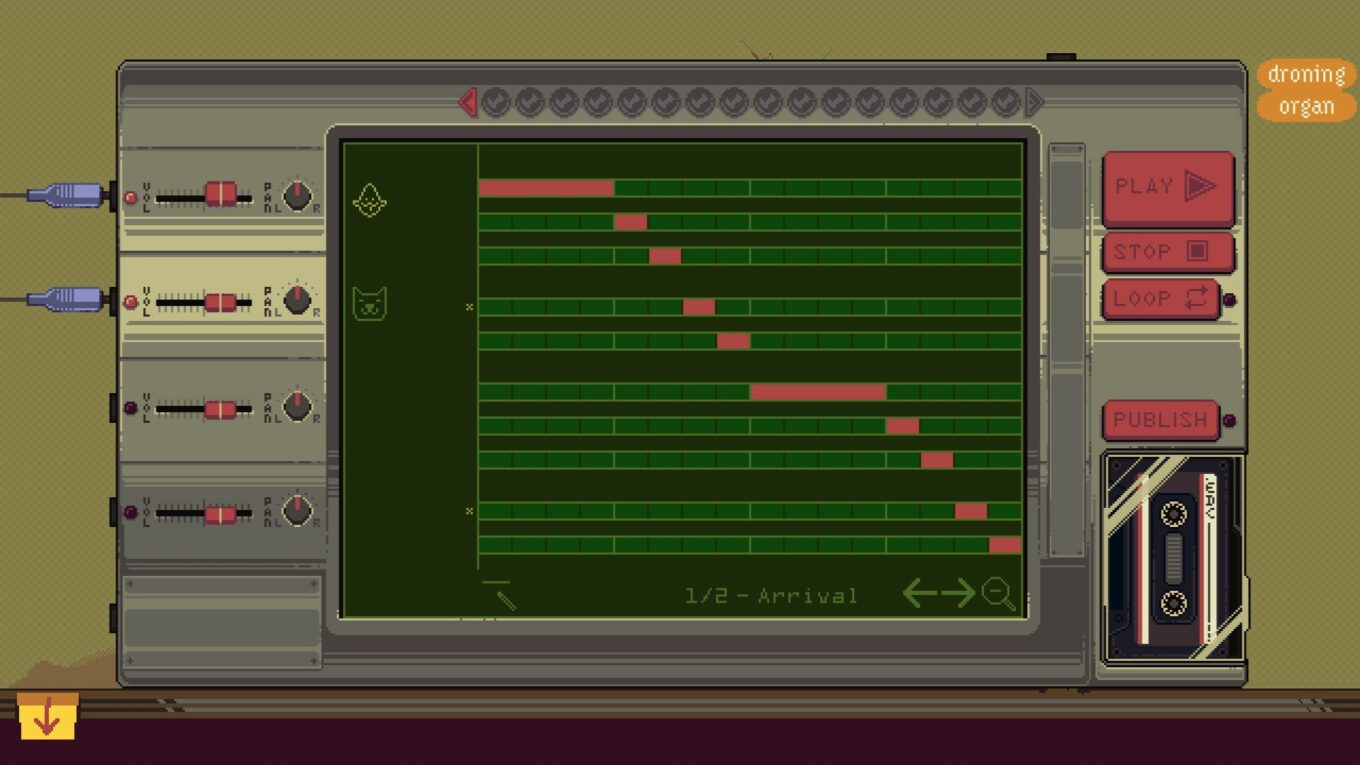
As with a real physical sequencer, your latest acquisition is a device that makes no sounds on its own. Rather, you can plug in a range of instruments and other contraptions, and control and record the sounds they make. Laying out sequences of notes on a grid lets you choose when a drum, keyboard key, or bass tone will sound out, for example. Placing notes across that grid, then, lets you build out a full piece of music, which can then be saved and shared. And that is the very heart of the Offbeat offering.
If that describes something a little too dry for your tastes, fear not, because Offbeat is a game that celebrates unconventional creativity, and that is confident in its own eccentric personality. Upon first receiving the sequencer, the only instrument available is the Tiger-01, a gaudily colourful children’s feline-shaped keyboard that can emit a range of meows, purrs, vehicle sounds, and toyish piano and organ notes. It is the first sign that Offbeat isn’t here to take itself too seriously, establishing a joyful, sometimes knowingly daft tone that frames the entire experience.
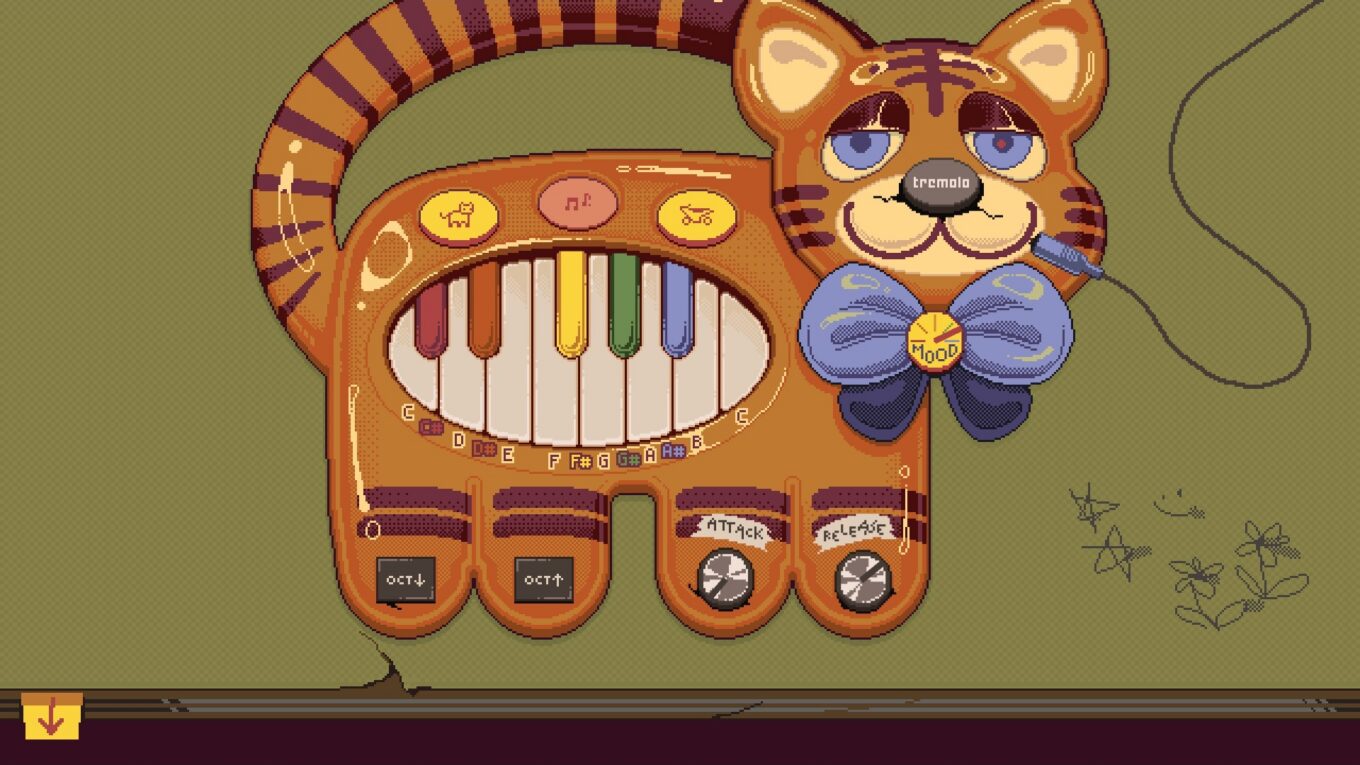
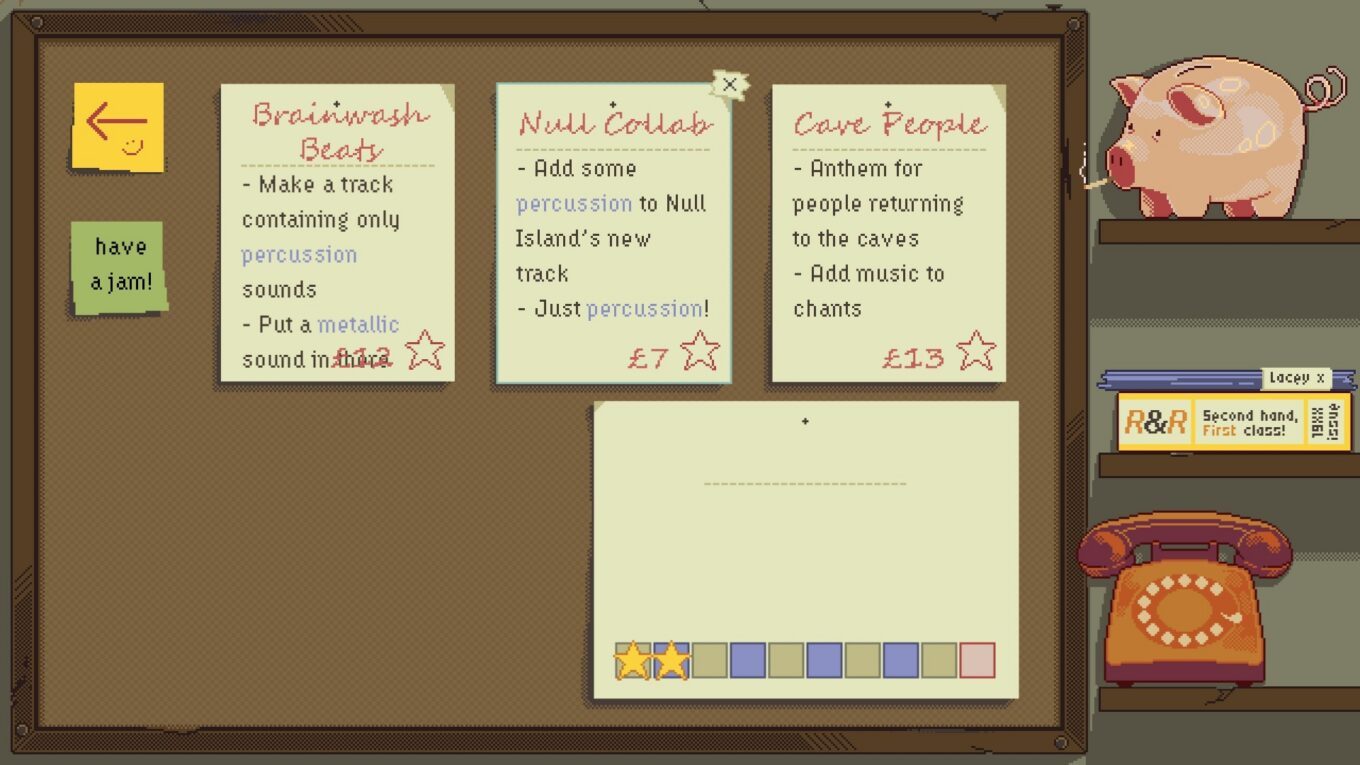
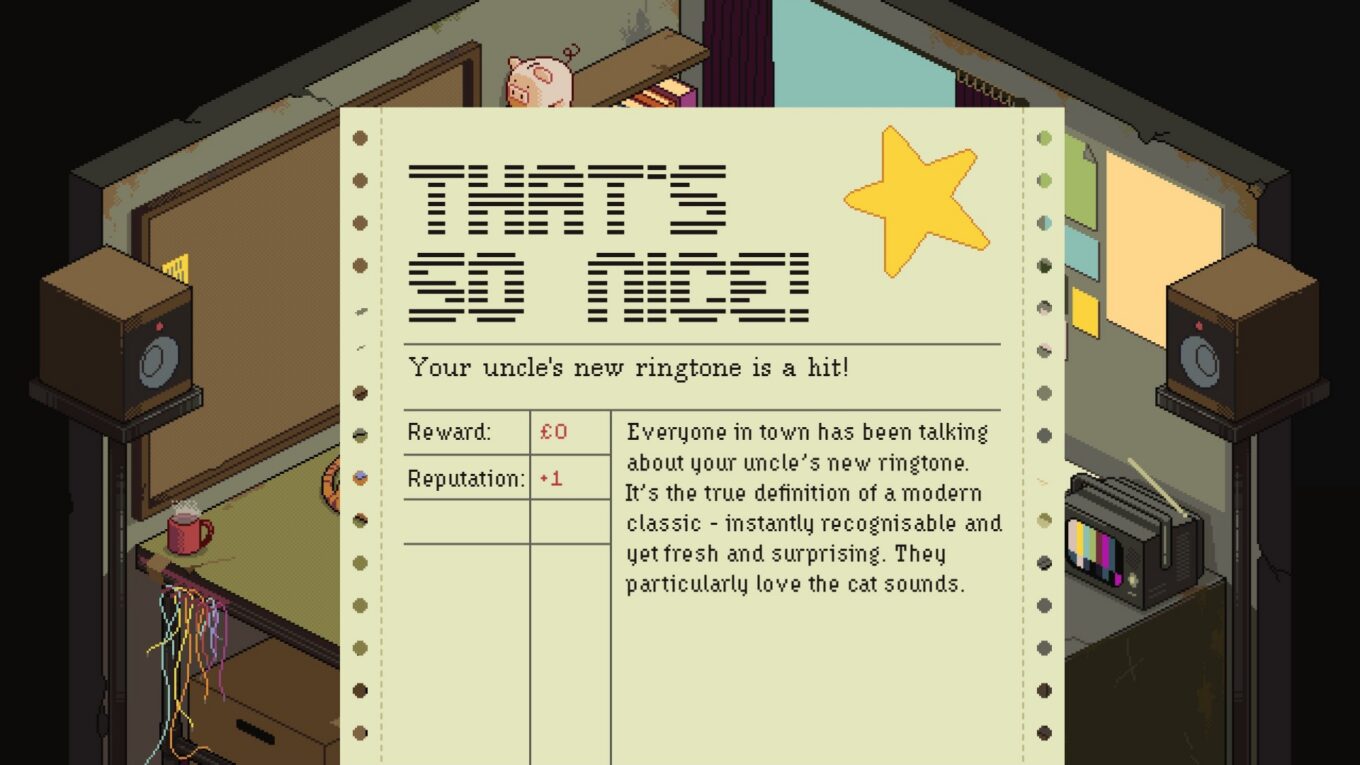
Plug your Tiger-01 into the sequencer, and it gives you enough to make that ringtone. In time more work comes in, insisting you construct the likes of esoteric lift music, a series of soundtracks for an exercise group who appear to be going a little Lord of the Flies, a theme for the nighttime wedding of a pair of ghosts, and a soundscape for a presentation at a soulless corporate entity. Again, Offbeat is a far from staid take on music production.
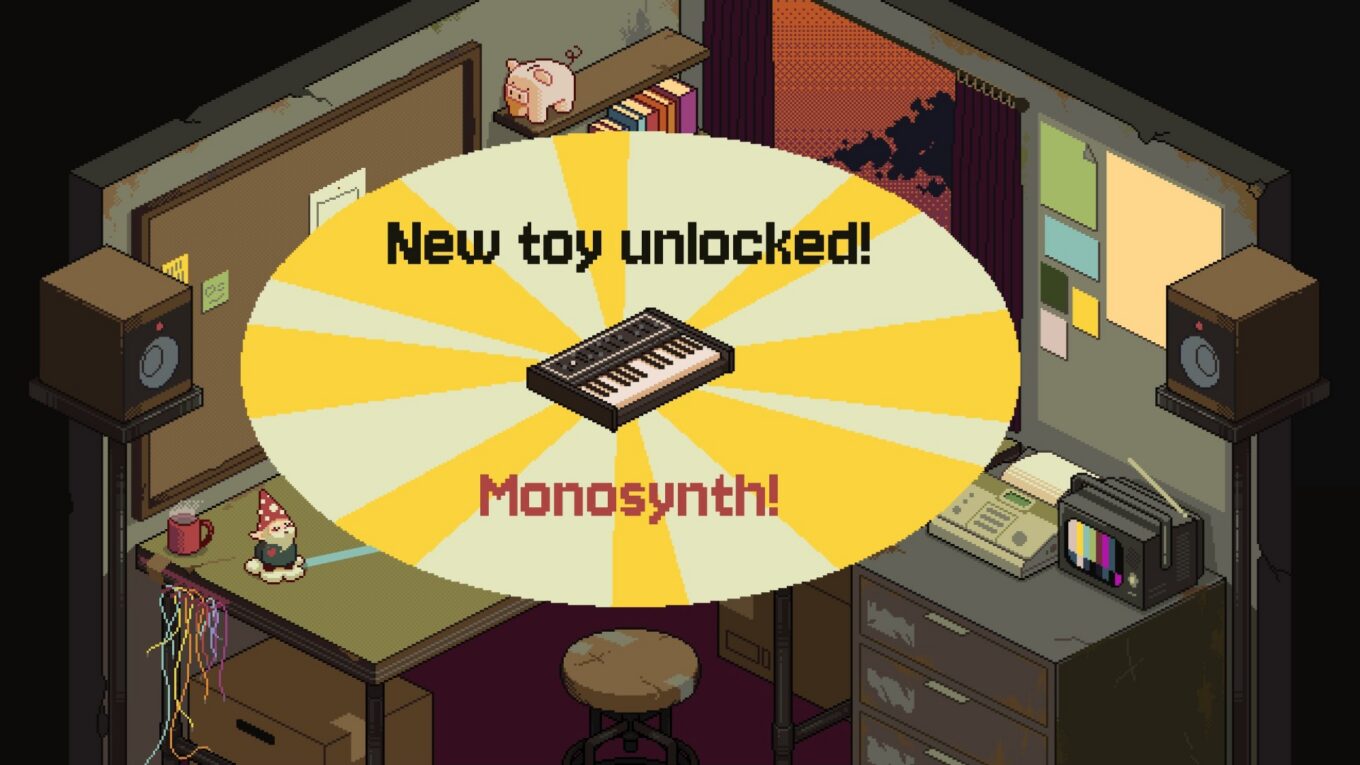
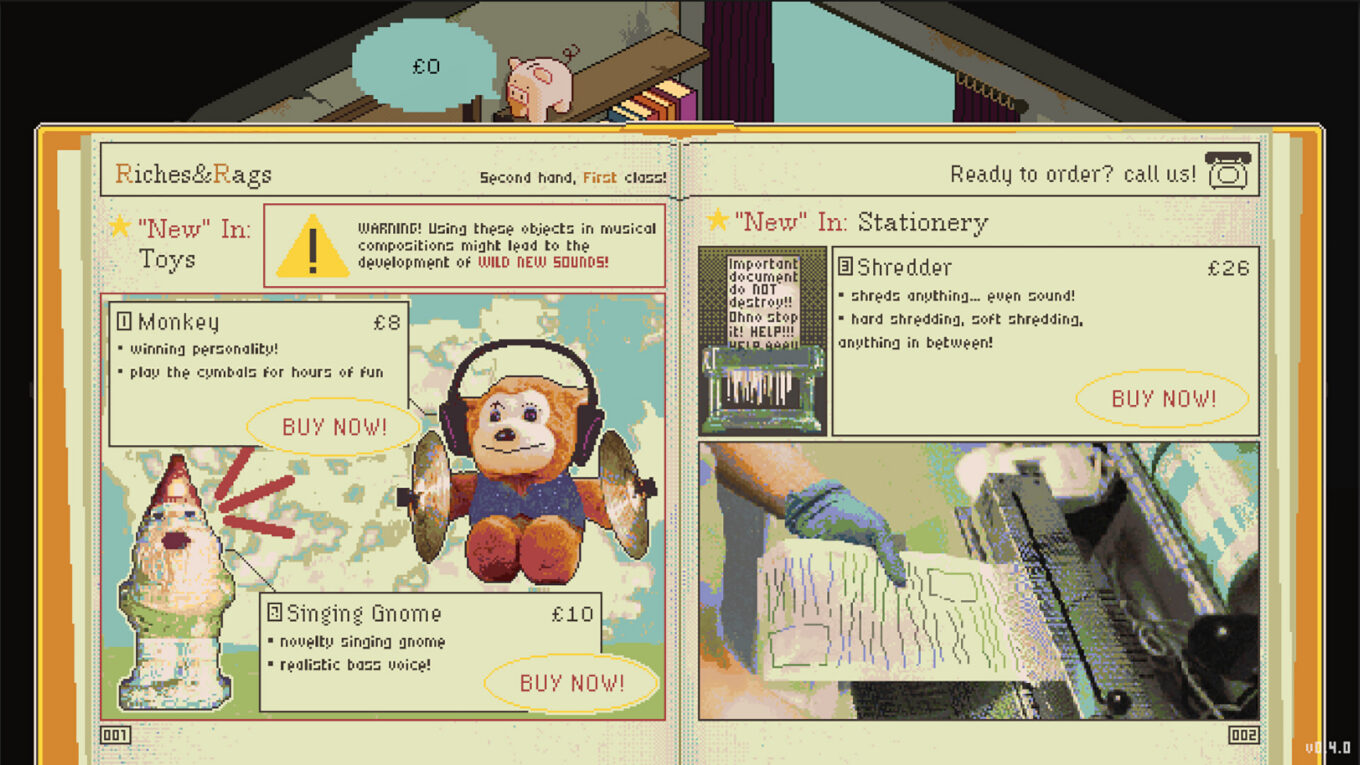
Each commission comes with specific requirements, such as starting with a rising melody, before delivering an erratic percussion pattern, followed by a bass-driven outro. Meet those requirements, and you are paid for your work, granting you the cash to invest in more instruments, from traditional options such as a monosynth keyboard and effects pedal to playful items such as a singing gnome toy, paper shredder, and mechanical cymbal-clattering monkey.
Thanks to a plethora of peculiar clients and the stories that found their needs, Offbeat is emerging as a delightfully lively game to play. It might not be narrative-lead, nor house a plot riddled with drama, but it brings an abundance of spirit and personality that utterly draws you in. It is well written, knowing, and funny, and that does much to extend how distant it feels from traditional routes to learning music production such as tutorial videos.
Offbeat’s master stroke is that rather than telling you what to do, it encourages you to tinker and play, discovering how things work for yourself. Learning through doing is usually the best way to educate yourself, and Whetstone appears to have a deep understanding of that process. When you finally get that effects pedal, for example, you’re given a brief overview of the fundamentals, but then explicitly told to get fiddling and find out how things work yourself.
In time you unlock various hacks and mods that add new features to your spread of unlikely instruments. And so begins a process of experimenting various knobs and switches, or even plugging distinct instruments and devices into one-another in chains. It’s amazing what a tiger-shaped keyboard can sound like running through a circuit bent document shredder. Keep tinkering, and in time you’ll find out how to add that echo or squelch to a rising melody that ends with a clattering of engine sounds – just like your latest client requested.
At times – just as with real music production – you’ll find yourself rather stuck, aimlessly prodding inputs you don’t fully understand, producing every noise apart from the one you need for that most particular of clients. But that is all the build up to the glorious moment that is so defining of the creative process more generally; that point when you solve the problem and see everything you imagined come together before you.
At times you might even find yourself frustrated, meaning Offbeat isn’t shaping up to be a game for everyone. But if you don’t mind a little persistence, the reward is tremendous. In fact, every time you overcome one of those tangled up moments, Offbeat delivers its ultimate promise. With each challenge bested, it starts to dawn on you that you really could do this for real; because you are doing it for real. A game delivering such an empowering creative experience really is a wonder, and something few other titles have ever come close to
At the same time, it doesn’t appear that the final release of Offbeat will unfurl into a true, fully-featured music sequencing software or ‘digital audio workstation’ (DAW). For now the Early Access build delivers two chapters of ten or so commissions, and seven instruments. Building tracks for your own pleasure in Offbeat’s Jam mode, you can shape long, elaborate tunes with intros, choruses, verses, breaks, drops, and all sorts else. There are a wide array of sounds available, but most of what you create will be tonally similar, even across tracks informed by dramatically distinct genres.
All the instruments you gather are impressively flexible, but if you were hoping to craft an orchestral house track rich in samples, original vocals, ornate atmospheric bridges, and your own guitar-playing skills, it looks like you will need to upgrade to professional music production tools and a bit of your own hardware. Some of the very basic functions of Offbeats are limited too. Cutting and pasting collections of notes, for example, relies on a rather clunky and minimal system that largely adds friction to the creative process of laying out tracks.
However, Offbeat more broadly gives you context, experience, and confidence in making your own music on a computer, via a captivating game experience. Going through the process of building a piece of music from scratch, refining it, and even publishing it to Bandcamp, Spotify, or Soundcloud is an empowering experience, even if that tune you create is far from perfect. You’ll come away from clearing the Early Access build with a fundamental knowledge of music sequencing and production, and the realisation that it is something you are capable of – and that could lead you to great things, particularly if the final release adds more ambition and flexibility.
A handful of Offbeat’s current missions even ask you to collaborate on existing tracks, perhaps adding the percussion to a well developed dance composition. As with reality, that process is where you’ll really learn the most, and start to sense the kind of quality you’re actually capable of.
As somebody who has previously only managed to dip a nervous, ill-informed toe in the waters of music production, to finish Offbeat’s Early Access feeling like you are actually capable is already a remarkable experience.
It is important, of course, to also consider Offbeat purely as a game. Forgetting the remarkable potential to make and release music you have composed yourself, there is still plenty to enjoy – even if at times it really does feel like work.
Don’t expect to experience the quiet, deliberately slow, meditative bliss that the likes of Powerwash Simulator so expertly deliver. Offbeat is a game with firm win conditions – set by the demands of your clients. To play is to focus, use your grey matter, and get creatively deep. There’s effort in playing Offbeat, even if music production has never felt easier. That is far from a shortcoming – rather, Whetstone has built a very distinct take on the chore-core genre that wants to enliven your brain rather than pacify it.
And thanks to the delightful characters and writing, the sheer outlandishness of the instruments, the variety of commissions, and the cozy pixel art styling, you’ll almost always find yourself with a smile on your face as you work and create; aside from those moments when the furrows of frustration begin to creep across your brow.
Offbeat is also emerging as a game best played in smaller chunks. It is certainly immensely engaging, and a little tricky to turn away from. But if you do choose to plough through numerous back-to-back commissions in one sitting, a feeling of repetition does set in as it currently stands.
The only significant flaw in terms of the experience of playing Offbeat as a game is the fact that you can place a lot of filler into the client tracks between the specifically requested elements, which rather undermines the learning process. At a point it dawns on you that you can meet the needs of many commissions faster by copying, pasting, and repeating whole sections; maybe the same percussion pattern four times over. It is a little too easy to fall into simply trying to complete the minimal requirements of each condition, motivated by progress as a player. In those moments, the notion of learning music production loses its value a little. Play in small chunks, however, and you’ll likely find yourself getting lost to tracks, finding your creativity and adding personal flair, delightedly lingering in the creative process rather than charging through it.
Ultimately, Offbeat is a distinct game with an empowering purpose – and we are still looking at an Early Access build. Whetstone has suggested many more chapters and instruments will be added. Should the game do well commercially, we could dare to dream that Offbeat’s technical prowess will increase its breadth through updates, perhaps letting you input samples or your own live instrumentation. That is wishful thinking, but the potential here is tremendous.
If you have ever pondered a dabble in music production, but found yourself at a loss as to where to start, Offbeat is a fantastic option that really could open up a creative future you’d only dreamed of to-date, setting you on the path to self expression through music. That is something far more rewarding than attaining a high score, defeating a final boss, or claiming every achievement a title has to offer.
As a game in its own right, Offbeat remains delightful and engrossing – but if you aren’t interested in getting more involved in music making, you might miss out on the real heart of what Whetstone has built. And if you want cozily charming meditation delivered via menial tasks that ask little of your brain, you’re in the wrong place.
But really, Offbeat feels like an Early Access build everyone should play, to give themselves a chance to discover the creativity they harbour. As playful and brilliantly eccentric as it might be, Whetstone’s latest is also powerful and important.