I don’t mean to shock you, but the world is broken. In a bright-eyed platformer like Duskfade, you can only fix it by travelling to its four corners, delving into their depths and ascending their heights to put the pieces back together. It’s another run at a classic formula. While it provides little novelty, it is confident and vivacious, eager to win you over. But a shallowness hides behind Duskfade’s sunny facade, which the game’s highs cannot escape.
Principally, Duskfade takes its cues from the second wave of 3D platformers for the GameCube and PlayStation 2, games like Ratchet and Clank, as well as more recent retro-flavored fare like A Hat in Time or Yooka Laylee. Kingdom Hearts stands at the front of these inspirations. Protagonist Zirian has a slick and complex hairdo, a sword which he uses as a key, and ornate clothes – with a lot of buttons and belts – which could nevertheless be described as streetwear. The inky enemies are clear riffs on Kingdom Hearts’ own iconic foes: the Heartless. The principle antagonist, Despair, and several of the game’s bosses, are aspects of a split self (more on this later). Duskfade’s pool of influences is both wide and deep enough that the game doesn’t feel rote. I couldn’t describe it as a mere “spiritual sequel.” However, it does move at a predictable, steady pace.
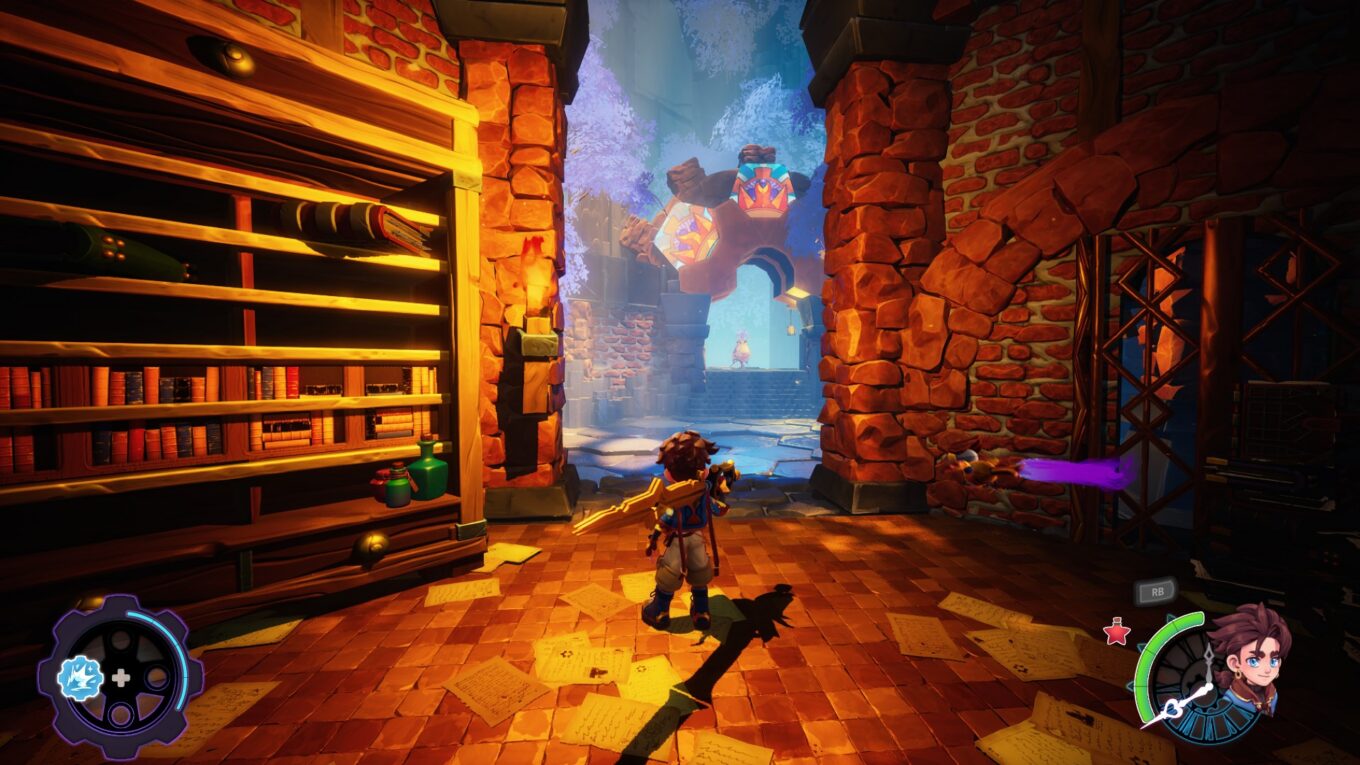
Each section of Duskfade works the same way. Let’s summarize. At the game’s start, Zirian’s sister Allira is conducting an experiment. Something goes wrong and a mysterious, gigantic tower appears in the center of Zirian’s hometown, spreading gigantic rifts in the earth and twisting his clockwork world into eternal night. To stop the world from eventual destruction, Zirian (with the help of the robot bird Cuckoo) must break the four chains which anchor the tower. The path to each chain is a string of connected levels which share the same basic themes: a heroic climb up a mountain, a beachfront and the school on the shore, etc. Halfway through the chain, Zirian will obtain a new ability, like a grappling hook or “skateboard” shield, which will let him travel further and faster. You’ll fight a miniboss partway through and a boss at the end. You’ll fight every new enemy on its own, before they ever get combined with pre-existing enemy types. Duskfade creates a formula in its very first set of levels, which it then proceeds to stick with over the next 8-10 hours.
This predictability is matched with an ease of play. Each and every new idea is introduced in its own bespoke section, letting you fully understand the ability before it ever gets tricky to apply. Even so, most of Duskfade’s challenges don’t require precision. Zirian starts with three jumps, which you can do in quick succession. With that much flexibility, it is sometimes Unlike some other platformers, even the games which it pulls directly from, you won’t be falling into bottomless pits or forced to retry a tricky challenge from the start. It’s rare that Duskfade will test your mettle.
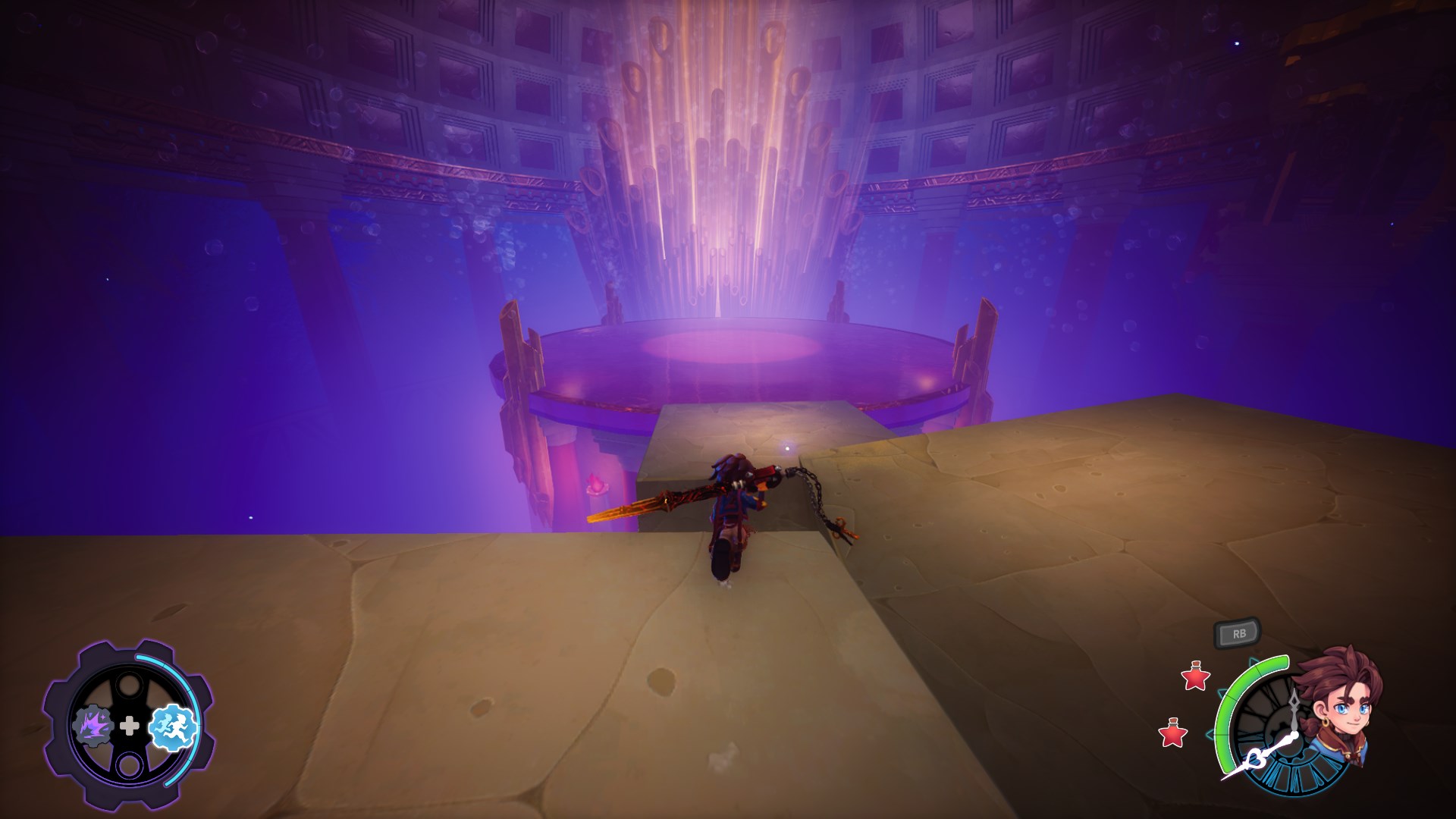
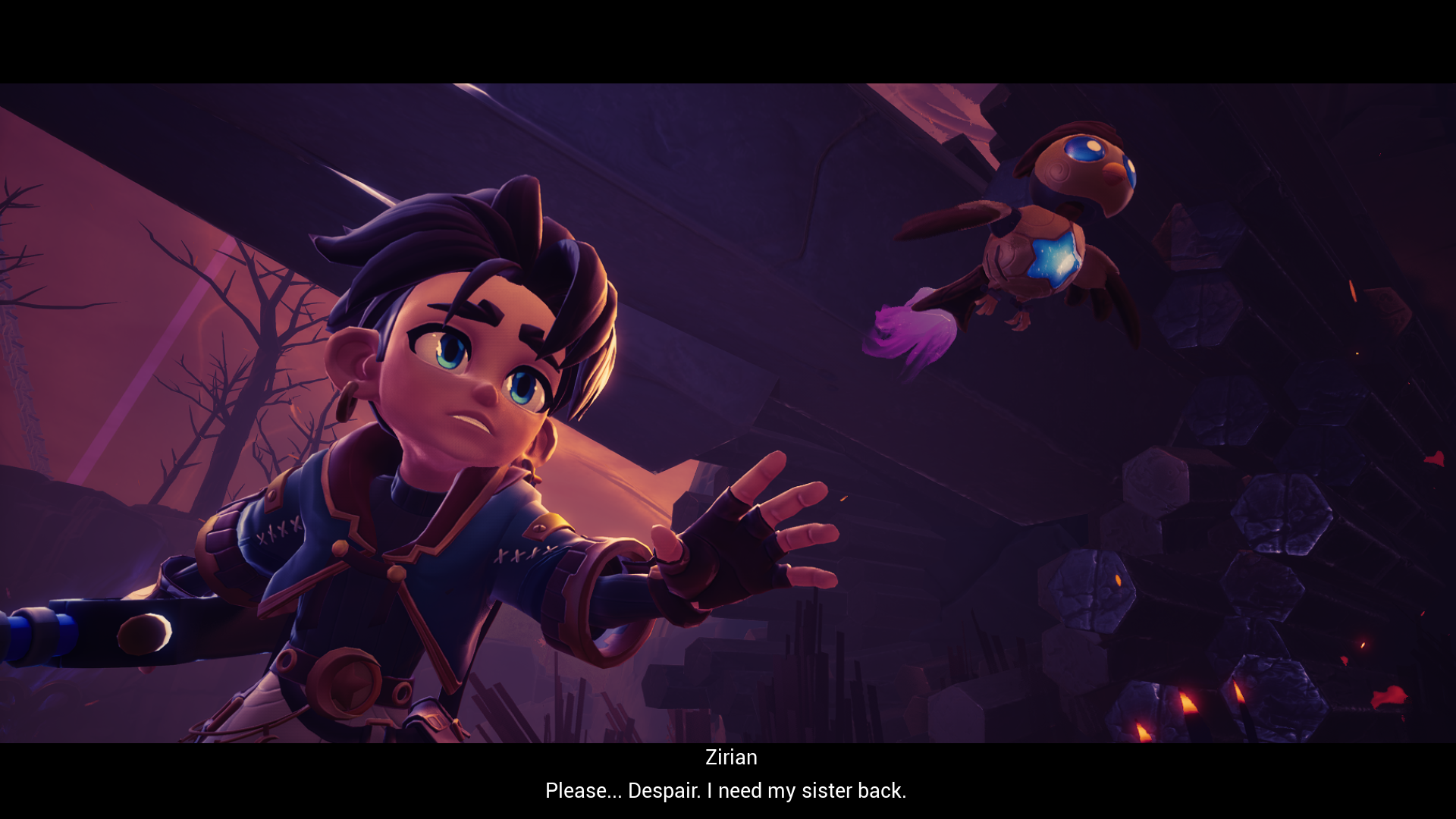
Don’t confuse this with a complaint; it’s a description. The game is this way because its target audience includes children. It is refreshing to play something that feels like it is for kids and families, rather than nostalgia-addled adults. Although Duskfade has something of its own vision, it does play it safe. While the exact combination has some novelty, none of Duskfade’s mechanical ideas are totally new to it. Every one of them is a sure hit. Because of that, Duskfade rarely thrills. Jumping and slashing are satisfying enough. Once you unlock Zirian’s full kit of abilities, the level design does start getting weird and inventive, but by then the game is almost over. Duskfade’s level design is so mannered, so tuned, that it is hard for it to stretch into real excitement.
Nevertheless, Duskfade does have some prickly points to it. By game’s end, Zirian has plenty of combat abilities to play with. At the same time, the Inkies get more complex, hitting harder over larger areas and able to shrug off basic attacks. As the game puts these more complex enemies in groups together, battles become more chaotic. I often dodged attacks from one side, only to be hit by another one from off-screen. It was rare that these woes led to deaths and the game is generous with checkpoints such that it is difficult to be truly set back. However, the chaos did make Duskfade’s battles harried and unfair, rather than sharp or tricky.
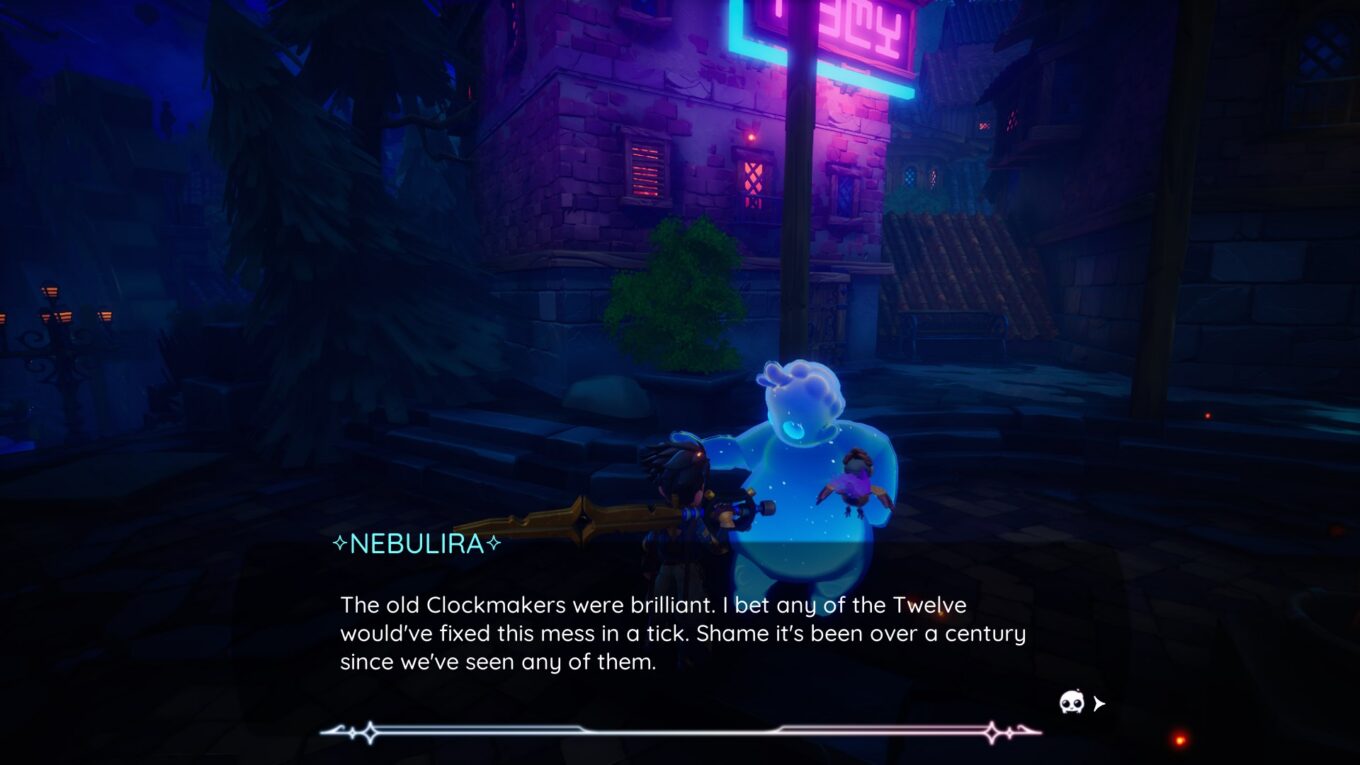
The other part where difficulty can emerge is its boss battles. These are an aesthetic departure from many classic platformers, but will remind hardcore Kingdom Hearts fans of those games’ biggest challenges. Unlike, say, the bosses in a Super Mario game where you can get by with a little common sense and puzzle solving, Duskfade’s bosses move fast and hit hard. You’ll have to time your limited heals and memorize attack patterns if you want to best them. For the most part, the bosses took me just two attempts. One to learn its attack and another to survive long enough to beat it. The two-phase final boss proved to be more of a challenge, taking far more attempts to really adjust to.
Befitting its relative lack of precision platforming, Duskfade is at its best when it is focused on exploration. The game is populated with hundreds of collectables, ranging from crystals and gears which let you buy upgrades for Zirian’s abilities to yarn which earns you new outfits. Each area’s opening level, usually a town-like area with few practical threats, is where Duskfade’s platforming feels the warmest and most expressive.
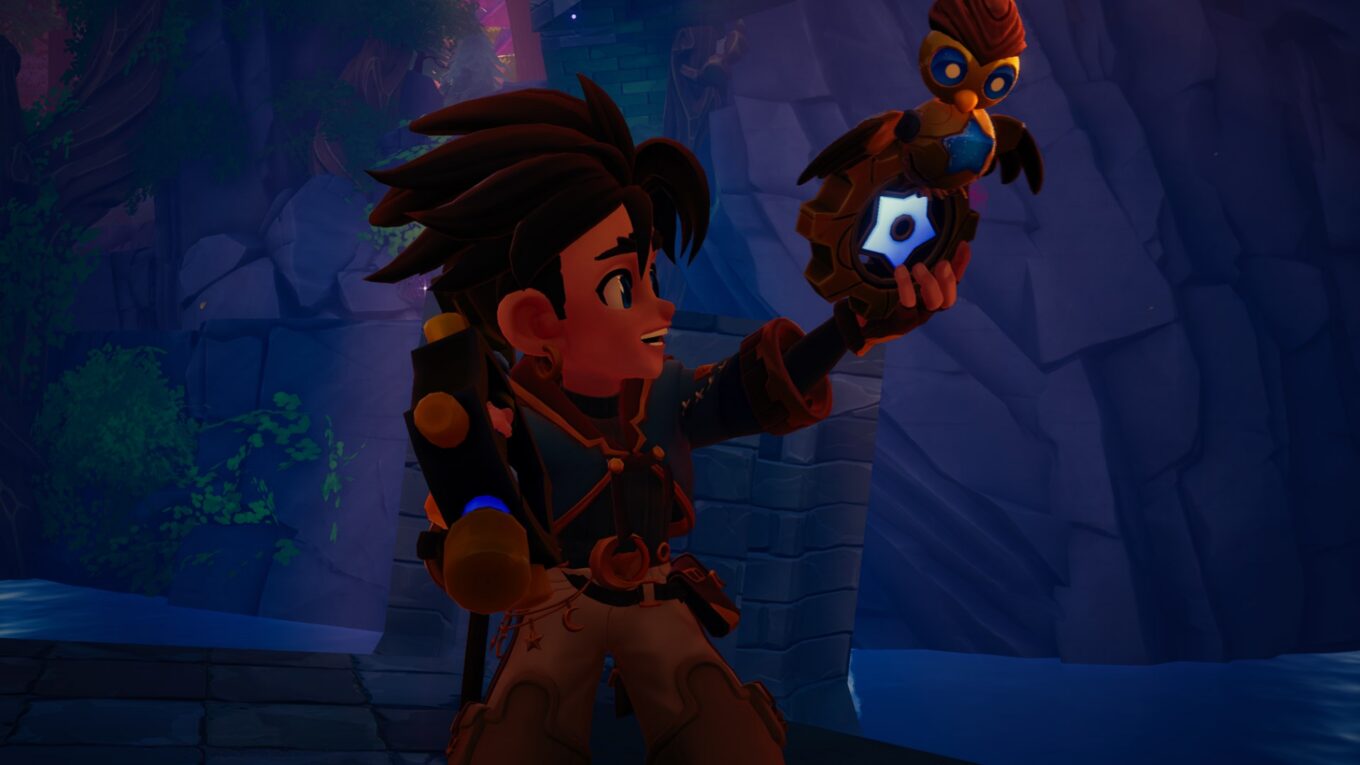
Duskfade is ornate, gilded with flashy bloom effects and clockwork details. Though none of Duskfade’s levels are open enough to cause serious confusion, the oversaturated environments can make it hard to read where to go next. I often got turned around, only to discover I was heading back from where I had come. But the problem goes deeper than that: Looking at Duskfade gives me a headache. There is always so much going on: gigantic vistas with plentiful particle effects, points of interest which lead to one of the game’s many collectibles, and countless level-specific details. It’s sort of spectacular, but it isn’t beautiful. In fact, it lacks the kind of simple beauty that its obvious inspirations have in spades. Kingdom Hearts 2’s Twilight Town is so memorable, in part because of how few axis it operates on. It’s just a few places, enough to suggest a resort town in the waning days of summer. Duskfade showcases much more, but without simple, compositional power, it cannot really be beautiful.
One of Duskfade’s other major inspirations is Pixar films, though it is visually closer to Dreamworks films like How to Train Your Dragon. Like those films, it trades in an appealing cartoonyness, which supplements more somber themes. Most humans died long ago. At the game’s start, Zirian is only aware of two others: his sister Allira and their grandfather Tristan. By the start of the game, Tristan has been dead for a couple months. Allira disappears in the opening cutscene. Scattered throughout each level are echoes of the past, where Zirian hears the voices of the long dead just as the apocalypse begins to swallow them. In other words, Duskfade is explicitly about grief. Its levels are all ghost towns, in which Zirian wanders, mourning what came before.
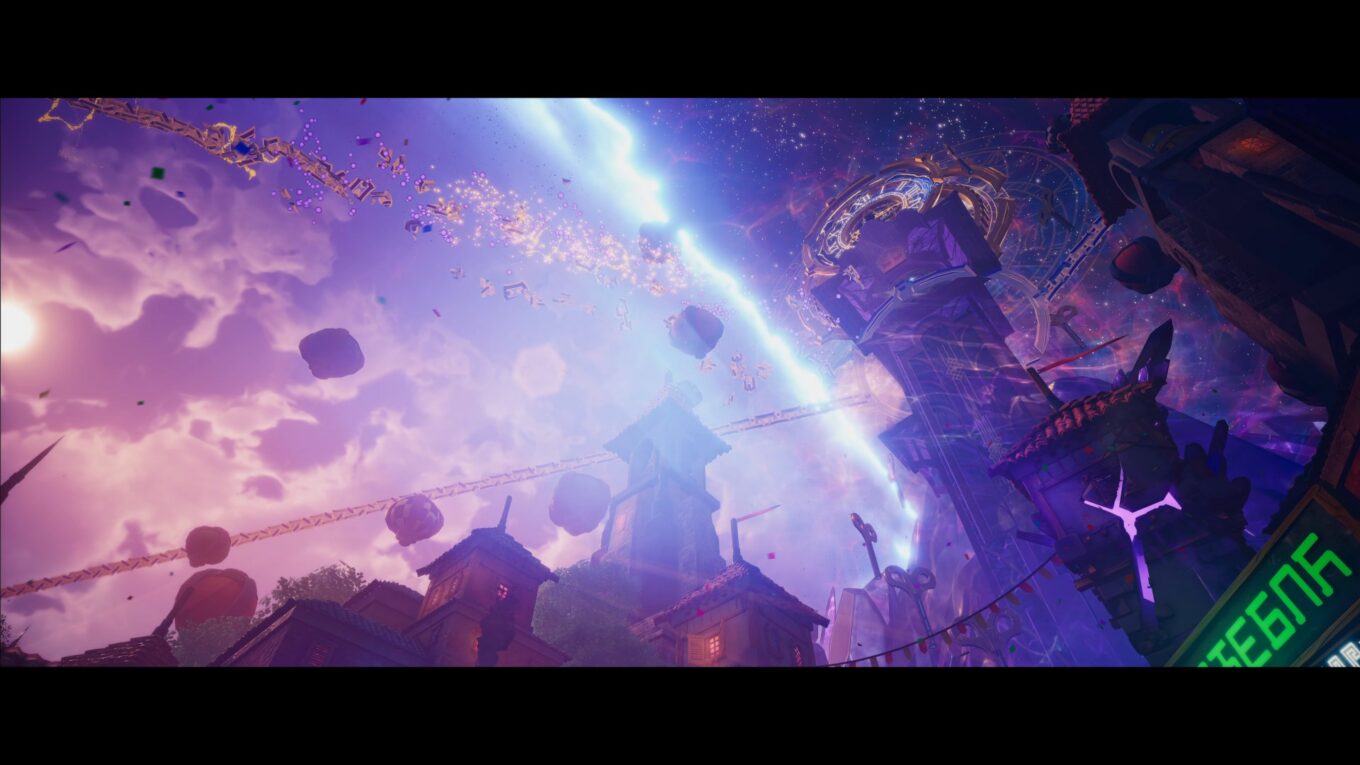
But, as you might predict, Duskfade is far from sorrowful. Cuckoo and Zirian trade joyful exclamations as they battle and jump. The environments are bright and often cozy. Even when they extend to being threatening, it is in the typical video game ways: lava pits and desert wastes. While it is not without emotion, it just feels too obvious to really cut emotionally. Kingdom Hearts’ odd resonance comes from its legitimate weirdness, with a philosophically and practically dizzying cosmology of selfhood. Duskfade is comparatively simple. Many of the game’s bosses, including the archbaddy Despair, are obviously aspects of Zirian’s sister. Anyone who has watched more than one of these movies can guess each of Duskfade’s emotional beats hours before they land. You can say many things about Kingdom Hearts’ storytelling, you cannot say that it has always been predictable.
In many ways, Duskfall is an admirable effort. It has obvious admiration for classic platformers, but has the good sense to stake some of its own ground. It builds a complex kit of movement and teaches you how to use it with patience and aplomb. It is shrewd. It is well done. But Duskfade could not reach into my heart. It wants me to like it too much. It walks with me every step of the way, showing me how each of its pieces works. It plans its emotional beats with clockwork precision. But yet, in all that, there is not enough room for the jagged and the human.