I don’t think I’ve ever felt quite as vulnerable in a game as I do in Flying Squirrel Entertainment’s chaotic Over the Top: WW1. The sound of bullets whipping past you and thudding into the mud nearby, the constant gunfire and explosions, the tank engines, the yelling… the screaming. It’s absolutely terrifying. Over the Top could well be the most harrowingly evocative videogame depiction of trench warfare ever created, but it somehow manages to achieve this while at the same time being outrageously silly.
I suppose that’s inevitable when cramming 200 players into a series of sprawling, entirely destructible maps and empowering them with push-to-talk privileges. “Bonjour, le petit croissant! Où est la piscine!” shouts one player next to me as he charges up and over the trench wall just before being turned into viscera by a mortar strike. Others are yelling, “charge!” and “jerries ahead, chaps!” in Black Adder-tinged cod-British accents. Still more are cursing the (presumably well-meaning) buffoon who filled this previously useful part of our trench with barbed wire. It’s powerful stuff.
That exploded polyglot’s grisly fate also neatly distils the frantic rhythm of Over the Top. The game is disorientingly chaotic: even on the more linear maps, death targets you from every angle (usefully hammered home by the stress-inducing audio work and tracer effects) and it is not uncommon to spawn in, and then almost immediately die before you’ve even gotten your bearings in an ever-changing battlefield. It can be frustrating at first, overwhelming you with a gameplay loop that feels less forgiving than other large-scale experiences like Battlefield 1, Isonzo, or the WW2-focused Hell Let Loose.
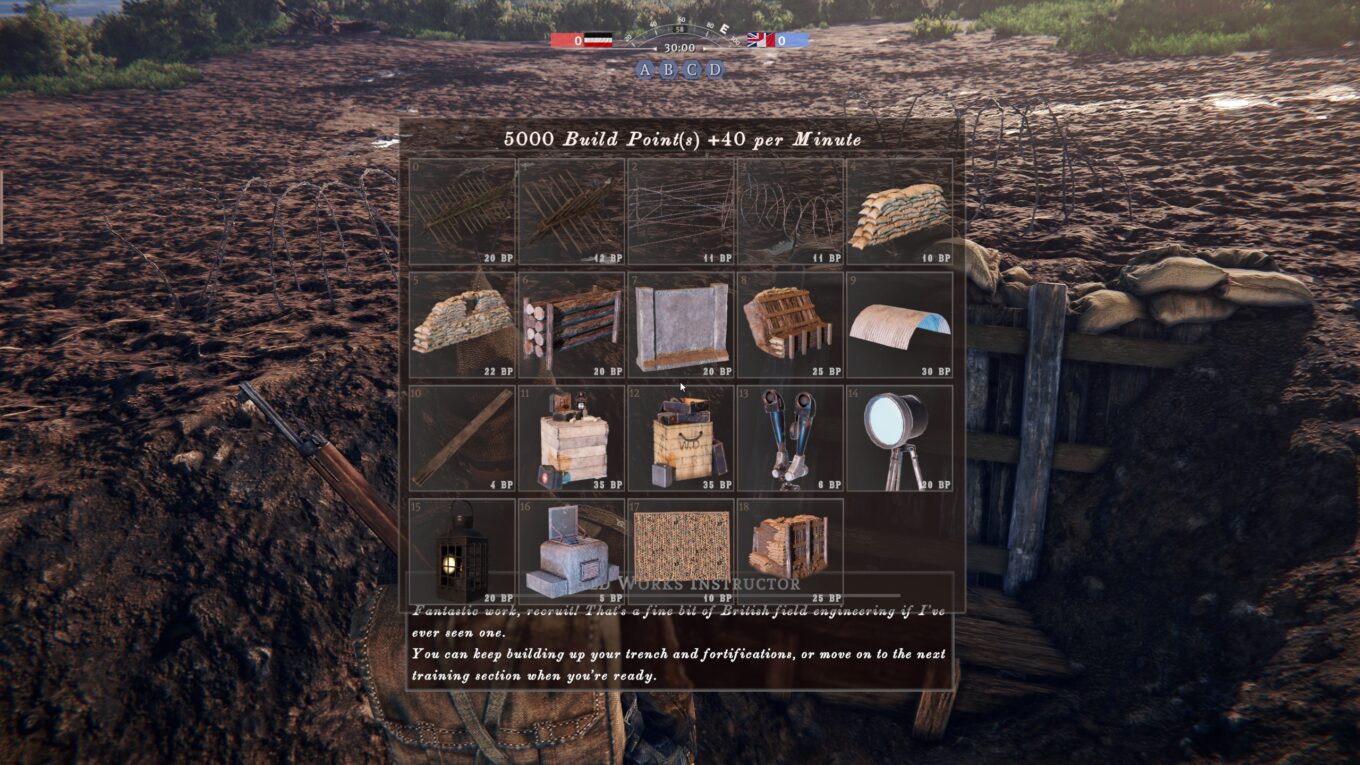
That’s partly down to the sheer number of players, and the resultant crossfire, but there are other design choices that dial up the difficulty. Chief among them is Over the Top’s headline party trick: trench digging. The entirety of the battlefield is deformable, and before every match you’ll get a brief window of time to prepare your defences or assault plan. It’s really quite something to see the best part of 100 players sprint into action to dig out a defensive line and fortify it with sandbags, firing steps, camouflage, and barbed wire. But it becomes even more remarkable as that trench network is expanded towards your enemy over the course of the match, becoming an increasingly complex – and hard to navigate – warren of pathways.
It’s not just a gimmick – using trenches is essential if you want to avoid being cut down immediately, but the constantly shifting landscape and fully destructible buildings can make it challenging to contextualise objectives or simply find your way around. It’s by no means a bad thing, but it takes a little bit of adjustment to get past the reliance on landmarks you’ve become used to in most multiplayer shooters.
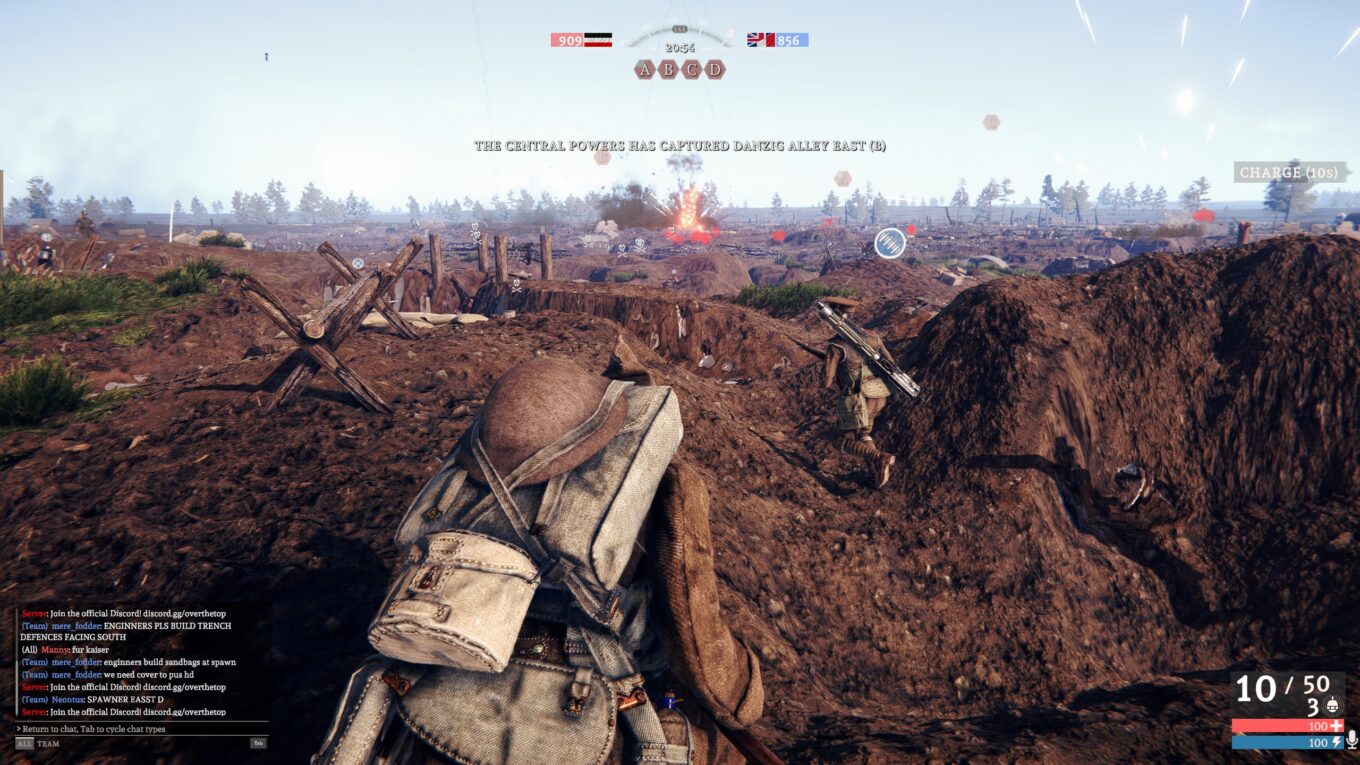
Even trenches won’t save you from the continual artillery bombardment, though, and the fact that there’s absolutely no warning before shells land often results in hard-won progress being obliterated in the blink of an eye. The engineer class can build shelters which will help you to survive a hit, but unless you’re holding a specific position it’s unlikely that you’ll be near or under one at the moment your entire squad is turned into mist.
Unlike the other genre examples listed above, there are no iron sights to shore up your aim, either. This seems to be a result of the ability to switch between first- and third-person viewpoints, but it means that even with crosshairs aiming can feel a bit woolly – a problem compounded by hit registration that can feel, well, a bit hit and miss. It makes for what I imagine is a more realistic experience, but if you’re seeking the satisfaction of a headshot-saturated killstreak, this probably isn’t the game for you.
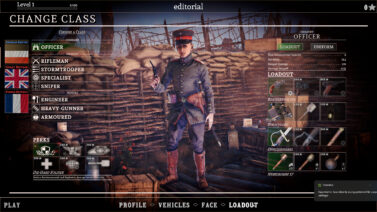
Instead, the relative fragility of every soldier necessitates cooperation, and the various classes available are built around encouraging this. Every class can dig trenches with an entrenching tool, but the rifleman is the backbone of each assault or last stand, and the only class whose number isn’t limited on the field. You’ll get a bolt-action rifle with a laborious reload speed, that will catch out players used to online shooters with more rapid turnarounds, but good stopping power and plenty of range. You’ll also benefit from low workplace pressure, safe in the knowledge that you are, without a shadow of a doubt, cannon fodder.
At the other end of the scale is the officer class, who is the only selection that has to earn their way to an entrenching tool and instead starts with a pair of binoculars. But this small setback is offset by a range of call-in abilities that become available as fire-mission credits accrue during the match. These include the ability to rally squads and charge the enemy, drop white phosphorus or gas, request various bombardments, or set up spawn points. There will only be a handful of officers in each match, and they’re key to breaking defensive lines and redrawing the front.
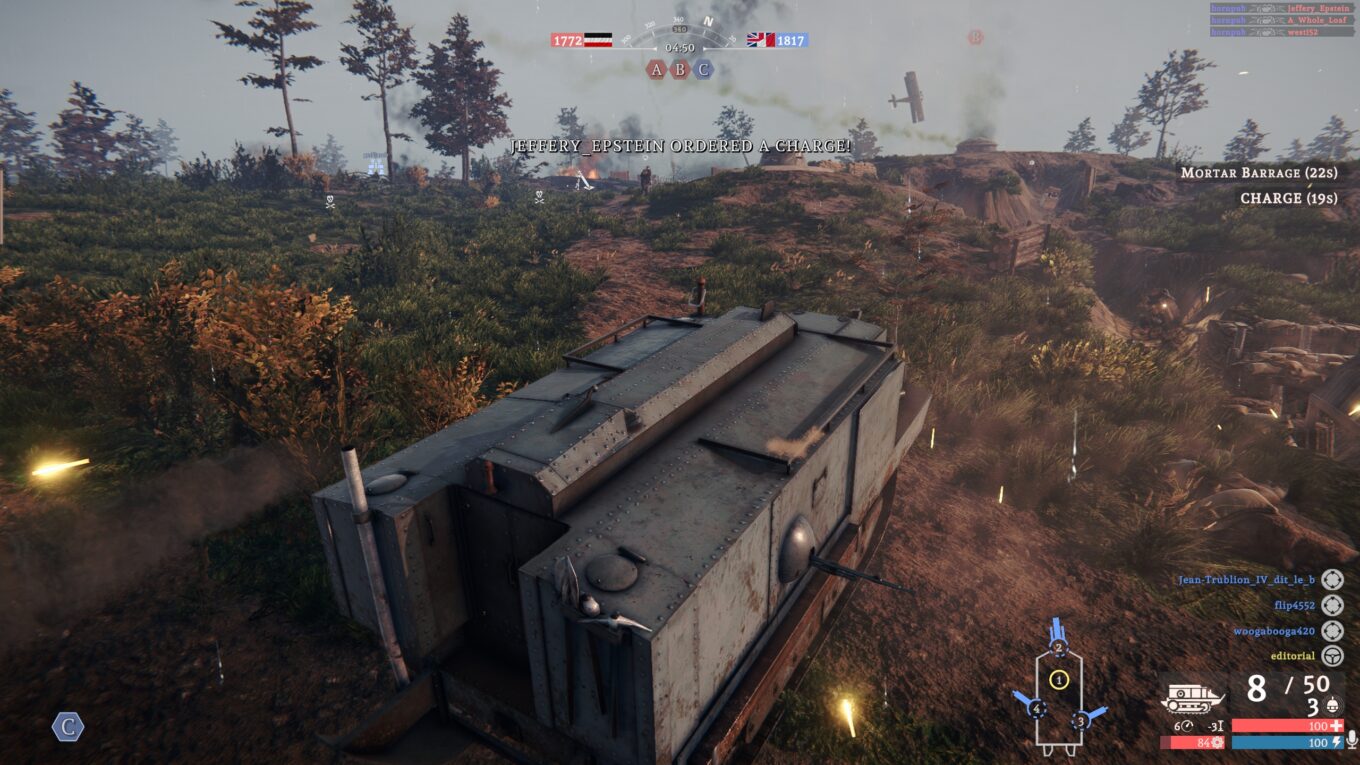
Heavy gunners are a high risk, high reward class that can deploy a stationary – but extremely powerful – machine gun anywhere on the map. You can unlock a pistol and a rifle as you level up, but initially you’ll only have a dagger for close-quarters defence, meaning you’re particularly vulnerable if effectively flanked. Snipers are similarly endangered, and you’ll need plenty of practice to actually hit anything given the previously mentioned aiming issues. Armoured troops are slung with a thin sheet of metal that will absorb a shot or two, which gives them an ever-so-slightly longer cannon-fodder shelf life.
Stormtroopers are kitted out for trench clearing with SMGs and shotguns but trade range for the privilege, while specialists bring anti-tank guns and flamethrowers to the terrifying party. Finally, the engineer class can create a variety of fortifications that make trenches more effective, and share the officer’s ability to build spawn beacons which help to keep pressure on the enemy and take ground. On top of all of this, there are also vehicles to commandeer, including planes and armoured personnel carriers.
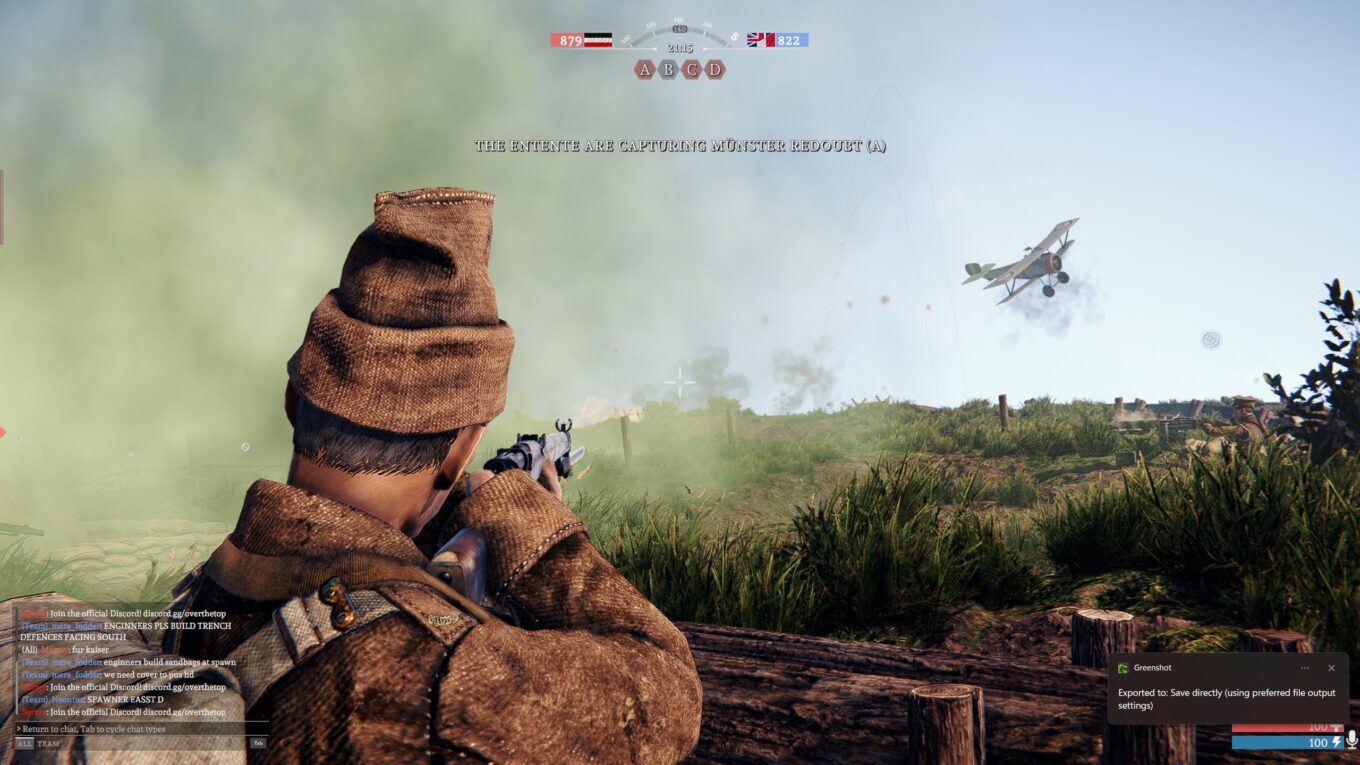
A lovely outcome of the sheer number of required tasks is that it’s possible to spend an entire 20-minute match simply working on the trench network, or hanging back and bombarding the field from a mortar position. The number of players fighting means that you can choose to focus wholly on defending a single map point without compromising the efficacy of a push elsewhere. Moreover, the game rewards you for every action you take, so you won’t fall behind if you’re feeling too overwhelmed by the frontline this time around.
All of this chaos comes at a performance cost, however. The game runs smoothly at max settings on my RTX 5060 Ti, but there’s a pervasive jankiness to proceedings that can chip away at the atmosphere: falling trees will occasionally fly hundreds of feet and come to rest mid air; dead soldiers will remain standing where they died, becoming unintentionally effective decoys; and on two occasions I witness soldiers slowly spiralling into the sky as if they had been raptured.
On first sight, the game isn’t going to win any prizes for its graphics, either – but there is an enormous amount of detail here, and given a little time the visuals reveal themselves to have a singular charm which often coalesces into hugely atmospheric scenes. This overall lack of polish doesn’t undermine the experience fatally, however, and for the most part feels in keeping with the game’s scrappy, chaotic, and often cheeky personality – when the available emotes include both ‘pray’ and ‘piss’ a stall has certainly been set out.
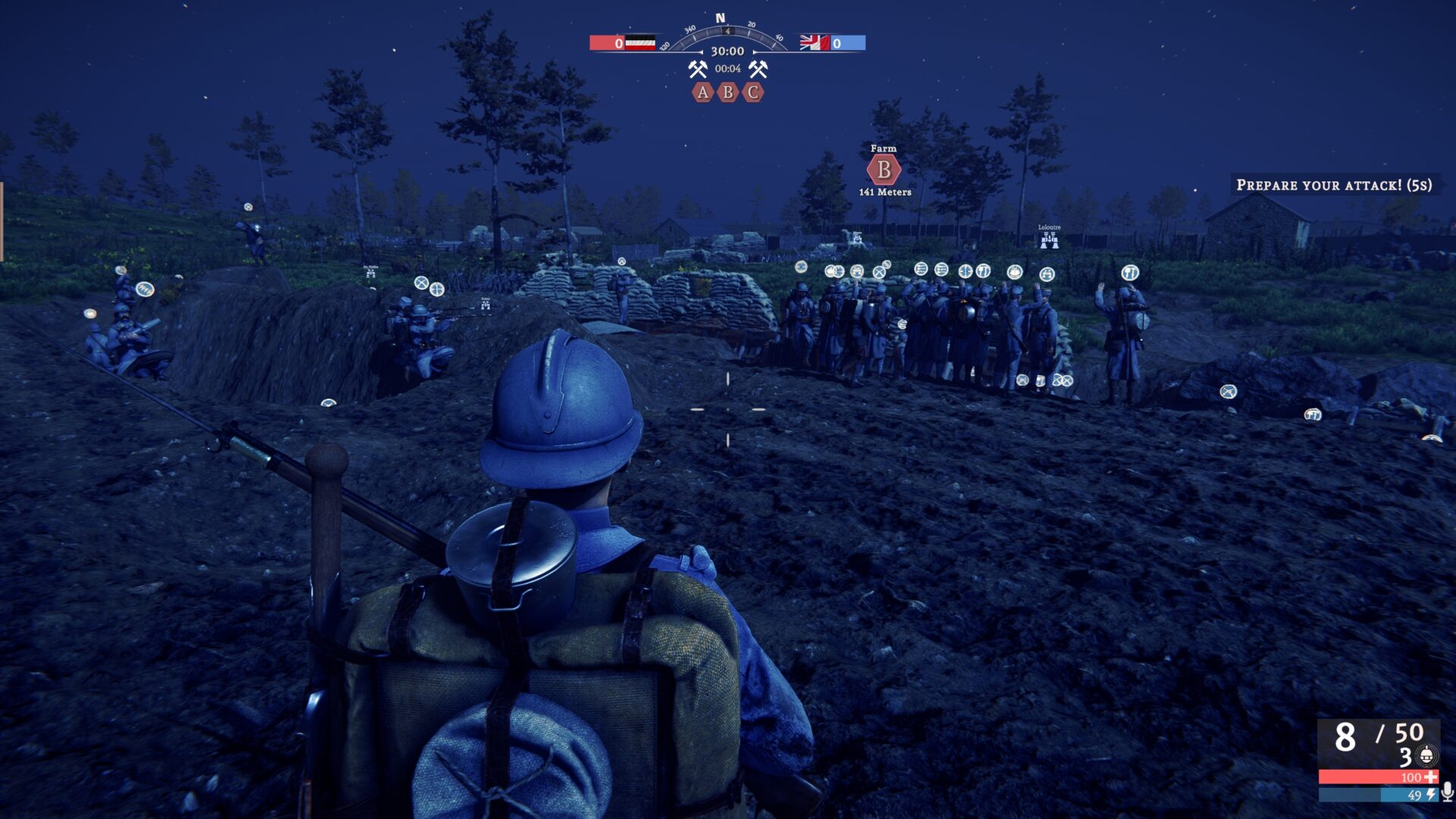
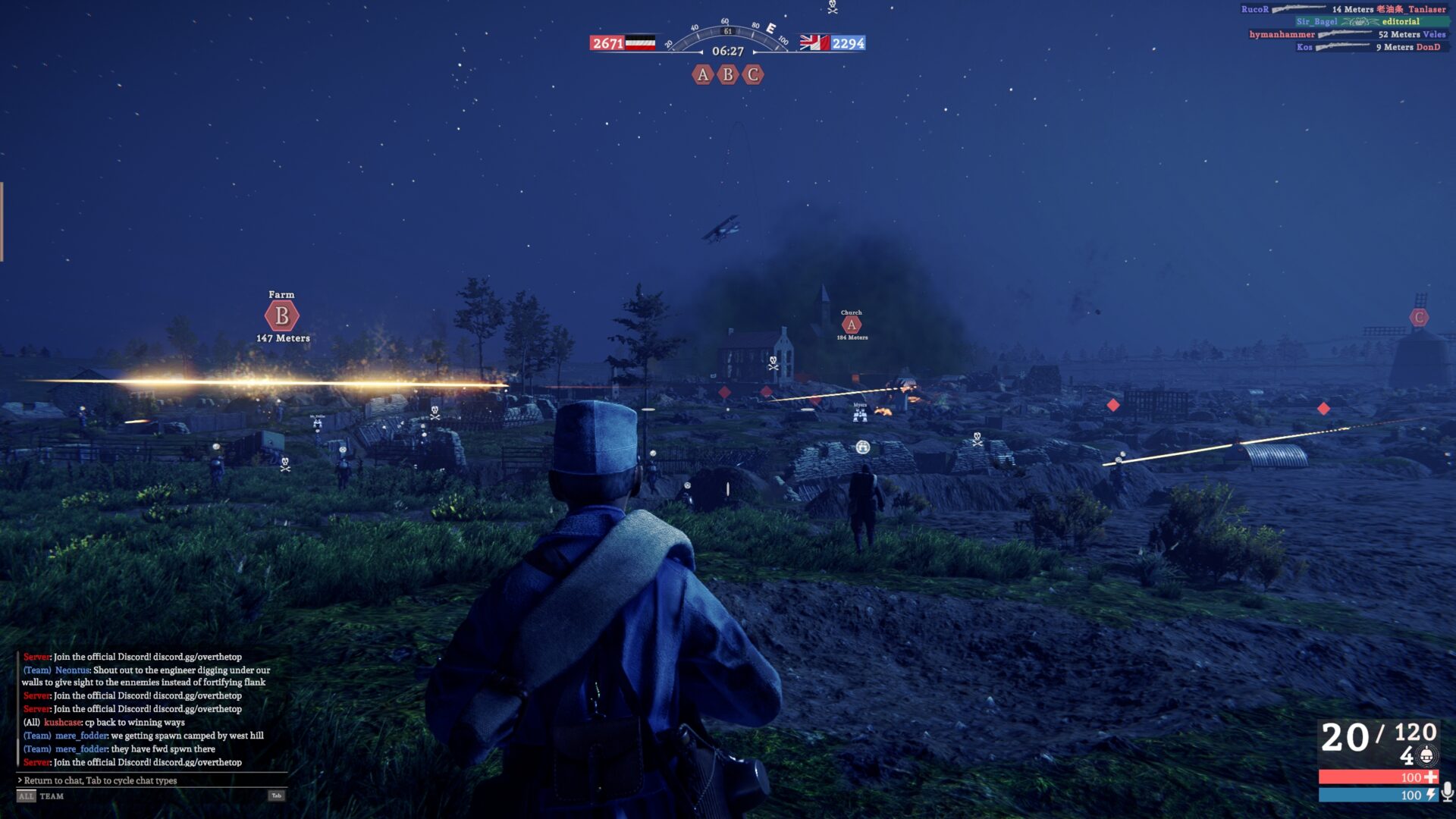
And it seems to have catalysed a genuinely affable community already – the roleplaying mic exclamations are charming and amusing in equal measure, and at one point I witnessed about 30 players lining up with their hands in the air while preparing to attack a defending team, good-humouredly goading them before the chaos kicked off. Oh, and every time a kilted man crouch-walks past you playing his bagpipes, it’s difficult not to be cheered. Introverts are well catered for, too – if you don’t fancy facing off against human reaction times, there’s a full-fat bot mode to enjoy, and you can make custom maps.
Over the Top nestles itself somewhere in between Mount and Blade (the team cut its teeth modding that game) and Battlefield, but manages to feel more joyous and convivial than either. The game’s blend of irreverent self-awareness, huge scale, and fastidious attention to detail when it comes to authentic uniforms, weapons, and other contemporary elements turns out to be an irresistible combination, let down only slightly by its unpolished gaucherie. That shouldn’t stop you from charging in, however, as you’ll find a uniquely enjoyable shooter if you do.