I am a serial watcher of South Korean television, in which writers often express an uncanny ability to blend seemingly disparate genres in ways that don’t seem possible. The depreciation of that ability over the past two years holds interesting parallels with a gaming industry in which singular genres are increasingly a thing of the past. Developers are forced to fit their games into as many categories as possible for the benefit of publishers, marketers, and even journalists. It’s an unenviable position and Lootbound, ArtDock’s “tactical loot management roguelike” tests the limits of just what can be effectively combined.
Blending turn-based combat with an inventory management system reminiscent of Resident Evil 4, along with occasional rolls of a D20, and dropping into an already overcrowded “roguelike” genre, Lootbound collates an impressive list of ideas. Less impressive is how they interact as, much as South Korea’s genre-bending feels like it’s reached a natural endpoint, Lootbound feels less like a gallant attempt to try a new combination than cramming what people appear to like into a singular, overstuffed package.

You begin as a warrior, rendered in Lootbound’s pleasingly dynamic pixel animation. Venturing from the castle gates, you emerge into ruins of fire and basalt populated by a horde of demonic creatures. To break through, you must attempt a series of turn-based battles.
Lootbound offers little justification for why you are doing any of this, or its world. Rather, you, and the environments around you, are built from a series of RPG archetypes: a warrior, accompanied by a mage, a bard, and a paladin. You’re weak, too. Your stats – the array of which will be familiar to anyone who has played an RPG, tabletop or otherwise – are insufficient even for the relatively feeble enemies of the first biome.
The game offers two ways to mitigate that struggle. You may upgrade a selection of your stats once you unlock the barracks. One of a series of locations that open up throughout the game, and one of the few that offers utility. Upgrades are bought with gems you accrue by selling your spare loot.
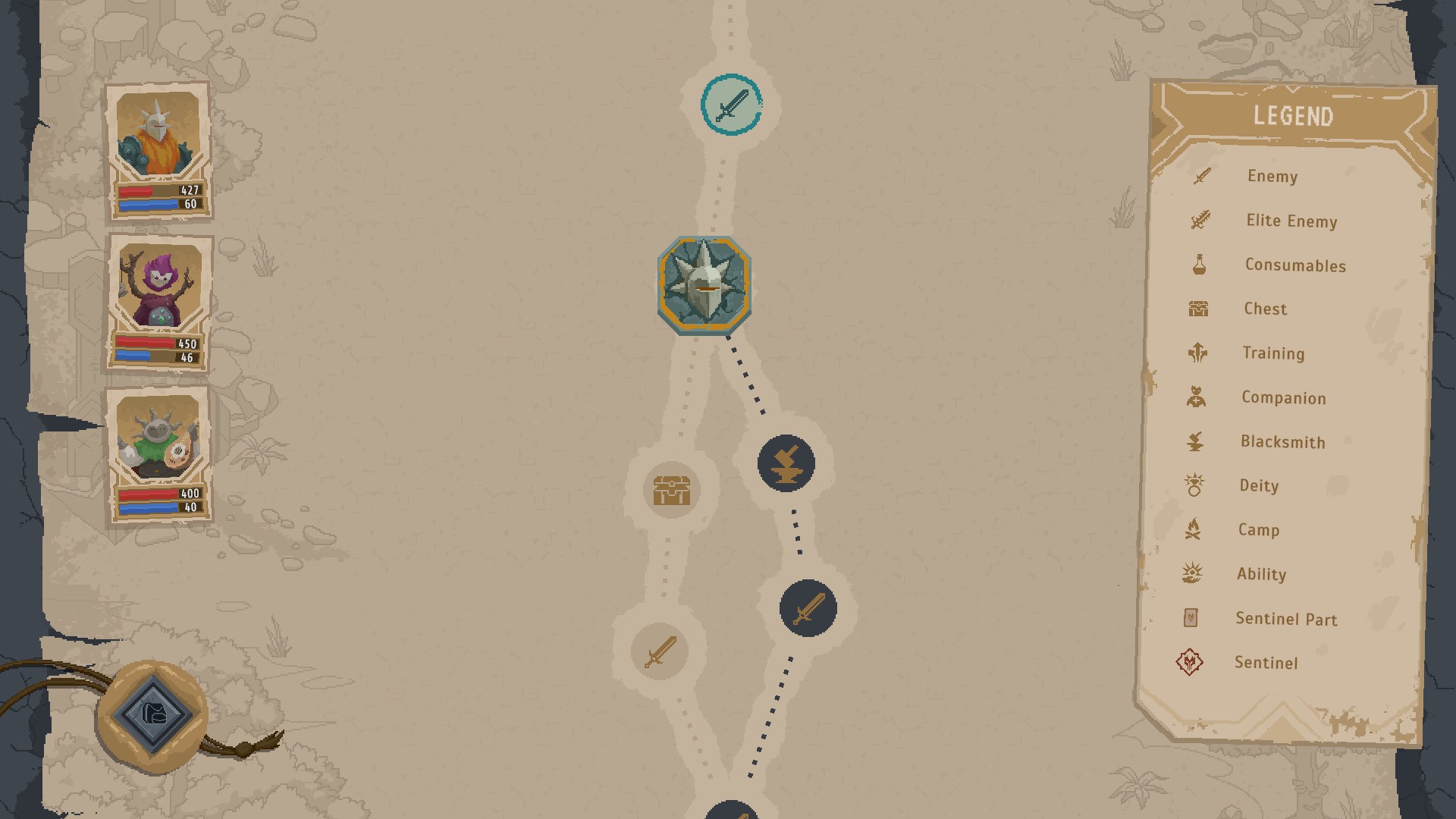
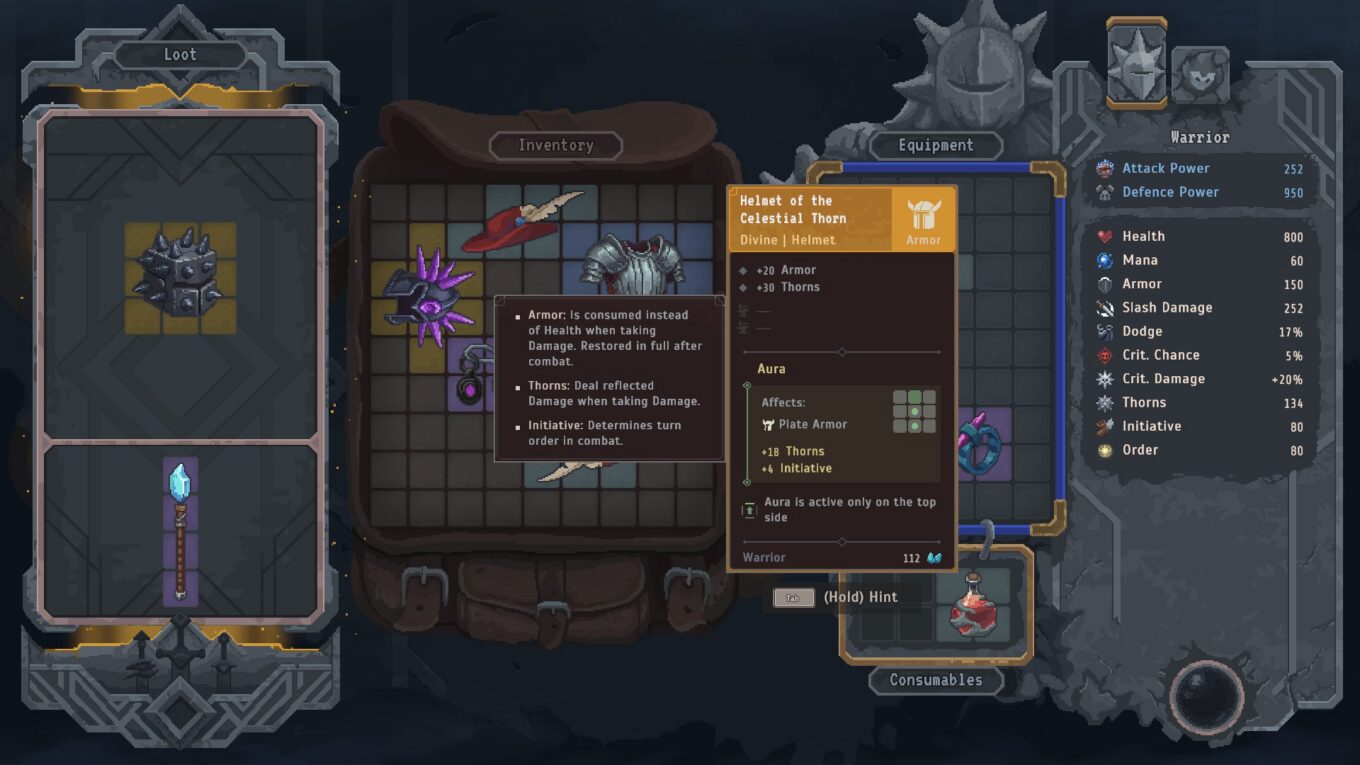
Or, by far the most important aspect of Lootbound (it’s in the name and everything), there’s the equipment you scavenge. Armour, weapons, and skill upgrades are offered after fights and at pit stops along the winding paths you choose through each biome. These are often presented as choices of chance, dictated by a D20 dice roll. You can choose a low number for a basic piece of gear or risk chasing something rarer.
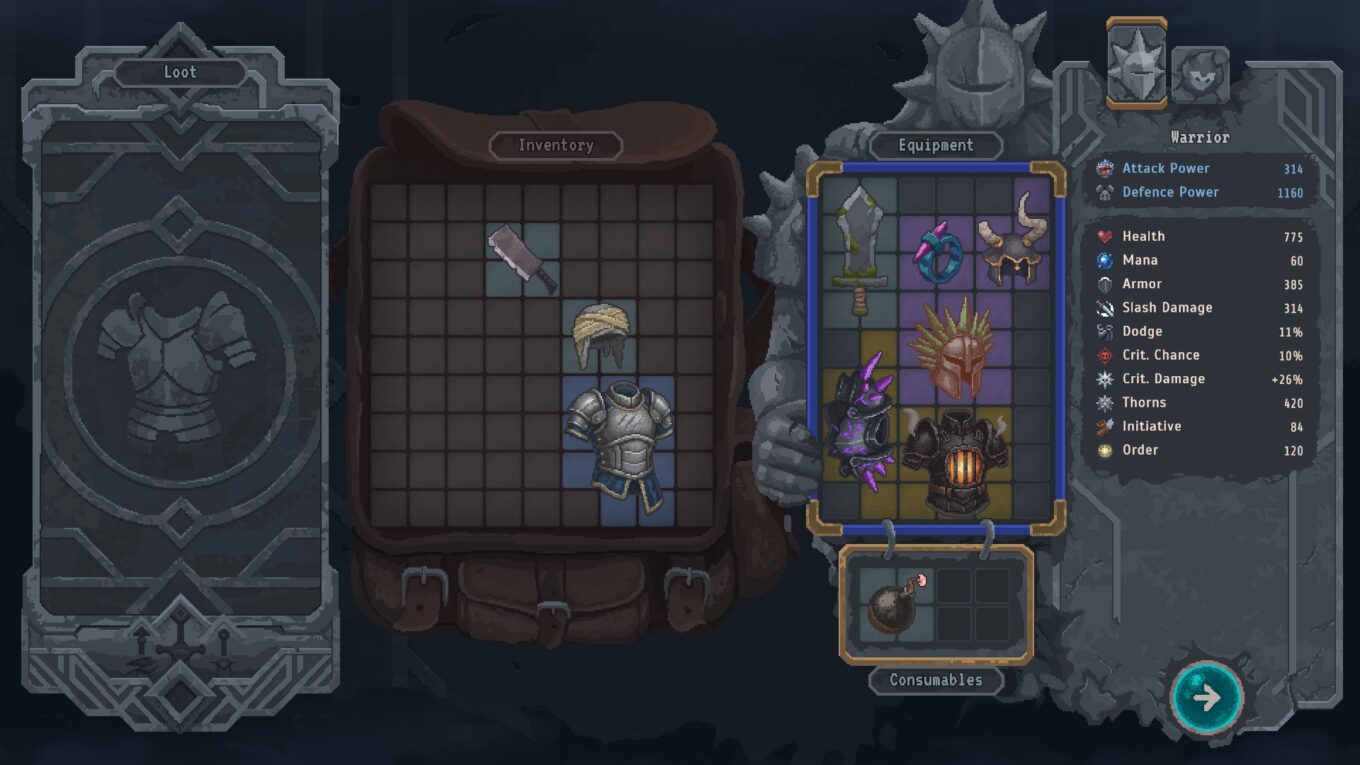
That rarer loot doesn’t just have higher stats, it comes with enchantments that can interact with your other gear to improve them too. A piece of armour may, for instance, add health and thorns — which makes enemies that attack you take damage — buffs to surrounding helmets. It’s the most interesting part of Lootbound’s design and the reason you’ll spend so much time slotting Tetris-shaped equipment together in inventory screens.
Loot is also the only way to differentiate your otherwise generic characters. The gear does not appear on your avatars, but it does offer ways to create builds that offer workarounds to Lootbound’s many roadblocks. You might become a thorn-laden knight who barely needs to attack or wrap yourself in an absurd amount of armour with the right combination of gear. Certain skills you pick up along the way can compliment – or more likely, dictate – these directions of travel. The warrior, for instance, can learn an attack whose damage is based on their current armour level.
One of the most interesting runs I had in the game was when bad luck forced me to deck out my mage before my warrior. Many enemies in Lootbound focus on the most armoured members of your party, and watching my mage use acid damage to bypass enemy armour while enemies focussed on my two armoured juggernauts was an interesting diversion in a game otherwise lacking in variation.
I admit, I’m not much of a role-player. But I do understand the appeal of a game built on player agency: one in which archetypes fuel player imagination and dice rolls dictate a sense of possibility. It makes campaigns that begin as a blank canvas not just acceptable, but often desirable.
In evoking Dungeons & Dragons, and a broader style of role-playing games, Lootbound does, however, draw attention to just how blank its canvas is. You cannot imprint character onto its archetypes, its generic biomes — there are three: fire, forest, and desert — do not brim with life and character. Instead, the game forces you down fixed pathways, varied only slightly by procedural changes. With a strong narrative that leans into the repetition that engenders, or embracing dice-driven gameplay more, Lootbound might have found a niche. As it is, it hovers, noncommittal, in a more generic space.
Without an emerging story to hook you as you’re forced into the same turn-based battles over and over, it’s up to gameplay to provide Lootbound’s impetus. This is where the limitations of the game’s roguelike setup bubble to the surface. While its game of slotting gear into tiny packs is initially diverting and dice rolls can offer a facade of player input, there’s little actual gameplay to speak of.
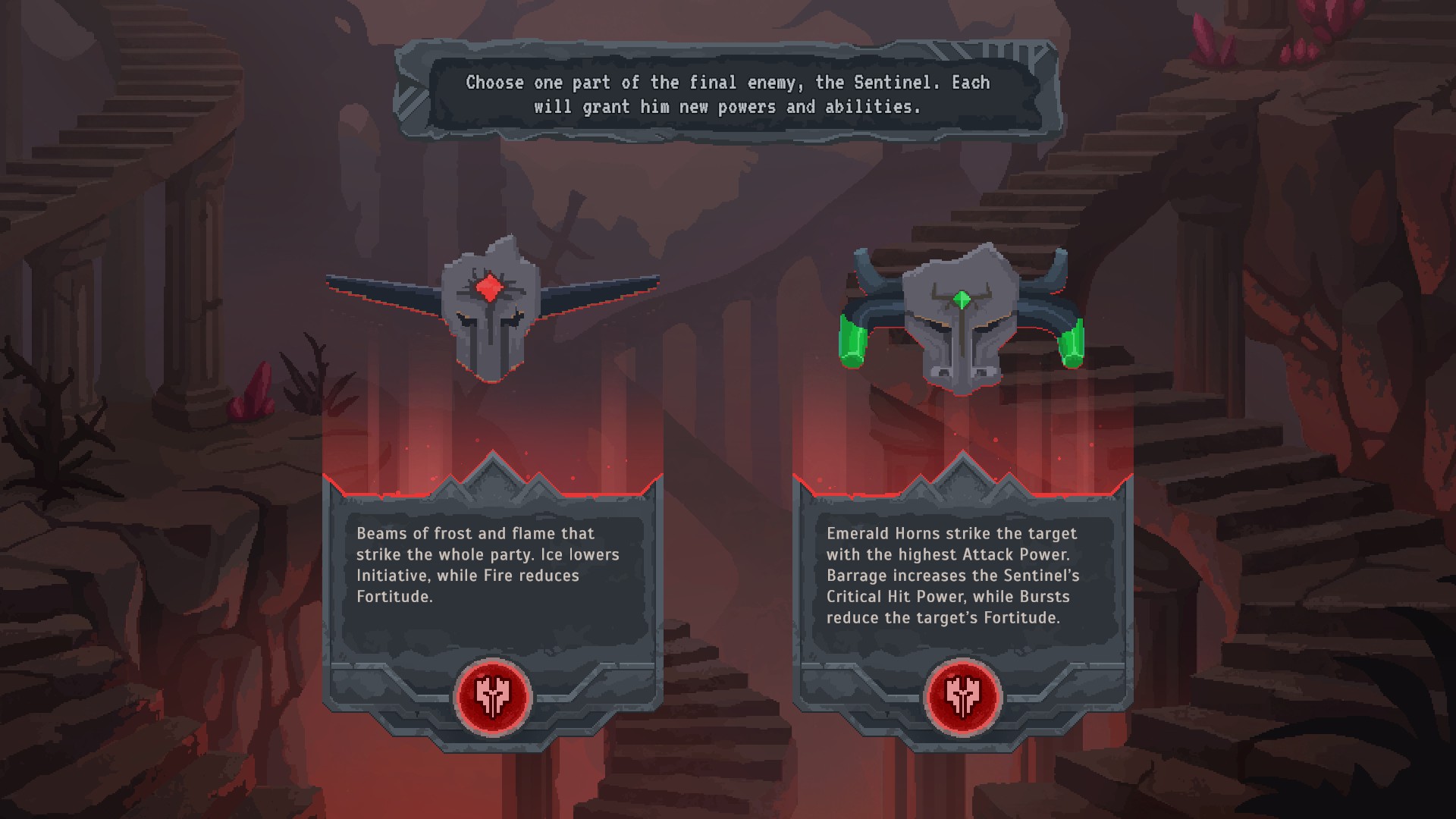
The most involved Lootbound lets you be is in building the final boss, the Sentinel, from three selections of qualities that rarely synergise with your own builds. Nor is there skill to its gameplay loop. You do need to be selective in what you attack — you may want to remove the most damaging enemy from the field first — and conserve your mana for more powerful attacks. Though, you’re unlikely to lose runs to poor resource and enemy management.
Lootbound does not boast a long campaign and the game works hard to make sure you cannot progress through it too fast. You can make smart decisions, have dice rolls fall in your favour, and Lootbound will still brute force a stopping point. Enemies become too fast (and thus attack more often), too strong, and too bulky. The only way through is more runs, more upgrades, and more enforced roadblocks.
Once you do upgrade your character — you can unlock the others as playable avatars, but that’s a long way off — the ease with which you deal with the early game only makes the lack of agency feel more pronounced. In more skill-based roguelikes, this can be part of the fun. Hitting a hard enemy or boss and feeling like you can get better and overcome it is a great motivator to return. Lootbound’s mix of luck-based gameplay and intentional roadblocks that reveal that luck as a facade, coupled with a lack of narrative justification for the journey you’re on, only makes the game’s repetition one more stumbling block.
Which is a shame. Lootbound doesn’t feel desultory. As individual elements, the many strands found within are considered. The art direction is generic, but it has excellent presentation; enemy design lacks imagination but they are drawn well. ArtDock has clearly considered how loot and skills interact and the balancing of its seemingly random pathways. But making a fun game out of these elements requires more than just placing them in close proximity.

That’s not to say turn-based roguelikes can’t work. Darkest Dungeon did it with aplomb a decade ago. With colourful characters, perhaps Lootbound’s world might be more appealing or if it had a sense of authorial intent in the form of a narrative that evokes a Dungeons & Dragons campaign. But in focussing on loading the game with so many elements that, elsewhere, have appealed to audiences the game has become relatively lifeless.
I caveat that with just how hard the juggling act of development and marketing is in the current industry: one that requires fitting into multiple genres to spread across as many increasingly fickle audiences as possible. Having watched established international writers begin to chafe against similar expectations, I can sympathise with how a game like Lootbound can reach the point it has. That should not be read as an excuse, however, particularly as Lootbound’s greatest error is both unforced and insurmountable: in focussing on exciting publishers with keywords, Lootbound forgets to excite the player.