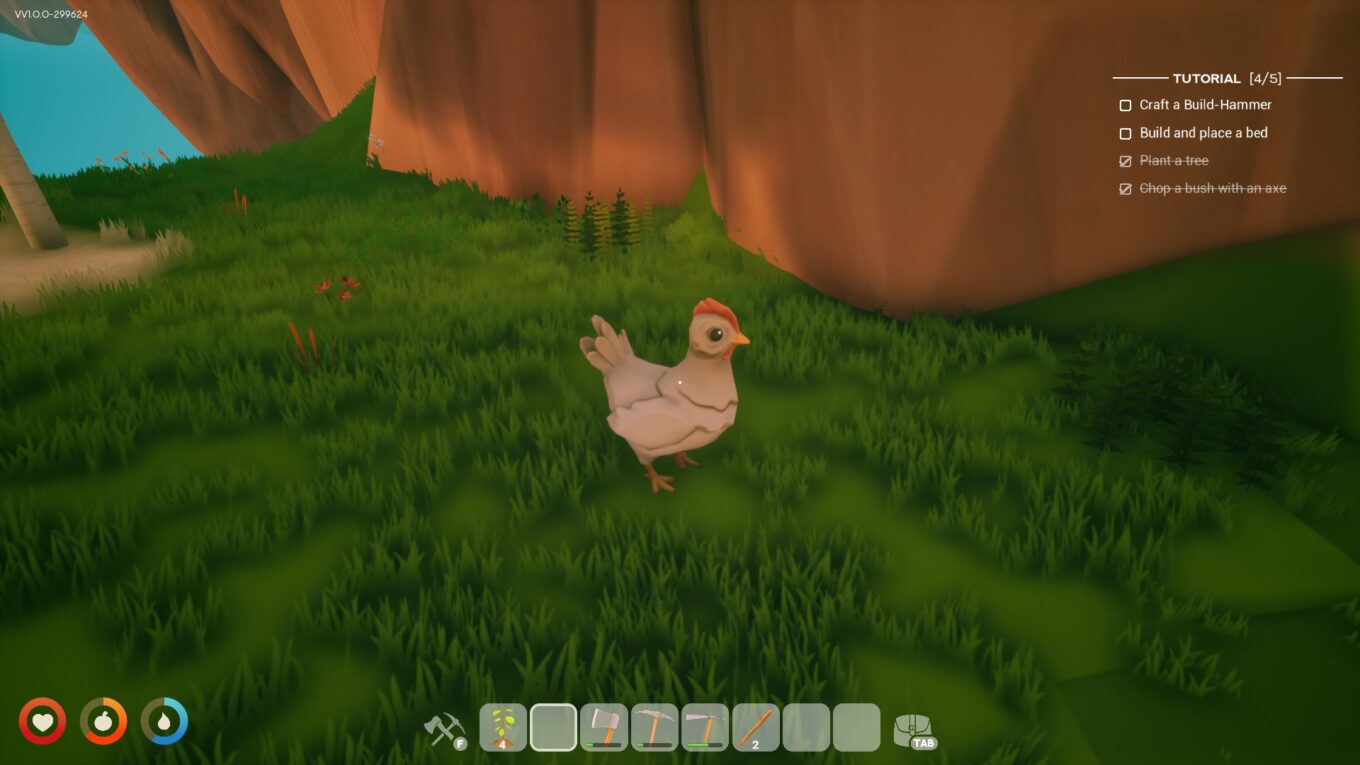
Our first glimpse of Solarpunk is as transporting as its name suggests. Rich blue outlines the near horizon of an island floating in the sky. Birdsong, the cluck of a solitary chicken, and a humming electronic soundtrack break through the warm light of Cyberwave’s cel-shaded survival sim. It’s a postcard-perfect introduction – it’s unfortunately as intoxicating as Solarpunk gets.
The island is orbited by others that promise new worlds to explore. The vehicle to that discovery becomes clear during Solarpunk’s tutorial, which walks you through a well-trodden gameplay loop: craft tools, collect resources, farm, repeat. It is all in service of eventually building an airship to take to the skies.
That sunny vista soon gives way to a storm. Solarpunk offers a choice between standard and “soft” difficulty, the latter reducing hunger and thirst, preserving your inventory upon death, and making you immune to lightning. Perhaps that becomes a threat as you build a more mechanised base, but I was not struck once. In fact, after an initial flurry of storms, it stopped raining altogether a few days in.
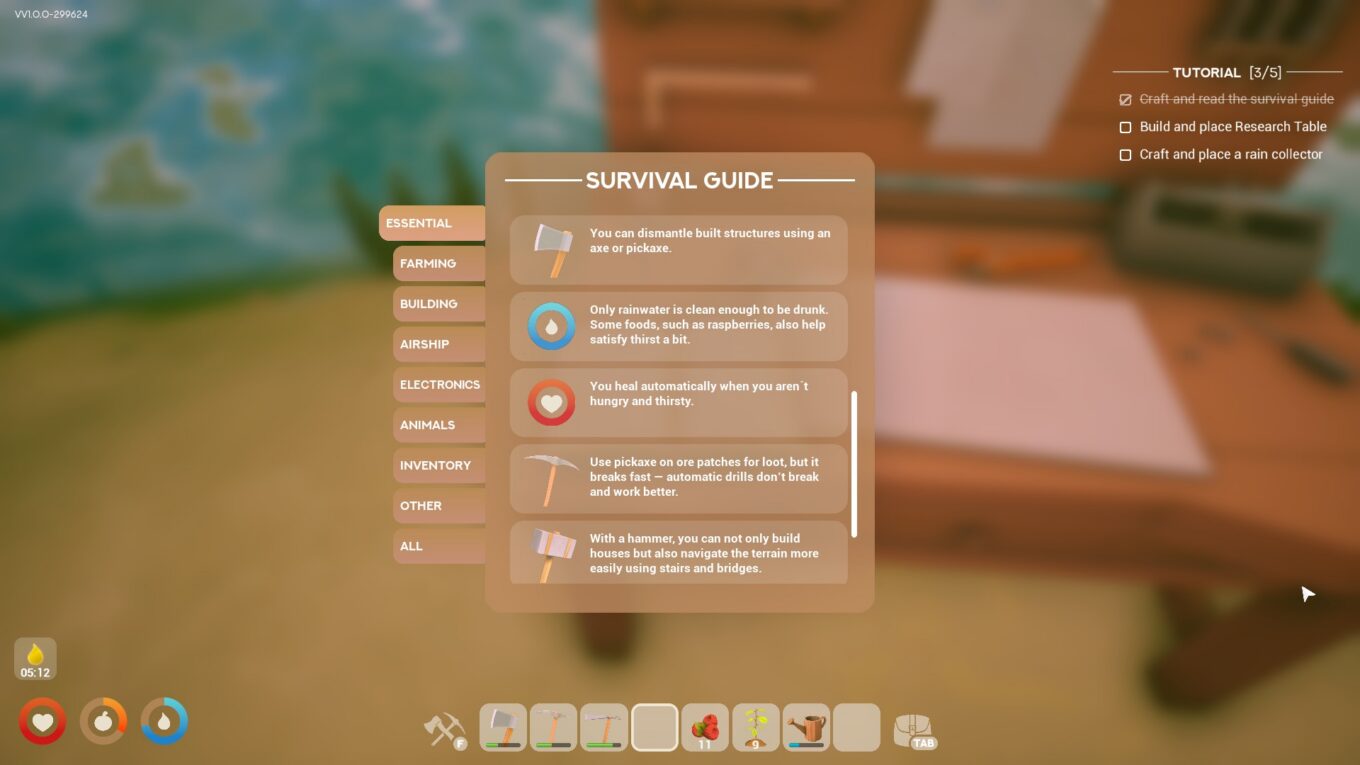
For now, you remain in a stone age crafting stone tools, foraging for berries, and attempting to find direction. The first thing you craft is a survival guide – part of an overabundance of guidelines Solarpunk deploys in lieu of intuitive design – which maps out the game’s entire trajectory. In a game in which freedom is already limited by the bounds of your island home, it instantly deflates any sense of discovery. It also proves surprisingly unhelpful.
Cyberwave borrows liberally from a crowded genre – evoking Minecraft, Don’t Starve, and The Long Dark, among others – to collate a desultory combination of ideas that struggle to coalesce. The basic premise of Minecraft clashes with a shelter building system indebted to Fallout 4 in both presentation and inexactitude, while Solarpunk’s exigent farming sim takes over most other activities. That appropriation does offer some mitigation to Solarpunk’s poorly-signposted and often counter-intuitive design, however, as you can fall back on what you’ve learned from the games from which Solarpunk cribs.
What you’ve learned from those games may make you want to forge ahead. You’ll want to gather wood but you’ll soon be distracted by crops that need watering. You may want to explore the upper levels of your island, but your crops need watering. Maybe you’re finally ready to take flight. Unfortunately, your crops always need watering.
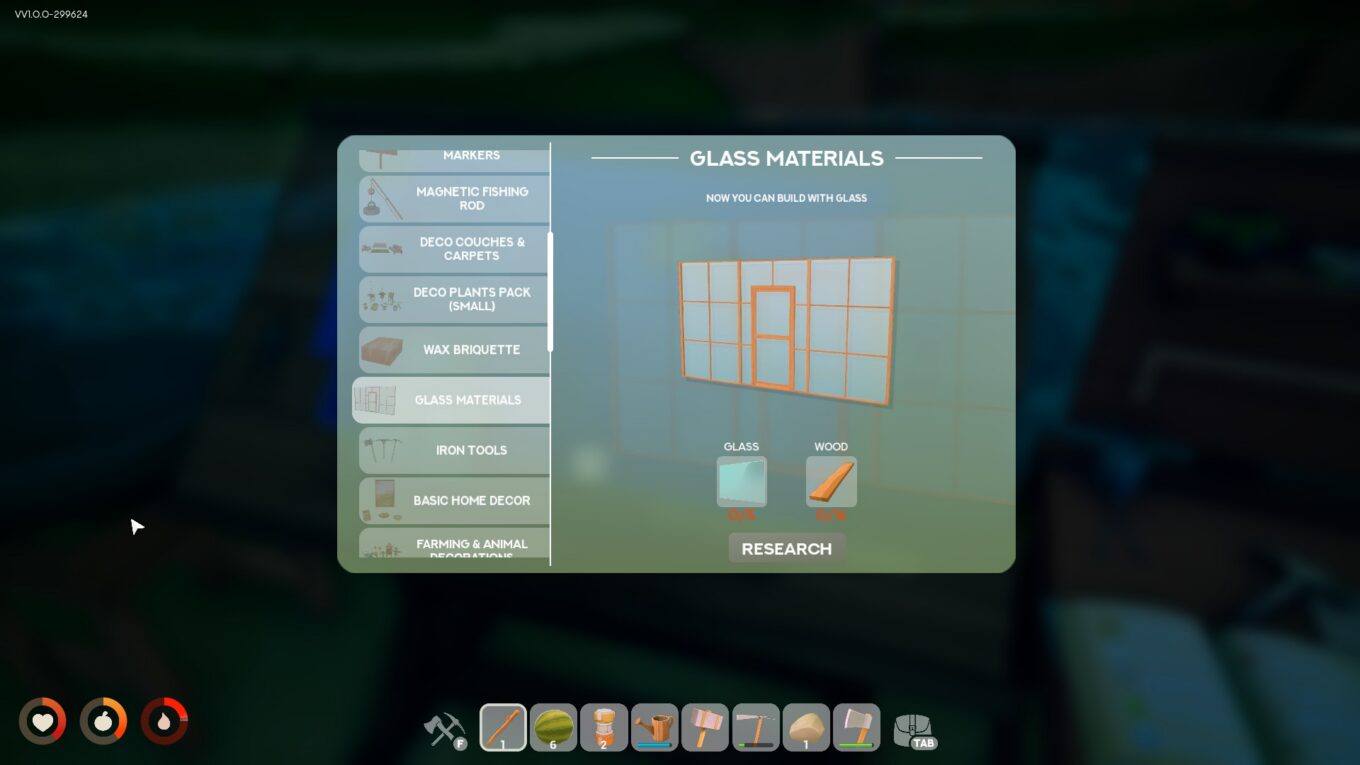
Those lessons were more helpful in deciphering the research system – through which you unlock crafting recipes. As I advanced through the various tiers of research I found that many required glass and yet had no inkling how to make it. Only when defaulting to Minecraft-brain did I spot, in text almost too tiny to read, a tooltip which suggested putting sand in a furnace. It was one of many sticking points that the guide, light on actual guidance, didn’t mitigate.
Sand was, at least, abundant. Research and crafting are separate menus, and the former requires a tribute to unlock recipes. To craft iron tools, for instance, you must first sacrifice a stone pickaxe and five iron ingots. A further tithe is required to craft the item. By the time I unlocked iron tools I didn’t have any iron. There is a limited amount on the island, all of which was required to advance to research tier four and research and build an airship.
I initially put this down to bad luck. According to Solarpunk’s Steam listing, however, all its islands are handcrafted. Seemingly aware that the artificial steps used to bloat this tiny sandbox are a drain on already limited resources, Cyberave included an inexhaustible source of copper on a second island. That island is the only other to which I could navigate and also did not include iron.
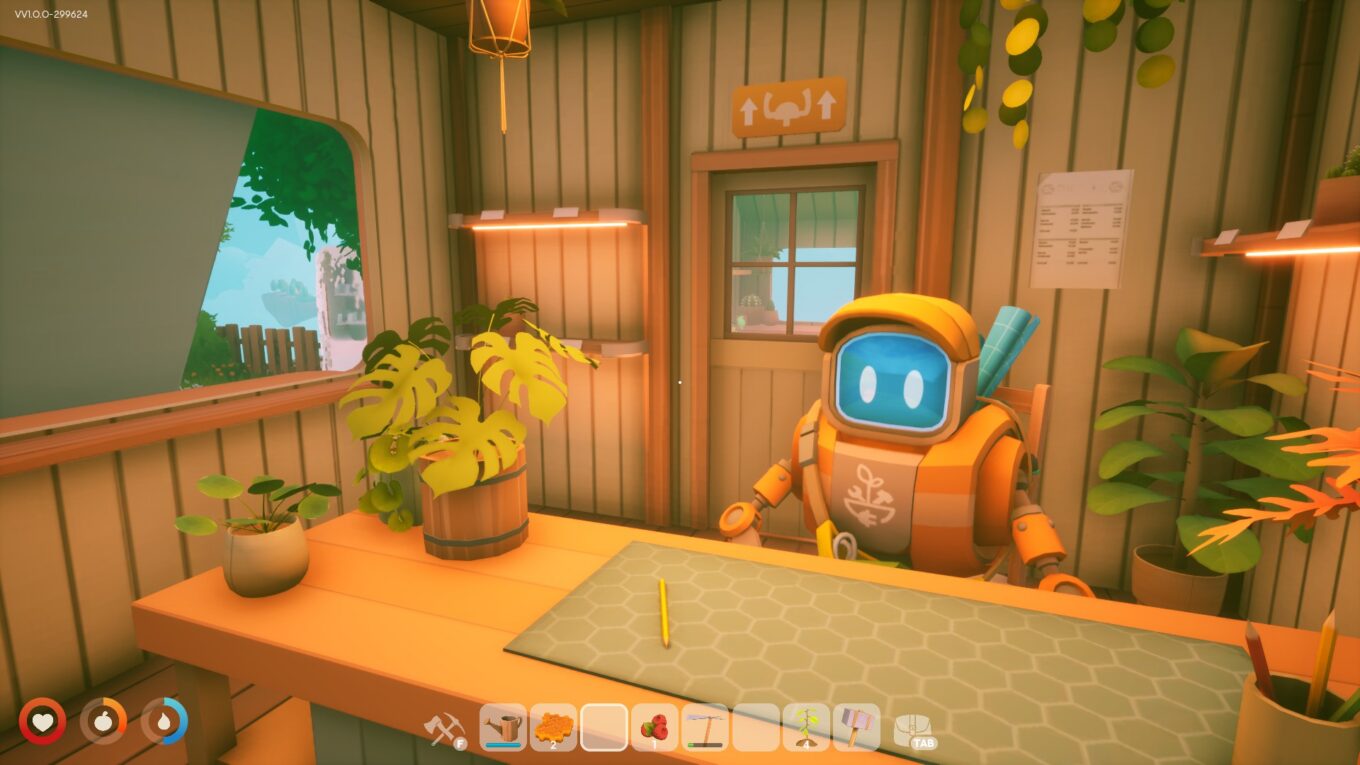
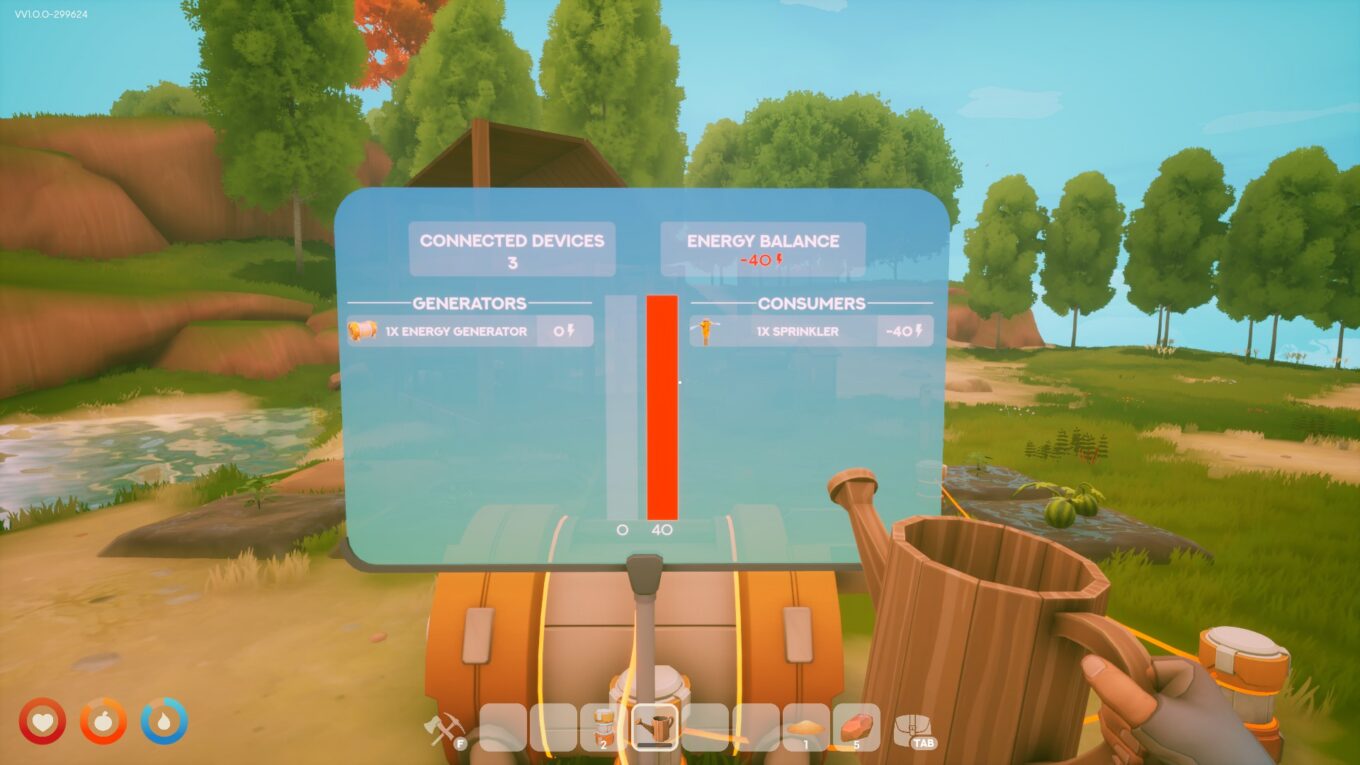
Copper is vital to automating your farm. That does remove some friction from the need to constantly water your crops, but adds others. You can trade a lifeless robot merchant, Chip-chop, watermelons for a sprinkler system. An electrical system which is needlessly convoluted, devours resources, and only waters a handful of crops (whose yields are already not exactly abundant in opposition to actual solarpunk). Future trades offer blueprints that can be redeemed at yet another crafting table. One that I couldn’t build as it required iron.
If this feels like a lengthy detour to arrive at the airship promised at the outset, it’s because the in-game journey is similarly gruelling. The special component necessary to build your airship are conveniently placed nearby in a hand-holding pattern that repeats. Watermelons and copper are similarly laid out in front of you.
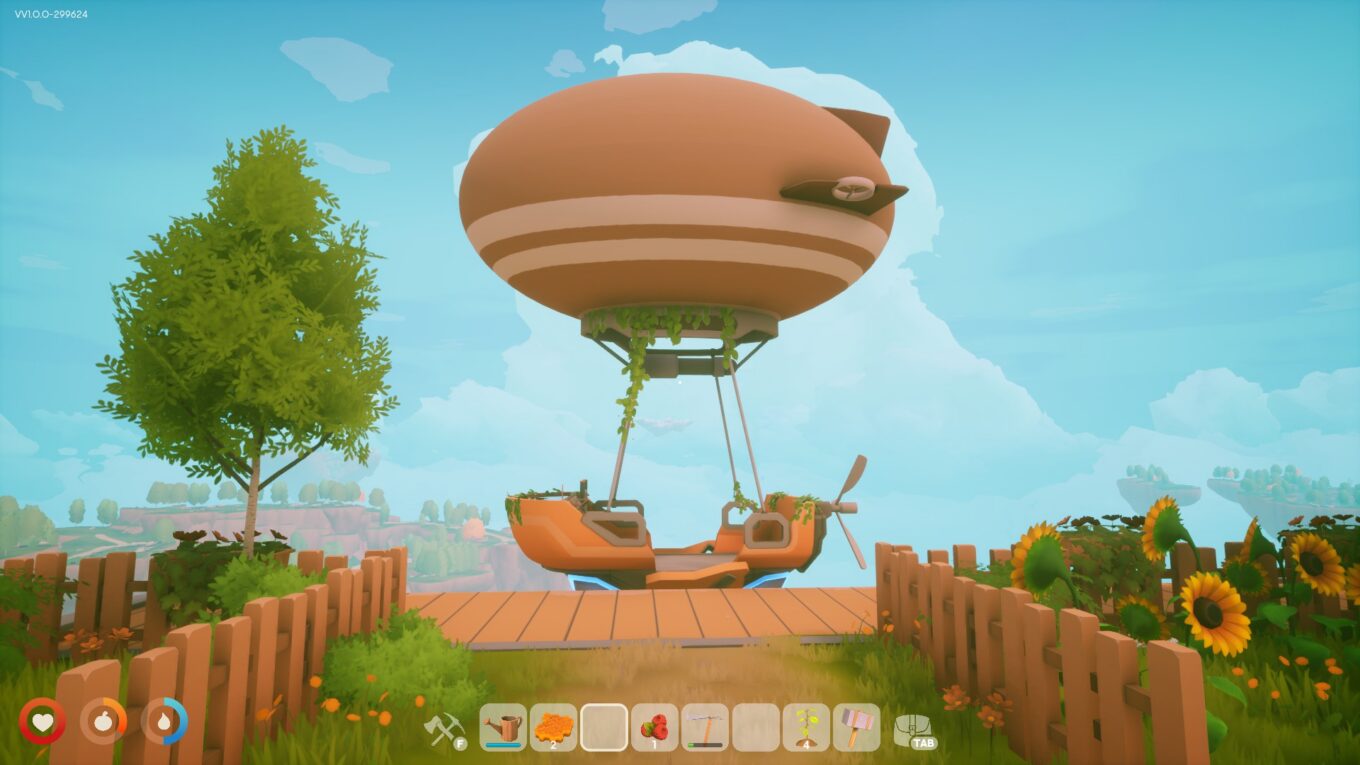
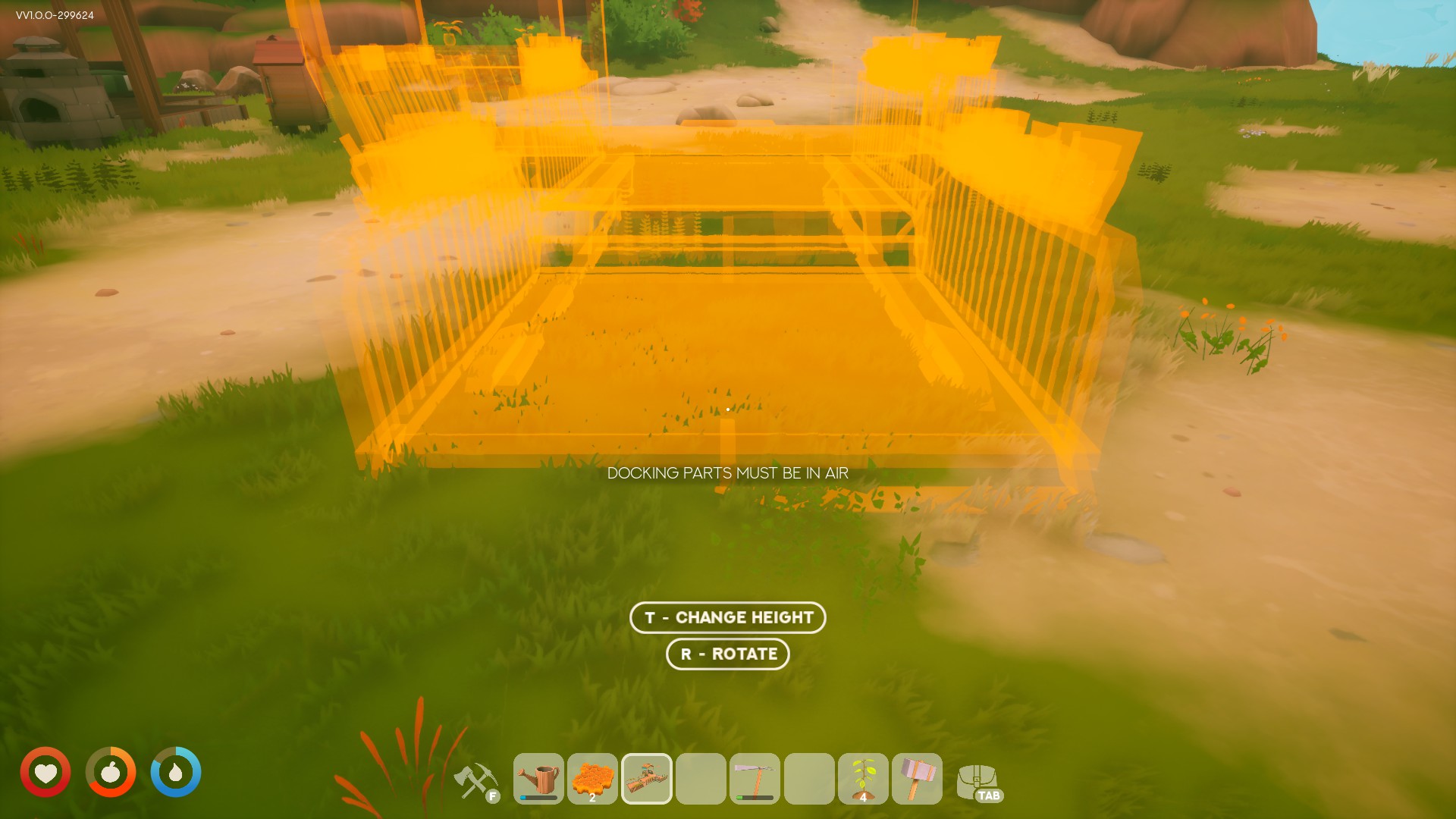
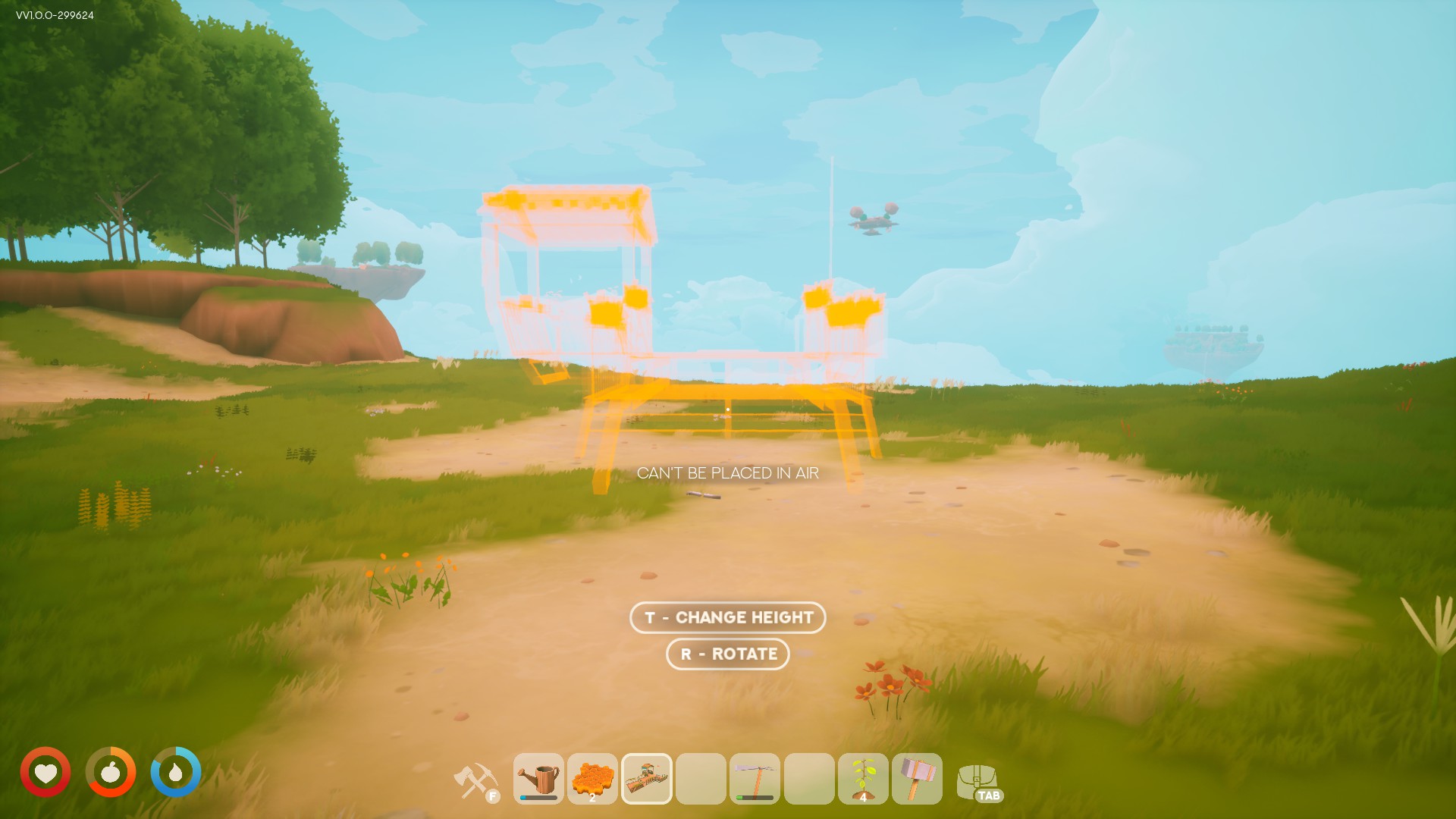
The airship dock, from which you craft and launch your dirigible, requires navigating a prompt that suggests it must be placed in the air and simultaneously cannot be placed in the air — I encountered many missing textures and similar paradoxical directions. Once you do launch, the craft itself is unintuitive to pilot. On mouse and keyboard, rather than utilising directional inputs those only dictate speed while the mouse controls direction.
I frequently drifted past targets or orbited them in the ship’s wide turning circle, hampered by these controls. Even though the airship comes with another guidebook and crafting table (is it time to water my berries again?) it fails to tell you that the ship will continue to travel if you try to pause and navigate to another window. A concession, one assumes, to its multiplayer.
That, coupled with inconsistent landing mechanics, almost destroyed my airship. The guidebook claims the craft will descend automatically over solid ground. In actuality, you must press “E.” That’s a prompt you get at docks but nowhere else. Doing so, however, will often leave you 20-feet in the air. To actually land, you must manually descend close to the ground; close enough that a slight overshoot will result in crash damage.
Having nearly destroyed my vessel just attempting to land down on the second island, and having been turned back by an invisible wall trying to travel elsewhere, I retreated home — starving, defeated. By the time I docked, I had to water my crops again.
With iron required to both advance and craft an airship repair kit, I had no choice but to take flight in a ship one gentle nudge away from destruction. I did discover that if you destroy your boat — or pass out; from hunger or by leaping from the island — you teleport home, your inventory waiting on the dock. I was pleasantly surprised that Solarpunk lets you retrieve your airship with a sliver of health. A necessary step but far from guaranteed amid the thoughtless systems that make up Solarpunk.
Yet, also one that removes any stakes from damage, health, and hunger. There’s no danger, no reason to maintain one’s self, no impetus to explore, and resources so poorly allocated and managed that they threatened to softlock the game.
Many of the issues I faced in Solarpunk appear to result from a need to add extra steps to inflate its short sandbox. Exemplified in the waiting. So much of Solarpunk’s core loop is about waiting: waiting for crops to grow, waiting for rain that never returns, waiting for a meter to fill, waiting for it to end. It’s a problem that mirrors Cyberwave’s equally desultory puzzler, Hourglass.
The justification is that this is supposedly a cosy game. But all these considerations add more friction and, in places, offer a disconnected and broken experience. In an Early Access title, these issues might be forgivable. In a full release, and particularly in such a crowded genre, they’re fatal mistakes.
I am not unfamiliar with, nor averse to, unrewarding repetitive work. I am, after all, a freelance journalist. I also harbour an intangible love for games that put me to work like this. Yet, at the risk of sounding like a washed-up actor, all that came to mind as I played Solarpunk was: what’s my motivation?
Cyberwave states on its Steam listing for Solarpunk that, “ the game is not trying to match large studio survival games in scope”, but then what are the creative gains of this clumsy combination of mechanics that mimic those found in similar, superior, games? Solarpunk isn’t a love letter. Perhaps Cyberwave hopes some of the goodwill the audience harbours for those games will come over with the mechanics it cribs from them.
If that’s the case, it doesn’t have the desired effect. Instead, Solarpunk is a reminder of more interesting and more enjoyable games one would rather be playing.