Styx is a perennially stroppy bugger. An unfortunate melding of Duke Nukem and Bob Hoskins, but with none of the latter’s charm, he’s a game character ripped from the playbook that gave us such lowlights as Bubsy, Gex, Shadow the Hedgehog, and well… Duke Nukem. And that’s not all the personal trauma he has to wrestle with, bless him: he’s looked down on (literally) by almost everyone he encounters for being a goblin; wherever he ventures, most of the inhabitants are either terrified of how he looks or want him dead; and worst of all, he is contractually obliged to deliver the wince-inducing quips which make up much of the series’ lumpen, cliche-drenched scripts. The horror!

At least he’s had a nine-year break since Cyanide Studio’s last entry in the series, Styx: Shards of Darkness. It’s a long old gap, but Styx: Blades of Greed picks up exactly where Shards of Darkness left off – with Styx and frenemy Djarak (who he meets during the second game) having a barney to the death on goblin hunter Helledryn’s ship. This gets interrupted when the golem that Styx slayed gets up again, and subsequently finds itself co-opted as the unwilling venue of a tutorial level as you clamber around and within the doomed stone behemoth to put it down for good.
It’s here that it becomes clear that Styx has used some of that intervening time to finesse his moveset further, mastering a new wall dash that allows him to reach greater heights as well as a slide that can be triggered when running – useful for disappearing into small spaces quickly when on the run. Later you’ll gain traversal tools which include a grappling hook and a glider, too, and it all combines to make Styx the most satisfyingly agile version of his Goblin self yet. He’s actually a joy to control, and boy does he need to be, given Blades of Greed’s sprawling new locations.
The game trades the discrete levels we’ve become used to for expansive open-world maps which push the series’ love of verticality to dizzying new extremes. There are three main areas: The Wall, Turquoise Dawn, and Akenash Ruins (a return to the now destroyed setting of the first game, Styx: Master of Shadows). Unexpectedly, it’s the initial area which proves to be largest, and by quite some margin. I suspect this is down to concerns that the dialled-up navigation challenges and enemy types indigenous to the latter two could start to grate with over-exposure, but this narrowing horizon does give the game the air of a marathon runner who started at a sprint and ran out of puff long before the finish line – especially given that The Wall is such a richly detailed and eminently explorable locale.

No matter, because – in between a handful of setpiece levels – you’ll revisit all of these locations multiple times throughout the game, always in search of quartz (which you now use alongside amber to unlock new powers and skills) but at different times of day. And as you gradually bolster your equipment you’ll unlock more of the map, activate balloon wharfs that allow you to move between sections, and be able to reach previously inaccessible areas. This pinch of Metroidvania seasoning works really well, showcasing Styx’s moveset, slick cover system, and some brilliantly intricate level design. But it is the Thief and even, dare I say it, Dishonored series that Blades of Greed most closely resembles. Yes, Styx might hark back to the late ‘90s/early noughtie’s odd proliferation of unappealing protagonists, but the other side of that tarnished coin is that the series has also always been in thrall to that same era’s golden age of stealth gaming.
Blades of Greed isn’t quite flexible enough to be considered an immersive sim (frankly a stupid term anyway that has no right to be parading about as a genre), but with this latest installment Cyanide has successfully snuck its way into at least the same ballpark as the best Thief games. Every problem can be approached from multiple directions, whether that’s distracting guards with a bottle or clone, carefully avoiding patrol paths while lurking under tables, mind controlling an enemy to pull a lever or trigger the release of poison spores, or simply walking right past everyone while invisible.

You can even scoot down chimneys, survey the room from the flue, then leap in and stab your target before scampering back up to safety like a pre-Coca Cola Santa Claus. Be careful, though – guards will light the fire to smoke you out if you’re hiding up there, which also blocks your ability to return that way. Very much a case of, as the saying goes, shutting the stable door after the person that you were employed to keep safe has been horribly murdered (or, indeed, bolted, as that’s yet another way Styx can take out his targets) but still something to be aware of.
Styx isn’t really equipped for combat. He’s half the size of most of his opponents for starters, and can only reply with wild slashes of his dagger. If you time a dodge perfectly you’ll get a prompt to instantly kill your opponent, but as soon as you’re dealing with more than one assailant the best option is to run away. Especially given that some enemies wear armour that must be removed first, or who will take more than one stealth attack to down. Better to stick to pulling soldiers over a ledge while they enjoy the view, poisoning their food, or dropping a chandelier on them.
You have options when sneaking up behind an enemy for a stealth kill: tapping X will kill them quickly on the spot but create noise that might alert nearby allies, whereas holding the button will take longer but generates no noise and lets you slowly move away during the ensuing struggle. It’s a nice touch that allows for some bold (and highly amusing) strategies as you pick off soldiers from the back of the line and chip away at a patrol.

While The Wall is populated almost exclusively by humans, other locations broaden the challenge by pitting you against different types of enemy. For example, meat-eating giant roaches that are blind but have a keen sense of hearing, fast-moving ghouls (also blind) that will smell you if you get too close, or feral monsters (not blind, but definitely a bit stupid) which leave no trace when killed but will swarm you if alerted. There are even invisible variants, but these appear, or not, mercifully briefly.
The intent to add variety is laudable, but everything that isn’t one of the humans or similar fantasy races in the game exhibits less complex behaviour, and only requires a subset of your normally available strategies to tackle. There are a couple of highly curated moments where they are thrown into the mix along with the broader range of elements in the game, but the overall result is a sense of compartmentalisation – compounded by those shrinking playgrounds – rather than one of a gradual layering of ever more intricate systems.
It’s no disaster, though, as there’s more than enough game packed into The Wall and those setpieces to view the other two areas as palate cleansers between meatier courses. What’s much more worrying are the number of bugs, beyond those roaches, on show here. The game crashed to desktop multiple times during my review, and there was a lot of texture pop-in during cutscenes. But none of that was half as annoying as the various moments it made my life harder for no good reason.

One mission tasks you with retrieving a key to unlock a cage containing quartz – you can go about it in two ways: figuring out how to pickpocket a heavily guarded captain on patrol, or retrieving one from the pilot house. I opted for the latter but was crestfallen to discover I couldn’t pick up the key, even after I’d killed every enemy in the immediate area (a tall order, by the way!), and so I had to set about tackling the other solution.
There were also multiple occasions where context-sensitive commands simply wouldn’t appear – like tapping Y to move up and over to a higher ledge. This meant I couldn’t perform, say, the easier window-ledge kill I’d planned and had to go about things another way. Enemies sometimes got stuck in a behaviour loop, too, though I’ll admit that it was hilarious watching two guards continually panic as they rediscovered a body over and over again each time they turned around on the spot.
While we’re on gripes, let’s have a moment of silence for Styx’s crew…
Okay, that’s long enough. Given the issues I’ve highlighted with Styx, it says much that he is the most likeable character here. There is some truly atrocious voice acting to wade through during the game’s cutscenes (not Styx’s own, to be fair). Thankfully, you’ll only meet most of your shipmates some way into the game, but female Orc Wren is particularly egregious and Djarak has bizarrely shed what little emotional weight he conveyed in the previous game and now sounds like AI.
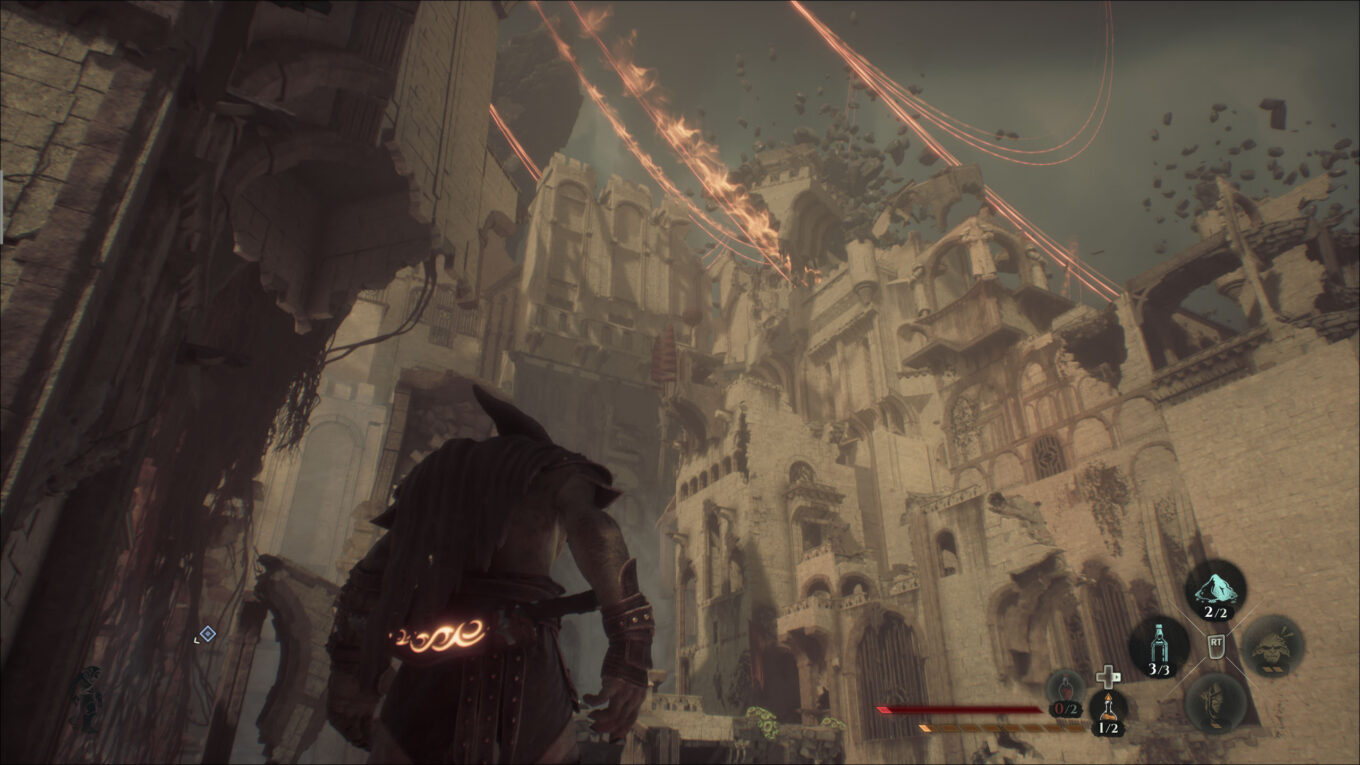

At least the game’s a looker. You wouldn’t know it from the opening sections, which suggest it’s going to continue the series’ rather muddy look. But as you explore more of the world Blades of Greed reveals itself to be very handsome indeed. The Wall’s rickety, torch-lit medieval towns are a particular highlight, as are the gloopy organic structures and waterfuls of Turquoise Dawn.
Cyanide should also be applauded for the design of Helledryn’s blimp, the hub area to which you return in between sorties. It’s gorgeous, and you can look down over the edge at the ground far below the clouds. As long as you don’t talk to anyone it’s a wonderful place to spend time. The views are expansive, but you’ll need a pretty chunky rig to get the most from it – my 5060Ti started out happy on max, but as the levels opened up I had to drop everything down to high in order to achieve a playable framerate.


All in all Blades of Greed is a thoroughly enjoyable stealth game that is by far the most successful entry in the series to date. Enemy AI is pretty simplistic for the most part, and it’s a shame that it takes so long to unlock some of the more dynamic ways of getting around – you’ll spend a comparatively small amount of time with your full complement of gadgets, and as such some of them feel underutilised. But Cyanide has captured that feeling of first playing Thief, Dishonored, or even Deus Ex, and the associated sense of anticipation at exploring a world brimming with possibilities.
I would love to see what the studio could do with a bigger budget and, while Styx’s incessant misanthropy might be tiring, I find myself dearly hoping that I don’t have to wait another nine years to spend some more time with him.