A Cthulhu game should be an easy sell. Within the pantheon of horror, the Great Old One is perhaps the most recognizable cosmic entity in fiction. He’s a squid-face deity capable of turning hoards into slavish cultists, corrupting minds till they snap, and causing mere humans to self-flagellate to death. Cthulhu is the face of cosmic horror itself, whose very visage is said to inspire unfathomable depths of fear and dread. The Cthulhu Mythos is so singular as it’s steeped in decades of rich literary heritage, so celebrated that it has led to an industry of Cthulhu and Lovecraftian games: Call of Cthulhu, Sherlock Holmes: The Awakened, The Sinking City. A Cthulhu game should be gold, and so immediately compelling that it seizes your attention with ease.
But Cthulhu: The Cosmic Abyss is not this game in this vein. Instead, its true horror lies in the inscrutable tedium of paperwork and emails. As a detective named Noah, you’re tasked with investigating the disappearance of miners after a work incident has gone terribly wrong. On paper, this means piecing together clues and making smart deductions, but real detective work is rarely exhilarating; like most jobs, I imagine it involves plenty of reading, research, and caffeinated-fuelled nights. Perhaps the drudgery of work is an experience thatThe Cosmic Abyss hopes to capture.
In an interview with Wccftech, game director Tommaso Nuti said that the studio wanted “to push the feeling of playing an investigation, not just being told one”. Yet busywork is rarely compelling, and realism can be a dreadfully dull experience to replicate in a video game. For The Cosmic Abyss, this translates to ploughing through pages of emails, descriptive text, audio files, and more to draw connections between clues. This is probably akin to actual detective work, I suppose, but it also feels very much like one who has to peer between lines in documents for evidence of something as banal as financial fraud.
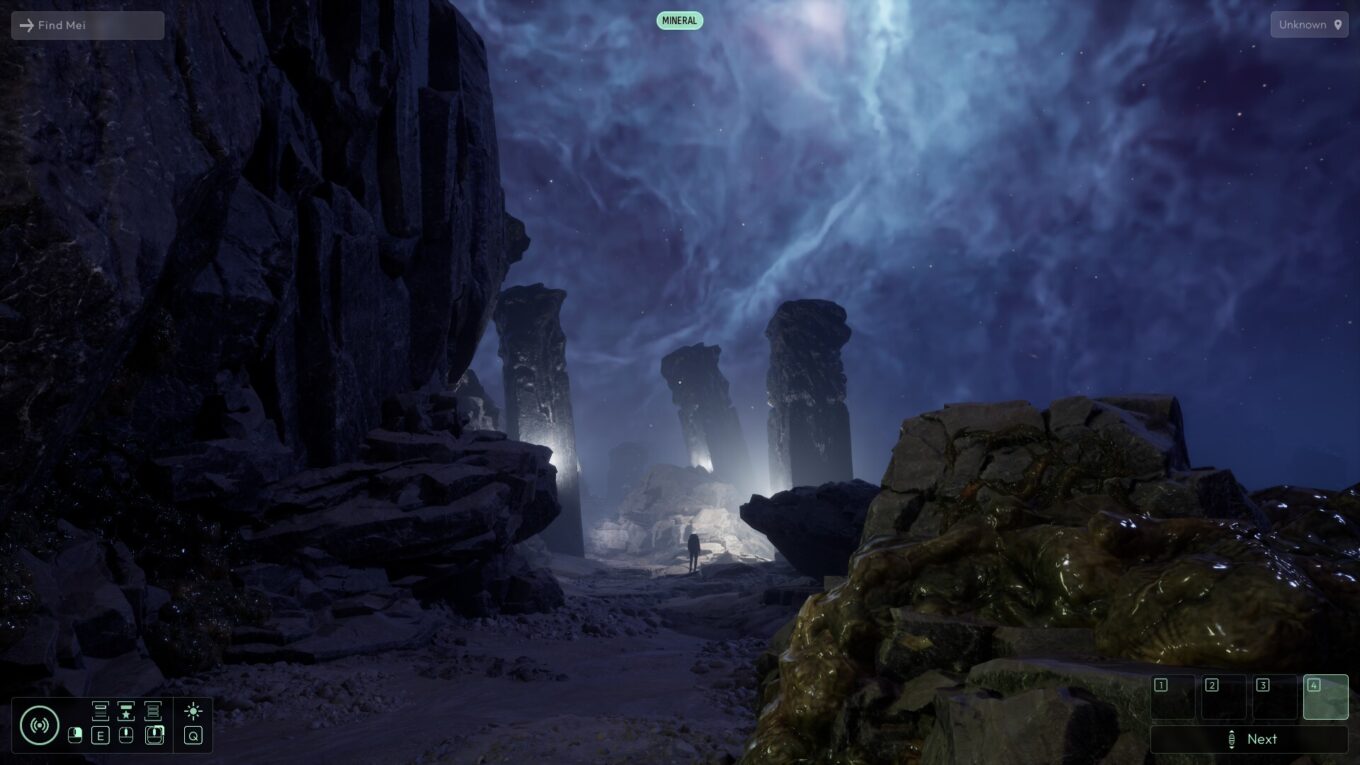
The Cosmic Abyss begins with you and your partner, Elsa, heading to her home and looking through her paraphernalia, as your colleague, Mei, has been reported missing. After breaking into her mansion, you found her place in utter disarray. Books and furniture are strewn everywhere. Empty pizza boxes are stacked on top of one another. Food has been spilt thoughtlessly. Most of all are the cryptic symbols and desperate ramblings of a clearly disturbed mind that have been scrawled on the walls – with blood. Blood! It’s all par for the course for a Cthulhu game, grime, dirt, dust, bodily fluids and more, but at the very least, it seemed atmospheric and eerie. I was appropriately spooked, and decided to take a look around. I was told to scan for clues, look for ways to get Elsa into the house since Mei’s house was locked. Something rang; it was Mei’s phone. She didn’t bring her phone with her, and all signs point to her being abducted.
This is when The Cosmic Abyss begins to show its first signs of banality. As Elsa bent over Mei’s laptop in search of answers, Noah continued to look around her home, picking up objects and ruminating over them. Here’s when the game makes it obvious that you’re to look through every single artefact in the place with a fine-toothed comb, in order to wring as much information out of them as possible.
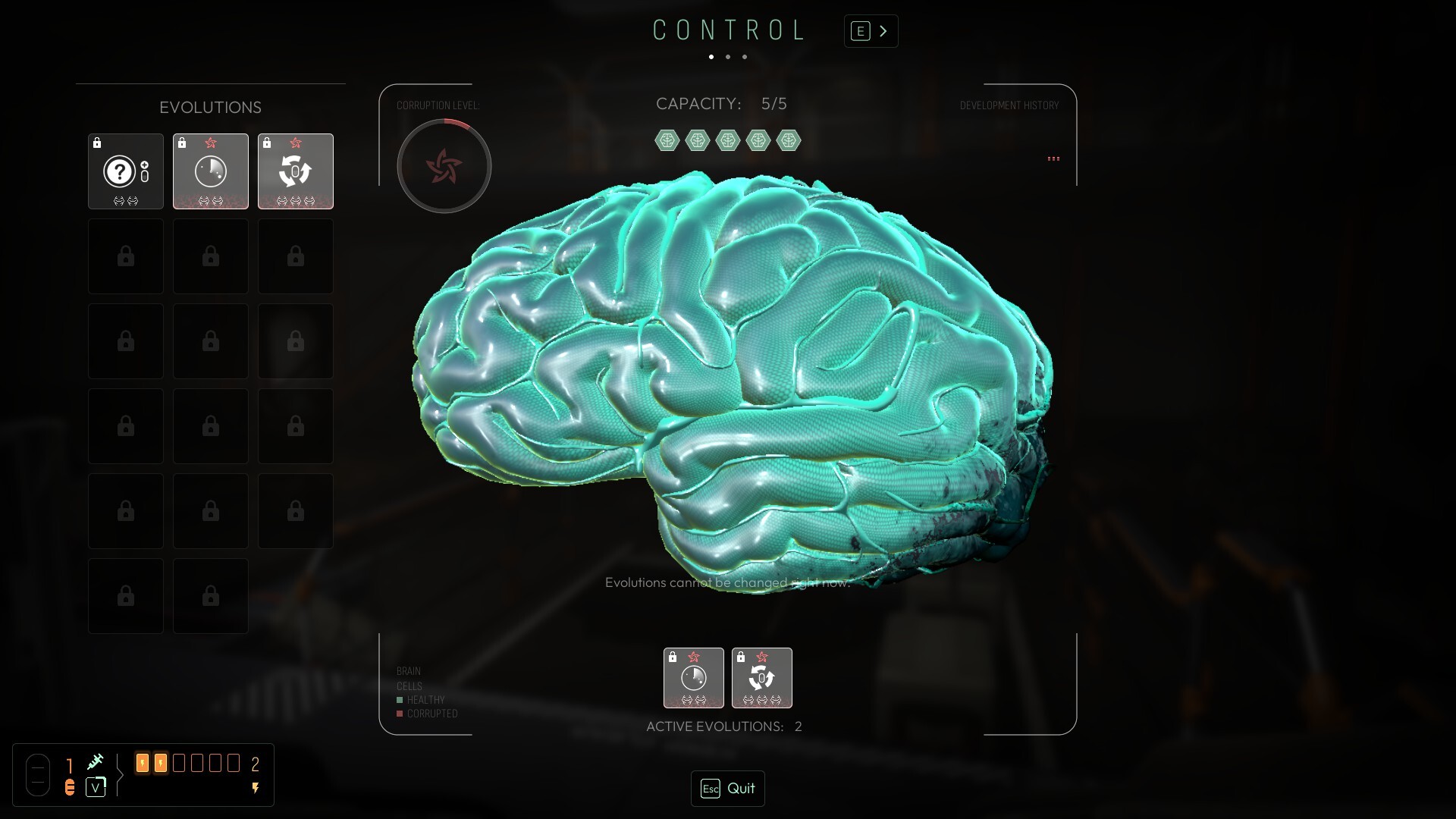
Making matters worse is an inexplicably tiny crosshair (just a white dot the width of a single strand of hair) you have to use for hovering over objects. Not all objects can be interacted with, and those that can be examined will result in the pointer swelling to a slightly larger size. This becomes an eye-wateringly exhausting pixel hunt, and as if anticipating this issue,The Cosmic Abyss gives Noah the ability to scan for examinable objects with a sonar. What this does is to tag relevant objects that you can pick up and stare at again. Relevant, of course, because the sonar simply won’t pick up every single item in its radar, but only objects belonging to a specific category. You can examine a relic, for instance, analyze the item at the cost of one energy to identify its element, like “astral stone” or “elders glyph”, and then look for other objects of the same element by putting it on your sonar frequency and scanning the vicinity. And yes, expand too much energy without replenishing them, and you risk corrupting your soul and poisoning your mind with unknown eldritch energy. This technically limits the amount of analysis you can conduct, which makes item hunting even more of a pain, but at this point I was more concerned about surviving the doldrums.
The idea of the sonar is to eventually mix and match different elements in order to look for specific objects, like a blood-stained totem (“human blood” with “astral stone”) that you may need to solve puzzles with. But with no context as to what you’re looking out for in the first place—you’ve only just entered Mei’s house after all—you’ll spend most of your search blasting sonar waves in hopes of picking something up. Thankfully, chapter one is mercifully short, as it concludes in a tense cutscene that revealed Mei’s downfall (spoiler alert: she got abducted by an eldritch creature).
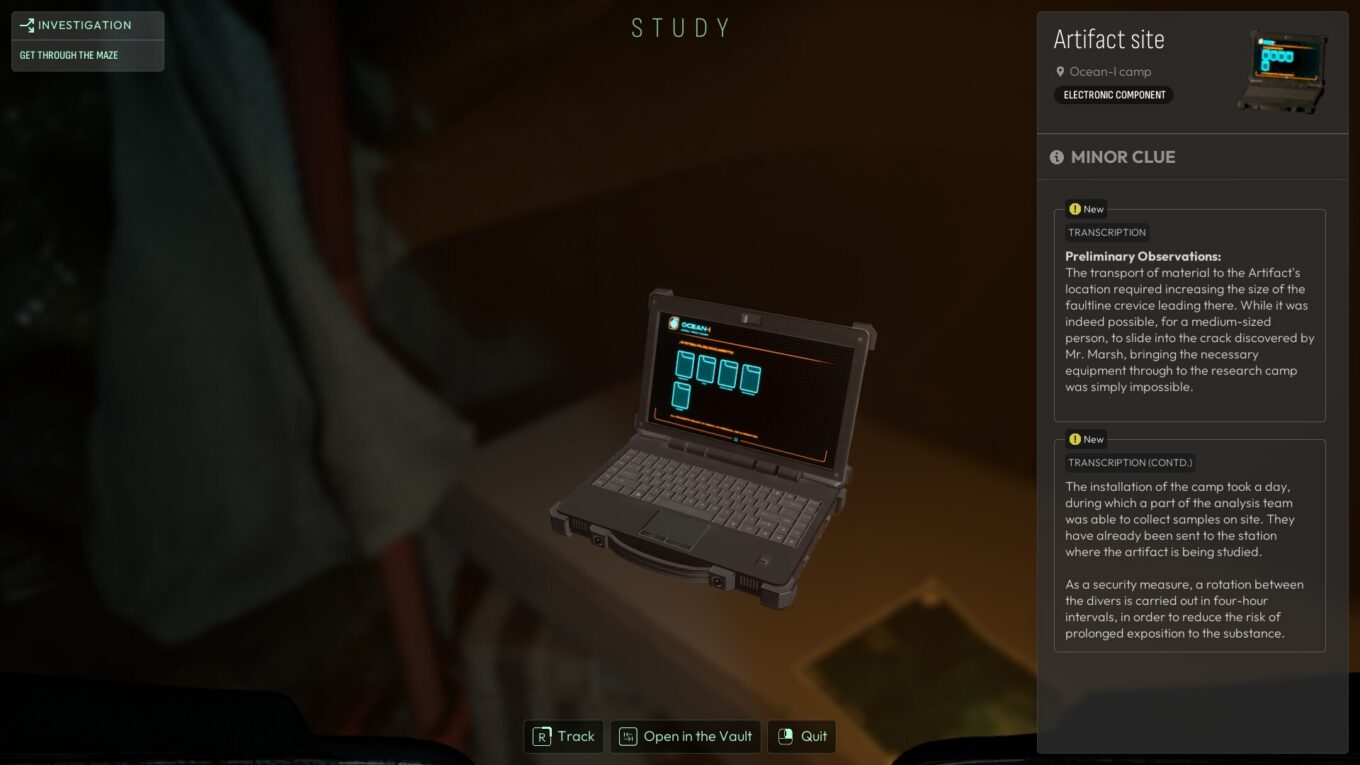
The subsequent chapter, however, is not as charitable. Taking place months after the first, and with Elsa also reported missing in the same incident, Noah continued his work as he found his way towards an underwater station with the missing miners. He’s not alone, however; an AI named Key has been embedded into his noggin, and this allows him to converse with Key to piece clues together. What could have been an evocative journey into the perilous underground is instead an endless series of chores that saw Noah meandering through the station, searching through room, after room, after room for notes, documents, artefacts, and so, so many emails. There’s even an underwater cavern you’ll need to navigate, which holds so much potential for genuinely claustrophobic, terrifying moments. But even in these caves you’re working. You’re looking for clues, staring at devices and turning over stones. You’re still reading emails.
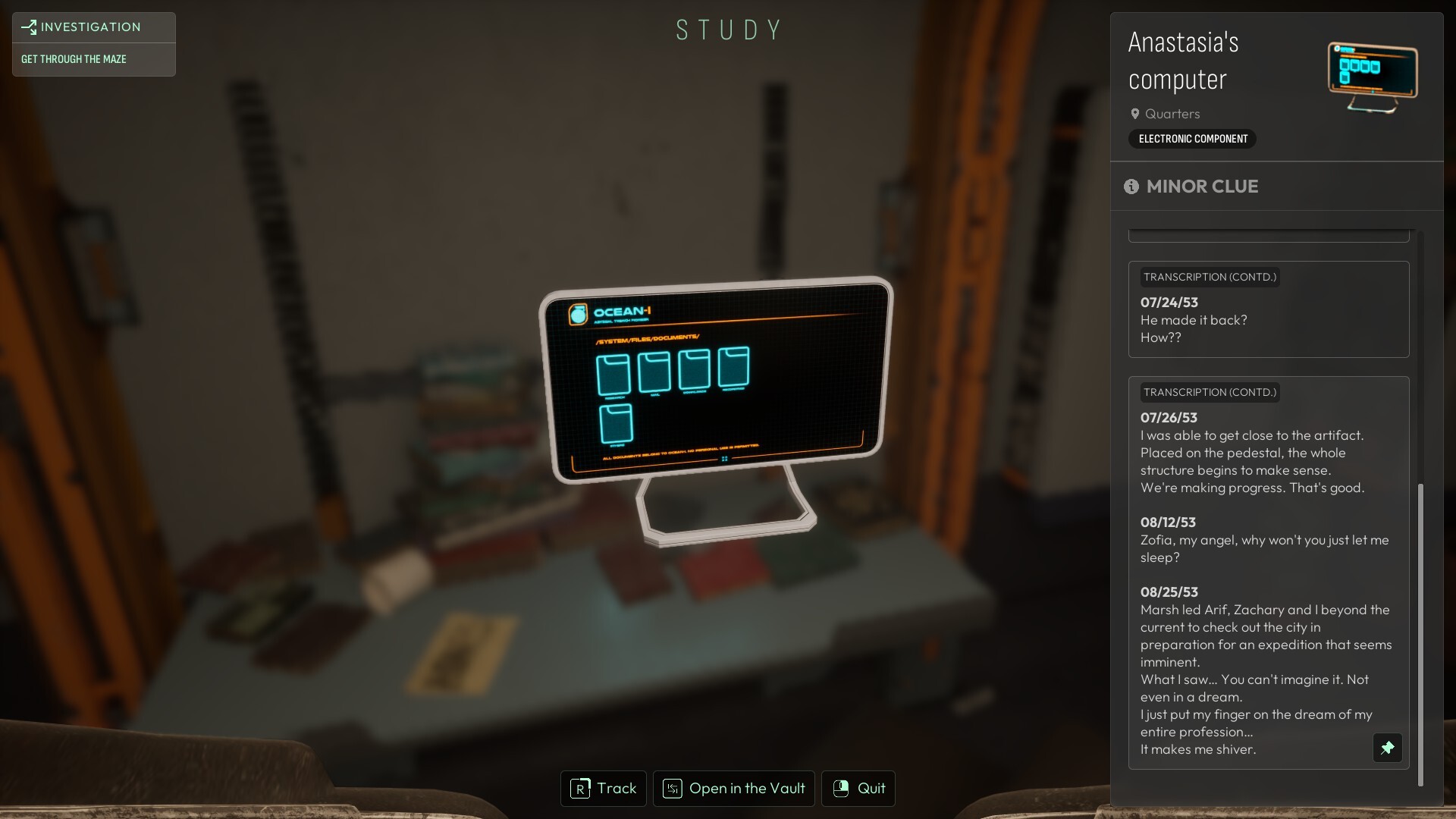
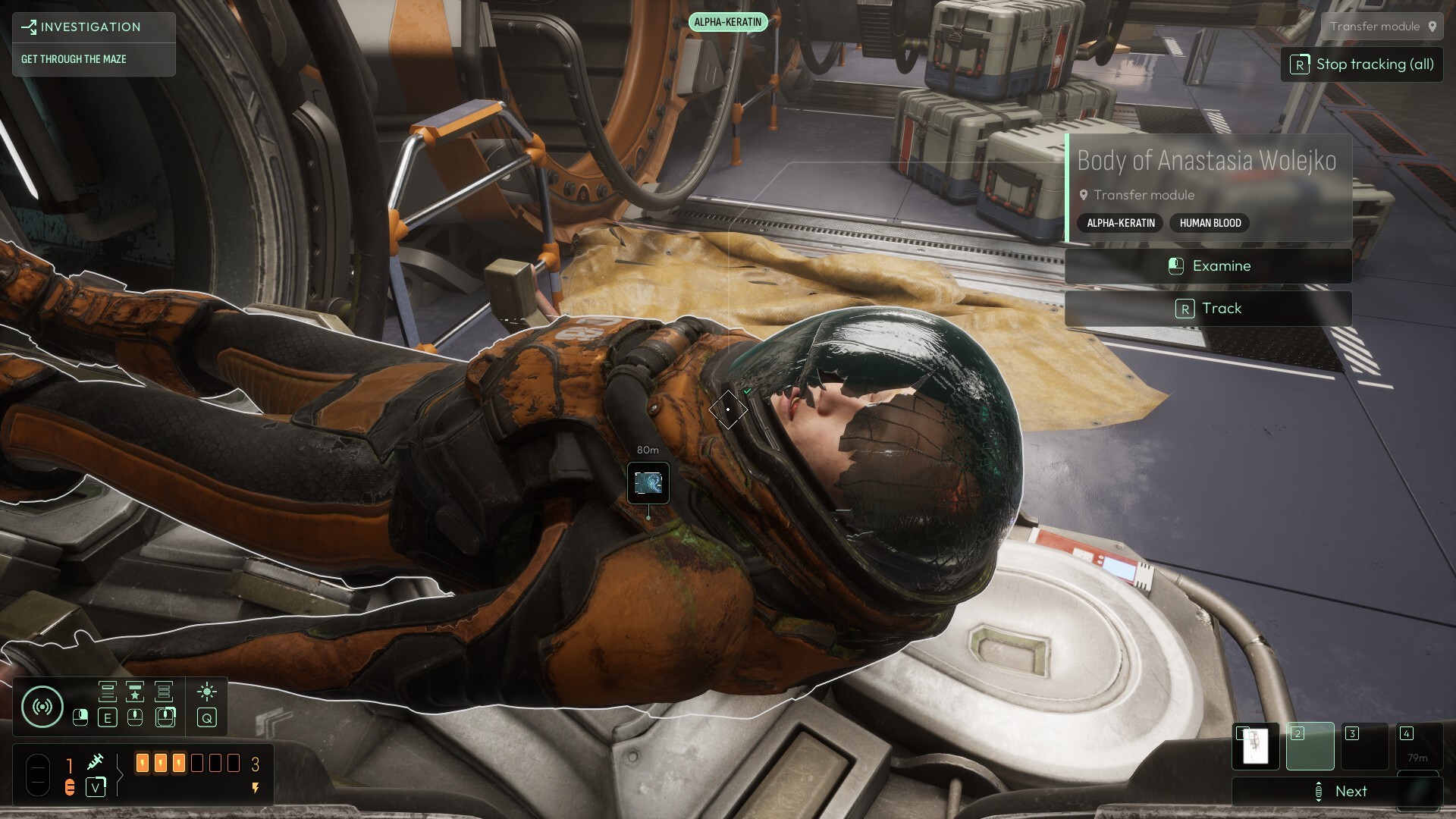
A scant few moments stand out. I once had to follow a trail of human blood towards a dorm in the station, which led to a pretty gory sight that I relish discovering. The outcome is somewhat predictable. I mean, we are in Cthulhu’s funhouse after all, but it did help to break the monotony of detective work. But such moments are buried under the absolutely debilitating endeavour of reading pages of notes and scribbles from the doomed crew.
Did I mention that the puzzles are a pain to solve? One demands that I look for a keycard, a thin, nearly imperceptible item, across the entire labyrinthine station. This is a huge area with numerous rooms, tables and artefacts to search through, and by the time I found one keycard, I realized that it couldn’t be used. Turns out you’ll need to analyze the keycard and scan the entire ship for another keycard with the appropriate access rights: d’oh! Key would occasionally pipe in to ask if I needed hints, and this was a crutch I exploited liberally throughout my time in the chapter. Even then, her help can be so vague and imprecise that they’re a bit of a dud at times. Sorry Key.
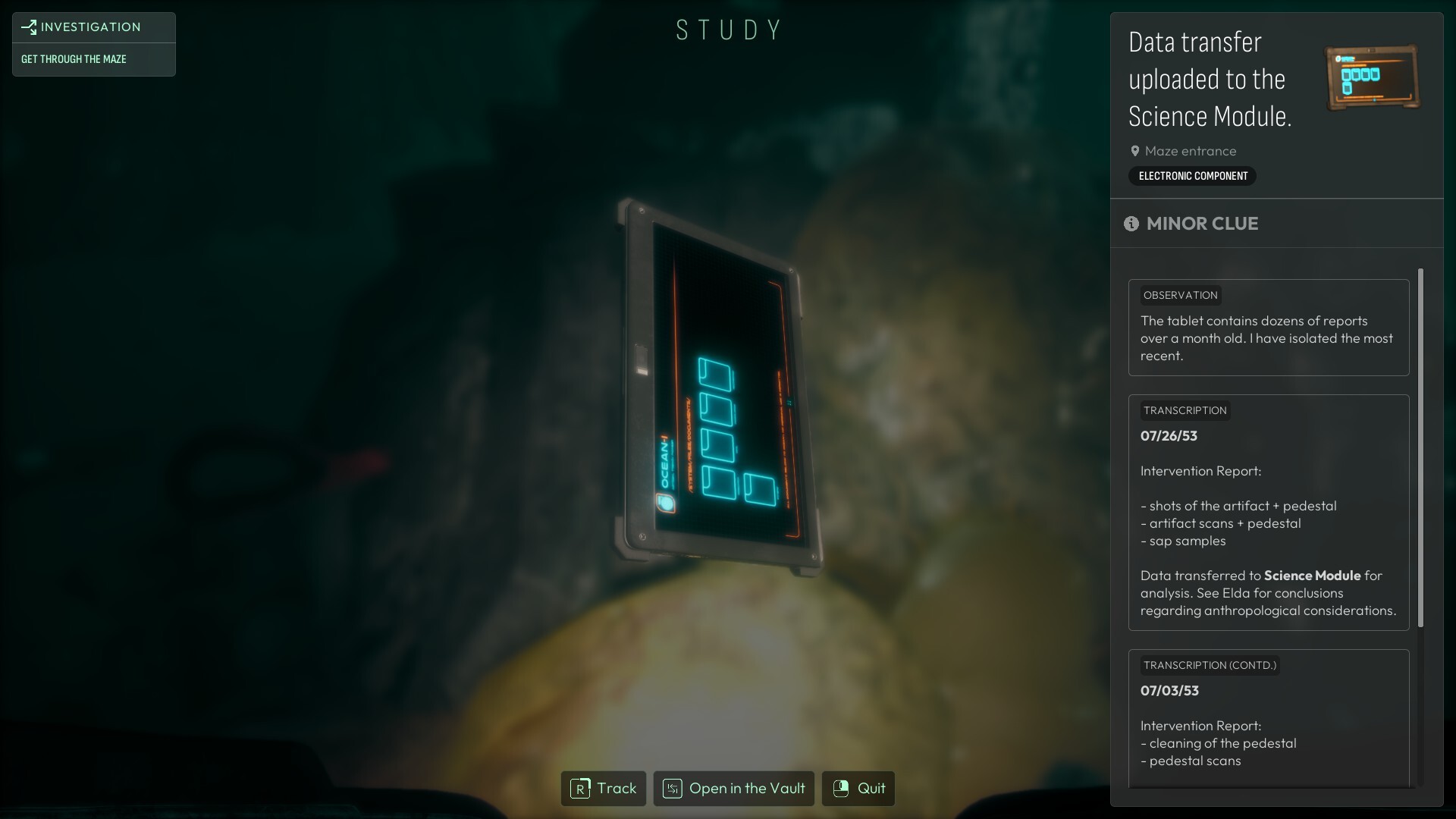
The tedium surprised me. I typically adore reading expositions and bits of scattered lore in games. I will gleefully listen to audio tapes, and vicariously devour books, manuscripts, and codexes that flesh out the setting in many games. But The Cosmic Abyss gives me no reason to care about its characters and its world (I can’t believe I’m saying this about a Cthulhu game), and Noah is largely a blank slate of a character with no discernible history. The fate of the miners, too, can be seen from a mile away. One miner has smashed his head against a wall repeatedly from sheer insanity. Another has had an altercation with Cthulhu himself and attempted to escape the station, to obviously no avail. These revelations are delivered with so little fanfare that they feel particularly bland and inconsequential.
You might think that The Cosmic Abyss is developer Big Bad Wolf’s first rodeo, but this isn’t so. The studio was behind Vampire the Masquerade: Swansong back in 2022, an enchanting, even if imperfect game about the nastiness of politicking within the upper echelon of vampiric society. This is a team that’s capable of penning complex characters, branching dialogues, and invigorating puzzles, but the same can’t be said for The Cosmic Abyss. Thus, it’s so disappointing and frustrating to learn that there are very few moments that make The Cosmic Abyss worth experiencing to the very end. After wandering the rooms and caverns for a few more hours, I would have preferred subjecting myself to Cthulhu’s venomous corruption if it meant breaking out of the humdrum routine of reading more notes and emails in this contemptible hell.