
History isn’t lacking for revelatory accidents: insulin, x-rays, superglue. In the 1930s, Barnum Brown stumbled upon the remains of Deinonychus while searching for Tenontosaurus, 60 years later it formed the inspiration for Jurassic Park’s velociraptors. Sunken Realms, Mega Puncher Games’ kludgey Souls-like, threatens to unearth a bygone era of dungeon-crawling it suggests may be overdue a renaissance. Judging by how it plays, that’s entirely accidental, too.
Sunken Realms begins with a jocular meeting between Alric and a bearded stranger. The latter is camping outside the dungeon of Aedaria, a multi-floor fortress teeming with orcs. He offers a grave warning about venturing further but you won’t be dissuaded. Your father disappeared into Aedaria and you’re intent on finding echoes of him. Moved by this, the stranger offers his aid: both as a merchant and in the form of Glis, a conveniently vibrant ball he suggests may light your way in the deep dark.

Dark is one way to describe Aedaria. Hiding in its gloomy dusk are crowds of orcs and wolves, silhouetted by the near black like a Kline painting. It makes every encounter a potential jumpscare. Or would, if the game’s music didn’t shift to something more intrepid whenever an enemy is near.
Your objective is to find a key to the final chamber, leading to a boss and, should you prevail, a way down. If you clear all the enemies on a floor, however, a treasure room will open. Mega Puncher, the studio moniker of developer Brad Warren, plays fast-and-loose with the definition of “all.” On most floors, the treasure room unlocks with enemies still present. On others, it remains locked despite notification that everything is dead.
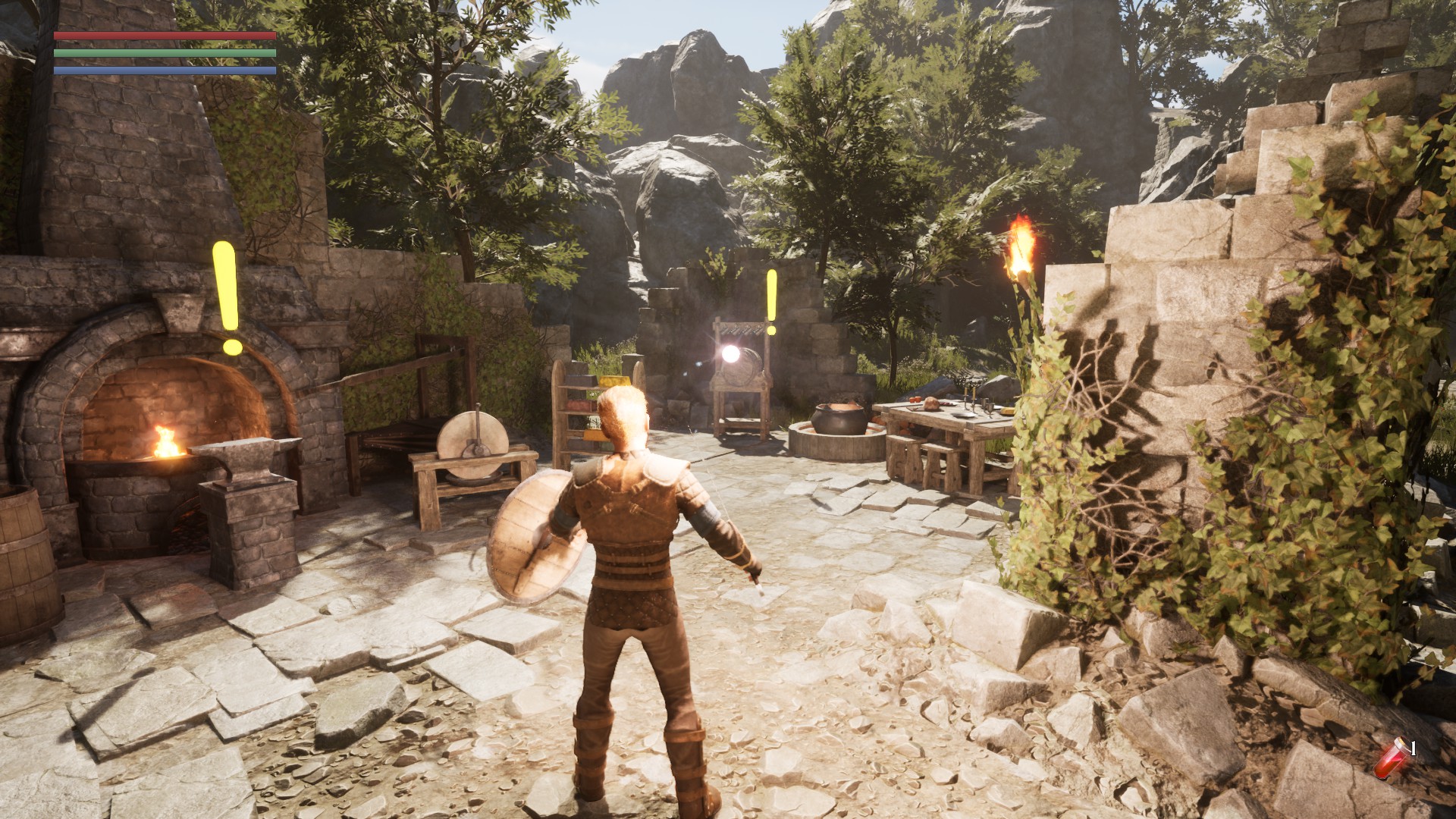
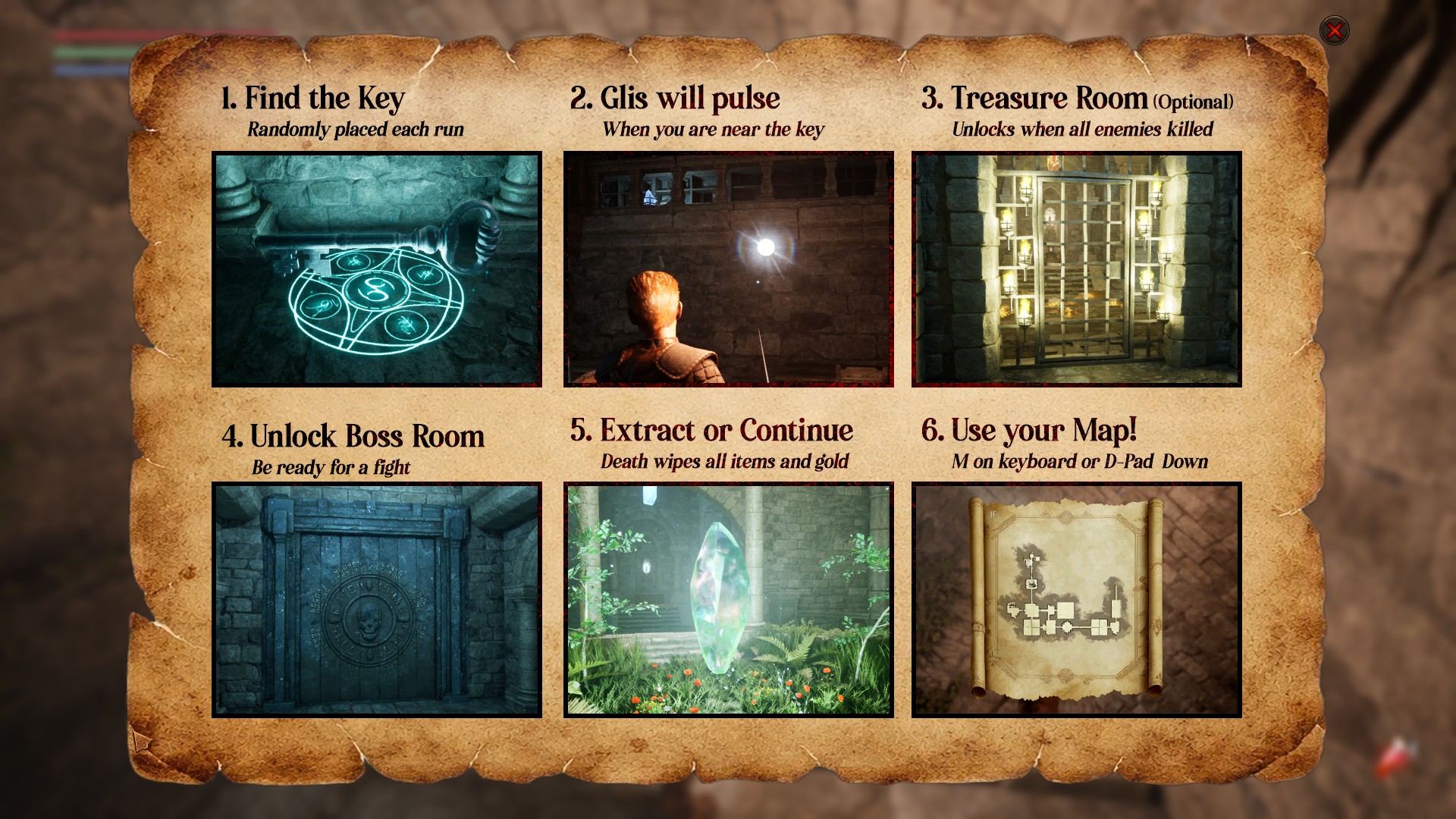
It’s a notification that takes up most of the screen. Ironically, on several occasions it appeared during fights with very much alive enemies. More than once, that it obscured a fight led to my death. Music, too, has a strange relationship with combat: seemingly flagged to enemy proximity rather than sightlines. Given enemies’ habit of getting stuck in walls, it makes for a jarring soundscape.
Despite these frustrations, Sunken Realms initially felt like a full-circle moment. I grew up obsessed with Might and Magic VI: The Mandate of Heaven, an overwhelming dungeon-crawler built on imposing difficulty and sprawling strongholds. With its narrow focus on dungeons and loot, Sunken Realms belongs to that bygone age of computer-RPGs.
If the core concept of games like Wizardry and Might and Magic has been expanded and, to a point, diluted within the primacy of Souls-likes, contracting that to something more contained while maintaining the trappings of the genre is a bold endeavour. Does it pay off? Not at all.

As early as the first boss, I realised the charming uncanniness I perceived in Sunken Realms crystallised into sloppy presentation and obtrusive design. Inputs are mapped in an unintuitive way to which I never really grew accustomed and remapping didn’t work. In places, you need two input methods as you cannot close an empty chest with a controller. Menus disappeared and reappeared at random.
The lock-on, so pivotal to hitting enemies in Sunken Realms’ desultory and imprecise combat, unlocks for no reason. Eschewing it as one might in a tighter Souls-like means Alric’s perspective shifts between enemies constantly, no matter how you orient your perspective.
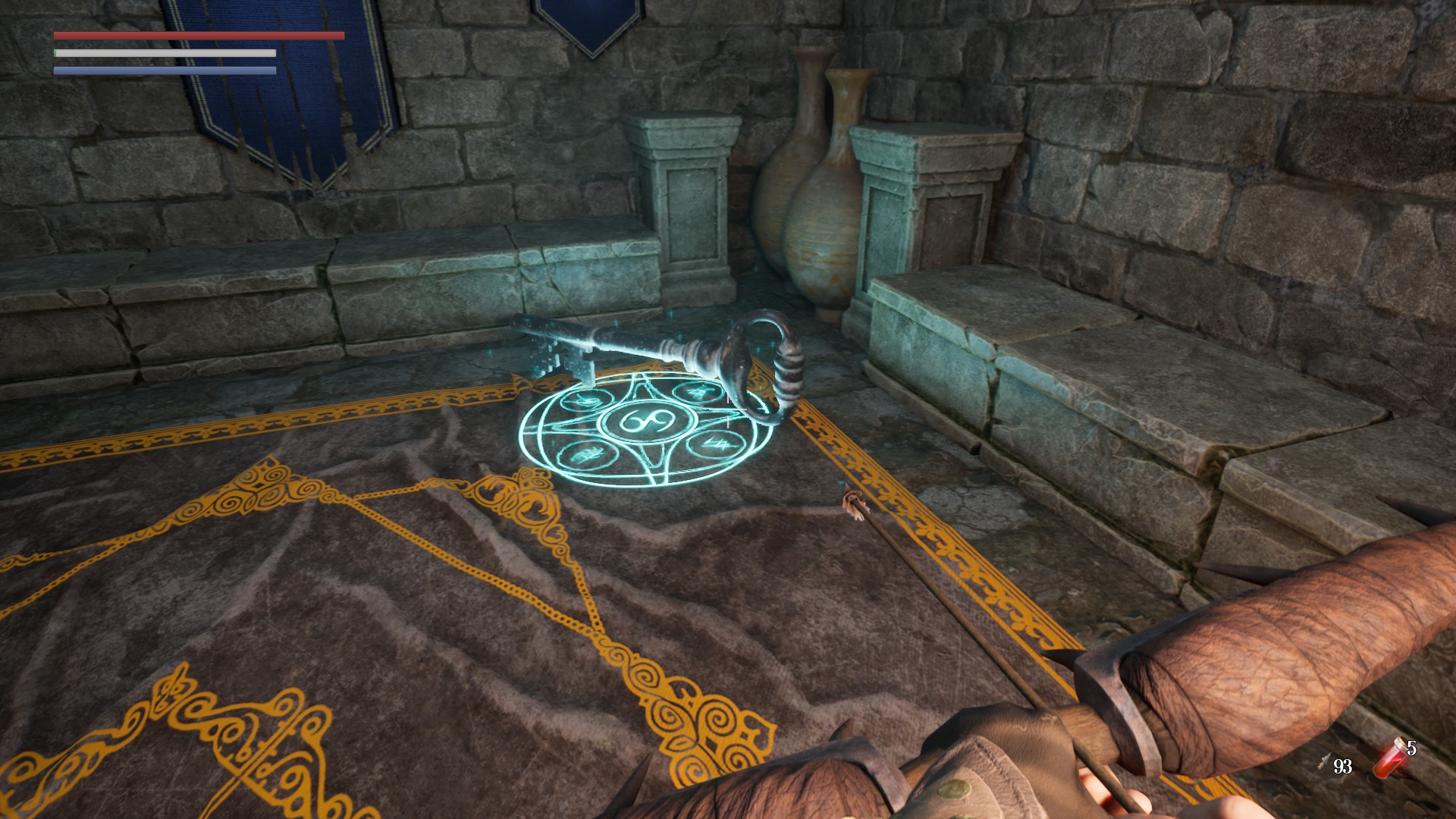

The procedural reshuffling of the dungeon often left no way forward. On a handful of occasions, this was because scenery obscured a hole through which I needed to crouch – a function not used elsewhere – or because Alric would slip off an obstacle he was supposed to clamber over. On others, I simply found no avenues to progress past the first few rooms of a floor.
Simply entering the dungeon killed me with alarming frequency. If the game momentarily reminded of Might and Magic VI in concept, that in practice a game from 1998 feels more compelling, more ambitious, and possessed of tighter design does not reflect well on Sunken Realms.
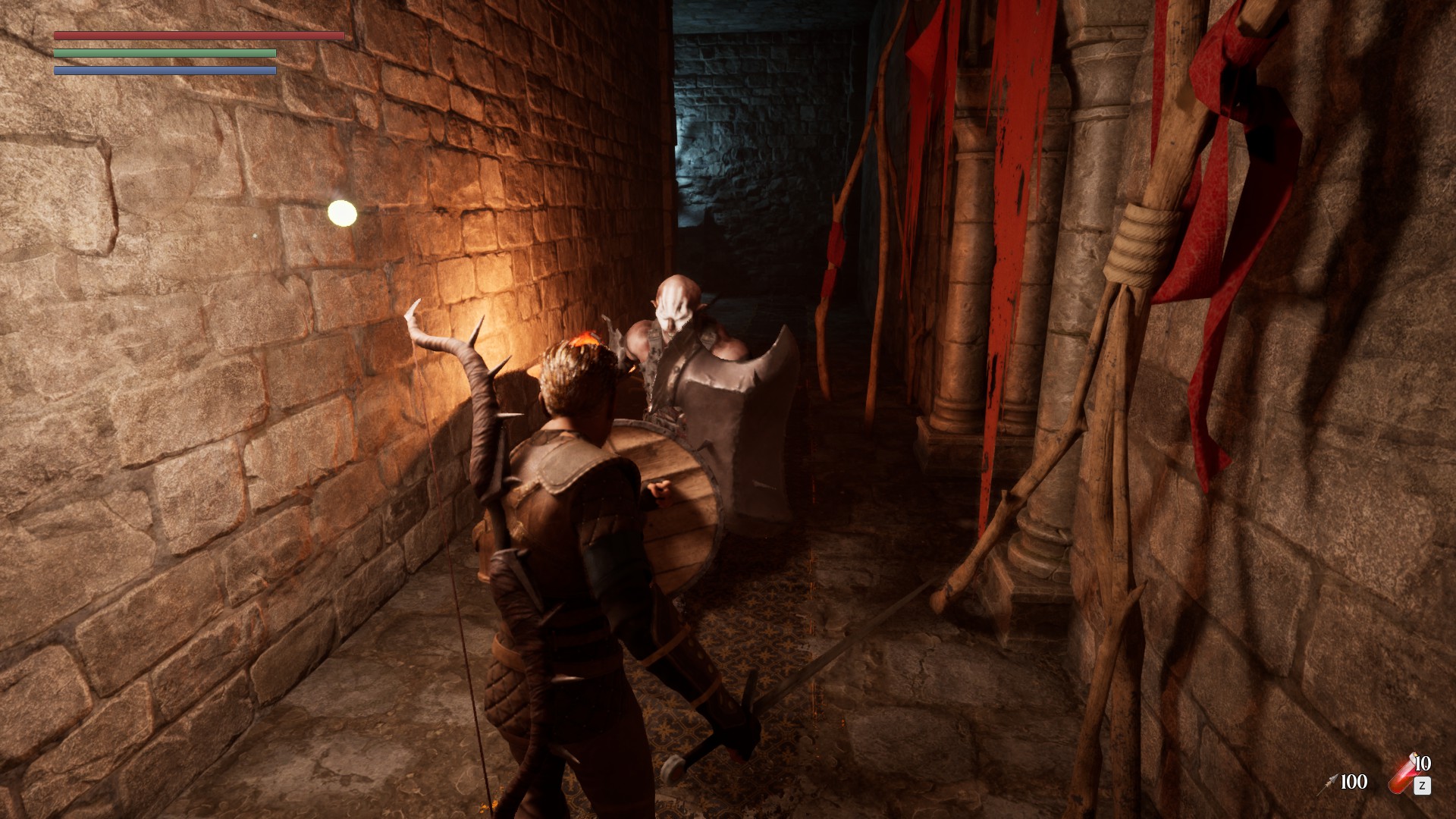
Taking a page from the orcs’ book, whose arrows have a homing quality even if you’re behind them, I quickly employed the age-old tactic: slowly walking backwards and shooting enemies, rather than enduring clunky swordplay. Funnily enough, it’s a method I learned from Might and Magic VI. Though, where The Mandate of Heaven encouraged careful archery through overwhelming difficulty that made exploring its ambitious dungeons genuinely tense, here it is simply more consistently viable than combat or magic. Indeed, my chief complaint with Sunken Realms isn’t its myriad mechanical frustrations but how empty it feels.
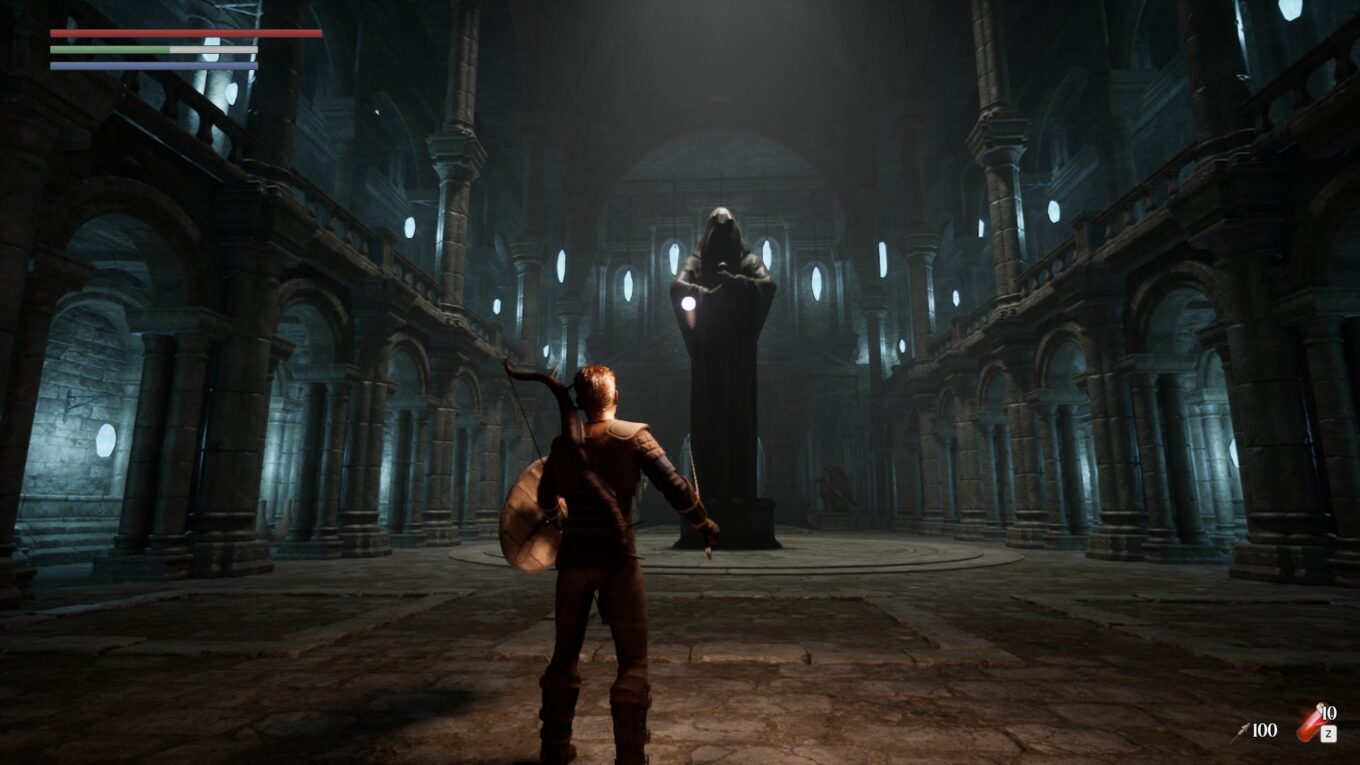
At no point during my explorations of its hideously dark environments did I feel like I was delving into gloom-ridden tombs of an ancient civilisation, now surrendered to hideous creatures who could emerge from each shadow and against which I must desperately fight for survival. There was no fear, not of the unknown nor orcs, only an ironically surface-level concept of what delving into deep dungeons should look like. I can forgive any amount of uncanny graphics and dodgy mechanics if a game can succeed in making me feel something. The lack of any tension or use of its pitch environment is a far more egregious failure.
This only magnifies as you head down. The boss of the first floor, a larger orc, immediately becomes a common enemy alongside the usual orc flavours of “bow” and “sword.” Similarly, as you drop down, the environment becomes somehow even darker. This combination should be terrifying. Instead, it’s frustrating and, more than that, unpleasant.
Staring at the near-black screen of lower floors gave me such a crushing headache that I could only play for an hour at a time and then only with the aid of painkillers. It was bad enough that I could only engage with Sunken Realms while medicated; worse that it has a curious amount of potential as a horror game but is so invested in being a typical hack-and-slash Souls-like that it cannot even begin to invoke a sense of tension or fear.

I always try to look behind the curtain of the games I review. It adds to the labour of reviewing but it also helps contextualise what I’m seeing, for me and those considering buying those games. On occasion, those explorations inform of deeper, more troubling, flaws in a game and on others can illuminate a need for a lighter touch. They rarely inform my review scores – we must judge what’s put in front of us, after all – but it’s important information: both for empathy’s sake and consumers.
It behoves me then to note how impressive it is that Warren, a solo developer, has put Sunken Realms together alongside work for ATMTA Inc. on Star Atlas. It’s also important to note that the game’s Steam page previously divulged that Warren had used AI to generate icons in the game while expressing an intent to later remove them. At the time of writing, that disclaimer has been replaced with another that indicates that Warren used AI to generate capsule art for Sunken Realms and modulate his voice for the game’s voice lines.
It forms a curious pattern with Star Atlas, on which Warren works as a programmer and animator, which has recently announced a partnership with SingularityNet to “revolutionise Web3 Gaming with AI Agents” (and remind us that people are still, inexplicably, utilising NFTs in 2026) as part of ATMTA Inc.’s self-branding as a builder of “paradigm shattering Web3 experiences” through Star Atlas.

Whether Warren’s use of LLMs diffuses from Star Atlas (which, it should be noted, is employing AI on a much larger scale) or not is uncertain, though it’s a link that can’t be ignored. But, as I wrote about Twisted Tower, it’s hard not to see generative AI everywhere when it’s divulged elsewhere: especially in games as devoid of feeling as Sunken Realms. Whether that’s a learned wariness from other AI-heavy games or optimism, I’m not sure. I do prefer to believe the shortcomings of games so lacking in considerations of player experience, like Sunken Realms, are the result of a misbegotten decision to outsource creative endeavours to a theory-free inference machine, rather than failings in our own creativity.
What is certain, however, is that Sunken Realms is a notably weak entry into the Soulslike genre: inconsistent, buggy, and, more importantly, without soul. There’s not nothing here. One can understand where Warren is coming from conceptually. Nor does the game’s shortcomings deflect from how refreshing it would be to experience a modern take on a more limited dungeon-crawling removed from the open and semi-open worlds of games since Demon’s Souls release.
Like any positives to be pulled from Sunken Realms, however, that revelation is one of our own making, not Warren’s intention. If history is full of happy and revelatory accidents, Sunken Realms is not one of them.